
Translated material
Through fire, water and copper pipes
The Trans-Siberian art festival is nearing the end of the IV . On April 3, Vadim Repin and Alexander Buzlov, accompanied by the Novosibirsk Symphony Orchestra and his chief conductor Gintaras Rinkevyavicius, will perform a double concert of Brahms for violin and cello. However, they will rather not put a point, but a comma. Because under the Trans-Siberian label, powerfully advanced both within the country and beyond, concerts in Krasnoyarsk, St. Petersburg, Tyumen, Samara, Brussels and Japan will continue for some time.
The logistics of the festival is becoming more and more sophisticated. Musicians and programs travel during it with airplanes, trains and minibuses on the bumpy roads of the Novosibirsk region (when it comes to speeches in the recreation center of district centers). But his capital still remains Novosibirsk - the birthplace of the protagonist, the famous violinist Vadim Repin. And the main platform is the peer of the festival, a concert hall, bearing the name of the first conductor of the local orchestra Arnold Katz.
Katz himself, who worked with the orchestra for half a century, did not wait for the opening of the hall. But the mighty rattle of the construction of socialism still forms both the city and its culture. The enormous opera theater, famous not only by the Tangaiser, but also the majestic title of Siberian Colosseum, was at one time designed so that large military equipment could call on its scene during street parades. The current chamber hall of the Novosibirsk Philharmonic was built in 1925 in the form of a certain architectural replica on Shchusevsky Mausoleum from Red Square. For some time his pediment was decorated with an alarming inscription “Lenin died. Living Leninism. " In the elite scientific reserve “Akademgorodok”, located in the B30 of the CCW of the city, like a decade ago, the local Philharmonic repeats its subscription concerts.
The very Philharmonic itself has one year of birth with the Novosibirsk region-1937. So the festival celebrates the 80th anniversary of both. And at the same time-the 85th anniversary of Vladimir Fedoseyev, who arrived on such an occasion to be punishable by the local orchestra, and the 60th anniversary of the Novosibirsk Conservatory (at the same time she got from Repin for laziness and complacency, his statement at one of the press conferences wanders on the Web). The age-related theme is shared by a large series of master classes in the Energia recreation center, which are held by the festival participants for everyone.
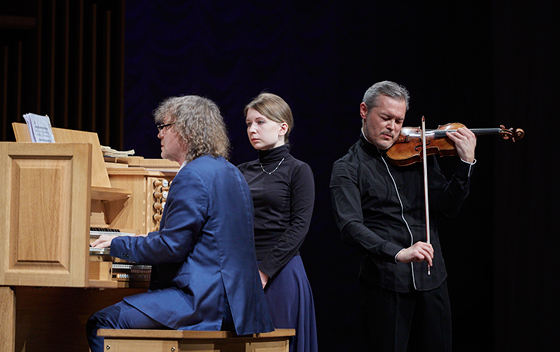 © Alexander Ivanov metamorphosis. Alexander Knyazev and Vadim Repin
The festival program tries to attract to the maximum of high -culture products that can interest the audience. It is no coincidence that the clarification of "art". There is both ballet and film documentary of the legendary Bruno Monsenjon with him, and children's events. Music is also for every taste, but it should not bore and scare. Each year, one of the key events of the festival is a specially ordered essay. This time it was called “ Dreamdansers ” , wrote his German composer Enyott Schneider, who works a lot in the cinema. Probably more than his name, the names of the three parts of his opus for the pico pipe, Flugelgorn and the orchestra-“behind the scenes of sleep: an emerald galaxy with soaring tigers and blazing moths”, “a walk under the moon, outside of reality”, “hummingbirds dancing under the gates of hell”. The Novosibirsk audience was seriously passionate.
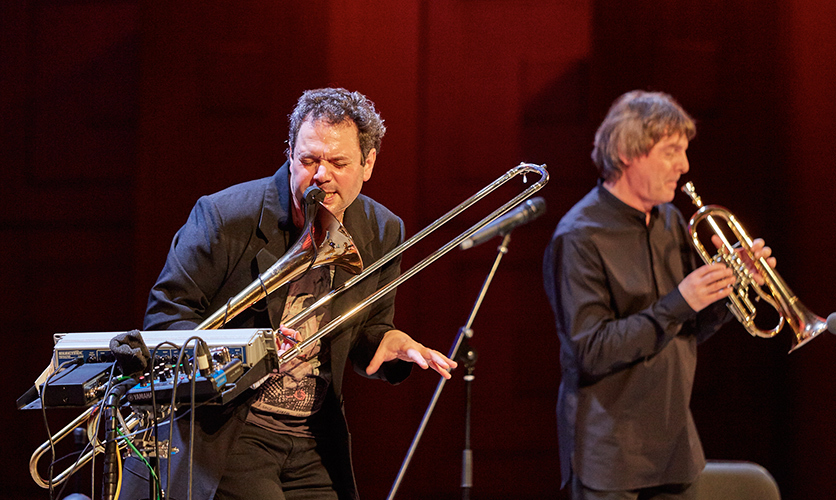
However, along with colorful musical film fantasies (they participated in the Novosibirsk Orchestra under the direction of the Krasnoyarsk conductor Vladimir Lande) presented her this evening and a luxurious selection of copper winds, which, perhaps, were outweighed even tigers from hummingbirds. In addition to the world premiere, the long program included Baroque (Luigi Otto), Symphojaz (Claude Boling), the transcription of the fantastic plays of Shuman, the Trio of Brahms and free improvisation. The German guest Otto Saurus surprised the piccolo pipe with rules. The noblely reigned on the stage Sergey Razuryakov (with Flugelgorn) and Andrei Ilkiv (with several pipes). It would seem difficult to come up with something more precious than the Brahmsovsky trio, in which Repin and Pianist Maria Meerovich joined Rubikakov. But followed by Arkady Schilloper with a valtor and proprietary alpine horn of cyclopean sizes and the Swedish thrombonist Elias Fayngershe, who responds to Ilya and spoke in pure Russian. Electronic special effects, a magnificent sense of musical time and a sense of humor were their assistants, and the show arranged by them, crowned with the execution of Ravel Ravel with two musicians instead of an entire orchestra, did not leave a trace from the usual academic stiffness of the Katsu hall.