
Translated material
The European University hopes that graduates will finish their studies before the license university deprivation
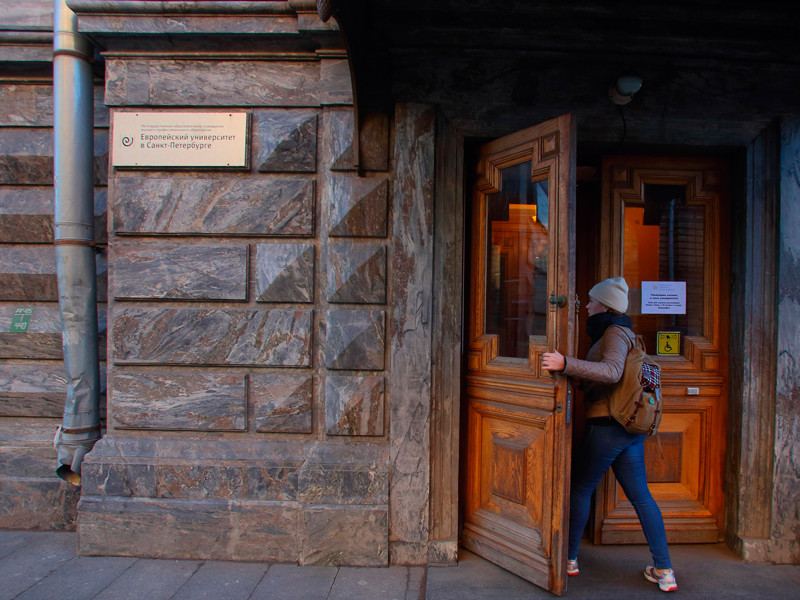
The leadership of the European University in St. Petersburg (EU) hopes that the courts of review of the license at the university will last until the summer, which will allow students to complete the school year, and graduates to receive diplomas, Interfax reports.
On March 20, the Arbitration Court of St. Petersburg and the Leningrad Region annulled the university license, suspended in December 2016 by Rosobrnadzor due to identified violations in educational activities. The university turned to a higher authority. In addition, three months ago, the authorities of St. Petersburg decided to terminate the lease agreement of the Palace of Kushelev-Bezborodko with the leadership of the educational institution, in which the university has been located since 1995.
University rector Oleg Kharkhordin said at a press conference in St. Petersburg on Wednesday, March 29, that Rosobrnadzor invites the university to submit a license and submit documents for a new one. “The usual period for obtaining a license is 40-45 days,” the head of the educational institution explained. According to the rector, Rosobrnadzor will try to speed up this process.
"One of the good options would be to be able to finish the semester, get diplomas, and then in the summer we would refuse a license and started receiving a new one," Harhordin said. In July, a license can be obtained, and then in August the university will conduct reception exams, he said.
However, the university co -founder Nikolai Vakhtin believes "a completely optimistic scenario in the fate of the European University is extremely unlikely." “To keep everything behind us, this is unlikely to happen. Absolutely pessimistic - this is if we are evicted and deprived of a license,” the professor, which is quoted by Rosbalt , said at a press conference on Wednesday.
Vakhtin announced the readiness of the university to lose one reception of students, because if the trial stretches for 3-4 months, the educational institution simply does not have time to gain new students. “This means that next year we will only have a second magistracy course, and a year later - only the first. This is not the worst option. We can lose two tricks if, having lost its license, we will not restore it in six months a year,” he explained.
The professor called the current situation "a viscous absurdity into which we safely plunged." According to him, before everything was extremely simple and clear. In 2008, when the professor was a rector, the university was also closed, explaining this by receiving a grant from the European Union to monitor elections, which was perceived by the authorities as the intervention of the EU in the internal affairs of the country. EU returned the grant, closed the program, and he was immediately returned to the license. “If there was such a situation now, we would be happy. But today there is no mythical figure of embodied evil, which is behind this,” he complained.
In turn, the rector of the university, Oleg Kharkhordin, noted that the university has not yet received an official response from the St. Petersburg authorities regarding the eviction of the university from the Palace of Kushelev-Bezborodko. “We will probably get this answer on April 5, when the case will be considered in the Arbitration Court of St. Petersburg,” he suggested.
In April 2016, according to the results of inspections, Rosobrnadzor suspended the state instrumentation of higher education programs in EU due to identified violations that the university’s leadership officially promised to quickly eliminate.
The new series of unscheduled inspections at the European University was initiated in July of the same year the current State Duma deputy Vitaliy Milonov, who was then a deputy of the St. Petersburg Legislative Assembly. Milonov said to the Prosecutor General’s Office about the absence of a first -aid post at the university, about illegal redevelopments in the building and that scholarships are supposedly issued in foreign currency in envelopes. At the university, these accusations refuted.
Nevertheless, Rosobrnadzor discovered 120 violations at the university and again ordered them to eliminate them. Thus, according to the regulator, the university did not organize a medical examination, did not certify teachers, the professors did not have academic degrees of the Doctor of Sciences and the necessary experience of scientific and pedagogical work. The university announced the execution of the requirements of the department, but in early December, Rosobrnadzor suspended the license of the European University.
Then, Russian President Vladimir Putin intervened in the situation. At a government meeting, the head of state gave Deputy Prime Minister Olga Golodets an order to resolve the situation. In December, the Moscow Arbitration Court abolished the order of Rosobrnadzor and the department restored the university license. However, in March 2017, the Arbitration Court of St. Petersburg and the Leningrad Region again annulled the university license.
Prior to this, the Committee for Property Relations of St. Petersburg announced that he sent a notification to the university of termination of the lease agreement of the Palace of Kushelev-Bisborodko. According to Smolny, the university violated the terms of lease regarding non -compliance with the requirements of the security obligation concluded against the object of non -residential fund.
The European University was established in 1994 with the support of the mayor of St. Petersburg Anatoly Sobchak. Students' training in it began two years later. The university’s board of trustees includes former Minister of Finance Alexei Kudrin and the director of the Hermitage Mikhail Piotrovsky.