
Translated material
"I came with the soldiers, with the soldiers and I will leave"
75 years ago in the forests near Vyazma, the 33rd Army of General Efremov fought fiercely and died
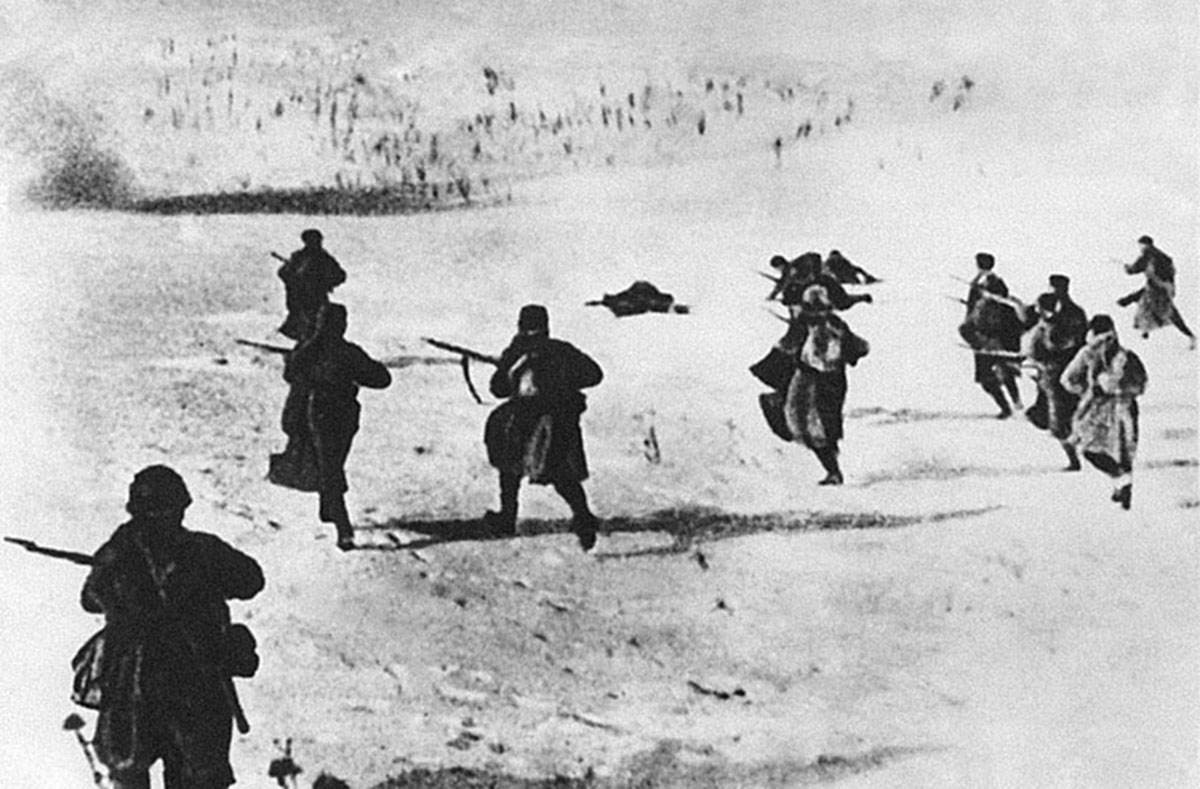
The Bialystok boiler, the Kiev boiler, the Vyazemsky boiler, Volkhovsky ... In each of these terrible encirclement of 1941-1942, not only people, not only platoons and companies died - entire armies disappeared. There were numbers from them, sometimes part of the command staff and scattered regiments and battalions. People were “poured” into new formations, the number was assigned a newly formed army. This was called "such and such an army of the second (and sometimes third) formation."
Silence of textbooks
Any person who studied at school - Soviet Lee, firmly knows: in early December 1941, a counterattack began near Moscow, during which “the myth of the invincibility of the Nazi troops was scattered,” the enemy was thrown back from the capital, the direct threat of the seizure of Moscow passed. About the counterattack itself - practically nothing. The modern Russian textbook (for example, the most massive today - “History of Russia. XX - the beginning of the 21st century. Grade 9” A. Danilova, L. Kosulina, M. Brandt) devotes two paragraphs to the beginning of 1942: the January instructions of Stalin about the transition to the general offensive, the objections of Zhukov and the adopted, contrary to his arguments, the decision to advance everywhere. What happened at the front for the entire first third of the year, for a Russian schoolboy remains the same mystery as in due time for his parents. And much has happened - mainly the most sad properties.
“And the bullets whistled, as it is all the same. And only one ran our Russians. They were said to be all beaten "
A number of major military operations were carried out: the Rzhev-Vyazemskaya Strategic offensive operation of the Kalinin and Western fronts (January-April), the Bolkhov offensive operation of the Bryansk and Western fronts (January-April), the Barvenkovo-Lozovskoy offensive operation of the Southwestern and Southern Fronts (January), the Kerch Forean Operations Operation of the Transcaucasian Occupation of Transcaucasian the front and the Black Sea Fleet (end of December - May), the Lyuban offensive operation of the Volkhov and Leningrad fronts (January - April), the Medvezhyegorsk offensive operation of the Karelian Front (January). In other words, almost throughout the Soviet-German front during this period, the Red Army with varying degrees of success tried to advance.
A blow to Vyazma
In the Moscow direction, the success of the December counterattack was given by great blood. At the end of January, the commander of the Western Front, Army General Georgy Zhukov, reported to the Supreme Commander -in -Chief: “In December and 15 days of January, the Western Front lost 55,166 people killed, 221,040 people wounded and sick, and in only 45 days of intense battles the front lost 276,206 people. During this time, about 100 thousand people were replenished, of which only 19 180 people were received in January, on 28.01. Many divisions have 200-300 bayonets, and shooting brigades and rifle shelves of 50-100 bayonets ... ”*
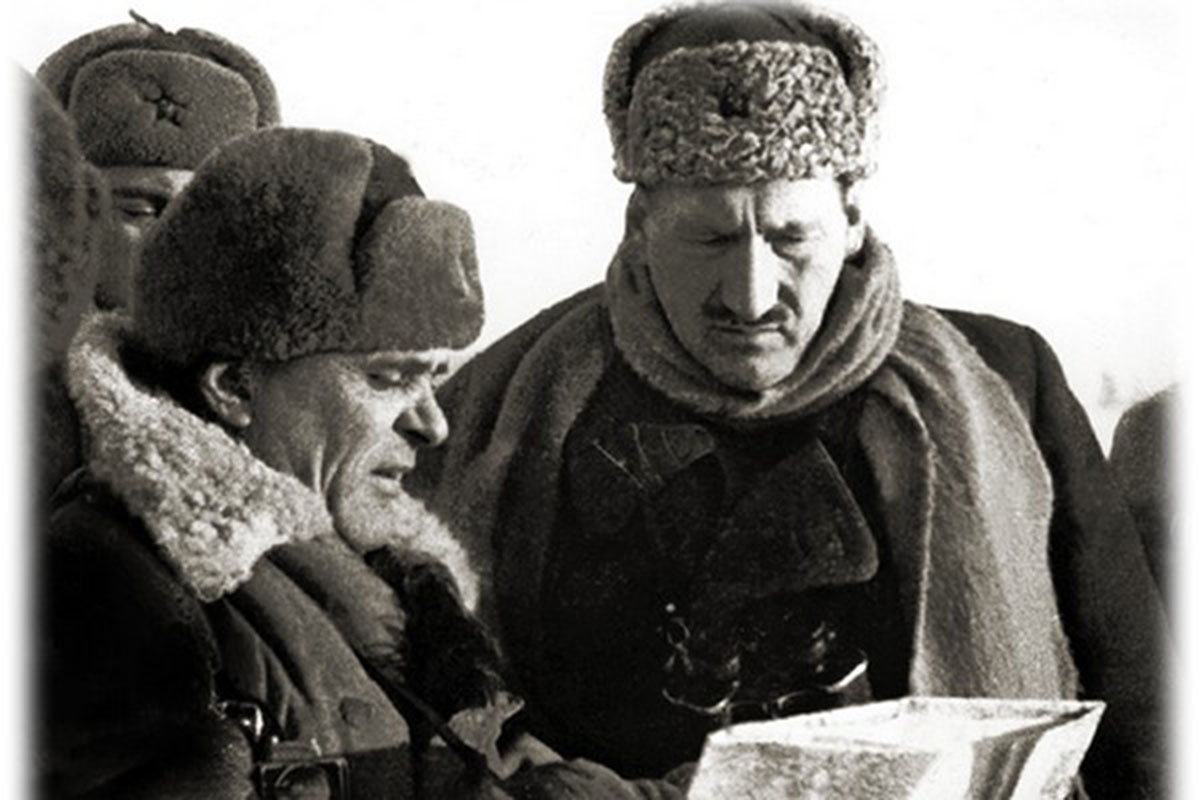
One of the armies, which lay the main severity of the counterattack, was the 33rd-under the command of Lieutenant General Mikhail Efremov. With heavy battles and large losses, she successfully advanced in the southwest direction: by December 26, 1941, Naro-Fominsk completely liberated, on January 4, 1942-Borovsk, and on January 19-Vereya. After a month of offensive battles, the army, like the entire Western Front, was in dire need of rest and replenishment, but on January 17, on the eve of the capture of the Veraa, Efremov received the order of Zhukov to continue the offensive: according to the plan of the front commander, the 33rd Army and the forces of the 1st Guards Cavalry Corps Pavel Belov had to surround a significant part of the troops in the Vyazma region Army Group "Center". The troops of the Kalinin Front were supposed to help them in this, which struck Vyazma from the north. In particular, the order said: “The commander 33 ... created a very favorable situation for the rapid advance of 33 army in the Vyazma region in the rear of the Vyazemsky enemy group. I order: simultaneously with the liquidation of the enemy in Vernya, the main forces in the morning of 01/19/1942, with a forced march, go to the Dubna area, the Temporary, having later had a task, depending on the situation, a blow to Vyazma or bypassing it from the southwest. The advanced units to the Dubna district, the Temporary to go no later than 19.01., The main forces - 01/20/42. "
Zhukov’s plan was extremely risky, which in the 1960s himself recognized in his memoirs: “Critically evaluating these events of 1942 now, I believe that at that time we were made a mistake in evaluating the situation in the Vyazma area.” The front commander proceeded from the fact that the German forces were depleted and could not resist the Soviet troops erupting to the west. The Germans really greatly got in December-January, but the decisive measures of the German command, and primarily the “defense masters” of Walter Model, which had just been appointed under Moscow, allowed the German army to plug the gaps in defense and again close the front behind the broken Soviet formations. Belov’s corps and a significant part of Efremov’s troops were surrounded.
Environment
In this situation, the four surrounded divisions of the Efremov army could be saved by a timely order to break through in the opposite, eastern, direction. The commander of the army Efremov could not give such an order on his own, since this would contradict the previously received orders of the front commander, so he tried to solve the problem with limited forces: “The commander of 1293 joint ventures (rifle regiment.-NT) from the Ran Bukanovo to immediately perform the Malinovka-Savino-Savino route, to knock out the enemy from Zakharovo, after which it is to restore the situation, after which Continue the promotion in the concentration of 160 sd (rifle division.-NT), where to subordinate the division commander ... "
However, it was not possible to solve the problem. He recalls the at that time recalls with parents, sisters and brother in the village of Bukanovo Alexander Vorovatov, who was 9 years old in the winter of 1942: “My brother and I somehow ran and sat down for the yard. And the bullets whistled, as it is all the same. And only one ran our Russians. They, they said, beat everyone ... The Germans came, we were gathered in one house, drove us all ... Then they drove us to Khimino from this house, not far from. We were driven to chemo, half of chemino burned. They also collected everyone there. A German came, kicked everyone out and lit a house. We had nowhere to go. We went forward and reached Burkovo, there are also a lot of Germans there ... ”*
The army headquarters, which remained outside the Namnski station (Vyazma-Kaluga railway line), performed his duties in far from the best way, largely due to the constant “breakdowns” of the chief of staff, Major General Kondratiev. In April, a member of the Military Council of the 33rd Army reported his state “upstairs”: “Slinking, completely uninitiated in his work; Comrade Kondratyev does not manage the work of departments. As a result, the operation of the operational department is poorly set, even worse - the work of the intelligence department. The state of this work in the parts is very bad. Kondratyev is systematically drunk. On March 6, 1942, he was drunkenly signed an obviously impossible combat order. As a result, the units suffered unnecessary losses. On April 3, 1942, he appeared on a report to the former member of the Military Council Shlyakhtin with strong intoxication, and the next day he categorically denied this. Everyone in the headquarters and parts is known about the drunkenness and idleness of Kondratyev, due to which Kondratyev has no authority. ” It is easy to condemn the general, but it should be borne in mind that in the first six months of the war he has been surrounded twice, and this could not but affect the psyche. However, the dying army was not easier from this ...
Efremov made significant efforts in order to somehow replenish the melting forces of his divisions, but the situation was emergency. In early April, the head of the Special Department of the NKVD of the Western Front reported: “Recently, the position of parts of the shock group of the 33rd Army has become even more difficult. The cut of it from the supply bases extremely complicated the position with the supply of ammunition, food and deprived the opportunity to be replenished with the personnel. As a result of this position, a significant part of the artillery is mothballed due to the lack of fuel and ammunition ... The personnel is not replenished. A particularly intense position with the supply of parts of the group of food. The power of the personnel consists of a small amount of boiled rye and horses. There is absolutely no salt, fats and sugar ... "
Breakthrough
On April 3, the German command invited Efremov to surrender. The commander-33 informed Zhukov about this and continued to lead the resistance of his rapidly melting troops. On April 9, the plane was sent for Efremov, but the general sent the banner of the army and the wounded on it: "I came here with the soldiers, with the soldiers and I would leave." On April 13, the front headquarters finally approved the army’s withdrawal from the boiler and indicated the circular exit route. Efremov, realizing that his fighters were exhausted, did not agree with him and insisted on a breakthrough along the shortest path; In this he was supported by Stalin himself. However, time was hopelessly lost. The broken troops were scattered and for the most part destroyed. The commander, who received a severe wound in one of the clashes, shot himself to avoid captivity.
“My hands were paralyzed from mental overstrain. My fighters stuffed their hands on my belt. The rope was tied to the belt and thus led me forward ... "
“The nervous state of many fighters was such that they were more automatically, completely not realizing what was happening around them. They were, as if indifferent to what they would have to stand in the next minute. I can’t remember those days without a shudder. My hands stopped moving from mental overstrain. They seemed to paralyze. My fighters stuffed their hands on my belt. The rope was tied to the belt and thus led me forward ... ”-later recalled one of the junior political workers of the 33rd Army.
Less than a thousand out of about 20 thousand fighters and commanders of units of the 33rd Army were able to go out to their small scattered groups.
Memory
Today, historians and lovers of military history, recalling the battles near Vyazma in the winter-spring 1942, continue to ask the main question: who is still guilty of the death of the 33rd Army? Someone has the main guilt of Zhukov, someone protects him and sees the main reason for the failures in the actions of Efremov and his headquarters ... The volume of material is too large, too many contradictions in the documents and memoirs of the surviving participants of those events, the historical and moral approaches of researchers are too polar. But it is unlikely that anyone will be able to question the conclusion made following the results of those battles by analysts at the General Staff of the Red Army: “... the Western group of the 33rd Army honestly and valiantly fought until the end of its existence. With a lack of ammunition and food, she fought for two and a half months in complete isolation from her troops, causing great damage in the enemy’s manpower, and constrained his big forces with her actions ... "
* Hereinafter, the document style is preserved.
* An interview with Alexandra Vorovatova, November 2016, from the author’s archive.
Photo: Military.wikireading.ru