
Translated material
It is impossible to endure this fear
The first domestic film award "Nika" is a round date - the thirtieth ceremony
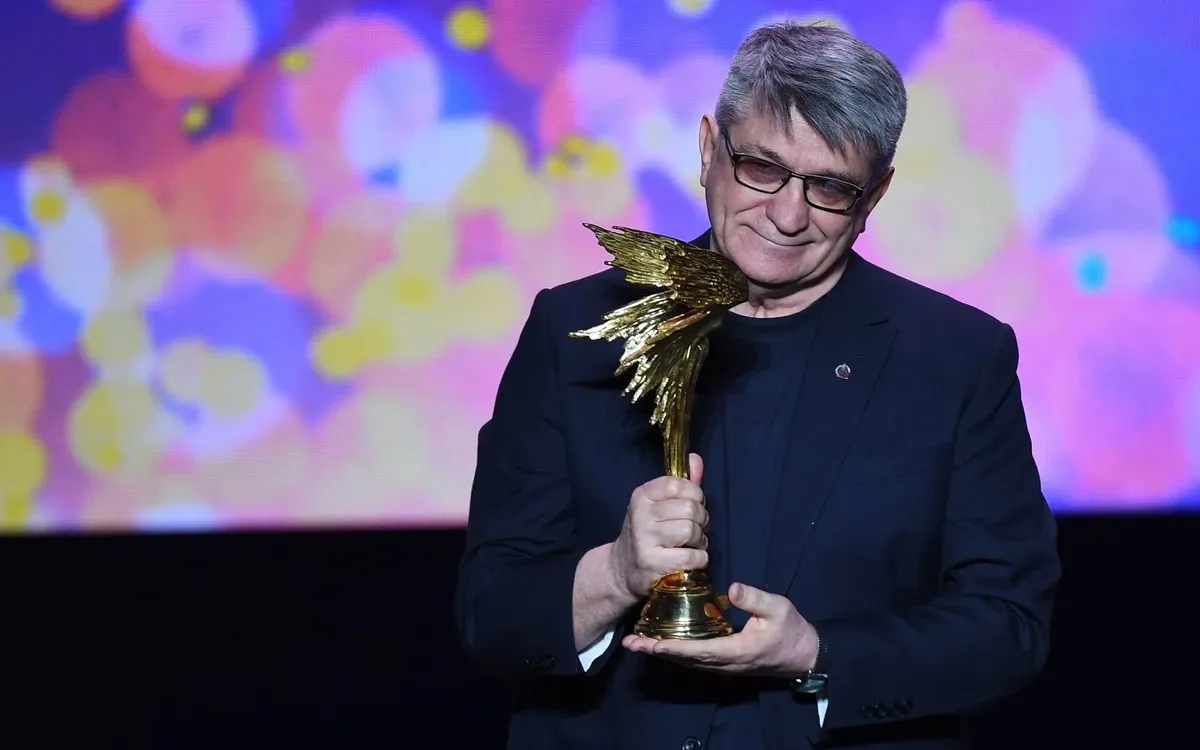
“They reviewed the films of our ceremonies here, and I saw my“ portraits ”, shouted:“ Cut off immediately! There is a young black -skinned Cossack - there is a fascinated uncle, ”said Julius Gusman during the traditional warm -up of the ceremony at the Mossovet Theater.
Nick was born in the era of another hopes. When the TV rattled the PROVTOR PROPERTION, and not the PROBERSHILTON. The first figurine - the “repentance” of Tengiz Abuladze is a sign symbol that determined the vector of the premium. If you call it laureates - “Ashik Kerib”, “asthenic syndrome”, “makarov”, “hobbies”, “about freaks and people”, “Khrustalev, car!”, “Taurus”, “Cuckoo” “Return”, “Own”, “Faust”, “It is difficult to be a god” - these are not just a picture of world significance, it is a milestone in the history of cinema.
As usual, the first birthday was recalled how they met the "birthday". Andrei Plakhov (he was awarded the prize “For contribution to cinematic sciences, criticism, education”) told how with Elem Klimov and Julius Gusman we went to the workshop to the sculptor Mikulsky to watch the just created figurine. They said about Klimov that he knows how to talk with the authorities on an equal footing, without a fashionable lyzostan.
Nostalgia shown in many performances. Nikolai Svanidze recalled how people crowded on the streets at the stands: they could not read enough, breathe in. Konchalovsky - as thanks to the hope of changes, everything seemed to be younger. And the “Nika” itself is the result of hopes, some of which remained illusions, transformed into disappointment.
Apparently, many people see the present more spacious. And even Mironov sang from the screen about Cinema: "As we have long dreamed ... but we could not." In the poetry prologue Dmitry Bykov - bitter words about the missed, slept, dashed freedom into perestroika.
“Nika” thirty years later - was brave, cutting in judgments. I appealed to conscience, responsibility for what is happening. True. The feeling that the twisted nuts break the thread. Receiving the “Opening of the Year” prize, the director of “Collector” Alexei Krasovsky recalled that many of the thousands of detainees on March 26, received deadlines. Cinematographers need to use authority to help them.
Two wonderful actresses are noted at once for the role of the second plan. Moreover, both starred in independent projects taken without state participation. Julia Aug - in the anti -lrical drama "Pupil" by Kirill Serebrennikova, Elena Koreneva - in the social tragifars "Her name was Mumu" by Vladimir Mirzoev. Koreneva reminded of the list of political prisoners, numbering about a hundred people, of Oleg Sentsov, Sergey Mokhnatkin, Oleg Navalny, sitting alone for that she took off the upper jacket in the chamber.
Among the predictable awards “In the Rays of the Sun” Vitaly Mansky, and not only because of the protest spirit that this evening hid in the hall (everyone knows that the Mansky was “devoted to anathema” by the Minister of Culture), this is a really bright, inventive movie in which the ecstasy of admiration for all the great in North Korea gets along with the ironic author’s look. Mansky is often asked: "Worse or better with us than in Korea?" Mansky reflects on the uniqueness of a merciless experiment on a man who is carried out in North Korea: "And we have been licked our country, so we are much worse ..."
Pavel Bardin is rewarded for the long conservation of his film “Salam Maskva”, shot in 2012, and only now released. A talented series about ethnic disagreements and all -pervasive xenophobia - a rare bird on our TV - was awarded the award “For achievements in the art of television cinema. In the animation, three talented films are immediately presented: the avant -garde psychological surgery “To love” Igor Kovalev, a melancholy burlesk, “Python and the watchman” of Anton Dyakov and the Cuckoo ” - needlework among the post -apocalyptic landscape of Dina Velikovskaya. The “cuckoo” won, which in the animation was nicknamed “conversation with the souls of dolls”.
Who would doubt. The main awards “Best Film”, “Directive” - at the “Paradise” by Andrei Konchalovsky. The main female role went to Julia Vysotskaya for the hellish and convincing nature of the Russian aristocrat Olga Kamenskaya (and yet it is a pity that the talented work of Natalia Pavlenkova in Zoology is underestimated). Konchalovsky explained that he was making a picture in order to ensure that the past would not be finally from memory, from the pages of a single textbook: “Disasters of the 20th century and especially the Holocaust begin to be forgotten. But this wound should not be forgotten by us. ” It's a shame that the relevant work of Kirill Serebrennikov “Student” remained outside the award. The event-dispout about the urgent one of the many nominations received only a prize for a second-plan female role. And how could you not notice the filigree complex work of the composer Ilya Demutsky and reward Edward Artemyev for syrup music for the unbearable film “Hero”?
“Honor and dignity” - Alexander Sokurov, who recently completed many years of work on his four -volume epic about power (“Moloch”, “Taurus”, “Sun”, “Faust”). Sokurov marveled at the special cordiality of the hall and admitted: "My ninety -year -old mother asked:" Do not speak, do not say anything, they will kill you, because you argue with the government all the time. " I do not argue, I only express my opinion. And I am waiting for an answer from the president whom I asked about the fate of Oleg Sentsov. The president promised what would think about this problem. I, like many, watched what happened in the country this weekend. I believe that the state makes a huge mistake, behaving so familiarly with the young generation of the country ... You can’t start a civil war among schoolchildren and students, we must hear them. None of the politicians talk to them. They are afraid to do it. It is impossible to endure this fear. The young finally realized what was happening in the country. There was a long silence. They seemed to be not. And so they appeared. Our main task: for the humanitarian development of young people to take place. Everything related to the substitution of education with religious dogmas leads to destruction. And yet. I would like to appeal to the deputies, first of all, men: “Let's take the law prohibiting the arrest of girls and women participating in such promotions. You saw how the girls grabbed the girls by the arms, they dragged the girls in the carriers. Ashamed".
Surprisingly, one evening, Sokurov and his longtime co -author Yuri Arav received nickname (for the script of the film “Monk and Demons”). The playwright Pavel Finn recalled how many years ago in an empty Lenfilm hall they began to watch a movie, and became a witness to a miracle. It was a "lonely voice of a man." For the first time in the credits, they saw two surnames unknown then: Arabs and Sokurov. Since then, the authors have done a lot together, separately. But these two names are forever inscribed in the history of cinema.
The award “For the Contribution to Cinema” was received by Alexander Mitta, who shared the alarm and despair of Sokurov: “We are extremely concerned: it is necessary that new generations grow under our care, and not under the scarecases.”
In general, at some point it began to seem that these statements about the sick, disturbing this evening are more important than the awards themselves, about which they gathered.
Konchalovsky thanked one of the creators of the award Julia Gusman: “For this holiday in the middle of the perplexity that our film process turned into ... In the era, when the best composer of the era, the best composer of the era, should really remind of enlightenment.”
But the result of the discussion, the “painful thought” about the alarming atmosphere in society was not summed up by the president of the Konchalovsky Prize, but the playwrights.
Yuri Arabov: “I do not agree with someone who believes that a little depends on us. We should not pretend that those who are seized and judged, no. We can write scripts, make films ... And then with them and with us it will be good. ”
Pavel Finn: “Nika” was created in the storm of our youth, in our common desire for freedom. And if today there are three generations of filmmakers: from Krasovsky to Sokurov and Mitta, they say exactly the same as we would say 30 years ago. So "Nika" is alive. "