
Translated material
“Now the Russian Orthodox Church is part of the state apparatus: the priest is why he is against the transfer of Isaac and the law on insulting the feelings of believers
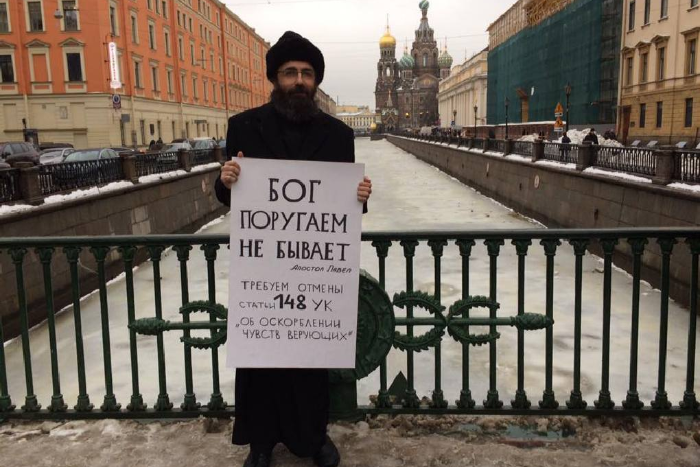
Grigory Mikhnov-Vitenko is the son of the Soviet dissident, poet and screenwriter Alexander Galich. In the 90s, Mikhnov-Vitenko was one of the pioneers of Russian satellite television, and in the late 2000s he became an Orthodox priest. He spent about seven years in the Russian Orthodox Church, but left the church after he publicly criticized the participants in the Donbass during the sermon.
Whether the clergy are really earn a lot and why they take loans, why the priest opposes the law on insulting the feelings of believers and whether the church pays attention to protests against the transfer of Isaacievsky - in an interview with “ paper ”.
- How did you come to religion?
- Already at the age of 14-15, I was a rather well -read young man, and my readiness, among other things, led to the fact that I did not really believe the Soviet regime. And if the Soviet government says that there is no God, then this is at least a reason to find out in more detail about all this.
Having read the Bible, I once realized that in God I believe that the god about which is written in the Gospel is close to me. Accordingly, I decided to be baptized. In the yard was 1983, that is, even before any fashion for religion and before it was possible in principle. My friends and acquaintances were friends with Father Alexander Menem, and I went to him. He then, fortunately, did not baptize me immediately, but said: it is very good that you believe in God, but first you need to know more about it. A little later, already at the age of 19, I became a baptized man.
- How religious were you in youth?
- It seemed to me that enough. Not always I was a worthy Christian, but still tried to classify myself to this category. I went to church, followed the post and so on. To the best of strength and capabilities. Although I am very restrained towards any manifestations of external religiosity.
- Why did you decide to become a priest?
-Vera has always been a very important thing for me, and when I was 40 years old, I realized that I needed to somehow change my own life. I completely stopped liked what I did, and then I was a television producer. There were difficulties, but it seemed to me that it was precisely what I did not work out. Now I understand that this was, of course, connected with the first mock of the state on independent electronic media and television channels. It seemed to us that we did not do anything bad: we show a good movie to people - but, apparently, this was a sufficient basis for proceedings with management and owners of Orthodox television channels. Well, in general, it seemed to me that it no longer makes sense to engage in electronic media in Russia. At least television. Well, if it was necessary to change the sphere of activity somehow, I thought that, probably, the time came. So I became, as they say, professional believers.
- How did you relate to the Russian Orthodox Church over the years?
-At different times, differently. But you need to consider that I was lucky. I began to get acquainted with this structure since the mid-80s and even then understood: the idea that there is a single Russian Orthodox Church, which acts as a party or a power structure, is a myth. Of course, this is not so so far. Today it is rather a “terrarium of like -minded people”, in which there are very different people and very different opinions.
The idea that in the state or the Russian Orthodox Church can be successfully built a single vertical of power with a single opinion is again a myth. But in the early 90s, this myth was accompanied by the feeling that I communicate with good, wonderful people from the church. And in the Russian Orthodox Church, new forms and initiatives appear all the time, which means that all these obscurantists should soon die. But, of course, no one died. Rather, on the contrary: all the healthy forces that would like some education that would like the church to have a clear social position to be crushed. People are simply forbidden to open their mouths publicly, and some were completely squeezed out of the church. Therefore, today it has turned into a certain political department.
-Can you highlight some point when obscurantism in the Russian Orthodox Church began to win?
-It is difficult to highlight it so hard, but, probably, this is the beginning of the 2000s. Now it is very tempting to blame Patriarch Kirill in everything, to say that it all started with his arrival and so on. But this is not so, it all started much earlier. Already in the early 2000s, the church clearly began to turn into a bureaucratic apparatus simply due to quantitative growth. In those years, the churches either returned or built many temples, there were several times more priests and so on.
The Russian Orthodox Church is a “terrarium of like -minded people”, in which there are very different people and very different opinions.
Even then, the first calls went, which I did not pay attention to at that moment, so in 2007 I quite consciously wrote a petition in which I said that I wanted to become a priest. Then it seemed that there are, of course, all these trends, but you can collect some healthy forces-and everything would work out. Well, then there was still a slightly different president and it seemed that everything could go the wrong place where it went in the end. Moreover, you know, it so coincided that in 2008 I went to Novgorod, where I was supposed to be ordained, on the night when the war in Ossetia began. I was twisted very much. At each station, I wanted to refuse and get out of the train, but somehow I still convinced myself that the matter should be done.
- How does the work of the priest work?
-In a normal situation, in addition to church services, the priest has a huge amount of what is called “tremba”: someone dies, someone needs to be professed and so on. Plus, the priest should do the most to self -education. This process is non -staff, as soon as a person thinks that he has read all the books, this is trouble. In general, with a normal approach, there is no time for nothing.
Also on the priests lies a huge number of organizational moments. He must build, paint, and report, and make more money so that there is something to give to the diocese. Today, often the temple is a retail outlet that has specific financial tasks. Everything else is a pious cover. The task is a profit, and this profit must be actively shared.
This procedure occurs in different ways and depends on a particular temple. Most often, there is simply a certain imputed tax that the temple must transfer the dioceses monthly. A small church pays from 30 thousand a month, large temples - sometimes more than 3 million rubles. Plus, there are many other fees: for the seminary, bishop for a birthday, and so on. The flow of money always goes only up this structure - and as a result, temples at best go to zero, and in the worst, rural priests take loans to pay this fee. Because the rule is very simple: you won’t pay, you can “walk”.
- Why then are priests hold on to this place?
- The reasons for people are very different. Someone really numbers himself to believers, someone feels their obligations to parishioners, someone is simply busy with business, and in business loans are normal.
The temple is a retail outlet. Everything else is a pious cover. The main task is profit
But most people who simply became priests too early. In general, according to church rules, a priest cannot become a priest earlier than 30 years, that is, a person must get some kind of education and a secular specialty at this point. And at the age of 18, the boy without education and knowledge says: "Let me make you a priest." He has no profession, there is no knowledge, he has been engaged in the same life all his life and at a certain moment - at 35 years - he feels that he cannot continue to do this, but he has nowhere to go. Only in taxi drivers perhaps. At the same time, very often priests have many children, a large family. Where will you go here? It’s easier to find these 30 thousand and then somehow spin. A very sad picture. These are those things that will have to be redone in that bright beautiful Russia that we all dream of and which, I am sure, are not far off.
- Recently, it seems that priests are very wealthy people. How true is it?
- It depends on where to serve. If you serve in the village, it can be poverty, and if the Gazprom managers go to the Great Temple, then, of course, the priest does not poor. It is possible to understand that not all priests are shocked, at least by the fact that in fact there are not enough clergymen in the Russian Orthodox Church. In millionaire cities, of course, the situation is better, but in the villages there is no one to serve.
- You spent about seven years in the Russian Orthodox Church. Can you single out any actions committed over the years that you are proud or ashamed?
- This is just a job, you see. There is nothing to be proud of there. I just tried not to lie in my daily activity. In relation to the rules, and to people, and to their own conscience. More often, it still succeeded, but not always.
- You have already said several times that very different people are in the Russian Orthodox Church, but from the outside it recently seems that people there are quite the same and not very pleasant. How are things really?
- The main part is just a working class. People who, to the best of strength and capabilities, try to honestly fulfill their duties. Real obscurantists can be counted on the fingers. And all of them are presented in the media space. Just when they talk from each iron, it seems that there are a lot of them and all in the church are like that. There is a feeling that they are all obscurantist there. Of course, this is not so. People who think differently are simply not allowed to speak publicly. And the majority eventually agrees to be silent and remain inside the structure.
A priest is just a job, there is nothing to be proud of there. I just tried not to lie
But you need to understand that some social and moral protest is now brewing both in society and in the church. And I think that the structure of the church is now extremely fragile. There is no reinforced concrete monolith there. There are left -wing and right. And the design can collapse with terrible force, which may not be so bad. Let them be separately left, and separately right.
- You left the Russian Orthodox Church after you publicly condemned the war in the Donbass. Why did you decide on this?
- It all started with the Crimea. I well remember how in February 2014 I sat with friends in Moscow and we said to each other: “Well, they are not crazy, it’s just a political game.” A few days later it turned out that this was not a game at all. It was an occasion for me to fall into a certain state of a half -studio.
You see, formally, I don’t care who is legally owned by one or another territory. But I don’t care how it is done. If you can lure about “there are no them there”, if you can tell monstrous tales, if you can give a damn about signed international treaties, it is very dangerous.
I would be for the “return” of Crimea if we were discussing some normal option-for example, negotiations on the purchase of Crimea. I would be the first supporter, because my first children's memories are connected with the Crimea. But the way it was done causes immediate rejection. You can’t. Because the lies are built to normal.
And then everything began to develop in the east of Ukraine. In August, the battles around Debaltseve began, then it seemed to me that it was cut by knives. Because it is not true, it is a violation of God's will, it is the murder of people under far -fetched pretexts. At the same time, monstrous fables are told about crucified boys and so on. And I see how people, my parishioners, have seen enough television and tell me: "We will go to fight." There were such cases. People who then did not have access to the Internet, access to alternative sources of information, got the complete impression that ours are killed there and we need to go to fight.
Then I realized that I could not do anything but openly express my opinion. It may not be very loud, but it is important for me not to lie to myself. While I am silent - I'm lying. And so, at least one or two people will hear, they will think that they are doing something wrong. There will already be some result.
After my statement, everything spun. My church authorities pretended that there was nothing, but a month later I was asked, expressed in secular language, to write a statement “at my own request”.
- When you decided to speak, did you understand that this would end?
- At that moment I did not think at all what it would lead to. I just had to do this, and then deal with the consequences. Then, when he wrote a statement, he did this with relief. Because this whole situation with the church, with its lies, was very clearly manifested through Ukrainian events. The only possible option for the church was then to scream daily: "Guys, stop." But this was not.
-Did your priest colleagues support your decision?
- Those with whom I communicate or sign personally, almost everyone supported. They said: "Well done, everything is right." But at the same time, no one publicly began to support me. It was clear to everyone that this was fraught.
-Do you think your statement somehow influenced the position of the church in Ukraine?
- It's hard for me to say. But so it coincided, perhaps, by chance, that literally a few days later at least some negotiation process began. Minsk agreements and so on. I think that then in August simply many felt that the situation reached an extremum and could develop into an open full -scale war.
- After this story with Donbass, you left the Russian Orthodox Church and joined the Apostolic Orthodox Church. What is it?
- The Russian church after the revolution was divided into three parts. The first is the official church. The second is the Russian Orthodox Church abroad (ROCZ), which existed until recently. The third is the smallest that remained in Russia, but switched to the "catacomb regime" of existence. The priests continued to conduct some kind of activity, but officially did not register the community and did not come into contact with the authorities. They served houses, moving from place to place and so on.
In the early 2000s, such “catacomb” communities united into the Apostolic Orthodox Church (APC). The task that we set for ourselves is simply the normalization of the church. Because the church should be separated from the state and primarily engage in moral categories.
The Russian Orthodox Church is part of the state apparatus. She is too closed to herself and hears only herself
Among other things, we advocate the transparency of finances, for the absence of some magnificent buildings, if they cannot be kept on the money of believers. It is completely wrong to take money from the state and spend it on beautiful buildings. It is necessary to engage in people, not buildings. And even people will build, if they have resources for this.
In addition, our principle: the priest must earn in one place, and in another to be a clergyman. For example, I work as a journalist and scientific editor of a series of books.
By and large, we did not go far from the “catacomb” stage. We do not strive for buildings, structures and so on. We have a fairly small community. We proceed from the fact that if there are 20-30 people in it, then this is quite enough. If the community begins to increase, then you need to think about creating another community. We have services in apartments, in offices, anywhere. Throughout Russia, at best we are several thousand people. But the process is gaining momentum and the quantity increases. Because very many are not happy with what they see in the Russian Orthodox Church. At least those who think about something. People are not satisfied with the position of the Russian Orthodox Church. That it works on the principle of a commercial structure: "I came, they did it beautifully, and I left." For some reason, the Bible says differently. It says about love, brotherhood, openness.
- Are the APC priests former priests of the Russian Orthodox Church?
- No, such a minority. Many, fortunately, do not have such a “positive” experience. The fact is that many priests of the Russian Orthodox Church are not ready for such a regime of existence when there should be some other way of earnings. You still need to eat something. For example, it would be hard for me to survive without the help of friends.
- Let's get back to the Russian Orthodox Church and its earnings. How do you feel about the situation around the St. Isaac's Cathedral? How is it called and understand in the Russian Orthodox Church that many Petersburgers are unhappy with this?
- Churches do not need such megazyzes at all, because to fulfill their tasks - working with people - such buildings are directly contraindicated. Accordingly, the question arises: if this building is not necessary for the stupid, then what is it for? The answer is simple: it is a financially very curious object, a status object. Any attempt to analyze the situation leads to finance. Then the question arises: what does the church have to do with it? Moreover, historically the church of the church never belonged. Why is he her now? To distribute financial flows yourself? Ugly, the church has a lot of other tasks.
Do people understand that people are unhappy? Someone understands, someone is not. It is no coincidence that there is still no official application. So, the person who depends on, to put this signature or not, understands that this does not need to be done. He cannot say aloud, but he understands.
I think all this is a semi -political game that passes along the line of money and is not related to the true tasks of the church. And it grieves. In a good way after the start of protests, the Russian Orthodox Church was supposed to refuse to transfer the temple. At least. But, on the contrary, the most obscurantist and suburban statements sounded.
- Do the Russian Orthodox Church even pay attention to such protests?
- No. This is the problem of today's government in Russia: complete weaning from the dialogue regime. Никто из большинства чиновников не избирался, в том числе и церковных. Все так или иначе назначенцы. Поэтому они привыкли слышать только себя и какого-то партнера по диалогу наверху. Пока никакой реакции на происходящее внизу нет.
Священник должен в одном месте зарабатывать, а в другом быть священнослужителем
При этом протесты 26 марта показали, что реальность сильно изменилась и все должны измениться, чтобы ей соответствовать. Даст бог, этот импульс дойдет и до власти. Но какое событие может повлиять на саму РПЦ, я не знаю. Боюсь, что никакое. Она слишком замкнута сама на себя и слышит только себя.
— Продолжая тему протестов, хотелось бы узнать, как внутри церкви расценивают уроки православия в школах и другие примеры навязывания религии в России.
— Очень настороженно, на самом деле. Понимаете, это навязывание происходит только на бумаге. На деле священник из-за бюрократизации вместо того, чтобы пойти с ребятами в футбол погонять или поговорить с ними за всё хорошее против всего плохого, вынужден садиться и писать длинные отчеты о том, как он будет строить свои уроки и отношения со школьниками. В итоге получается очень странная ситуация, когда в школу приходят люди и рассказывают детям что-то очень странное, основываясь на материалах в лучшем случае XIX века. А дети ведь чувствуют неискренность. В итоге они скорее отдаляются от религии и церкви благодаря этим занятиям. Всё происходит ровно так же, как с историей КПСС в СССР. Ну кто-то разве серьезно относился к этому? Нет, все думали, что нужно зазубрить и всё. А в итоге чувствовали лишь какое-то отторжение к партии.
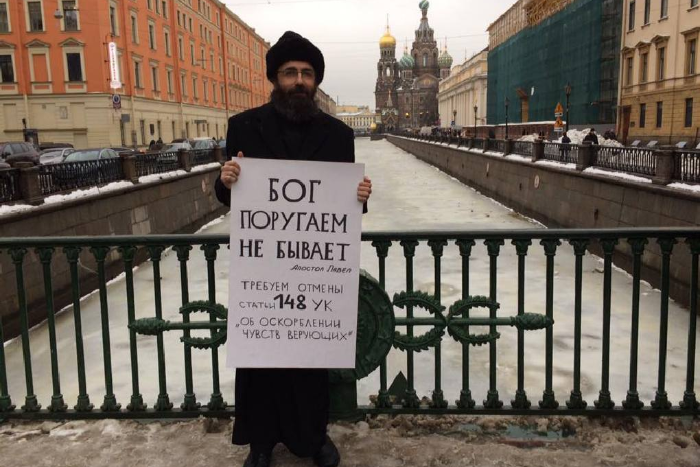
— Не так давно вы вышли на пикет против закона об оскорблении чувств верующих. Why?
— У меня к этому закону самое резко отрицательное отношение. Потому что это чудовищный обман. Этот закон не имеет права на существование ни в светском государстве, ни в христианском. Он развращает верующего человека, который в силу своей эмоциональности, необразованности или корыстных соображений может прийти в любое место и заявить, что его якобы религиозные чувства оскорблены. Более того, закон очень криво написан и заявитель никак не должен подтверждать свою принадлежность к религиозной организации или свою веру. Абсолютное безобразие.
Я еще мог бы понять, если бы иски могла подавать какая-нибудь религиозная организация. Это хотя бы логически объяснимо, но неоправдываемо морально. Сегодня же о своих оскорбленных чувствах заявляют люди, имеющие явно опосредованное отношение к религии. Причем обижаются они не совсем понятно на что и не могут четко сформулировать свои претензии.
Закон должен быть отменен — мое четкое мнение. Потому что это закладывает бомбу подо все отношения в обществе. Завтра люди начнут ходить и возмущаться тем, что в Великий пост колбаса в столовой лежит, а следующий человек оскорбится наличием свинины. А последователи Летающего макаронного монстра напишут заявление о том, что дуршлаг — это священный головной убор и его нельзя продавать в отделе товаров для кухни.
— Но этот закон принимался в качестве ответа на акцию Pussy Riot. Почему вы тогда не выступили против него, хотя были в РПЦ?
— В день приговора я до последнего момента верил, что дадут условный срок или штраф. Узнав о реальном сроке, я даже написал в фейсбуке, что мы прошли точку невозврата.
Тогда люди в церкви к суду в целом относились по-разному. Но даже довольно «скрепоносные» ребята понимали, что реальный срок был избыточен. Ну а нормальные люди в церкви относились к этому как к позору.
Я не выступил против публично. Но я уже говорил, что не всегда выполнял то, что должен был с точки зрения совести. Это одна из тех вещей. Очень велика внутренняя инерция, чтобы решиться даже на очевидный шаг. Видимо, мне нужен был более сильный раздражитель. Для меня им стали украинские события.
— Вы сказали, что Церковь не прислушивается к протестам и реакции на громкие скандалы. Как вы думаете, что-то может изменить РПЦ?
— Всё зависит от состояния общества. Сейчас церковь является частью не гражданского общества, а частью госаппарата. А там общая повестка определяется национальным лидером. Есть одна повестка — и мы говорим, что в Сирии идет священная война, меняется повестка — меняется и всё остальное. Вот когда будет меняться этот госаппарат, тогда будет меняться и церковь.