
Translated material
"Paradise without cats is impossible"
Lyudmila Ulitskaya, Vsevolod Emelin, Alexander Livergant recall Natalya Traumberg
April 1 marks eight years since the death of Natalia Leonidovna Traubberg, in the translations of which we read Chesterton, Woodhauz, Lewis, Ionesko, Pirandello and many others. “Gorky” asked to tell about Traubberg her friends and colleagues.Alexander Livergant, translator, editor -in -chief of the magazine "Foreign Literature"
We met Natalya Leonidovna in the early 1980s under business circumstances. She then lived with her mother in Pure Lane - her father, filmmaker of Traubberg, was no longer alive. I came to her, in fact, because I was preparing the Tom of Chesterton's essays, who later came out under the name “Writer in the newspaper”. He came for an obvious reason, because Traubberg translated a lot of Chesterton, although she almost did not publish. You can understand, 1983, Chesterton was not the most popular author. In essence, we became the compilers of this volume.
She immediately caused me greater sympathy. In 1981–82, we saw each other regularly. Every time only on the case, but I sat down, we drank tea and discussed not only Chesterton. Then we called back, rarely saw each other. The fact is that in the journal Foreign Literature, which I then - and now - imagine, it was printed quite little. In her translation was the “End of one novel” by Graham Green. He seems to have been in Foreign Literature. Then he published a separate book, fell into the six -volume collected works of Green. And now, in my book about Green, I am writing about her translation of this novel.
Then Traubberg and I connected on another author. After all, she was in a literary sense a very amorous person. In addition to Chesterton, the English comedian Pel Grenville Woodhaus became her late love. I also translated it, but, as in the case of Chesterton, very little. In the early 2000s, that is, the Soros Foundation, together with the AST publishing house, produced a large series of the Golden Fund of World Classics. There, Tom Woodhauz, including her translations, came out. Woodhaus, like Chesterton, turned out very well for her.
Traumberg translation style is easy to describe - this is an elliptical style. What is very rare from translators from English, she managed to write as economically as the author wrote. Her translations are not devoid of shortcomings, like all of us, but her Russian language is perfect, very elegant.
She had another attractive feature. She worked a lot with novice translators. At the same time, as a person is unusually kind and responsive, she rewritten completely indecent texts. And she fiddled with translators who could not obviously grow. I never did it.
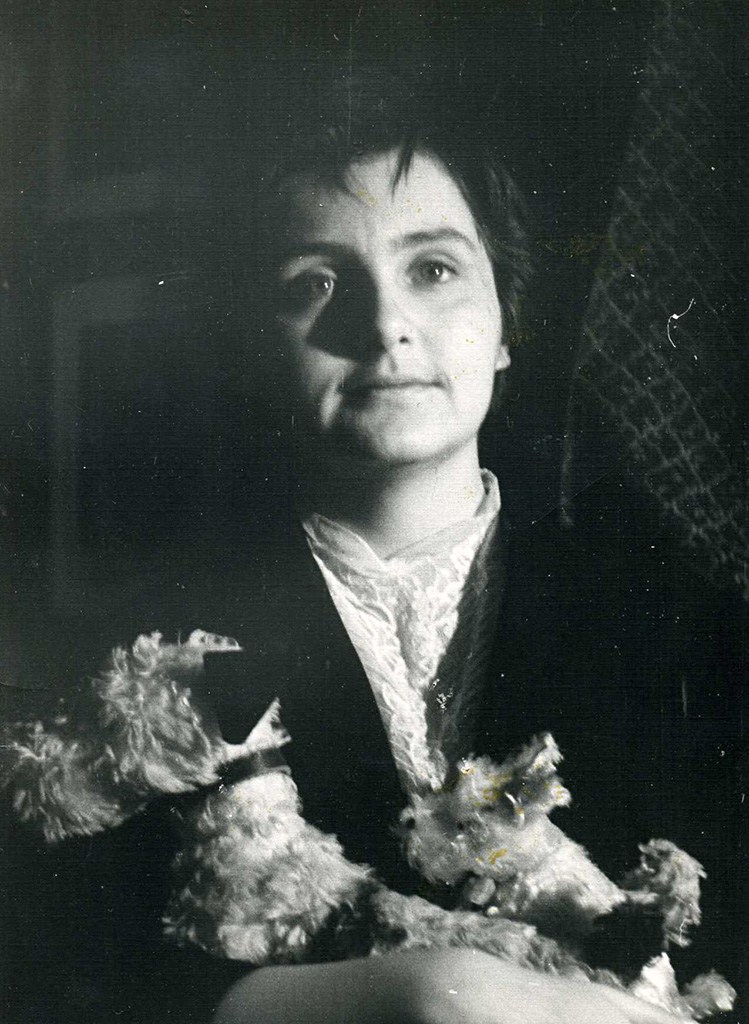 Natalia Traubberg with Tyvaya's toy dog, 1957
I will not use strong words - “unique”, etc., but I will say that she was a remarkable person. She was a believer, a Catholic, although in communication there was no proselytist position in a penny. Perhaps the Catholic ideas have learned from the Spanish authors, who also translated a lot and felt very well. I am sure that her parents had no attitude to religion and were quite Soviet people. She was far from politics, although, of course, [to Soviet power] was skeptical. Her environment was also made up of people in many ways of religious perception. She knew many priests, talked a lot with Alexander Menem; Many of her friends - for example, a wonderful translator and philologist Vladimir Muravyov - were also Catholics.
She loved cats and was good. Dark, combed back hair, huge black eyes with which she ate you. And there was something in her appearance witch, witchcraft.
Vsevolod Emelin, poet
We met Natalia Leonidovna in the early 1990s, when I worked as a watchman in the temple of Saints Cosmas and Damian, and she was his parishioner.
Now I have moved away from church life. But then in the early 1980s, I-a simple factory guy-got into catechization courses that existed under the father of Alexander Mene. And I opened up a kind of abyss of wisdom, giant cultural layers. As I understand now, I reached out not so much to faith, but to knowledge. Christianity is not just a religion. This is another life, and few live. Natalya Leonidovna was one of these few. When she died, I wrote that of all that I knew, she was least like a person and most of all to an angel. "I went to my own."
And not in the sense of some kind of Susykan, it is completely not. She could drink vodka - surprisingly a lot for her age - and put a person in place. And yet there was a breath of something more in her than this world.
People were drawn to Natalia Leonidovna. She was the daughter of a famous director, Eisenstens-Meyerhold constantly came to visit their parents. People often asked about this, and she was sincerely surprised why people were asking "not about that." Say, why interesting? People are sitting, drinking cognac, biting with red caviar-it doesn’t matter, in the courtyard of the 41st, 37th or 25th year-and tremble. Nothing interesting.
She did not like my poems. When I first published, she said: “Seva, why are you climbing there? This is dirt. You are much better than pretending to be. ” In my opinion, she even wrote a review, almost with the words “I cry, sob”. Of course, she perfectly understood that these were game verses, but she had a clear understanding that it was not worth playing these games. In general, I now understand that she was right. I even feel some responsibility for what is happening, because what I wrote in the late 1990s and zero now sounds in talk shows from television screens. It is stupid to compare yourself with the great ones, but in the silver century they finally finished off.
I remember Natalia Leonidovna’s dislike for Borges, whom I loved very much. She translated him, and she took it right away-she chose some kind of instinct-for the story in which all Borges is encrypted, "Pierre Menar, the author of" Don Quixote "." She said that thanks to Borges she found out - you can translate not only to love, but also on hatred, sobbing - these postmodern games, attitude to reality as creativity were so unacceptable for her. She generally had a specific idea that a Christian could not have an average state: he either shines or cries. She learned this from the nanny, a village woman who behaved like that: she saw good - shone, saw evil - cried.
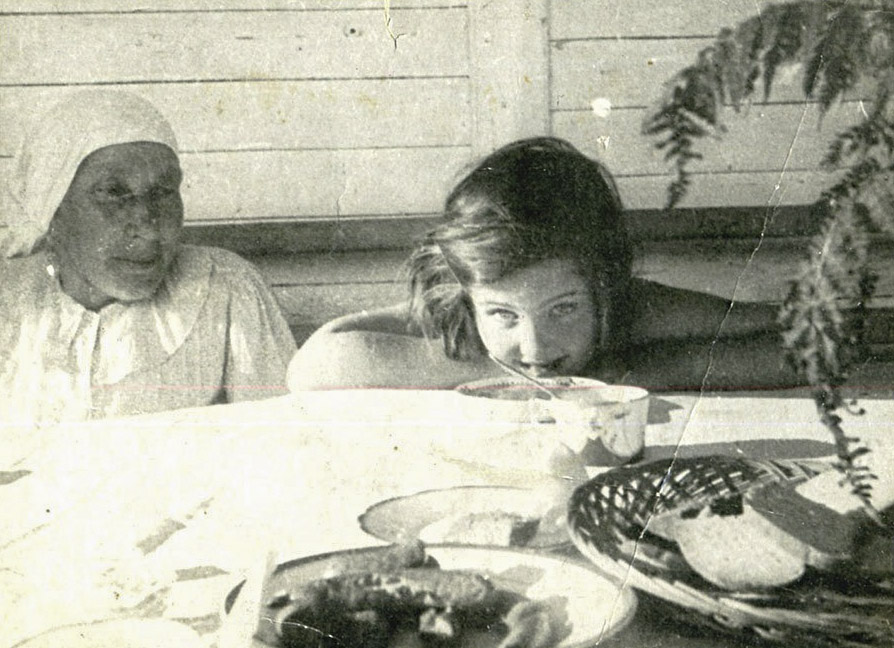
Natalia Traubberg with a nanny glykeria Yakovlevna Buyanova. Fox nose, 1934
Photo: Trauberg.com
I repeat, it was fundamentally different from the people whom I met in life. Maybe I just didn’t see people so close to holiness anymore.
And, of course, cats. She had a full house of cats. I remember how she led long discussions about whether cats would fall into paradise. She believed that paradise without cats is impossible, that cats are one of the evidence of God's being. After all, they even had a cat in Chesterton's society.
Chesterton as the author of Natalia Leonidovna, of course, was the closest of everyone - both Woodhaus and Clive Lewis, whom she also translated a lot. She loved Chestertona most of all. He had lightness, cheerfulness, childhood.
And at the same time an absolutely clear understanding, where is good, where is evil. Actually, like herself.
Lyudmila Ulitskaya (recognized as a “foreign agent”), writer
Life in the 70s-80s was organized by such nests with different interests, but not quite closed-with intersections. Now I can’t even remember which of these houses I met Natalya Leonidovna. Then she was called Natalie ... Brilliant, somewhat strange, some admired her, others were annoyed. I got closer to her after the funeral of my university friend Lena Lapina, and it was the circle of Volodya Muravyova. I call him so familiar, although I was almost not familiar with him. But so he was called. In general, patronymics were rarely used in this circle.
Lena's death brought us closer, and we were friends, I think, the last decade, and maybe longer.
The first impression of acquaintance with Natalya Leonidovna seemed to be not. Let's just say - immediately the second. I knew her as a translator of Chesterton (there was a great discovery for us) and Lewis (his charm to this day has not faded). She loved Woodhaus. I somehow did not share this addiction. She could never understand what she finds so beautiful and funny in him. Maybe you have to re -read?
On our poor background (and on any!) She was an incomparable star, with her education, memory, acute originality. We became very close, I knew well how vulnerable it was, and sometimes luminous. And how charming is simple -minded. This is a special charm - the innocence of a smart person.
Very difficult tests fell to her precisely at the end of her life. She was not just seriously ill, she also suffered very much from painful pain. And she exclusively courageously endured it all. But it grew in the greenhouse, according to the then concepts, conditions. I didn’t even go to school, I received a home education. I think that it was for this reason that was so defenseless in many respects. The Soviet school gave a certain hardening ...
I remembered many times, especially after her death, as she admitted that she bequeathed her to sake three priests - all three of our dear friends. But at that time, just their relations were divided, and she dreamed of connecting them over her coffin. This did not happen because one of the three, the youngest, left her earlier.
There were disagreements. But I won’t talk about them, because I still stand on my own, but there is nothing good in it. Moreover, she is no longer there, and the objects of our disagreements became, maybe even brighter.
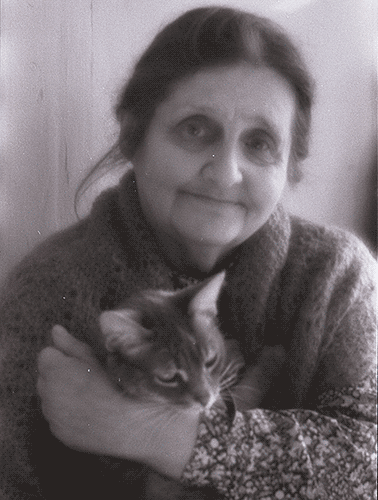 Natalia Traumberg with a cat Murochka, 2000s
You ask what the significance of Christianity is TraUberg for today? This is the most important and most painful point. And the point here is not in Natalia Leonidovna, but in the changed time. And in the changed face of Christianity. The Christianity, which attracted it so, fifty years ago, was persecuted, poor Christianity - in the sense of “Povere” - does not fully coincide with the Russian filling of the meaning of the word. It is consciously poor, it does not want and cannot be different. It was dazzlingly beautiful. Natalie moved to Catholicism, to her Francis Assisian, as we once said, patronized. And the light is not Byzantine, gold, imperial, from which now there is nowhere to go, and the light of exactly that early Christianity, which to this day is measured by the events of church life. And much that today calls himself Christianity, I am afraid, will burn in this quiet light. Here again I say excess. However, Natalya Leonidovna also did not learn how to be silent - sometimes she spoke very strongly and murderously. And the Christianity of Natalia Leonidovna was inclined to that early.
How many years have passed, as it has not been, and I miss her. It’s good that Maria, her daughter, stayed with my friends. She is differently arranged than her mother, N.L. And there was a mother, a nun in the world. But in the world she did not at all at all - she knew how to rejoice at little joys: cats and dogs, delicious pies or a good book. And with Maria, we often remember about Natalie, and with Vladimir Andreevich Uspensky.
In general, I will say a completely strange thing: sometimes it seems to me that Christianity is a religion of the impossible. She knew this, but there was torn all her life with a great thirst. And prayed. It seems she knew how.
Vladimir Lapshin, Rector of the Church of the Assumption of the Blessed Virgin Mary on the Assumption Bolshoi
Natalya Leonidovna was close to the circle of Alexander’s father, and although I was also close to him, our paths in those years [in the late 1970s] did not intersect. Then I studied at the seminary, became a priest, served in the suburbs. In 1992, I was transferred to Moscow to the Temple of Cosmas and Damian, but even there, Natalya Leonidovna and I were not familiar.
We met already in the Russian biblical society - both I and it were members of his reign, met at meetings and meetings. Later they worked together on the church and public radio channel "Sofia". At some point, she became a parishioner of our temple, which has existed since 1996. Suddenly, it turned out that it was this community that became her native. She tried not to miss a single Sunday service. She held wonderful conversations here - literary and spiritual.
Why was it unexpected for me? I am not a very scientist and never had anything to do with literary circles. And so it was strange for me to see that people who are able, capable are attracted here. To some extent, it was amusing my pride, but at the same time it was amazing-such a gift, a gift of God.
Natalya Leonidovna, of course, was the gift of God. The way she said, how she behaved was always valuable for creating a community. After all, what is a church community? These are people of different ages, men and women, educated and not very educated, educated and not very well -mannered. Everyone has completely different interests. Friction is inevitable. But Natalia Leonidovna had an amazing gift of reconciliation. Most people want to defend their point of view, I want to win. She never had a desire to win. She wanted everyone to be good. This does not happen, of course. But the desire for peace and joy in it was always present.
In recent years, when she was seriously ill, I often came to her. Why is the priest going to a sick person? To support it, strengthen, communion. And as a result, it turned out that I was leaving the fortified and supported.
The Gospel has the words: "Look first of all of the kingdoms of God and His truth." The rest will fit. The Lord does not say that the rest is not necessary or bad, but a person - and a person who believes first of all should live for the sake of another. Look for the kingdoms. On the other hand, the Lord says - the kingdom of God inside you. Not in the sense that inside each person is separately, but inside - in communication between you, in your community. For Natalia Leonidovna, this was the central moment. Hence this desire to reconcile so that the kingdom of God arises, that is, the kingdom of love, peace and joy.
And at the same time, this is not an attempt to get away from the world, to hide in your closed world, where we will rejoice and love, and around Gori everything with a blue flame. No, she was very open to other people. I loved communication, feasts, easily found topics for conversation. Her house was always full of people. I remember that the Biblical-Bogoslovsk Institute in connection with Natalia Leonidovna even held a conference on the topic of a feast as an image of the Kingdom of God.
I often say here, in the temple, that being a Christian is to live so that others are good. In many ways, this message arose for me because I was familiar with Natalia Leonidovna. I can’t say that she formulated this so, but the way she was a Christian - allowed me to formulate it so. She lived so that the other nearby was warm, light and joyful.