
Translated material
Penelope fabric
After the book
- Category: Time skin. Read all materials
I have been living for so long that I remember when the TV was a luxury, although there was nothing to watch it. I am old enough to remember how even the adults got their heads to enjoy the plane. It is more important that I cannot forget how the literary world shook the discussion, whether the writer can compose on the computer.
“The poet,” the Purists said, “definitely cannot, this is profanity.”
“But the prose writer,” the moderate objected timidly, “sometimes allows the conscience.”
I myself resolved the issue in 1987, when I bought my first Mack. The head -shaped box with a window also inspired horror because there was a book thickness with the Bible in the box. It was called "Instruction", but I never opened it once. After I found a socket under the table, the instruction turned out to be superfluous, and after an hour I wrote the next text on the computer, forever throwing my favorite typewriter donated by friends (from Dovlatov, according to him, I got three letters, easily guessed - which ones).
All the authors switched to the computer with me. The genius of “Macs” is that they selected an electronic revolution from “physicists” to share its fruits with “lyrics”. The writers quickly stopped being afraid of computers, they were afraid to be left without them. In New York, an ambulance was even opened on motorcycles, which for a clock repair computers for customers from the West End End, densely populated by writers. Since then, in the literary environment, computers have become the usual technique - like light bulbs: we notice them when they burn out.
But if now it does not occur to anyone to argue about all this, then electronic reading causes even more violent discussions. Which is understandable: there are more readers than writers, although in the age of Facebook and not much.
We live in a turning point when paper books are still with us, but we already mourn them as sentenced. Nostalgia for the inexhaustible is a lyrical phenomenon, which is overlooking the library. Previously, we boasted and used it, now - we grieve on it, unable to part. Some throw books to friends, but now less often - all on his guard. Others leave on the corner, lulling his conscience with the fact that someone needs it. And only one familiar poet openly admits criminal insolence.
“Every day,” he says, “in a pile to the basement.”
- In the trash?
- In the insiner.
“In the furnace,” I scream with horror, “like a Lazo?”
“Well, they are under the heart,” the poet justifies, clapping himself on a breast pocket with the phone.
This is just not a focus. I myself have one library moved to an electronic cloud, but the other still divides the house into unequal parts: she is all, to us-what will remain. It is most upset that I can not find a reasonable use of reasonable use, only unreasonable ones. The books collected by two generations serve as a personal memorial to family scholarship. From school droppings that allocated places where the classics expressed love for the people and hatred of tsarism, to wine spots on the satellites of youth, from workers' bookmarks that helped compose smart, to eating marginalia in the fields of their loved one, from the epigraphs prepared for the future, to the end of the epitaphs - in my books there is everything that makes them mine. Including, of course, those that, like old virgins, are faded and unread. There was some reason because of which hands did not reach them? And if it was, then such books are also roads to me - as a negative example of selective affinity.
- Throw it off! - says the wife.
“You suggest me,” I ask menacingly, “put my life in the boxes, equip a caravan and go to the mound of waste paper with him?”
“Yeah,” the wife said, rejoiced at the future, and I have no arguments in defense of the library.
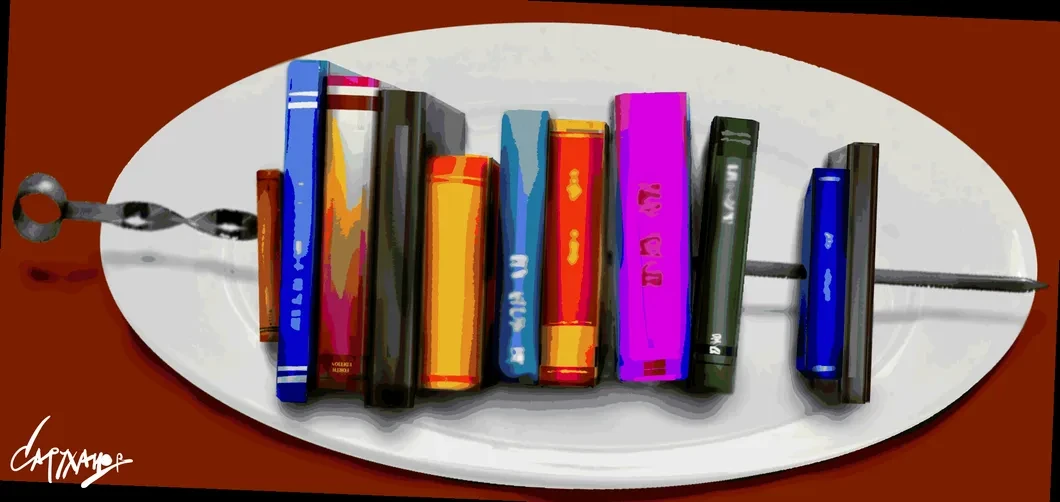
The book was never only a thing, but now it has become it. Having lost the monopoly power over her own content, she shared him with a lightweight computer reader. The book not intended for reading becomes a fetish, but only for believers. The useless and sacred begins to live in its own way, finding a different and bizarre application for itself. We love the book not with the mind, but with feelings - touch, smell, vision, even taste. So, in the new novel by Sorokin “Managara”, books are burned at the stake of culinary ambitions. As always, materializing the metaphor, Sorokin offers to swallow books in an almost direct, and not figurative sense.
Upon learning of this, I was not too surprised, because my acquaintance of the avant -garde artist Borya Zeldin fried books forty years ago without even looking into the text. In both cases, only a shocking gesture is important. Bleading is the reverse side of admiration, the sacrilege ritual first of all needs holiness, and only that which is worthy can be sacrificed. Turning a book into a “firewood” of a perverted cult, an artist (or, like Sorokin, a cook) gives it an surplus metaphysical cost. And this promises books a career for a precious object for aimless admiration.
Divorce of content with the form is addressed by a penny product of mass production into luxurious rarity. There should not and should not be many such books, for each is worthy of a unique place in the collection of the most expensive owner of things. Having become precious, the book will turn into a favorite exhibit that plays the same role in our housing as the paintings. Instead of cabinets and shelves - several books, each of which requires in -depth contemplation and white gloves. Actually, this has nothing to do with reading. Matisse, the co -author of the most expensive books of our time, sometimes did not read them, as happened with the Ulyustration “Ulysses”.
The cardinal gap between the paper and electronic books is inevitable, no matter how we, old people, are wringing our hands. In the near future, a personal library like mine, at seven thousand, will seem as absurd as Nansen's grocery warehouse next to the supermarket.
Another thing is that the electronic book not only displaces the usual, but also changes the nature of reading.
Opening long before the school of joy, I immediately mastered the first type of reading - drunken. From Jules Verne to the Dostoevsky book entered me unconsciously, without separation for (and not from) production. The scandal with the lights extinguished by the parents, reading in the lessons and instead of them, I lived, like everyone around me, inside the binding and not noticing it.
The readership did not leave me until I finished the classics, and only having taken them again, I learned to read slowly. Only then, relishing and indignant, I saw behind the author’s text - with everything found and stolen, invented and guessed, with his personal idiosinocrazia and the generational tick. The less the reader is in a hurry, the more difficult it is to hide the author.
With the advent of the Internet, however, reading became not only slow, but also discrete. Having taken up the E-Knig, connected to the World Wide Web, I fulfilled my childhood dream: to settle in the Alexandrian library without leaving home. On our fat days, when everyone has an digitized civilization at hand, the reader is doomed to suffer from omnivorousness. Information abundance is deafening and risky, like winning a lottery. Having received more than they asked and hoped, we became the owners of books with endless comments.
For me, electronic reading turns into Borgesian phantasmagoria: one book replaces everything and never ends. Like a cripple on the stairs, I stop at each step and get rid of every paragraph. Having reached the name of my own, I study his biography, the geographical name encourages a trip on the map, the date provokes historical research. I look at the mentioned landscapes and paintings, listen to the same music as the heroes, and study the whole insighten events described.
This - horizontal - reading raises the reader over the book, allows you to expand it in space and time, equalize the author and even surpass it. If the quick reading introduces the book, and the slow - with the author, then the encyclopedic approach breaks the cover from the very reality that served the writer with the source material.
Once upon a time, when Brodsky was still alive and wrote constantly complicated poems, I decided to understand them by reading the same as he, or at least those whom he mentioned. This turned out to be a fascinating and executive occupation, because the poet had a great taste and knew Latin no better than me.
Only having achieved my goal, I discovered the limit of deepening the text and expanding the context. Unraveling each thread, we, like Penelope, dissolve the author woven, returning to places everything that he claimed. Moreover, overtaking it with the help of borrowed erudition of the Internet, we add to the book that she could not or did not want to know.
“Excess,” said Nietzsche, “the enemy of the necessary, and excellent,” he added, “the opponent of the good.
The e-book is so richer than paper that it goes beyond its own boundaries, ceasing to be a book. And I, replacing the old new library, gradually sigh at the time when each book lived on its own - without the help of a network, a certificate of Wikipedia and the Facebook advice.
New York