
Translated material
Paleoor in Brazil
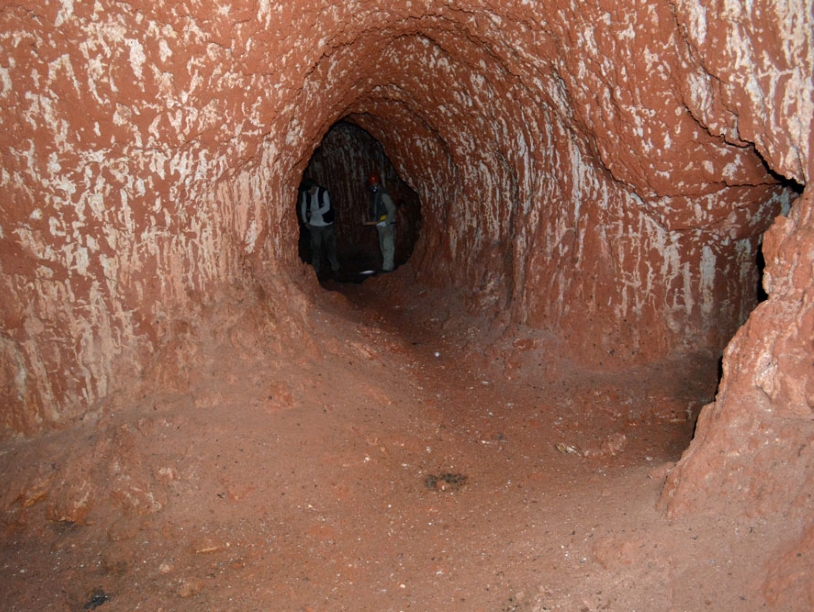
Brazilian geologists believe that many unusual caves in their country did not arise as a result of any geological processes, but were dug up with giant sloths who had previously lived in South America.
Modern sloths also live in South America, but do not differ in large sizes. The largest of them - a biennese slut ( Choloepus Didactylus ) - reaches a maximum of 70 centimeters in length and eight kilograms of weight. Giant sloths appeared about 35 million years ago, and died out about 8 to 10 thousand years ago. The championship in size among them is held by representatives of the genus of megatherium ( Megatherium ), who reached six meters in length and weight up to four tons. Of course, giant sloths could not live in the crowns of trees, like their current relatives, but lived on the surface of the earth.
Photo: Heinrich Frank
The unusual cave was first discovered near the city of Novo-Amburg, Heinrich Frank, professor of the Federal University of Riu-Grandi-Du-Sul. In 2010, an employee of the Brazilian Geological Service Amilcar Adamy found a similar cave in the state of Rondonia, near the border with Bolivia. In both cases, these were tunnels of a round section, often branching. They were not like caves arising from natural geological processes.
Professor Frank was the first to conclude that the cave is a Paleonor, noticing the traces of the claws of a giant animal on its walls. In the scientific literature, before that, no holes related to the extinct Megafaun were described. The interested Frank has discovered many similar caves over the past decade. Only in the state of Rio Grandi-Do-Sul there are at least one and a half thousand of them and a few more hundred in the neighboring state of Santa Catarin.
“There is no geological process in the world that produces long tunnels with a circular or elliptical cross section that branch and rise and descend, with claws on the walls,” says Professor Frank. “I also saw dozens of caves that have an inorganic origin, and in these cases it is always clear that the grumbling animals did not play any role in their creation.”
Traces of claws. Photo: Heinrich Frank
According to scientists, initially the Paleonors had up to 1.8 meters in height, and the length of the tunnels could reach 600 meters. One of these caves in Santa Katarin, not yet examined by scientists, may have a length of even more than 900 meters. During their creation, animals removed up to 4000 tons of soil and stones. Amilkar Adami believes that the largest burrows were created not by one or two animals, but by a family for several generations.
Henry Frank and his colleagues believe that the ancient burrows were dug up with giant sloths. Based on the size of the tunnels themselves and the prints of claws on the walls, representatives of the Catonyx , Glossotherium and Lestodon birth are most suitable for this role. They were inferior in size to megateria, but still they were quite large. For example, the length of Lestodon from the face to the tip of the tail was 4.6 meters, and its weight was at least 2.5 tons. Like other giant sloths, they ate ground vegetation, and also ate the foliage of trees, rising on its hind legs.
Giant sloths. Ill.: Wikimedia Commons
There is an alternative hypothesis, supporters of which consider the creators of the Paleonor not giant sloths, but other representatives of the ancient megafauna - giant battleships. Now the giant battleship ( Priodontes Maximus ) is called an animal up to a meter long and weighing more than 30 kilograms, living in South America. The holes of the modern giant battleship have about 40 centimeters in diameter and six meters in depth.
The extinct relatives of this battleship were much larger. Armenarians from the now disappeared family of glyptodontines ( Glyptodontinae ) reached a length of more than three meters and a weight of two tons. Their claws were impressive and can correspond to prints on the walls of the caves. They died out, like giant sloths, they are about 10 thousand years ago. Representatives of three births are called as probable diggers of caves: Pampatherium , Holmesina and Propraopus .
To establish the exact time of creating cave-Nor, scientists are subjected to radiocarbon dating organic material found when clearing caves. Professor Frank believes that to determine the age, it may also be possible to use the pele -like mock -ups - mineral deposits on the walls.
Scientists have yet to answer many questions related to Paleonors. For example, it is still unclear why they are so unevenly distributed geographical. Hundreds of caves are in the south of Brazil, in the states of Riu-Grandi-Do-Sul and Santa Catarin, but only units are known in Uruguay and Argentina. They are also very little in North Brazil. Frank and his colleagues studied many caves in other parts of the country, but the vast majority turned out to be geological rather than biological origin. Paleontologist Greg McDonald believes that partly the absence of caves in other regions can still be explained by insufficient knowledge. Also, the cause may be a different type of soil in which the holes dug not less than 10 thousand years ago have not been preserved.