
Translated material
Memory of Evgeny Yevtushenko
Galina Yuzefovich - about the brightest poet of the sixties

On April 1, 2017, Yevgeny Yevtushenko died. The literary critic of “Medus” Galina Yuzefovich tells about Yevtushenko, about the role of the poet in Russian culture and about the generation of sixties, which is now completely remaining in history.
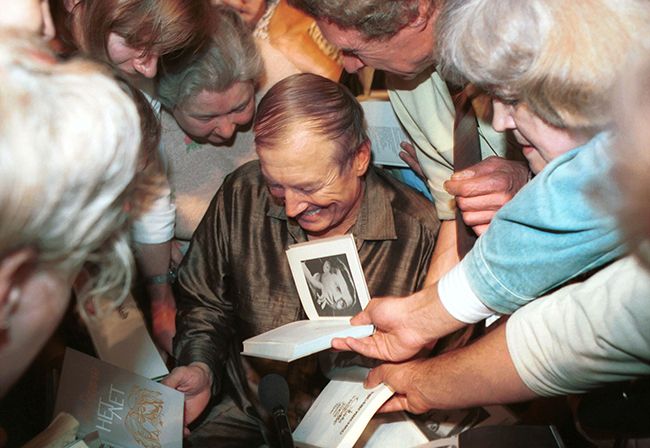
In the past 20 years, the figure of Yevgeny Aleksandrovich Yevtushenko has caused a certain feeling of awkwardness: an extravagant look of an old man in crazy shiny jackets, clown caps and homemade bags over his shoulder, which loudly and affectedly read his own poems, such old -fashioned and excessive ones.
They loved to recall Brodsky’s well -known phrase (“if Yevtushenko is against collective farms, then I, for”), as a poet, it was customary to compare him with the same age as the workshop Andrei Voznesensky (always in favor of the latter), and his half -century, since 1963, the nomination for the Nobel Prize seemed almost a misunderstanding. He was accused of an endless self -party, depreciating even the most daring acts - such as intercession for dissidents Julia Daniel and Alexander Solzhenitsyn, the publication of the scandalous poem “Babi Yar” or the poem “Tanks follow the Prague”, dedicated to Soviet invasion to Czechoslovakia in 1968. He was often and, although, seemingly quite groundlessly), was accused of cooperation with the KGB - it seemed suspicious that for so many years Yevtushenko had an emissar of the Soviet Union, which had been closed around the world, establishing friendly relations with political leaders from President Nixon to Fidel Castro. In a word, in recent years, Yevtushenko tried to perceive us at best as a curiosity.
Everything is so - starting with the collapse of the Soviet Union Yevtushenko gradually turned into a grotesque and even inappropriate person. After 1991, when he, as a deputy of the Supreme Soviet of the USSR, resolutely opposed the State Emergency Committee, his lyro-political star no longer knew sunrises. The tribune poet, which actually spoke on behalf of the huge, highlighted mass, disappeared-or, rather, it stopped being needed by gaining the very mass of voice, turning into a slightly ridiculous, slightly sad anachronism. The most “advanced”, fashionable and relevant from the generation of the sixties, it turned out to be the least in demand in a new reality.
And this, of course, is no coincidence. Nothing is obsolete faster than things are acute. Unlike their lyrical, personal, much more rooted in the thickness of the tongue and therefore much less prone to the influence of the time of peers - Okudzhava, Akhmadulina, Voznesensky, Yevtushenko was the flesh from the flesh of the sixties - the era of half -school, vague hopes, great construction and total triumph of metaphors as an expressive means.
The Czech poet and the Nobel laureate Yaroslav Seyrter wrote in 1984: “There are countries and peoples who find spokesmen for their questions and answers to them among wise and sensitive thinkers. Sometimes this role is played by journalists and media. In our country, the national spirit is looking for its most effective embodiment in poets. This path is best for us due to the poet’s ability to use a metaphor, to express what is key, indirect, opaque for prying eyes. ” The other Nobel laureate, the Pole Cheslav Milos: "Starting from the Second World War, poetry becomes the only way to expression for many." It was such a poet - not an artist of the word, but primarily the exponent and a retranstlator of meanings that are important for the country as a whole and for each of its inhabitants in particular, was Yevtushenko.
He, like no one, was able to balance on the verge of a permitted, literally sixth feeling knowing where this line ran, and never stopping it. He argued with the leaders (so, it is known his fearless participation in the polemic around the already mentioned poem “Babi Yar”, which Khrushchev did not like terribly), being - or at least considering himself - one of them. By the way, the arrogant need for contact with the elite, the firm belief that the poet has the right to speak from the powers on equal terms, was not alien to the one hundred percent antagonist Yevtushenko Joseph Brodsky: after the so-called Leningrad aircraft business (a group of Jewish dissatory-weaving then tried to keep the plane in Israel) Brezhnev with a request to have mercy on its participants. And this was very in the spirit of the times: as Yevtushenko himself wrote a little later in his pompous and officiaious poem “Bratsk Hydroelectric Power Station”, “The poet in Russia is more than the poet” - at least then it seemed to many, if not everyone.
Whatever Yevtushenko was talking about - about the construction of a fraternal hydroelectric power station, about the murder of Martin Luther King or a military coup in Chile, he always responded to vague vibrations spilled in the air. It would not be an exaggeration to say that it was through Yevtushenko in the late 50s, in the 60s and in the 70s the nerve of time passed, and when this nerve moved to another area, the poet could not change the frequency and reconfigure to a new wave. The most elegant, bright and uncompromising representative of the sixties generation, it was because of this that Yevgeny Yevtushenko was unacceptable for us today.
Now interest in the era of the thaw is returning. The series “The mysterious passion”, the “Thaw” exhibition at the Central House of Sciences and other cultural phenomena discussed, actualize, return to the discussion field this strange, mirage, naive and in their own way very nice time. Evgeny Yevtushenko in this context for a long time remained a raised guest: his presence among us did not allow the holiday to end, and the era of the sixties finally set sail into the past, thus becoming an object of emotion, sympathy, and simply an impartial, distant consideration. And now, when Evgenia Alexandrovich is no longer there, perhaps, the feelings of the irritation and awkwardness addressed him to be much lighter, fair and unbiased. The time of the sixties will finally end, and Yevtushenko himself will take his place in the host of his departed heroes-romantics, liars, passionaries and conjuncturers. And this place will be, of course, honorable and important.
Galina Yuzefovich