
Translated material
The country will not accept the command: "Sit!"
The authorities are looking for a response to the conflict between the elite and society. There is a very dangerous dispute between "moderate" and "hawks"
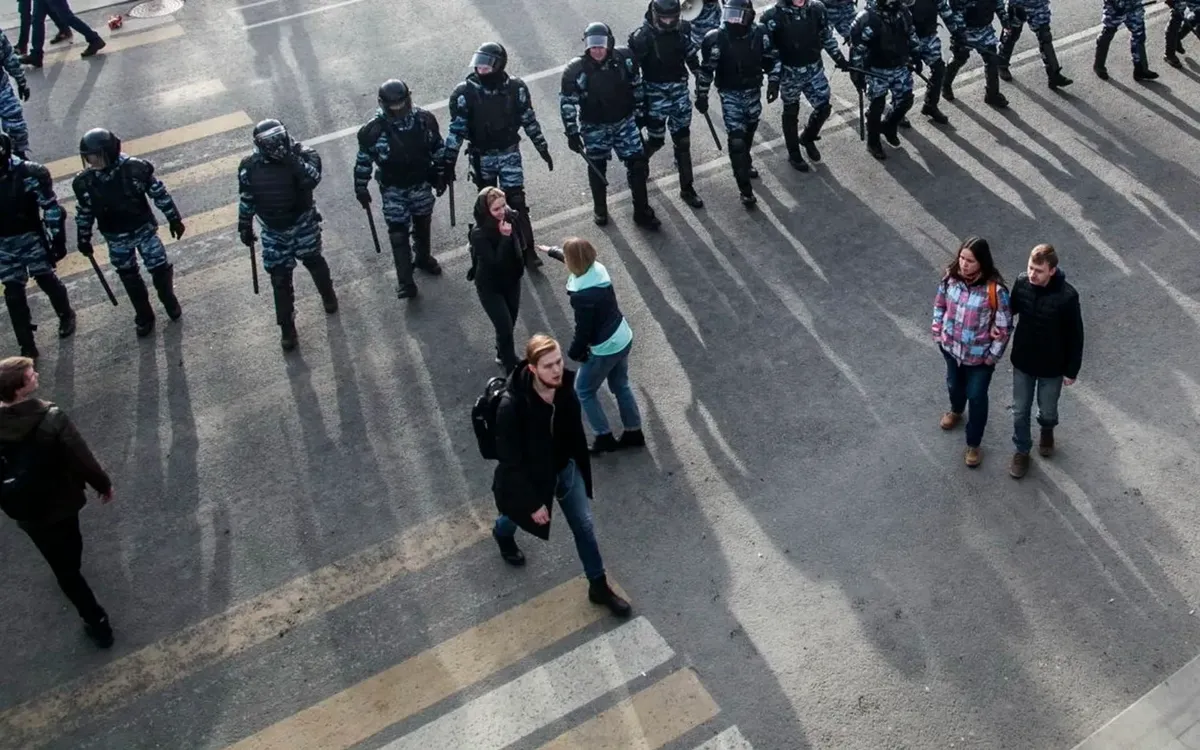
The latter believe that a new “swamp business” should be the best reaction, which on its scale could overshadow the persecution of activists after 2012 and give work to hundreds of operatives and investigators throughout the country. Supporters of the power decision are sure that this scenario will allow you to preserve “stability” for several more years, to prolong the power contract with the conditional sociological majority, to isolate activists and intimidate the rest of the dissatisfied.
In fact, the victory of the “hawks” will lead to an unacceptable increase in risks for both society and the Kremlin.
The scenario of the mass criminal case against the opposition on the country's scale contradicts the interests of the main elite groups in Russia, and a narrow group of security forces can be its beneficiaries. At the same time, the preparatory work on the implementation of such a scenario is already underway: while some activists detained after the shares are serving administrative terms, the operatives interview other participants and prepare the “evidence base”. The Investigative Committee immediately after the shares on March 26 announced the initiation of criminal cases under the articles “Hooliganism”, “The attempt on the life of a police officer” and “Application of violence against a representative of the authorities”. On April 1, a new case was added to this list under Part 3 of Art. 212 of the Criminal Code of the Russian Federation - "Calls to riots." Nevertheless, there are no suspects yet, which means there is time to stop the car of criminal justice.
Scenarios: Zero, Light and Bolotnaya-2
The authorities have three scenarios.
The first ( Zero ) assumes that activists will assume administrative punishments, the case of an attack on a policeman in Moscow will be investigated, and this will end, the teams will not follow the further persecution of the opposition. This option in the medium term entails the smallest number of risks - the parties will disperse into its original positions.
The second option ( “light” ) is associated with an attempt to bring to criminal liability of a part of the Navalny team and individual citizens who may impose hooliganism for political reasons (Article 213 of the Criminal Code of the Russian Federation, Pussy Riot participants were held on similar charges). The punishment under this article implies up to seven years in prison, but leaves the prosecution of wide opportunities for maneuver - you can make the defendants get off with a fine. The risks of this scenario depend on how tough it will be implemented.
Finally, the third option ( “Bolotnaya-2” ) is an investigation against unidentified persons suspected of organizing riots. According to the first part of this article (212 of the Criminal Code of the Russian Federation), the accused will face from 8 to 15 years. There were no mass riots in any of the Russian cities on March 26, but this is unlikely to stop the investigating authorities from the article through Art. 30 of the Criminal Code - i.e. Through an attempt to commit a crime. A feature of the third option is not only potentially large prison terms, but also the opportunity to charge almost any person, at least indirectly related to rallies on March 26. This scenario potentially leads to a disaster.
Bolotnaya-2 will hit the country
From the point of view of law or morality, it is quite pointless to discuss the choice of these scenarios: according to the Constitution, citizens have the right to peaceful manifestations, and a walk in Tverskaya and similar shares in the regions are definitely not similar to an attempt to violent overthrow of power. But ethical arguments, presumably, will not be seen by supporters of power decisions in the Kremlin. So it is worth discussing what risks attempts for the country to initiate a new large -scale criminal case against the opposition in the current conditions. What will lose power if its opponents and critics find themselves in prisons?
Red card
Firstly, the World Cup, which should be held in Russia in 2018, will be very probable. In Europe, a discussion is already underway on the appropriateness of participation in such an event, taking into account the role of Moscow in the Ukrainian conflict.
Information about the new political prisoners, including the well -known to the West Navalny, will become a trump card in the hands of those who insist that playing the Russian field in a literal and figurative sense is impossible.
The English team and, possibly, the national teams of other European countries will refuse to participate in the championship, which in the Kremlin is a large image rate. The championship should become the development of the traditions of sports holidays of the latest Russia, laid down by the Olympics in Sochi, and a vivid start of the possible fourth term of Putin after his re -election in the spring of 2018. The foreign policy significance of the championship is transparent: he must show that “Russia can be dealt with Russia”, that we are essentially a normal country, with our own national interests, but nothing more. All this agenda can be destroyed by a major political affair against the opposition. There is some irony that the football championship is becoming the main factor that can now cool the “hawks”.
Flaw Politicalization
Secondly, in the hands of the authorities there is no reliable data on moods in society, and, therefore, repressive measures will be the action blindly, with unpredictable consequences. In addition to the peacefully rallying Russian cities, in which the surge of youth interest in politics is recorded, truckers and farmers rebelled. How will all these disparate groups react to power actions? Will the prison deadlines turn out for oppositionists, issued on such controversial occasion as the popular outrage of the luxurious life of an unpopular prime minister, further politicization and street mobilization?
They like to remember about the Maidan, but at the end of November 2013, no more than a hundred students protesting against the abandonment of the country's integration into the European Union spent in the central square in Kyiv. Yanukovych was sure that he had taken possession of the initiative, some local Ukrainian “hawks” whispered to him that it was time to disperse. It is precisely as the reaction of Ukrainian citizens to a night action of intimidation by Berkut that Maidan became possible. What will happen in Russia if activists are transplanted, and students will begin to press university administrations everywhere, how are truckers are now crushed now? What forms will take a protest if peaceful discontent turns into prison terms?
Lukashenko’s path
Thirdly, even if you take the World Cup for the brackets, the destruction of the opposition leads to a further exacerbation of relations with Western countries. If in recent years Russia has been accused of violating international law, now the Kremlin risks provoking a powerful return of the topic of human rights violations.
Economic cooperation with the European Union will be reduced; personal sanctions can be imposed against Russian leaders on the model of those under which Lukashenko was located. Opponents of normalizing relations with present -day Russia around the world - from Senator McCain to Ukrainian elites - will appear in their hands new trump cards, and potential allies of the Kremlin will be forced to shut up. In the long run, this means that Crimea as a “legitimate acquisition”, which Russian elites clearly dream of, will not be able to protect - just as it will not be possible to protect foreign assets of individuals associated with the Kremlin.
Storm before the election
Finally, it will be difficult for the Russian authorities to hold presidential elections in the format as they are conceived now, that is, in the form of a “referendum on trust in the president”. One of the main domestic political achievements of Putin was the fight against corruption, which was reported to the official media in criminal cases: against governors and Minister Ulyukaev.
To fight corruption, having behind bars of the participants in the opposition FBK after their investigation against Medvedev is the same as directly using state propaganda to promote the presidential campaign of Navalny himself.
The 2018 elections in this case will take place in the conditions of obvious weaknesses of the authorities, the expansion of the social base of protest, and the inability to conduct dialogue in other methods, except for power shares. The order to rally against the internal enemy will inevitably entail a narrowing of the field of opportunities for representatives of elites at all levels: both federal officials and parliamentarians and regional authorities. That in turn, exacerbated the already intensive intra -elite conflict, which has recently become almost open - it is enough to recall the confrontation of various power departments. Russia will come to the inevitable and unpopular economic reforms of 2018-2019 at a war of all against all.
***
Moral correctness, no doubt, will remain with the opposition, around whom a new consolidation will begin. It is no coincidence that Grigory Yavlinsky, the opponent of Navalny, has already called to allow the latter to participate in the presidential election.
Acting from the standpoint of power in the current conditions for the Kremlin means exposing their weakness.
The scale of risks and the instinct of self -preservation must lead to a compromise with the opposition.