
Translated material
The last countdown
On March 29, at 15:20 Brussels time, the British Permanent Representative of the European Union, Sir Tim Barrow, handed a small white envelope to the chairman of the European Council Donald Tusk. At that moment, when the fingers of the tight touched the envelope, the Brexit chronometer officially turned on - the exit of the United Kingdom from the EU. How will the divorce take place and what risks he carries for both sides - analyzed The New Times
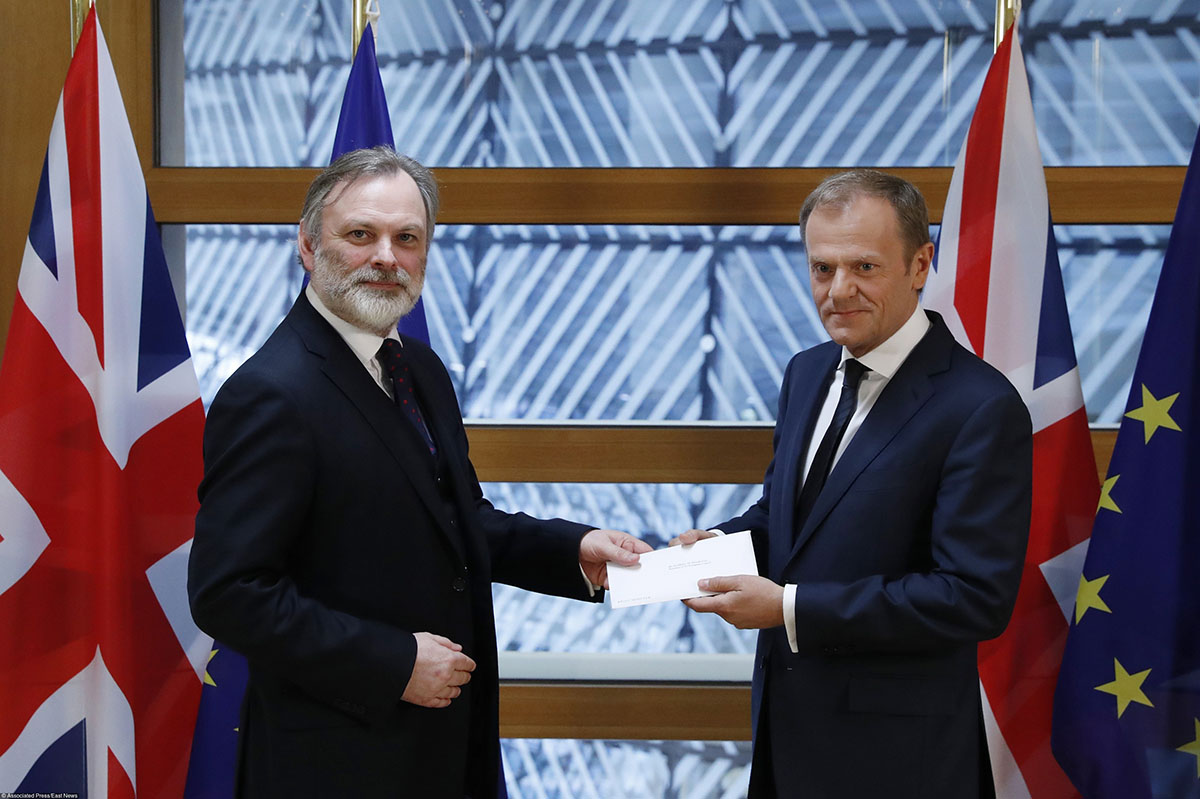
There was a letter in the white envelope-six sheets on which the British Prime Minister Teresa May officially informed the EU leadership about the beginning of the country's withdrawal procedure from the European Union-according to the 50th article of the Lisbon Treaty for this, exactly two years were allocated. That is, March 29, 2019 at 15:20 the United Kingdom should stop being a member of the European Union. However, Britain will stay a member of the EU almost nine hours longer: for an even account, they agreed to extend the deadline to midnight.
Will the UK and the EU be able to agree on the conditions of Brexit in 24 months, to coordinate the formula for future economic and political relations? Nobody knows this today. If they can’t, the negotiation period can be-theoretically-to extend for several months or even years, but subject to the unanimous consent of all EU member states. In addition, Britain itself should ask about this, and this is unlikely to happen: the triumphant British Eurosceptics are configured, on the contrary, on a tough and sharp gap without any agreements. Yes, and Teresa May herself recently said that “there is better no transaction than bad”, allowing the possibility of “jumping from a cliff” in the event that none of the agreements would satisfy the British conservatives.
In any case, the upcoming “divorce” process has no precedents, and there is no doubt: negotiations within the framework of Brexit will be among the most difficult in history of Britain and the European Union.
Divorce on schedule
On March 31, Donald Tusk presented in Brussels his draft negotiating plan. 27 permanent representatives of the EU member countries transferred it to their governments-for coordination. Those for thoughts have exactly four weeks, until April 27, when the document should be agreed by the EU Council, and two days later, the 29th, is finally approved at the EU Extraordinary Summit. In May, the European Commission will publish detailed directives and tasks set by the EU to negotiators. After that, the most interesting and fraught with insoluble conflicts will begin if these directives conflict with the position of Great Britain. In the fall, the British government is expected to submit to the parliament a bill on the procedure for leaving the EU, as well as invite incorporating, that is, to include, pan -European laws, norms and rules in the legislation of Great Britain - so that they can be canceled or changed at their discretion.
If the sworn enemy of the European Union Marin Le Pen wins the elections in France, then EU members will be difficult, if at all, to agree on a general position in negotiations with Britain
About a year later, in October 2018, the parties hope to complete the negotiations, and the text of the reached an agreement on the exit of Britain from the EU will be submitted for discussion of the British parliament, the Council of Europe and the European Parliament. By March 2019, all these bodies should ratify it, and in this case, from 00:00 on March 30, 2019, the United Kingdom of Great Britain and Northern Ireland will leave the European Union.
Three dates
Three dates of 2017 are superimposed on a two -year Brexit schedule, which may well become fatal. This is April 23 and May 7, when the first and second rounds of the presidential election in France are held, and on September 24 - parliamentary elections in Germany.
If in France the sworn enemy of the European Union Marin Le Pen wins, then EU members will be difficult, if possible, to agree on a common position in negotiations with Britain. Not to mention the fact that France can also get together, and the example of the two largest countries in Europe can be contagious. That is, in this case, the question will arise about the survival of the European Union in principle.
The EU and the autumn elections in the Bundestag are also extremely important: if the political and international arena will have to leave the Chancellor of Germany Angela Merkel - one of the pillars, on which the entire current building of European policy is held - this will radically change both the balance of Brexit negotiations and their result.
However, another “subversive” date is possible-it is trying to include it in the already intense political calendar, the first Scottish minister Nicolas Nryzhen, whose proposal to hold a regional parliament on the independence of Scotland again between the fall of 2018 and spring 2019. Roden directly connects the desire of the Scots to separate from Britain with the country's exit from the EU. She also blames the British government of ignoring Edinburgh’s demand to establish a special trade regime for Scotland in relations with the EU, and considers London’s proposal to expand the Scottish autonomy for insufficient compensation for Brexit damage.
Meanwhile, conversations about the referendum have already begun in Northern Ireland - about the accession of this part of the United Kingdom to the Republic of Ireland. The unification of Ireland has always been the political goal of the Olster Republicans and a significant part of the Catholic community of Northern Ireland. Now the reason to think about such an opportunity also appeared among the Protestants of Olster, who do not want to part with the EU. Indeed, in Scotland and Northern Ireland, the majority in June last year voted against Brexit, while the Scots and the Irish are sure: the decision to withdraw from the EU was imposed by the British contrary to the interests of the local population. By the way, one of the most puzzling tasks in the negotiations of the British delegation with the EU will be the question of the border between Northern Ireland and the Republic of Ireland, which has been completely open since ancient times. Teresa May firmly promised that it would continue to be so. But how, in this case, to control the migration and movement of people across the border, that is, for which the British mostly voted for Brexit?
In search of formulas
In his letter about the launch of the “divorce” mechanism from the EU, Teresa May is especially emphasized by the desire to maintain, despite Brexit, warm friendly relations and close cooperation with the countries of the European Union in all areas. It suggests that a new formula of relationships, which is advantageous to all sides, can be found. However, this will not be easy to achieve.
The United Kingdom is one of the main Donor countries of the EU, which introduces more to its budget (annual contribution-€ 11 billion) than he receives (€ 5.5 billion). So, whatever one may say, the European Union will become significantly poorer with its departure. But Britain will suffer - at least in the short -term and medium -term plan. Especially if she does not manage to preserve her current trade and customs privileges. In this case, according to the estimates of the British Treasury, the country's GDP may fall by 7.2 %. Brexit caused by the Founding course fall (now £ 1 is about € 1.10, this is the lowest mark over the past six years) leads to an increase in food prices and essential goods. Some analysts, however, believe that this can be compensated by the advantages that a cheap pound gives exporters. But there are doubts about this, given, on the one hand, the deplorable state of industrial production in the country and low labor productivity, and on the other, the high proportion of imported parts and components in the products manufactured. The power of the British economy is in the privileged position of the London City, which plays the role of the main financial center of Europe. However, it is not known whether it will be possible to fully maintain this role in the conditions of Brexit. At least, some large banks are already developing plans for transferring some of their operations to the continent. At the same time, an exorbitantly high level of public debt - £ 1.7 trillion (!), The budget deficit - £ 6.9 billion, or $ 8.63 billion - leave few space for maneuver.
One of the already revealed sharp contradictions between London and Brussels is the question of whether the EU will agree to parallel to political negotiations on the possibility of concluding a trade agreement. In Brussels, we would prefer to immediately agree on the amount that Britain should pay against projects and other expenses approved by the European Union, such as pension payments to the British employees of the apparatus of the EU and the European Parliament. According to some estimates, this amount can reach € 50 billion. In London, firstly, indignantly reject this figure as completely exorbitant, and, secondly, insist on simultaneous negotiations on monetary compensation and trade agreement. London can be understood - otherwise Teresa May will be extremely difficult to “sell” the idea of payments to British public opinion. However, both Angel Merkel and Donald Tusk have already responded to this proposal categorically.
The power of the British economy is in the privileged position of the London City, which plays the role of the main financial center of Europe. However, some large banks are already developing plans to transfer part of their operations to the continent
In a letter from the British Prime Minister, a transparent hint of the fact that the failure of negotiations on economic conditions Brexit could interfere with pan -European cooperation in the field of security. This caused the rapid indignation of individual European politicians, some even declared the approach of Britain - a nuclear power - “blackmail” and “ultimatum”. But in London, many think differently. One of the members of the government directly stated in an interview with the BBC correspondent regarding the conjunction of economic and military-strategic issues: “This is our strength, such cards in our hands.”
Traveling without a card
Accepting the letter of Teresa May, Donald Tusk with sadness in his voice spoke of “Damage Control” - that is, the need to take measures to restrict damage, which will inevitably cause Brexit to the European Union. Some British EuroSceptics were delighted: yeah, Brussels is aware of the economic consequences of Britain’s exit and is ready to make trade. But this joy is premature. After all, the term that used Tusk can be interpreted wider: if you allow Britain to “get out of the water”, maintain the main economic advantages of membership in the organization, at the same time from obligations, then a seductive precedent will be created for others.
The situation is witty, although not without sadness, the Daily Telegraph newspaper summed up: with any divorce, “it is easier to pretend that it occurs by mutual agreement, but the bitter truth is that in almost every such case one of the spouses is looking for happiness on the side, and the other feels insulted and abandoned.” The main propagandist of the camp of the radical “Brexiters” Daily Mail left no doubt about whom she considers the happy side in the break: on a historical day, March 29, the newspaper came out with the arshin heading in the first lane: “Freedom!” A fiercely fighting against Brexit The Guardian melancholy stated: "Britain takes a step into the unknown."
It is difficult to argue with the fact that the country is waiting for a "marvelous new world", a journey for which there are no cards and laid routes.
Photo: Emmanuel Dumand/AFP Photo/Pool/East News