
Translated material
Truckers require ether
Directors-dietary workers conduct an indefinite “passive” strike against the predatory, as they believe, Plato system, with the help of which federal routes are charged from heavy vehicles. The trucks lined along the roads became a familiar picture for almost 70 Russian regions, including the North Caucasus, Siberia and the Far East. The organizers of the strike promised to bring 10 thousand people to it, and its participants already require the broadcast on federal channels and declare distrust of the president and government
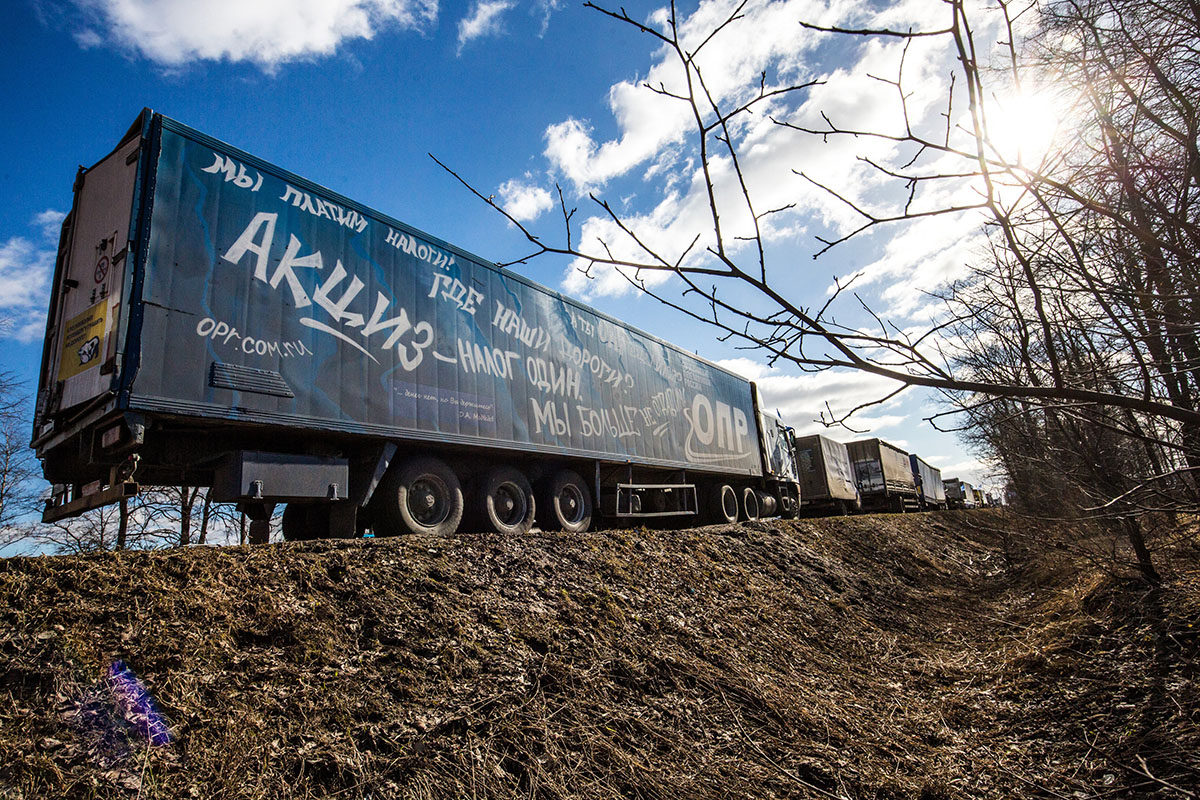
On March 27, the day after riot police in the capital and regions cleared streets and squares from participants in anti-corruption shares, a new protest wave started around the country-a strike of Directors-Sewarer against the Plato system began. It was introduced in 2015, for 2016, as the authorities assured, through the system it was possible to collect 22 billion rubles, which seemed to have gone to repair roads.
The first promotions of truckers (see NT No. 42 of December 14, 2015 ) were held at the end of 2015, immediately after the launch of Plato. The authorities then promised drivers the “preferential period” of the system with the subsequent emphasis on “soft tariffs”. In addition, the Ministry of Transport was forced to freeze fines for non -payment of the fee*. Foreign observers were amazed at how quickly the protesters managed to force the Russian authorities to make concessions ** - this has not happened since protest against the monetization of benefits in 2005.
In March 2017, the government promised to extend the grace period and generally abandon the plans of a double increase in tariffs this year, replacing it with indexation by only a quarter. “I think we could not flatten this experimental part (in the work of the Plato. - NT), but to stretch and extend the preferential period that exists ...” said Prime Minister Dmitry Medvedev.
“We have a Russian Constitution, and over the past year we ourselves and our comrades fell into a situation where the Constitution is completely not respected”
However, truckers do not believe the government. The Plato system, they say, is working with malfunctions, the tariffs - even the current ones - high, non -payment threatens with “huge fines”, and the broken roads did not repairs, and does not repair. In addition, half of the RT-Invest Transport Systems, the operator of Plato, owns Igor Rotenberg, the son of Arkady Rotenberg, a close friend of Vladimir Putin. And this, according to the protesters themselves, also does not add confidence in Plato.
"There is a distrust of the president"
“Association of carriers of Russia”, one of the organizers of the strike, arose and grew on the yeast of the first protest against Plato in 2015. The head of the association, Petersburger Andrei Bazhutin at a press conference on March 13, stated that among the slogans of the March strike by truckers, distrust of Russian President Vladimir Putin. “We have a Russian Constitution, and over the past year we ourselves and our comrades fell into a situation where the Constitution is completely not respected. And the guarantor of the constitution, apparently, is not interesting. Therefore, there is such a requirement as distrust of the president, ”Bazhutin said then.
On the very first day of the action, March 27, Bazhutin was detained by St. Petersburg police. Inspectors fenced the trucker with strange news: it turns out that he has been traveling without rights for a year and a half. The police did not call the reason for this on the spot, they tried to evacuate the car, and Bazhutin himself was taken to court. The result of the proceedings - 14 days of arrest, which the next judicial instance reduced to five. The driver was released on March 31.
According to NT, human rights activist Dinar Idrisov, Bazhutin three times, by decision of the courts, was deprived of a driver’s license for participation in shares against the Plato system in 2016. At the same time, Bazhutin did not recognize two decisions that Idrisov calls “controversial and politically motivated”, since they were taken out in absentia.
The police also tried to pick up three minor children from the apartment, but the trucker's neighbors prevented the trucker. The wife of Bazhutin, who was in the seventh month of pregnancy, was discharged from the hospital after the arrest of her husband and returned home, said Idrisov.
“Of course, without Bazhutin it became more difficult. This does not mean that the security forces were ahead of the protest, we still have a horizontal structure, but ... Bazhutin is a leader, a good speaker, can give an interview, ”Elena Filippova, edited by NT, explained NT.
"We are not going anywhere"
In Moscow, participants in the action gathered on the morning of March 27 at a parking lot on the 35th kilometer of Gorky highway. The secretary of the “Association of Carriers” in Moscow, Sergei Rudametkin, promised that there will be 60 cars on the shares, that is, the parking clogged under the eyeballs. In addition, it was expected that the participants in the action would take five more sites around the capital. However, it happened differently.
“On the same day, the drivers began to surround the security forces. The guys decided not to go to direct clashes, they began to look for new places. Many journalists simply did not find them, ”Elena Filippova told NT. In the following days, she explains, the drivers decided to “not glow”-due to the fact that the police threatened to take away the omissions from the Moscow Ring Road: “They will take the pass-and then they will not only not be able to get to the ring, but will not reach their parking in the city.”
So far, according to Filippova, the truckers decided to protest without slogans: “After all, the main thing is not to work in the strike. Here are drivers and sit on the holes. They sit in garages. ”
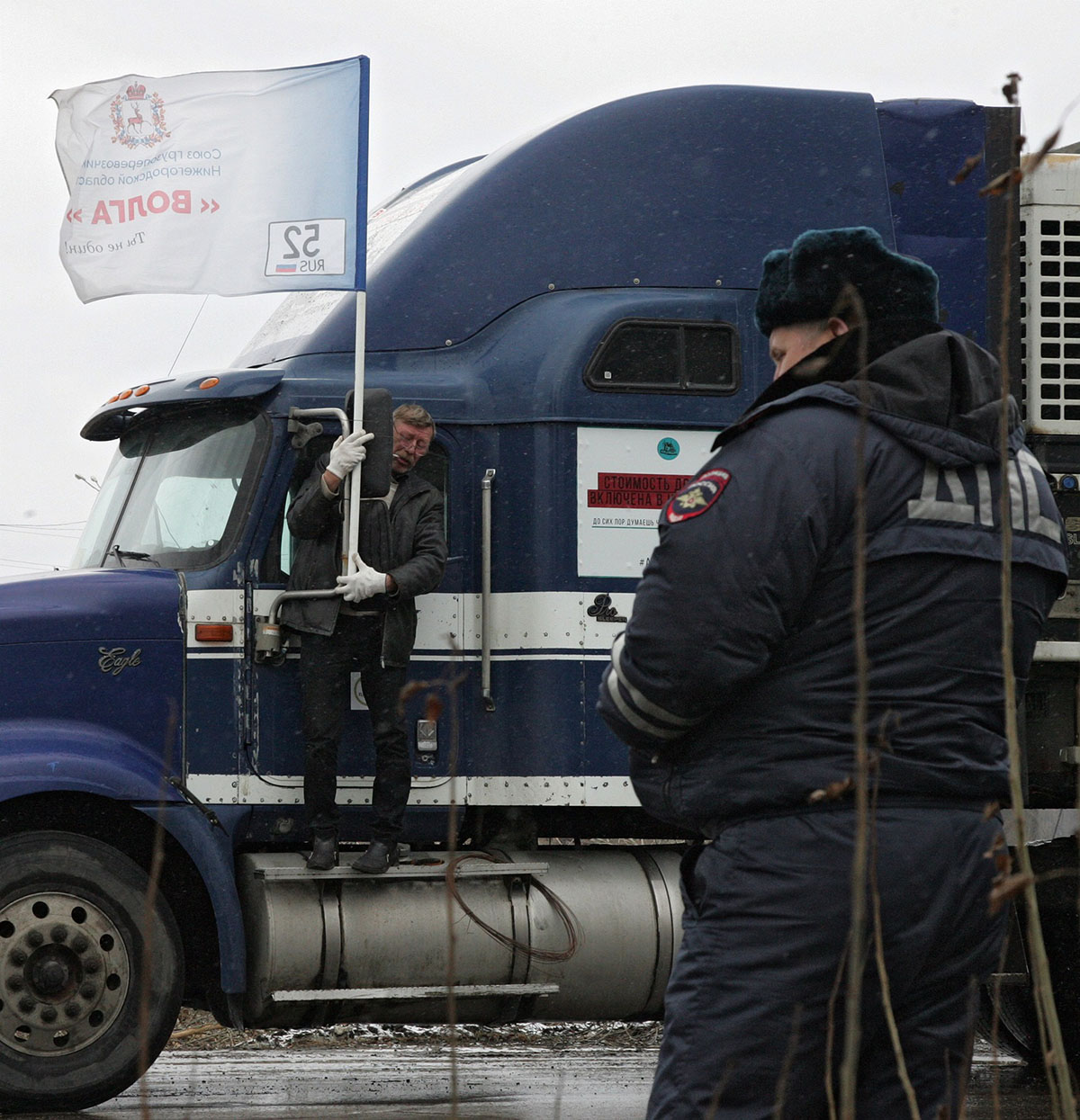
At the time of delivery of the material, the secretary of the Moscow “Association of Carriers” Sergey Rudametkin was busy searching for a new place to collect drivers and did not communicate with the press. But in St. Petersburg, the rally of truckers was supported brighter and radical. Smolny was burned by Niva, stuffed with tires. Video with an SUV, blazing on the Square of a proletarian dictatorship opposite the governor’s residence to the sounds of the “Valkyrie Valkiria” Richard Wagner, gained 100 thousand views on YouTube by the end of the week.
The main place of protest, according to tradition, was not the city center, but the M10 highway connecting St. Petersburg with Moscow: on its road, protesters were parrot of dozens of cars-cars and heavy.
“How does the strike go? - the trucker with the call sign “Gagarin” grinned to the question of the NT correspondent (he became known at the very first promotions of high truck drivers thanks to the suspended tongue and a cowboy hat). - We sit in cars and do not work. We walk, drink beer. We don’t take goods and are not going anywhere. ” Nobody prevents St. Petersburg drivers, as they assure. "Everything is wonderful, everyone is standing in the parking lot, how can one stop standing in the parking lot?" - laughs Gagarin.
"We are not in the savannah!"
“I think, Inlala, everyone will agree with me! I call myself a simple worker! I think, Inlala, there is no from the government or from which organs of people ... I do not know. Here are 99% of drivers! Such as me! First of all, I am addressing my appeal to the President of the Russian Federation Vladimir Putin, Prime Minister Dmitry Medvedev, deputies of the State Duma, ”the Dagestan trucker Abdurashid Samadov spoke on a rally of drivers. The video with the driver’s performance was published by the site “Caucasian Knot”. According to the Association of Republican truckers, about 500 heavy truck drivers took part in the action.
“I am turning to you on behalf of my people! On behalf of their colleagues, who, in these difficult times, survived these difficulties. Why are we, the people of Russia, so suffer today? We do not live in the African savannah to suffer like that! Where are the animals all around! " - Samadov said to the approving comments of colleagues.
In the middle of the week, photos of burned trucks allegedly from Dagestan appeared on the Web. The media signed the pictures in different ways-someone claimed that drivers burn their own trucks in protest, someone insisted that the burned skeletons were atho-vehicles of the drivers-stracbrechers who tried to make money on the strike. The truckers themselves call news about burning trucks.
“The trucks have not yet begun to burn,” Rustam Malamagomedov, a representative of the Association of Dagestan truckers, said in a conversation with NT. - Of course, we have radical guys. We have to calm them down. I hope that it will not reach. It is very difficult to restrain, everything is on emotions. ”
The authorities, says Malamagomedov, were sent to the site of the machine -gun - they are afraid of provocations. The military, like the police, behave correctly, assured the trucker. Videos with armed people dressed in camouflage appeared in social networks and chats of truckers.
Officials reacted with restraint. Deputy Minister of Transport, Energy and Communications of Dagestan Yakub Khujaev went to drivers and said that at the regional level “Plato” cannot be canceled. “We will not adjust the federal law in any way,” Khujaev spread his hands and asked the drivers not to block the road. “Someone in the hospital may be late, someone could be in a difficult situation.”
As in other regions, the Dagestan action will be unlimited. Drivers of heavy trucks require the presence of federal television journalists and live broadcasts. “We join these slogans about distrust of the president. We see that a person is a guarantor of a constitution that is not fulfilled. We demand the freedom of the media, central television, a live broadcast, ”said Malamagomedov.
"Nobody comes"
In other regions, they also complain that the regional and federal media ignore a strike. “We called all the media, no one comes, no one takes an interview, no one wants to illuminate this event,” a driver from Blagoveshchensk (Amur Region, Far East of the Russian Federation) phlegmatically complains about a video that appeared on the network last week). The driver himself is not visible - he removes from the cabin the line of the trucks of the protest protest, parked on the sidelines. “The truck is already worth it or so.”
The protest of truckers was reported in Kazan, Chita, Nizhny Novgorod, Murmansk, Ivanov, Ryazan, Ulyanovsk, Kostroma, Irkutsk, Yekaterinburg ... Moreover, in the video from the last two cities, drivers also talked about the fact that they did not trust the president. Information from the regions reached a clear delay - coordination was limping, the arrest of Bazhutin affected.
In North Ossetia, the Minister of Transport of the Republic Haydarbek Butov met with protesters. The speaker of the Kirov Legislative Assembly Vladimir Bykov said that he was ready to meet in Kirov with drivers to show them renovated roads.
In Yaroslavl, local deputies came to drivers. The meeting was held with the participation of an armored personnel carrier
In Yaroslavl, local deputies came to drivers. The meeting was held with the participation of an armored personnel carrier. No comments from the authorities, why there are no armored cars at a peaceful protest rally. Drivers of the Vologda region also reported the military. Through the chats they shared the filming of the columns of army equipment. On the videos removed from the cabs of trucks, under the chanson from radio and chattering radio, dirty green military trucks passing by truckers were visible.
In Primorye, on the road from Vladivostok, according to regional media reports with reference to drivers, the “Stop is prohibited” signs appeared. It was there that on March 29, several trucks with the inscriptions “Plato” were lined up - no! ” “We drove up (the police), demanded to remove the cars. The sign, they say, “the stop is prohibited, the tow truck works,” the private carrier Evgeny told the Vladivostok-Novosti publication. - They began to check the documents, I had an unpaid fine. While I was going to pay him, someone erased the inscription from my car about Plato. Nevertheless, Eugene intends to protest further: "Other participants in the strike parted, and I moved to the other side of the road, wrote again on the cabin" Protest "and I will fundamentally stand."
* In 2015, the truckers demanded amendments to the Code of Administrative Offenses, which reduced fines by 9 times-from the original 450 thousand rubles. up to 50 thousand rubles, and for a repeated violation - from 1 million rubles. up to 100 thousand rubles.
** In February 2016, the Deputy Prime Minister of the Russian Federation Arkady Dvorkovich said that the feud for heavy trucks within the framework of the Plato system will not increase and will remain at the level of 1.53 rubles. For 1 km, allegedly until October (it was previously planned to increase the tariff to 3.06 rubles per 1 km from March 1, 2016).
Photo: David Frenkel/Kommersant, Roman Yarovitsyn/Kommersant