
Translated material
"We live by some miracle ..."
April 5 in the Tretyakov Gallery opens a retrospective of paintings by Zinaida Serebryakova
This is the largest exhibition of the famous artist over the past 30 years. The previous one took place here in 1986, and the earliest and most complete-in 1965 in the exhibition hall on the Kuznetsk bridge, during the Serebryakova’s life, which, due to the illness, could not come to her from Paris, where she lived in forced emigration. At that very first and unexpected for the Serebryakova exposition itself, 250 of her works from Soviet museums and private collections were presented. Having already agreed to the exhibition, she began to doubt. “I can’t imagine what of my things can attract the attention of the public of the USSR? After all, there is no “originality” in my art either in the plots or in the drawing manner ... ”, Serebryakova wrote in one of the letters and repeated this thought in the following:“ ... everything that I painted for my life is the unfinished nature of the sketches ... ”
For the first time, Soviet viewers then discovered Serebryakov for themselves. A lot of people came, and this interest inspired the artist for new works. “My exhibition in Moscow has been closed for a long time (June 22),” she writes to a friend, “now this exhibition is sent to Kyiv, and then to Leningrad (where it will take place, maybe in November or December), to the halls of the Russian Museum, where temporary exhibitions are arranged. There were a lot of people at my exhibition, but what was the “material” success, I don’t know anything ... In general, my daughter (having started all this “story” with the exhibition) did not write anything intelligently to me, and I don’t even know what was exhibited from my sketches sent from Paris ... ”
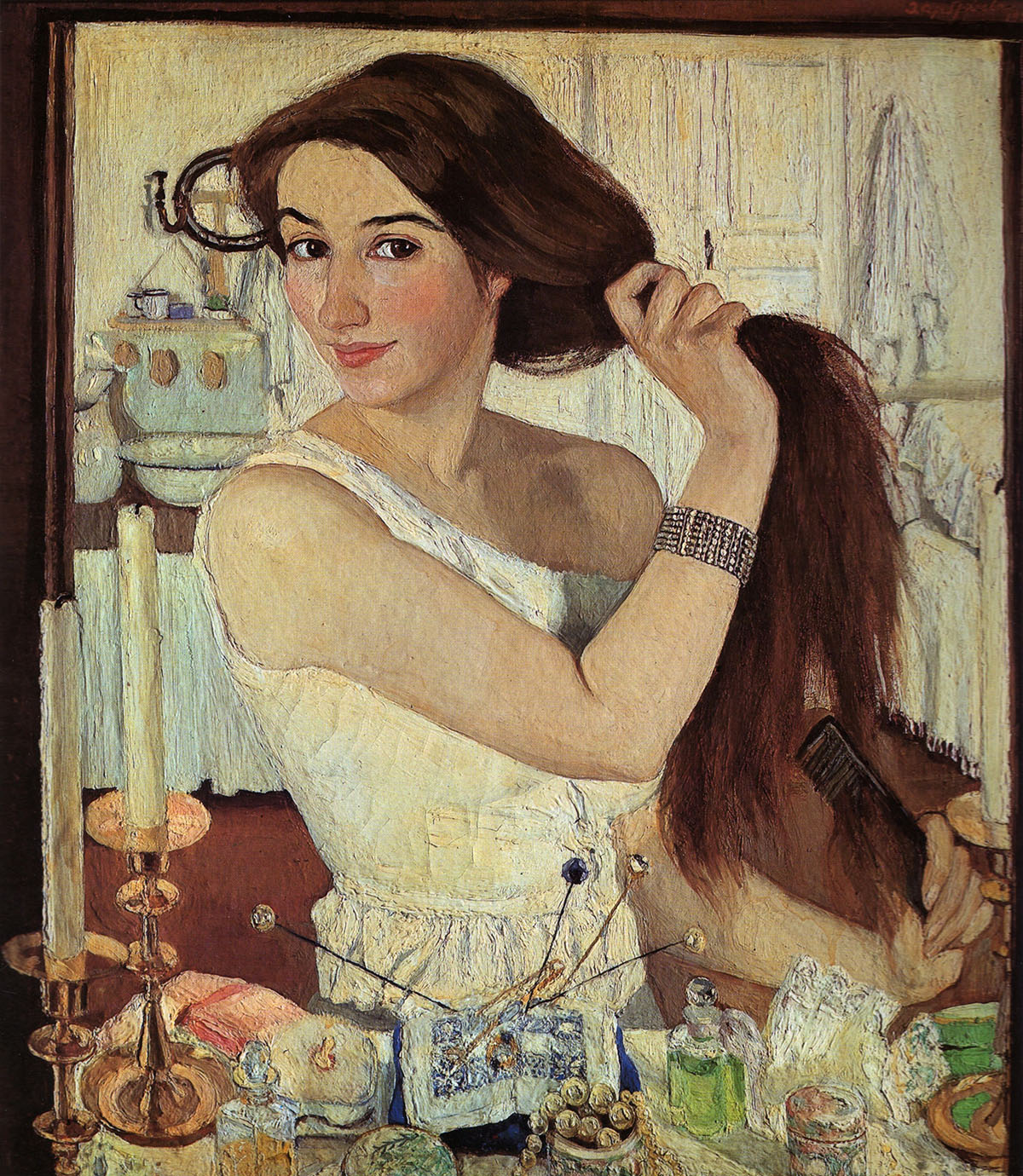
“The happiness of life blows from this room, and in it it leads its game, frolic and laughs affectionate youth”
In front of the mirror
This time, the Tretyakov Gallery tried to gather all the most famous works of Serebryakova from both the Tretyakovka itself, and from the Russian Museum and other collections. 16 of the paintings was provided by the Parisian Fund Zinaida Serebryakova (they were stored by her daughter Catherine, who had recently died in Paris at the age of 101). The emphasis is on the most fruitful Russian period of the artist’s work, but her portraits and landscapes written in France and stored in private collections are also represented.
Surprisingly, in the history of Russian painting, Zinaida Serebryakov entered one of her earliest paintings, written as if by chance - this is her “behind the toilet. Self -portrait "(1909). The place of this picture in Russian painting is the same as that of Valentin Serov’s “Girl illuminated by the Sun and Kuzma Petrov-Vodkin,“ Bathing of the Red Horse ”. In the audience perception, this is a combination of love, admiration and intuitive feelings that these paintings personify national self -consciousness. “Winter came early and snowy ...” recalled Serebryakova, who decided not to return to St. Petersburg in 1909, but to stay along with two young children in the village in a small house, which was easy to score. The husband was on a business trip to Siberia. “Everything was brought by snow: our garden, the fields around - everywhere snowdrifts. You can’t get out. But in the house on the farm, it is warm and comfortable, and I began to draw myself in the mirror and amused, trying to portray any trifle on the toilet. " This self -portrait was written by Zinaida Serebryakova at the brightest and most happy moment of her life. She is married to her cousin Boris Serebryakov, she is in love and loved - all this is reflected in a picture breathing extraordinary purity and freshness.
At the insistence of the older brother, Yevgeny Lansere Zinaida, put this self -portrait along with 12 other works at the VII exhibition of the 1910 Russian Union: a portrait and her two more works were bought by the Tretyakov Gallery in her collection. “She just struck everyone: such freshness, simplicity, accuracy, liveliness, so much light!” - So her uncle Alexander Benoit responded about this self -portrait. Shortly before his creation, Serebryakova returned from Paris, where she not only studied, but also actively absorbed the spirit of contemporary art. Manet, Renoir, Degas - they excited her. The influence of impressionists is felt in her paintings of this period.
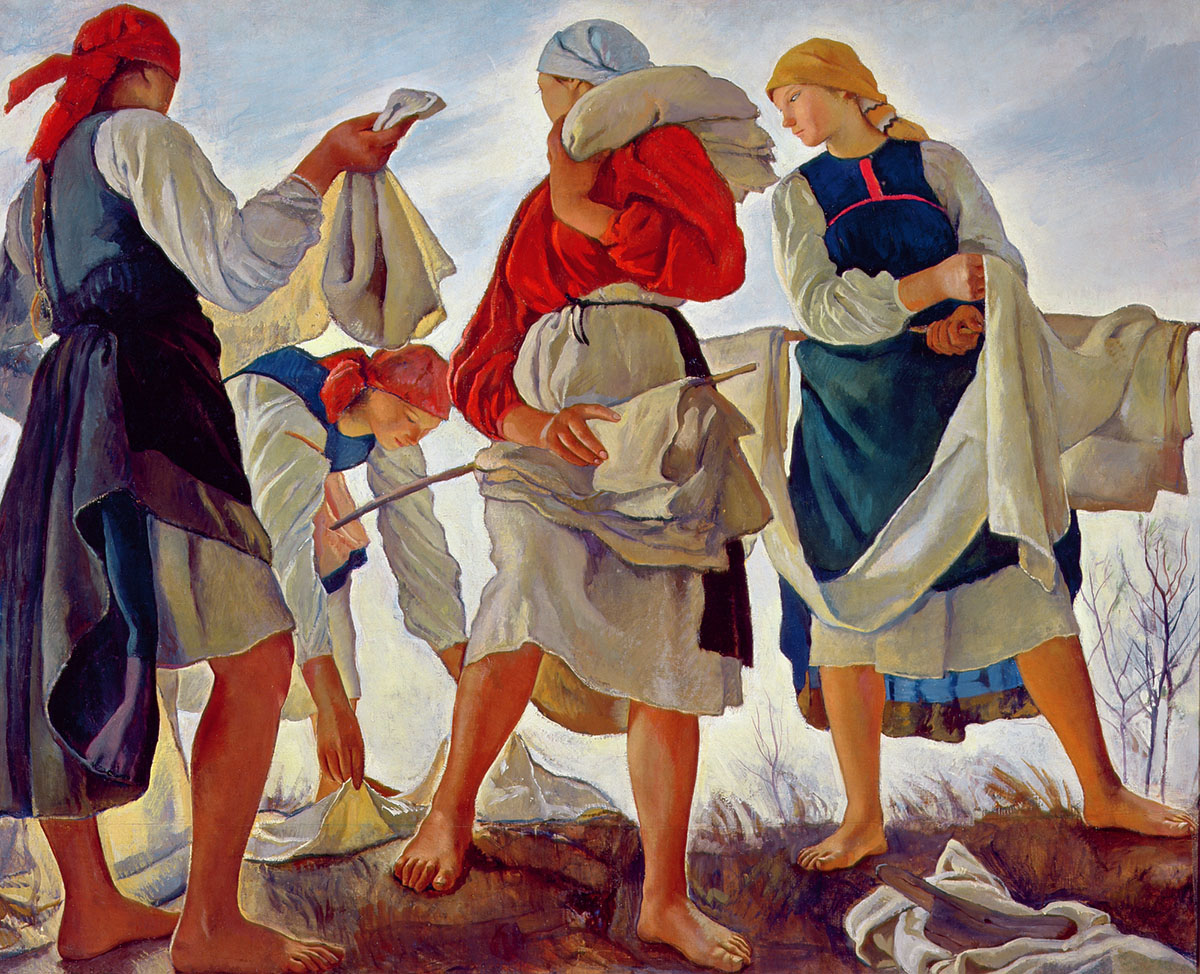
Harvest
The whole further life of the artist is the trials that fell to her lot, as well as the share of all the inhabitants of the country. The revolution erased the powder for many destinies, families, hopes. Behind the clean and bright paintings of Serebryakova, the terrible household context in which they were created is almost never guessed. One of her beloved artists - Alexei Venetians - was for her a “mirror of a pure soul”, a painter who knew how to convey harmony and the quiet joy of everyday life. Following him, Serebryakova draws from the nature of the stage from a peasant life: “harvest”, “peasants. Lunch ”,“ Peasant woman with a rocker ”,“ Sleep of the canvas ”,“ Bath ”,“ Sleeping peasant ”.
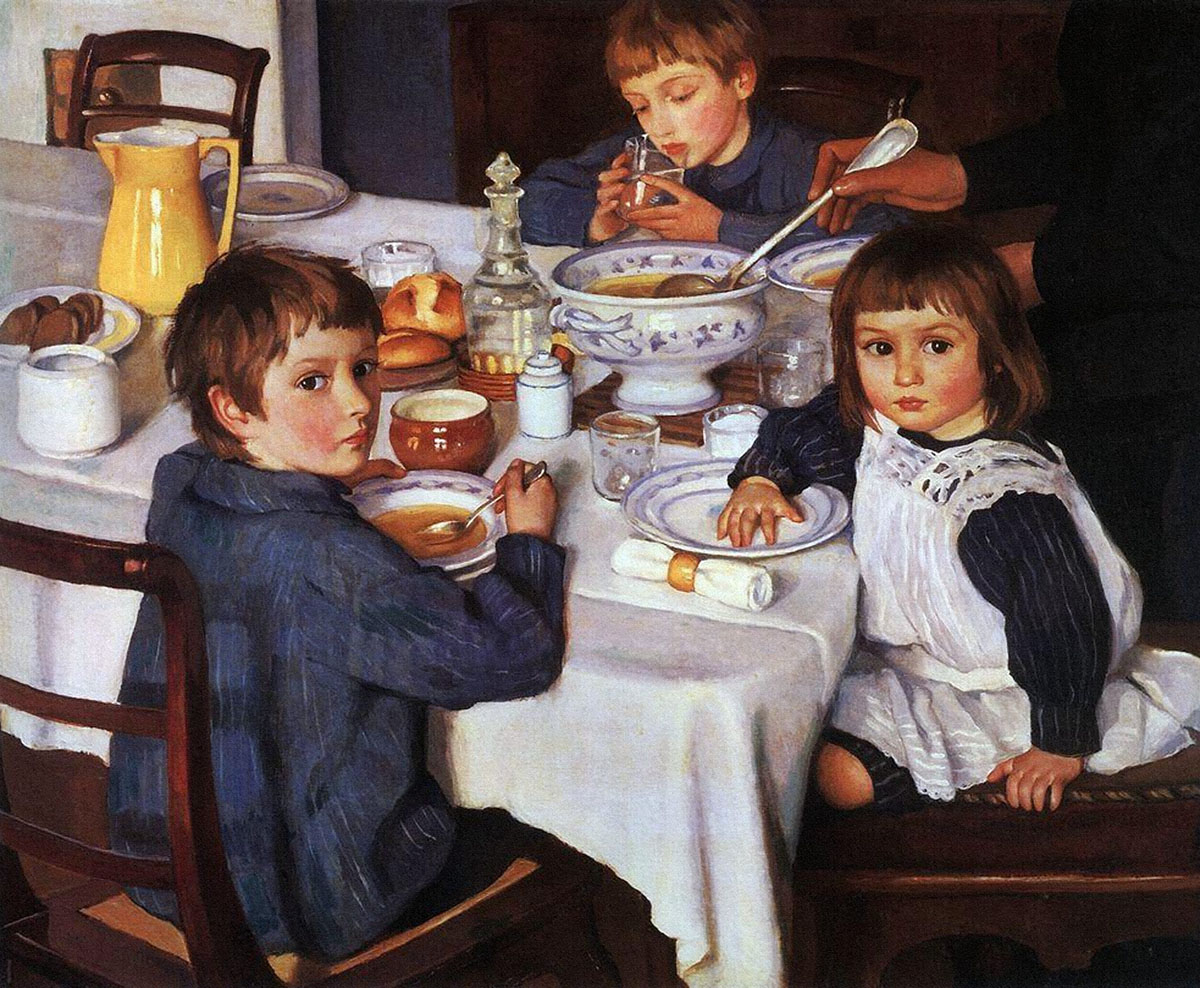
“... Complete simplicity, almost squalor, almost longing and despondency, and yet the happiness of life blows from this room, and leads its game, the affectionate youth frolic and laughs,” wrote Alexander Benois about the atmosphere of the village life of the Serebryakov estate. She arranged Christmas trees with peasant children, celebrating the name day with the workers. On her canvases - a family circle: four of her children are two daughters and two sons, husband, home. The plots are emphasized chamber, as in the picture “Breakfast”: three children sitting at the set table, a white tablecloth, a strain, napkins in the rings. This is an almost tragic spell of her family’s right to happiness, almost a foreboding ...
During the revolution, the Serebryakovs set fire to the estate, but the local peasants warned the family in advance, and Zinaida with four small children and mother left on a cart in Kharkov. The peasants provided her on the road with several bags of grain and carrots. Her husband was all this time in Siberia, where he built roads. Zinaida wrote to her brother: “I’m here in crazy anxiety - I’ve been not a line from Boris for two months, it’s so scary that I’m losing my mind ... I sent an urgent telegram, but God knows when I’ll get an answer ... I’m so worried that I can’t do it at all and I don’t sleep at all ... if I’ll not get an answer to telegrams for a long time, then I’ll go.” And she went, leaving the children to her mother. Found, brought to Kharkov. On the road to the soldier's warmth, Boris infected the typhus and died in the arms of his wife. All her life, until recent years, she will live in memories of him. In the Parisian archives of Serebryakova, the children then found portraits of Boris, written by her from memory and old photographs. After a while, in a letter to friends, she writes: “If only not to remember the past, not to worry again and again what cannot be returned ...”
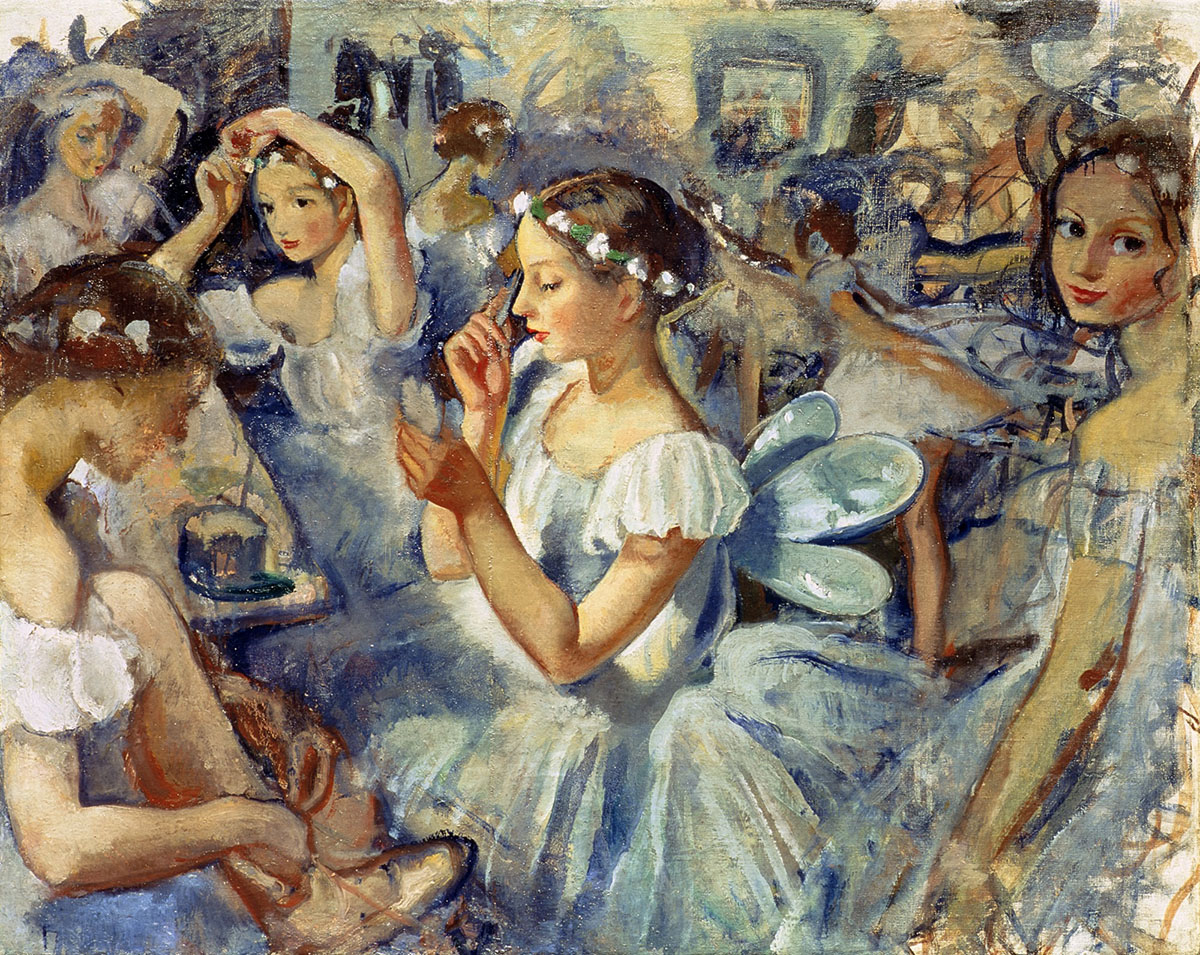
After the death of her husband, Zinaida with the children returned to Petrograd. Their apartment was populated by strangers, Serebryakov got only one room. Tatyana’s eldest daughter entered the Petrograd Choreographic School, and for three years the artist sketches the ballerin in the intermission and after the performances, invites them to her home. So one of the best series of her works arose - “Blue Ballerins”, “Ballet Land Ballet. Snowflakes ”,“ Girls-orphanes ”; A separate hall was given to them at the exhibition in the Tretyakov Gallery. In 1924, work from the ballet series was shown at the last exhibition of the Art Association "World of Art". In the paintings of this cycle, Serebryakova’s shining happiness - beauty, youth, creativity, inspiration. As a challenge to a difficult life. In 1921, she wrote to her relatives: “I sew all day ... I lengthen Katyusha dress, I repair linen ... I cook oil paints myself-I rub powder with poppy oil ... We still live in some kind of miracle ...”
Parting
On August 28, 1924, Zinaida Serebryakova left for Paris: there her relatives Benoit, there was an order for a large panel, hope for earnings. She hopes to get a job and pick up the children who are still with her mother. The whole family is in a sense of tragic separation forever. Tatyana Serebryakova wrote about her mother’s departure: “I broke, rushed off to the tram and ran to the pier when the ship began to set sail and my mother was inaccessible. I almost fell into the water, my acquaintances picked me up. Mom believed that she was leaving for a while, but my despair was limitless, I seemed to feel that for a long time, for decades, I parted with my mother. ”
In 1925, with the help of uncle Alexander Benois, Alexander Benois was taken to France, he was already 18. In 1928, one of the clients, learning that the artist had children in Russia, offered help. So managed to bring Katya to Paris, the youngest. She was 15 years old, and she alone went to her mother by train throughout Europe. In Paris, the children took over part of the household chores and tried to earn a living. The son helped Alexander Benoit, sketched the types of Paris, made illustrations for books and magazines, painted lampshades, painted postcards, Paris maps for tourist guides.
The doors ajar to the west, however, slammed shut. Leningrad became a trap. The time of repression began. Zinaida sometimes touched to return to the USSR, and was afraid at the same time. She yearned for his wife and Tanya, wrote letters with instructions to them, but you won’t be fed with letters, my grandmother and grandchildren constantly have no more no n forbal. In 1933, the mother of Zinaida Serebryakova Ekaterina Lansere died of hunger. Children sometimes had to exchange their mother’s work with collectors for a loaf of bread ...
In Paris
The French period of his life Zinaida Serebryakova turned out to be quite fruitful, she managed to visit Morocco twice and create in this country the cycles of work that were successfully exhibited in Paris.
Among the emigrants there were true admirers of her talent. The artist writes many custom -made portraits, as well as landscapes, sketches, genre paintings: “In the hairdresser”, “In a cafe”, reproduced later in the magazine “Le 'Dame”, Temper “Versailles Park”, “Versailles. The roofs of the city ”,“ Paris. Luxembourg Garden ”, finding addiction to lighting effects. Konstantin Somov wrote about Serebryakova: “Impractical, makes many portraits for nothing to advertise for a promise, but everyone, receiving wonderful things, forgets it and they will not hit a finger on a finger.”
“Impractical, makes many portraits for nothing to advertise for a promise, but everyone, receiving wonderful things, forgets it and they will not hit a finger on a finger”
The family lived more than modestly - money always on the back, the son made lampshades, painted Parisian panoramas, wonderful interiors of classical mansions (the first monograph on the work of Alexander Serebryakov has just been published in France), Katerina made to sell wax dolls. The remaining Tatyana in Russia became theater artist, Eugene became an architect. Tatyana Serebryakova was able to see her mother only in 1960. A year before the death of the artist - in 1967 - visited her in Paris and the eldest son.
Zinaida Serebryakova complained that life in different countries has forever divorced loved ones and their outlook on life is significantly different. All this tragic and vivid story is hidden, however, from a prying look at the exhibition in the Tretyakov Gallery, introducing us to the artist of bright, bright, gentle and pure talent.
Photo: press service of the State Tretyakov Gallery