Date
Author
Серафим Романов

Preserved copy
Translated material
What have you done for the revolution?
By the centenary of the events of 1917-18. Museum workers are looking for new approaches to the involvement of the audience
So far, the official state ideology seeks to give domestic history the format of a strict vertical, Russian museums (following the world) are increasingly abandoning the direct assessment and interpretation of the events of the past. The creators and guardians of museums and exhibitions are unanimous: the main value that a modern person can endure from a visit to any historical exposition is not knowledge (most of them can be found on the Internet), but emotions. It is they, in the era of information overload, can serve as a guarantee that interest in the topic will not be lost along with the exit beyond the threshold of the museum.
What does it look like in practice? From the use of personal belongings and private stories in historical expositions, up to failure of information tablets that “chew” and simplify what they saw.
Personal involvement is especially important in such painful and conflicting episodes as a revolution in Russia. About how the events of a hundred years ago are reflected in today's museum expositions, at the end of March they spoke a round table in Krasnoyarsk. The discussion was the first event of the project “Museum in the Revolution/Revolution in the Museum”. The author of the idea is the St. Petersburg historian Julia Kantor, with the support of the Charitable Fund, Vladimir Potanin, gathered museum workers, historians and journalists from different regions at the same table.
 A press conference on the eve of the round table in the Krasnoyarsk Museum of Local Lore // Photo: Kkkm.ru
With the help of the participants of the Novye Event begins the revision of museum trends to the anniversary of the revolution in Russia (and not only).
On sound and smell
The State Museum of the Political History of Russia presented its updated constant exposition “Man and Power in Russia in Russia in the XIX-XXI centuries, however, according to museum workers, the exhibition is a“ living organism ”that transforms together with visitors.
“We proceed to them that the revolution is a single multifaceted process,” explains the scientific concept of the next constant exposition “Revolution in Russia. 1917-1922 ”(2015) Head of the Department of Scientific and Expocation Design Alexander Kalmykov.
It is a presentation of “alternative history”, but “alternative” not in the sense that some populists from historical science understand it. “The revolution has incorporated thousands of names and events, and for different people each of them has its own positive or negative coloring, depending on the angle of view,” continues Kalmykov.
The preparation of these expositions took about 15 years from museum workers. During this time, dozens of interviews were recorded (including with the immediate contemporaries of the revolution), unique archives were raised, and the appearance of the exposition began to develop several times from scratch. As a result - in the halls of the mansions of Kshesinskaya and Baron Brant, where the museum exposition has been located since 1957, today there is not a single exhibit that has not contained a whole many different interpretations. Another feature of the modern museum is some exhibits (for example, even weapons!) You can touch your hands.
Not only physical objects, but also sounds are responsible for the transmission of the “spirit of the era” in the Museum of Politicalism. In order for the museum to begin to “sound”, its employees developed an audio program of sounds of the civil war, songs of both “white” and “red” with their original texts were recorded. And among the so far not realized know-how remain museum ... Smells-today in the GMPI they do not refuse to convey the historical context at the level of smell.
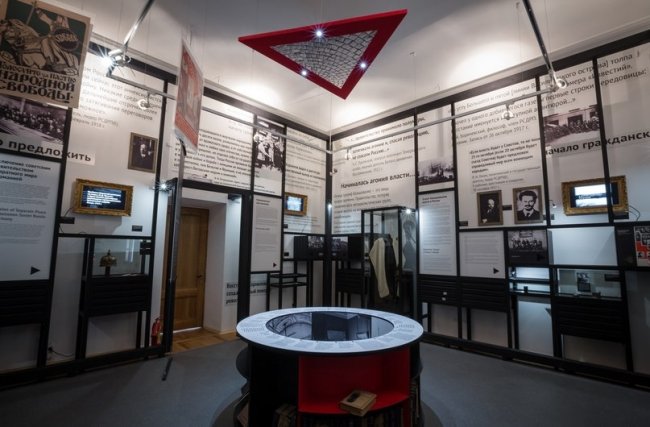
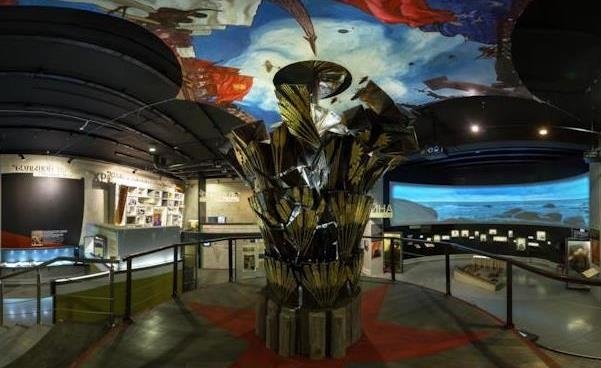
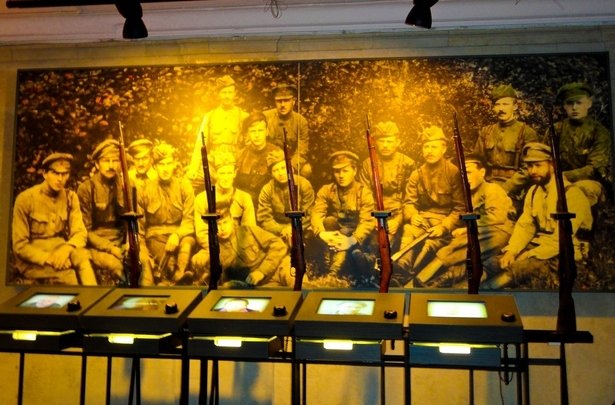 Exposition of the Museum of Political History of Russia // Photo: Polithistory.ru
"Some kind of nonsense is happening ..."
The tendency to appeal to private stories is continued by the diary of the gymnasium student Katya Gaidukovich, stored in the funds of the Krasnoyarsk Museum of Local Lore. A young girl made her notes in February 1917 to February 1918. On the pages of the diary, studying, going to the cinema and parties, romantic experiences are adjacent to thinking about politics and state system. Moreover, the latter 16-year-old Katya pays relatively less attention.
“The impressions of the holiday in the gymnasium are superimposed with the girl on the October coup, so much so that it is quite difficult to understand what specifically is talking about,” says Ilya Kuklinsky, senior researcher at the Krasnoyarsk Museum of Local Lore. “But the diary is not important from the point of view of facts - with its help, we can trace what reflection found revolutionary processes in the minds of most young contemporaries.”
This year Katya Gaidukovych was first represented by the general public, despite the fact that his typewritten copy was handed over to the museum of the author’s daughter back in the late 60s. Today, quotes from the diary were issued an exhibition for the 100th anniversary of the revolution on the steamer-museum “St. Nikolai ”, who is in an eternal parking lot on the Enisei embankment. The emotional memories of Katya Gaidukovich replaced traditional information stands here.
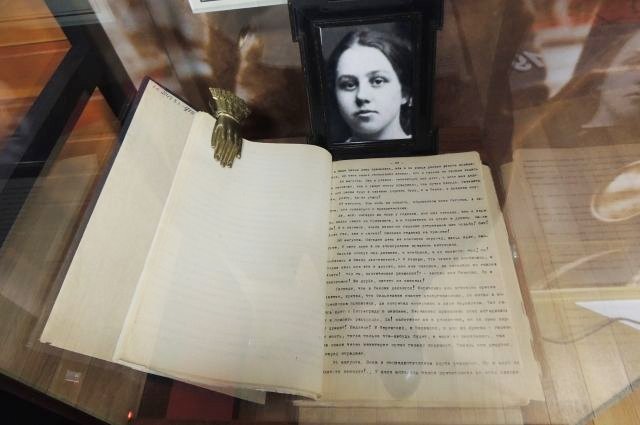
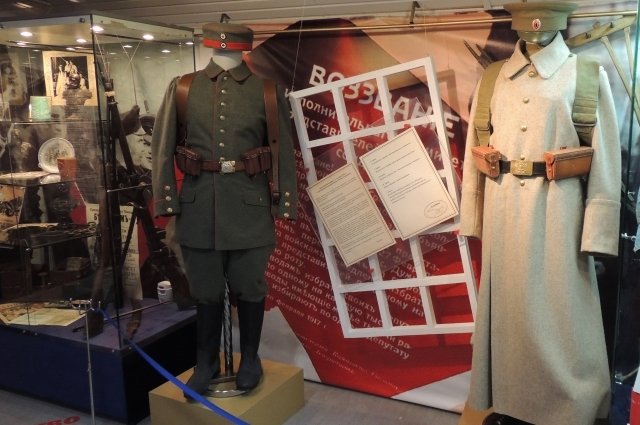
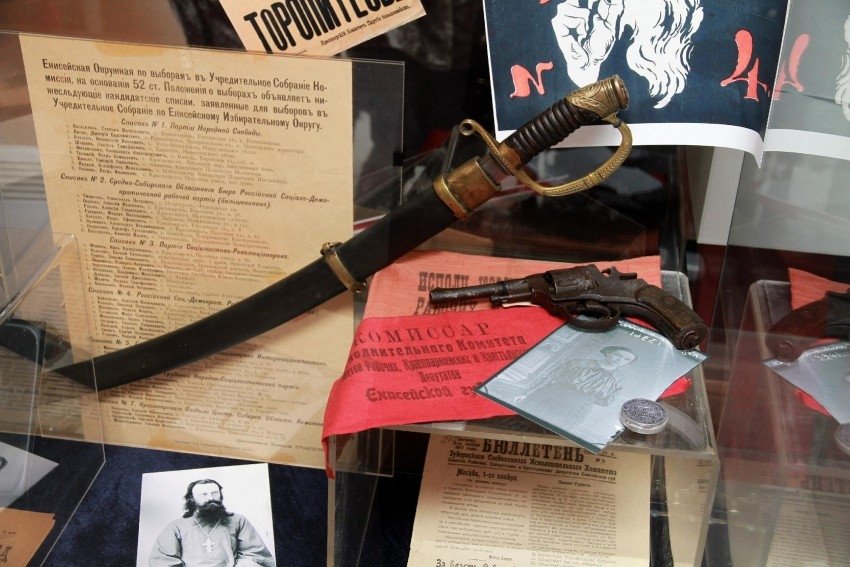 Exposition of the ship "St. Nikolay "// Photo: krskplus.ru
“On the Law of God, they began to argue about politics. Our Socialist -Revolutionaries and Cadets attacked us. I did not want to give up, but I couldn’t say it, since they literally did not let me open my mouth, ”the girl complains on November 9, 1917. And the next day he continues: “Do not study. Some kind of nonsense is happening: either students are striking, then teachers stop classes due to elections. ”
According to Ilya Kuklinsky, since then the initiative group is engaged in the search for funds for the publication of the diary in the form of a printed book and electronic Longrid. It is not strange, the descendants of the author counteract this: the granddaughter of Ekaterina Gaidukovich has not yet given permission to ensure that the full version of the memoirs became public.
Coffee with Lenin
There is no consensus on the events of a hundred years ago in the society of our northern neighbors - Finland. It is no coincidence that the exhibition “Mannerheim - the Life of the Great Man” does not disregard the vandals in Helsinki. “The main problem for the Finns is how to objectively talk about gaining independence. -explains the scientific secretary of the Vyborg United Museum-Reserve Julia Moshnik. “For most local museum workers, of course, this is a triumph.”
Last summer, in the city of Tamper, after reconstruction, the Lenin Museum, the first museum of the leader of the revolution, opened in 1926 outside the USSR, resumed work. As before, the exposition is located in the building where Lenin and Stalin first met in 1905.
The reconstruction of the museum was carried out with the direct participation of local residents: in 2014, the Tamper administration addressed the townspeople with the question of what they themselves would like to see in the building of the former house of workers. The “collective mind” made the following plot: if it was here that the first meeting of the future leaders of the Soviet Union took place, then Tamper should be considered the cradle of the USSR. Thus, by the time of “restart”, Museo Lenin had turned into a museum of the history of the USSR, where today you can make a selfie or drink coffee with the leader of the world proletariat.
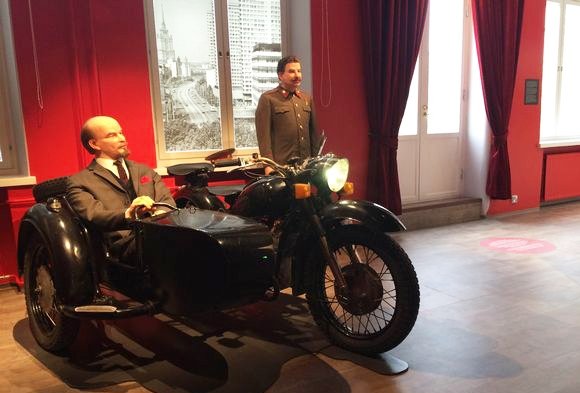
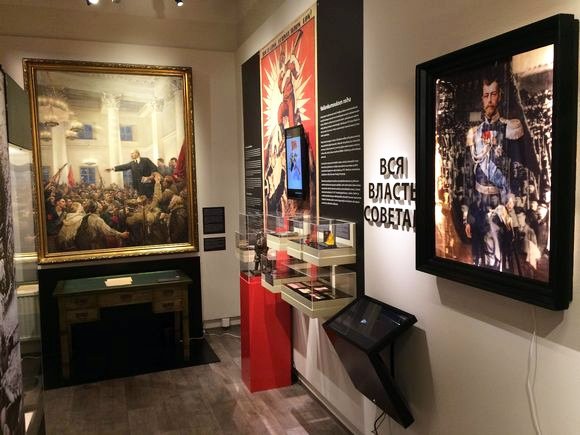 Lenin Museum in Tamper // Photo: Lenin.fi
All the events that are held in the country of Suomi for the anniversary date are posted on the official website of the Museo 100 project (he does not have a Russian version). Among other things, an interactive tour of the city of Vaas, which became the capital of the White movement during the Civil War. The project was called "blue-white Vaas Anna"-in honor of the young girl Anna Mendalen, whose diary records of 1917-18. The pedestrian route is accompanied.
Another interactive project was carried out on the initiative of the Lappeenranta Art Museum. The main characters here are two famous Finns - the artist Vorine Kunnas and the composer Toyvo Kuul. It is known that both were in Vyborg at the height of the Civil War and later described these tragic events in their memoirs. But the history of the two creators did not preserve the fact of the personal meeting of the two creators, so Finnish museum workers offer everyone who wants to fantasize on this topic.
And the most important exposition of the anniversary year in the National Museum of Finland is only preparing for the opening in June. It is known that objects associated with the life of ordinary people - witnesses of historical events will occupy the central place in it.
***
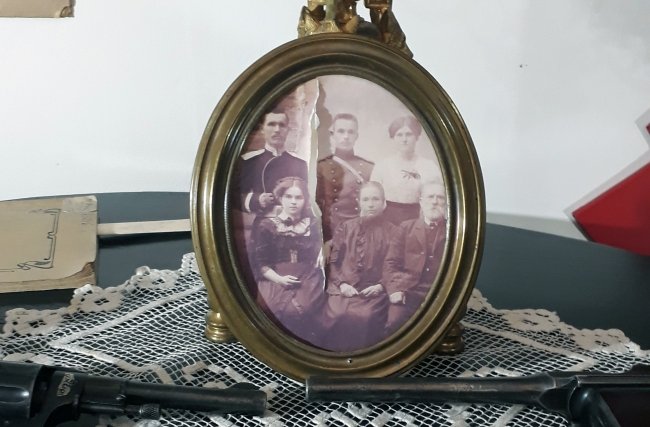
The official symbol of the project “Revolution in the Museum. The Museum in the Revolution ”was the split photo from the funds of the Krasnoyarsk Museum of Local Lore. Participants in the round table admit - for all the creativity of the voiced approaches, the museum community of Russia is extremely conservative, and, most alarming, is still divided into conditional “red” and “white”. Therefore, one of the tasks of the discussion project - talking about the past, also talk about the future. This will continue to do this in the summer and autumn at events in Yekaterinburg and St. Petersburg.
To be continued...