
Translated material
Black obelisk
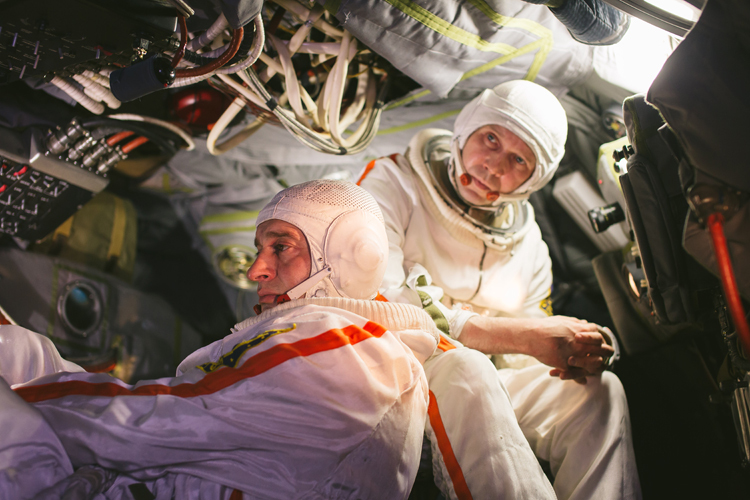
1965. Cosmonauts Pavel Belyaev and Alexei Leonov are preparing for the first time in the history of mankind to go into outer space. It will turn out or not - no one knows at the flight control center. Even Korolev. But there is a cold war on Earth, and the states are trying in every possible way to tear out the championship in the space race from the USSR (the American Ed White will go into space just two and a half months after the Russian flight). It is necessary to take risks, hoping for the courage and heroism of Soviet people.
The courage and heroism did not let down, and there is nothing surprising in this-the valiant people used to live, they conquered space, sometimes faced difficulties, but they were always overcome: after all, faithful friends with beautiful hairstyles and principled engineers were waiting for them. They did not throw their own. Radili for the common cause.
That, in fact, is all that can be taken out of viewing the picture “Time of the First”. Clearly, very intelligible cinema. In places - in space - quite beautiful, in some places - quite spectacular. The whole message of the picture is completely exhausted by a monologue embedded in the mouth by Alexei Leonov: the astronaut recalls repression and war and adds that, they say, then they were subsided, and now.
It is difficult to argue. The Soviet people really endured deprivation and committed feats, and Leonov really first went into outer space. However, these truths have nothing to do with cinema. In general, it would be most correct to call the “time of the first” not a cosmic drama, but a conscientious illustration of historical events. A set of staged pieces, which are often added to documentary films in order to dilute the speaking heads of experts and eyewitnesses. The illustrations are well made. Historical figures are depicted by wonderful actors. They have nothing to play.
There is such a scene in the film: the heroes before sending to the cosmodrome are filmed by documentaryists. Something similar happens in the “The Happy Day in Ollie's Life” (an example from the nearest - the film will be released next week). There, the protagonist was also shot for the chronicle. And the viewer was shown the difference between the real behavior of Ollie and how he had to exist in the frame. The difference between a person and his ceremonial image. In the "time of the first" this difference is absent. Belyaev and Leonov every secondly look young-and this are not like living people of any era or the heroes of the movie of the 60s, always reflecting and asking themselves important ethical questions. Sort of monuments; It is not surprising that they never go to the toilet and eat almost nothing. But sometimes they drink. This is what the characters of the films of not the 60s looked, but the stuffy Stalin Lesser.
Human stories are completely replaced by the history of the feat. What is their soul? What are they people? Leonov seems to love to draw. Belyaev is strictly and more demanding on himself. At the same time, both are simple, good guys. At difficult moments, they joke and fool around, but all this is wasted - we still look at them from a great distance. There is an action - but what really drives heroes? Dramatic music (in some places reminiscent of a melody from the screensaver to the "Game of Thrones"), ready at any moment to remind you of the seriousness of what is happening?
It would be seductive to announce that the “time of the first” is generated by nostalgia for the Soviet past, but everything Soviet is too illusory here. Yes, the generals wear karakule caps, and Comrade Brezhnev is led by the country. Comrade Brezhnev is sitting in the Kremlin Palace of Congresses, drinking tea with dryers and watching the “road to the stars” of Kloshantsev. Behind the walls of the palace are jubilant masses and Muslim Magomaev (in 3D it all looks especially impressive). However, the authors of the film are simply nothing to say about the 60s. All signs of time are needed only to give a slight entourage. No one is going to comprehend or at least reproduce the era on the screen. So it turns out that the frame with the wives of astronauts gathered at the TV is more like a staged photograph from the magazine Caravan of Stories.
The “time of the first”, the long -suffering long -building studio Bazelevs (in the process of filming, one designer, director Yuri Bykov, who seemed to be responsible for the “human”, was removed from the post, and replaced him with the technician Kiselev - “Christmas trees” once, two, three; the result is available), it should be attributed to a special type of Russian blockbuster. These are strange films in which there is a plot (the hero went, the enemy has come, the heroine said, etc.), but there is no plot (why did he go, what did he want, what all this happened to?). Rather, instead of the plot, some very simple slogan is taken, and this slogan should illustrate everything that happens on the screen. Such is the artistic version of the newspaper editorial or report from the Time program. The plot always involves a certain change in the angle, when the things and phenomena specified to us suddenly appear from a different angle, or a change in the hero, the need for ethical choice. The transfer of information, on the contrary, does not require any changes - if only the recipient has learned it. It turns out that all scenes in the film are official, and each remark is technical in nature. A radical example of such a movie can be called “defenders” (which were not a blockbuster). In this amazing film, any hints of artistry were completely absent. Rather, it was a naked scheme of conditional superhero cinema, for some reason carefully reproduced on the screen. A sort of natural layout. The whole conventionality of what was happening became clear when one of the characters, standing on the roof of the former cinema "Russia" and looking towards Pushkinskaya Square, began his monologue with the words: "My brother and I often played in childhood in this yard ..."
Of course, the “time of the first” is not as vulnerable as “defenders”, but this lengthy movie resembles a museum of one feat made beautifully, richly and without a soul. Regarding the entertainment, it should be noted that the budget of the picture was mastered honestly, and in the most weighty part the film is trying to challenge “gravity” or “surviving”. However, like many Russian directors, trying to make large-scale spectator cinema, the authors of the “time of the first” are more like Chinese masters of some 19th century, who could have reproduced the appearance of a European machine gun with perfection, but the resulting weapon did not shoot-it was intimidated inside. The “time of the first” is both empty and monolithic at the same time, it is as if cut out of a solid piece of granite. The nature of the cinema, the essence of which is the movement (figures, characters, time, finally), is successfully defeated by the authors who turned the film into a monument, which, like a steel figure near the Leninsky Prospekt metro station, with all its appearance depicts a rise, but stands on Gagarin Square for years.