Date
Author
Татьяна Брицкая, Нина Петлянова, Изольда Дробина, Елена Бердникова, Алексей Полухин, Дарья Кобылкина, «Новая газета», Василий Авченко
Source

Preserved copy
Translated material
Protest on the joke
What are the real scale of the All -Russian strike of truckers?
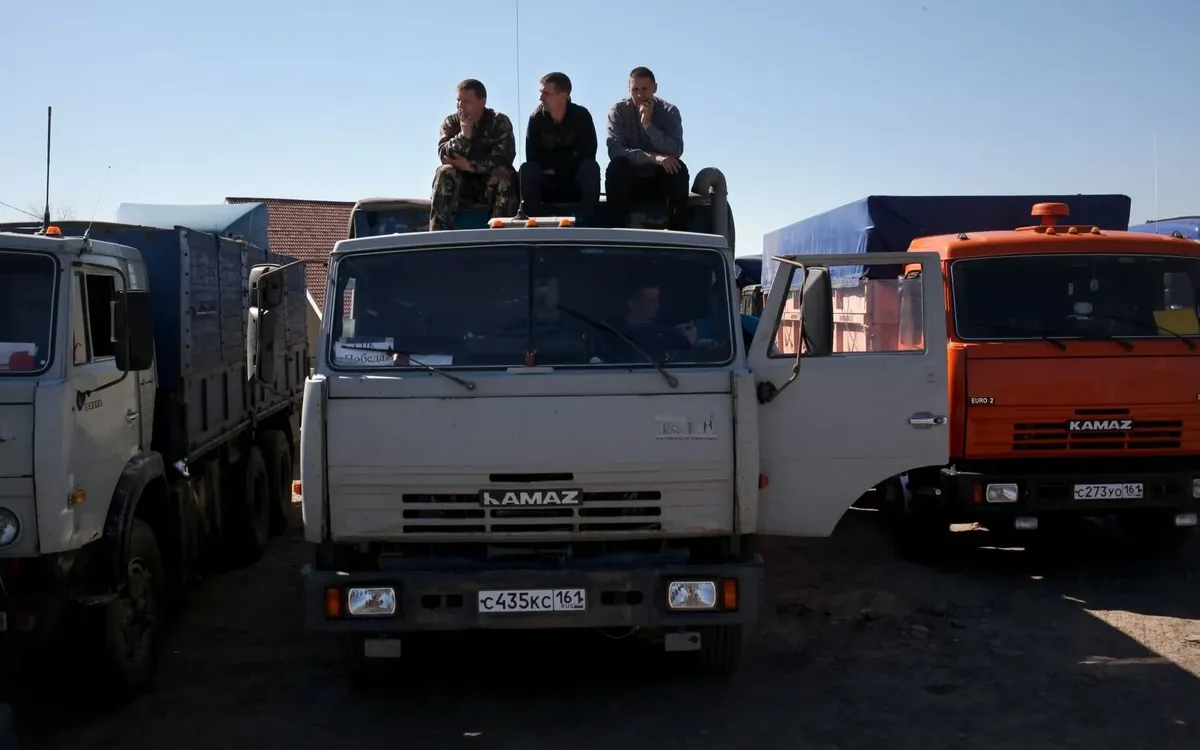
To understand the real scale of the All -Russian strike by truckers, it is necessary to consider not only those cars that defiantly go to the highways, but also those that are quiet in garages.
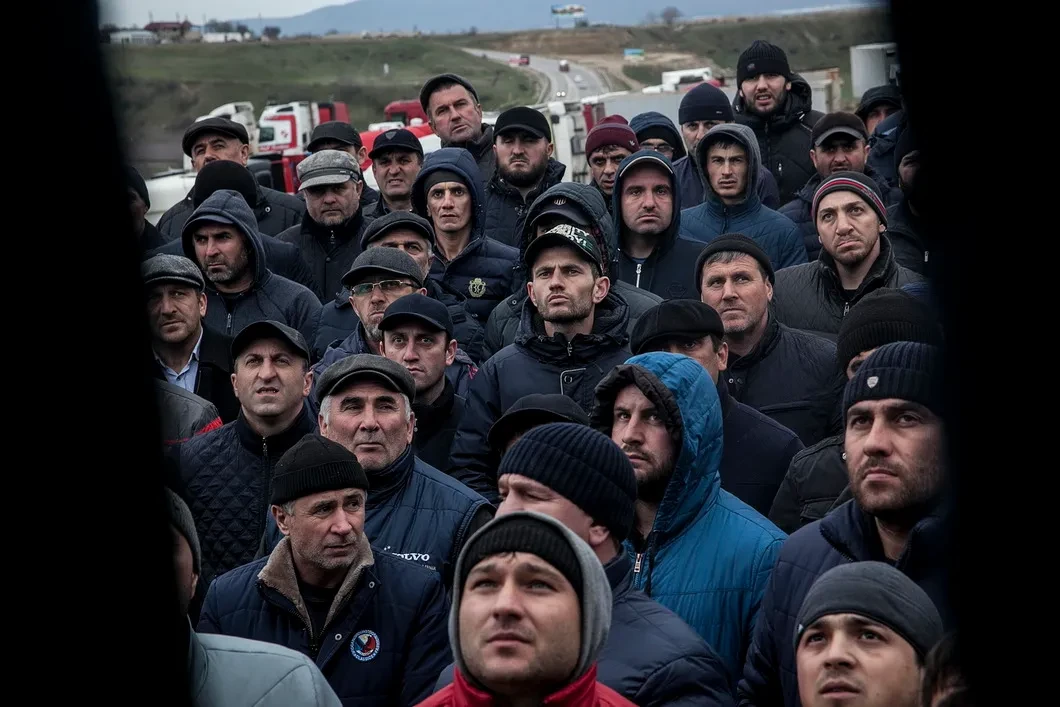
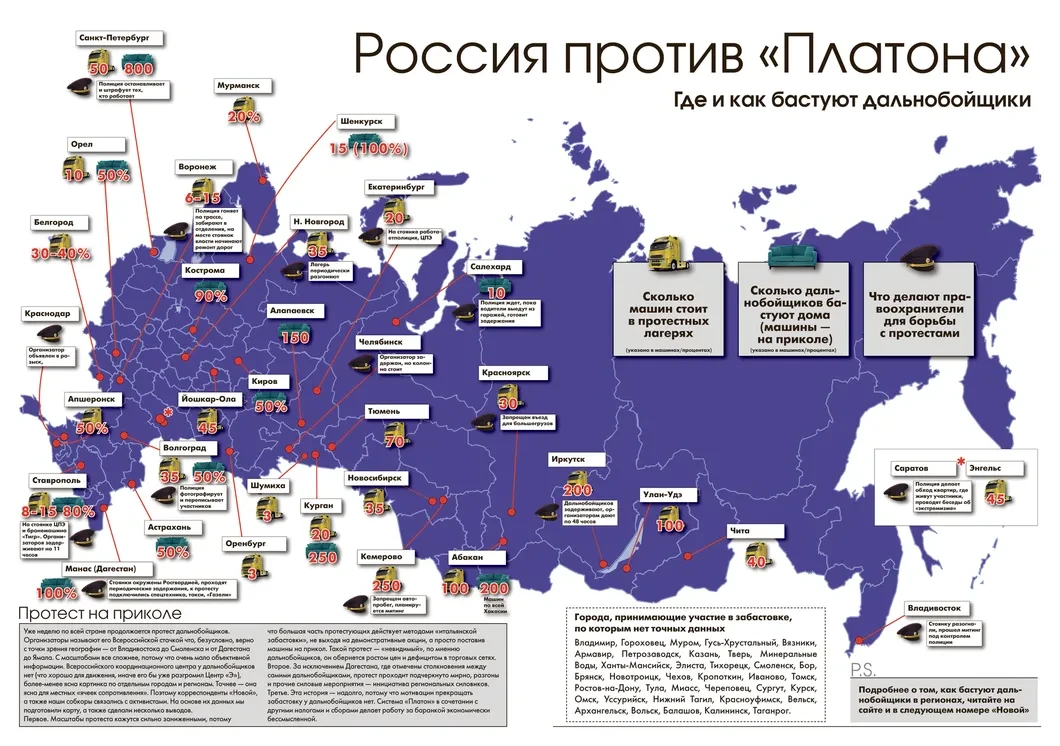
For a week throughout the country, truckers protest have been going on. The organizers call it an all -Russian strike, which is certainly true from the point of view of geography - from Vladivostok to Smolensk and from Dagestan to Yamal. The scale is more complicated, because there is very little objective information. Truckers have no All-Russian Coordination Center (which is good for movement, otherwise it would have already defeated the EE center), the picture in individual cities and regions is more or less clear. More precisely, she is clear for local "resistance cells." Therefore, the correspondents of the "New", as well as our sobs, contacted activists. Based on their data, we prepared a card, and also made several conclusions.
First. The scale of the protest seems very low, because most of the protesters acts on the methods of the “Italian strike”, without going to demonstrative promotions, but simply putting the cars on the joke. Such a protest is “invisible”, according to the long -range workers, it will turn into a price increase and a shortage in retail chains.
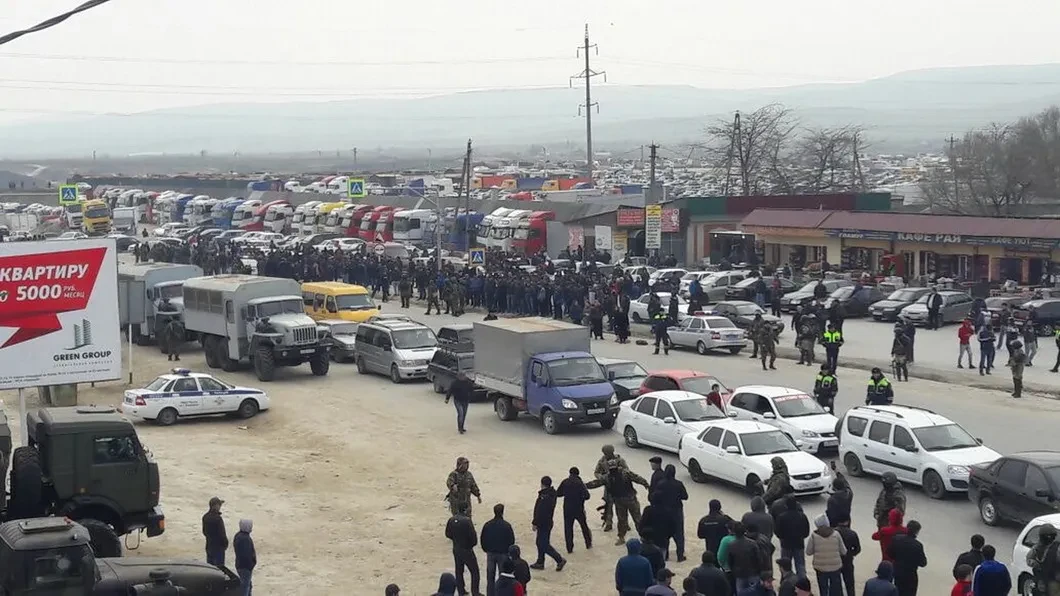
Second. With the exception of Dagestan, where clashes between the truckers themselves are marked, the protest is undergoing peacefully, any acceleration and other power events - the initiative of regional security forces.
Third. This story is for a long time, because truckers have no motivation. The Plato system, combined with other taxes and fees, makes work at the steering wheel economically meaningless.
Alexey Polukhin, Daria Kobylkin, "New"
Mound
The caravan stands
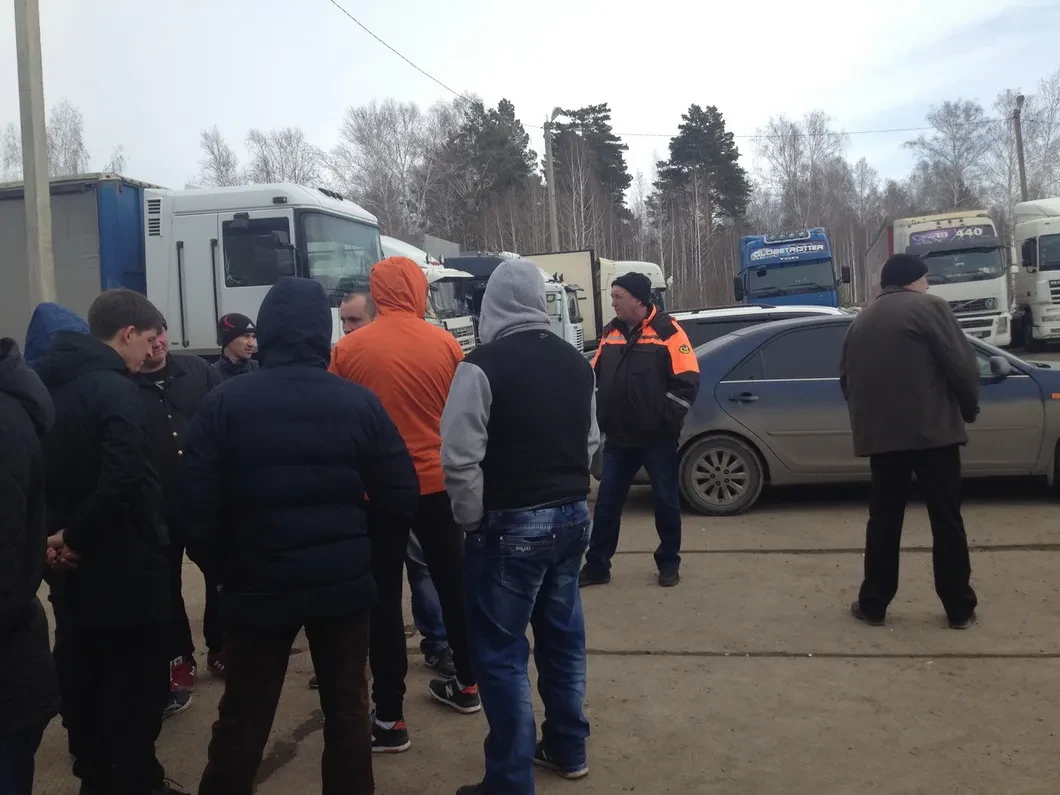
About 1000 heavy trucks stand without movement in the Trans -Urals - truckers are striking. Drivers of one of the largest transport hubs of Russia at the crossroads of Europe and Asia are waiting, according to them, “dialogue with the government” regarding the cancellation of the Plato system.
The largest cities of the region - Kurgan, Shumikha and Shadrinsk - became centers of a protest campaign that began on March 27. In Kurgan, drivers stood on their cars on the Baikal highway (Zauralsky Trut parking) and on the same parking lot of Baikal near Schumikha, between Chelyabinsk and Kurgan. In Shadrinsk, they protested near the Rublev cafe on the Shadrinsk -Chelyabinsk highway. The demonstrative part of the protest lasted 2 days. Then the garage began.
“260 people participated in the action, all have a different number of cars, but all of them are private carriers, market participants,” says Nikolai Zverev Shadrinets, the coordinator of the association of Russian carriers (OPR) in the Trans -Urals. -In Shadrinsk until the 1990s there were two major motorcons, when the enterprises broke up, people were left without work, and they themselves, without the support of the state, developed this business: at the beginning they repaired cars, established transportation, and then brought new, modern technologies.
The Baikal highway is laid in the Trans -Urals approximately parallel to Trans -Siberia, according to the northern version of the Great Silk Road, if you recall the great history. Here is one of the most powerful transport interchanges, and the intensity of the movement of heavy trucks on the Omsk bridge under the mound equals traffic in large European car carbans.
-The geography of transportation is wide: St. Petersburg, Murmansk, Krasnodar, Sochi, Vladivostok, Urengoy. Therefore, we are called "truckers"; But now I'm in the garage, and in front of me is 18 cars, ”says Zverev. - At the moment, a dozen cars are worth on the highway in Schumikha.
“Plato” became - and then not immediately - the last straw. A straw that has fallen on the back of a modern caravan camel - a truck of brands Volvo, Renault, DAF. The fleet of the Zauralites is a modern one, from the European seven of the main manufacturers of machines of a similar class, but they suffered this advancedness, as drivers emphasize, without the help and support of the state.
- We are told that our cars cause damage to roads. This is not so, our cars are specially made for transportation of large goods, but the roads are not made in GOST, ”Zverev is indignant.
The strike of truckers hits throughout the roadside infrastructure - from cafes to maintenance stations, but drivers are unshakable: their requirement - “Take Plato!”
Now the Zauralsky carriers are waiting for a meeting with the deputy governor of the region, director of the Department of Industry, Communications, Transport and Energy of the Kurgan Region Alexander Konstantinov - such an answer was promised by Governor Alexei Kokorin. Also among the requirements of the striking are a round table with a transport inspectorate, the traffic police, and the transport prosecutor's office of the region. “There is a misunderstanding of all the problems, a misunderstanding of what is happening,” formulates the Trans -Ural Coordinator of the ODR.
According to him, there was no pressure on the striking yet. Their hope: "We want to draw attention to ourselves and achieve a dialogue with the government."
Elena Berdnikova - especially for "New"
Yekaterinburg
Products in abundance are brought by local residents
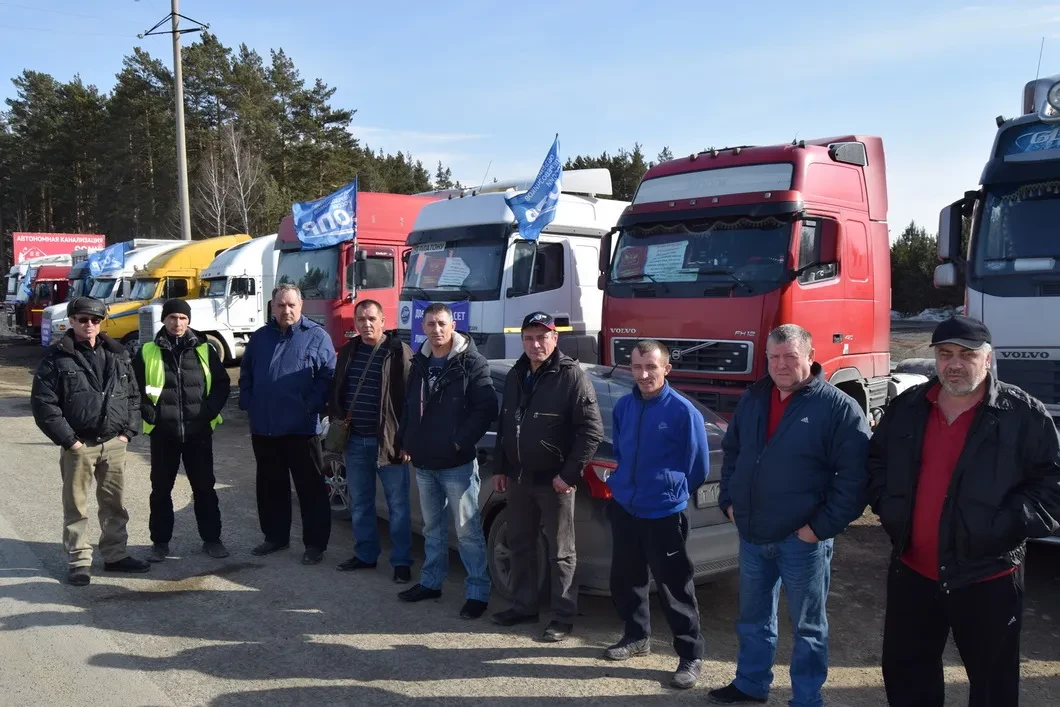
For more than ten days, the All -Russian strike of truckers continues, advocating the cancellation of the Plato system. In Yekaterinburg, protesting drivers put their heavy trucks on the 30th kilometer of Yekad-this is the only place that the organizers managed to agree with the local authorities ready to send rebels away to the forest, if only they saw them smaller people.
On the patch next to the gas station costs about twenty heavy trucks, it is no longer placed physically. The traffic police officers zealously make sure that no one stops at the side of the road, so the truckers periodically replace each other: someone leaves, making room for colleagues. Immediately burn the bonfires on which they cook food. Products in excess are brought by local residents and other drivers who are sympathetic to truckers. Law enforcement officers are constantly monitoring whether any of the drivers of vodka had drunk and was not inspired by further actions. Protesters do not drink fundamentally. The protest in this case is not a courage, but a manifestation of the last stage of despair. Many of the Urals have not been in the country in their trucks for a year and a half. Someone got a job in a taxi, someone just without work.
“Our task is to convince the power to cancel Plato,” said Andrei Gurov, a member of the strike. - In our opinion, this system is illegal, inhuman and unfair. We also require an explanation where the money collected as part of the excise tax on fuel, because the price of diesel fuel is growing monthly. Why is this money not to repair roads?
With each of the more or less active participants, the strikes are stablely held preventive conversations on the initiative of police officers.
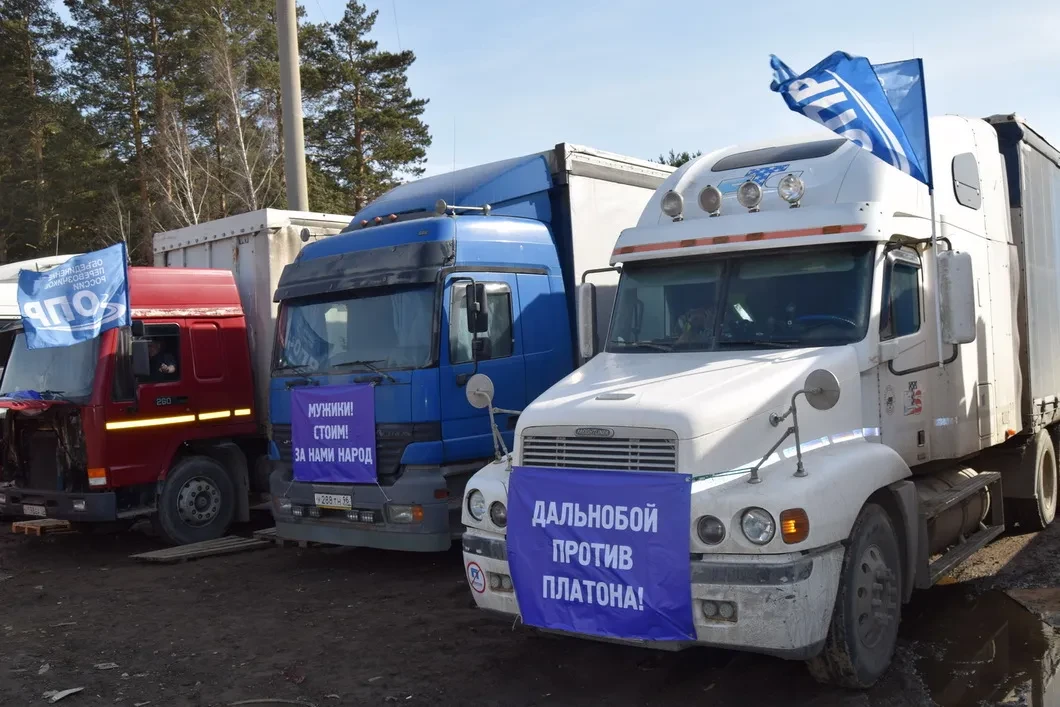
“Police first of all require us to remove posters and flags from cars,” said Nail Nigmatullin, one of the activists of the “Association of Russian Carriers” in Yekaterinburg. “They say in direct text: they say, stand silently so that no one can see or hear you.” Pressure is carried out constantly. They came to my house “to visit”, came to my parents ... There is one of the “guests”, usually this is a policeman, the rest remain nameless. The emphasis is on the fact that this is a private conversation, "purely human." Trying to find out who pays us for the organization of strikes. How do you explain to them that when you have nothing to feed and children, you do not need any “external” organizers? As I understand it, people in uniform do not care about us, by and large, they are afraid of only one thing - no matter what it would not come out of our confrontation, which will damage the current government.
According to Maxim Fokin, a member of the strike of truckers, the police are constantly gathering from the participants in the explanation, they are worried about the question: what is the officially called this action, is the meeting of the truckers a rally, whose participants can be held accountable? So far, law enforcement officers have not decided how to respond to the response of truckers that they hold an unlimited meeting. Participants promise to stand before the cancellation of Plato. Approximately every second private owner of the heavy truck in the region participates in the "Italian" strike without going to the track, and this is a total of up to a thousand cars.
Izolda Drown
Volgograd
Officials promise to transfer a letter to Moscow
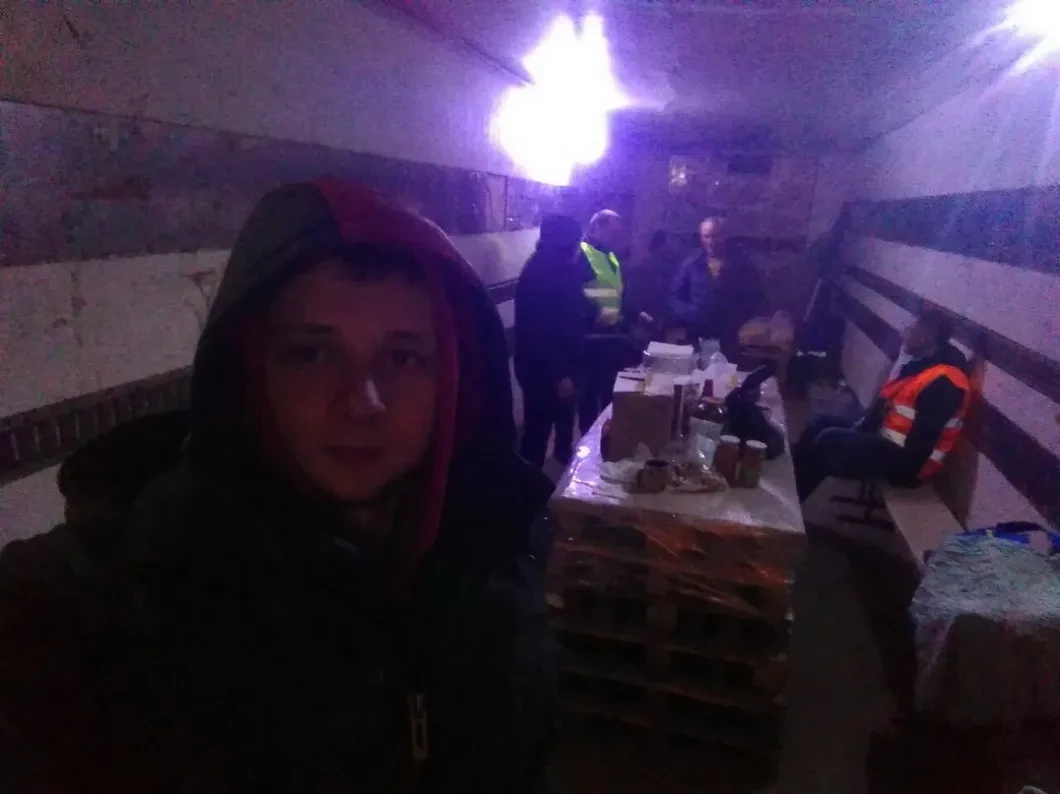
The extreme row of the road lane in the Samara roadway, in the Dzerzhinsky district of the city, occupied about three dozen heavy trucks lined up one after another. Volgograd residents are in the know - truckers are striking against the Plato system.
The fact that drivers of heavy vehicles intend to join the unlimited protest rally, the start of which was given on March 27, were reported by local media.
By noon on March 27, a chain of two dozen trucks of domestic and imported production was stretched at the Samara road. Drivers in a businesslike way installed a car factory on a roadside section, which became a mobile point and a place for future negotiations with the authorities. They brought folding chairs and a table, a gas cylinder and tiles to cook food, kettle, plastic dishes, supplies of food and water, communications, just in case, a medical first -aid kit.
During the day of heavy trucks, everyone arrived. Drivers were traveling from different regions of the Volgograd region: Gorodishchensky, Mikhailovsky, Frolovsky, Uryupinsky, Svetloyarsky, Kamyshinsky, Zhirnovsky. Someone needed to overcome 50 kilometers before the appointed place of the promotion, to someone-200. But not one of them is going to leave today-truckers intend to continue the indefinite action until they pay attention to officials and their requirements and proposals will listen to them.
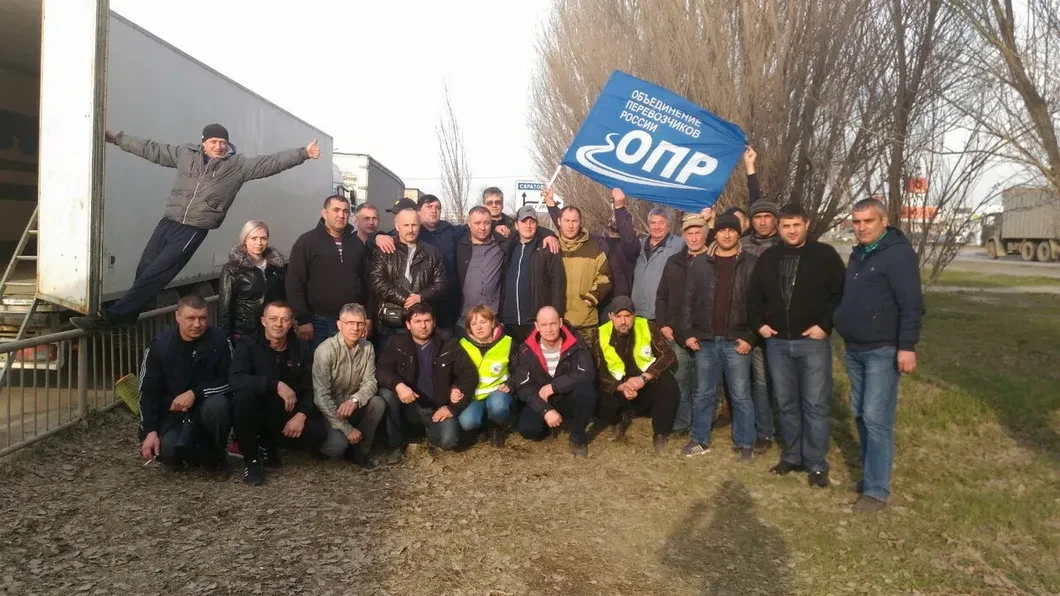
Fide drivers say that they will “stand to the last” - at least a week they will be enough for sure. And then - the serious consequences predict, first of all, for ordinary Volgograd residents. After all, while drivers drink tea in cars and listen to the latest news on the radio, there is no one to carry the goods to the Volgograd retail chains. Anton Vladimirov, a participant in the action, is sure of this:
- The situation is similar to a vicious circle. With the solution of the problem with Plato, which drivers are opposed, the issue of filling the city’s stores will be resolved. If our action is delayed, dairy products, bread, vegetables, fruits will disappear. Tint Networks have their own transport service, but we can’t know that only we can cope with the transportation of perishable goods.
Roman Andronov is an entrepreneur, he has been transporting various cargoes for several years for several years. He says that his business is surrounded on all sides by different taxes, there are only eight of them. Three road taxes, and above all, “Plato”, consider to be excessive for entrepreneurial activity. The costs of paying for tax obligations are more than profit.
“Working almost free is what we are forced to do now,” says Roman. - And we gathered here to explain to the authorities: “Plato” is a hard and cruel, devastating road. We will demand its cancellation or at least reorganization for transit transport.
In fact, Volgograd truckers have more requirements: to resign the Russian government, cancel transport taxes, establish a system of labor and rest of large -loading drivers, for which a developed roadside infrastructure is required, and provide carriers with justification of excise excise taxes on fuel.
In the crowd of men participating in an unlimited protest, there is a pretty young woman whose trailer was used to arrange a mobile point. This is Alla Run, Head of the Union of Cargo Cars and Entrepreneurs of the Volgograd Region Soyuz 34 and a representative of the association of carriers of Russia.
“Our action is peaceful, we are all law -abiding citizens,” she says. - We do not overlap the track, do not arrange riots, do not interfere with the movement. But we have requirements and we are ready to discuss them. We want to carry out a dialogue with the Minister of Transport Sokolov, and not with his subordinates who do not actually make decisions ...
Nevertheless, the next day the truckers met with Anatoly Vasiliev, the head of the road economy of the Volgograd region. He informed the participants in the action that a working group was created from among regional officials, which asked for substantiating the stated requirements. In order to then transfer them to Moscow, to the government.
Alla Run says that most Volgograd residents are understanding about what is happening. Citizens carry warm blankets, food, drinking water to the Samara road.
“The patrol car and police are constantly with us,” says Alla Run, “we can say that they protect us and guard ...
There is someone to protect drivers from. More than once, different types came to the place of the action, pushed drivers to stop the strike: they say, a family, children, and it’s not worth going against the government and the president. Truckers do not join the controversy, because, yes - at home, family, children who need to be fed, but nothing - all income goes to repay the road gathering.
Evgenia Akhremenko - especially for "New"
Saint Petersburg
"And the next morning I go out onto the road with renewed vigor ..."
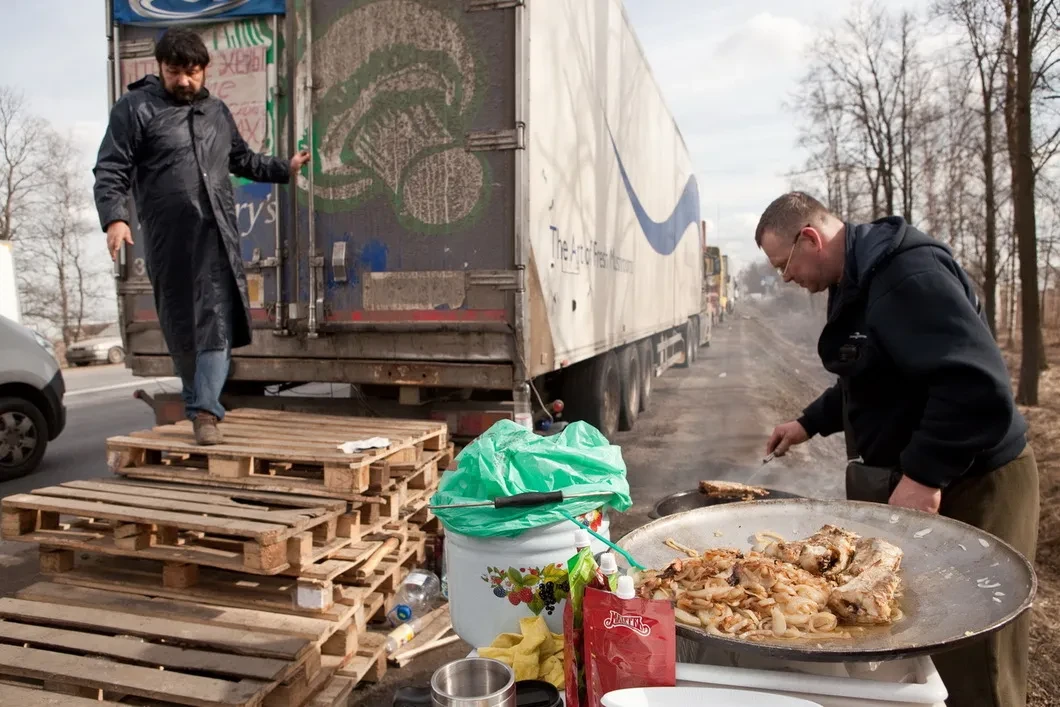
“Twenty heavy trucks on the Moscow Highway are, of course, only a sign that“ we are striking, ”says St. Petersburg truckers,“ in fact, protesters are hundreds of times more. ” How much exactly will be known by April 10. Now the protesters are busy just because they recalculate colleagues in all regions of the country opposing the Plato charge system. The task is not easy: only in St. Petersburg it is necessary to go around more than 200 parking lots, and in the Leningrad Region and there are even more points, and the distances are different.
In addition, the initiators of the strike noted, all like -minded people, even those who do not protest openly, are noted to take into account.
“Initially, several forms of participation in the protest rally were provided,” says Anatoly Shilov, a representative of the OPR (unification of Russian carriers) in St. Petersburg, “stand on the highway, not to leave the parking lots, not to refuel fuel, and not take cargo.
On March 27, when the All -Russian strikers of truckers started, about two thousand drivers connected to it in the Northern capital, according to the OPR. On April 7, OPR coordinators counted over five thousand protesters in the city, and the counting has not yet been completed. With numbers in the Leningrad region, they are even more difficult, but, they assure the unification of carriers, they are hardly less. In the St. Petersburg branch, ODR generally believes that the number of discontent expresses Plato in the near future will grow more than decreasing, despite all the difficulties that truckers and their family are now experiencing.
“Yes, we all lose profits,” admits Anatoly Shilov, “but if we are not lost today, we will lose everything in a year or two.” It is better to lose small. By and large, there is nothing special to lose-not the same salaries in order to worry strongly. We will find another job for ourselves for sure. But what will happen with transportation, with the industry?
The final requirement of the protest rally has one more than once repeated by them: negotiations with the authorities that will lead to the abolition of Plato. They formulated their main thesis as follows: “We do not want to block the roads - we want dialogue and justice.” There was an idea to draw a poster, but changed their minds, decided not to provoke law enforcement agencies. The patience of people is especially surprising that the inhabitants do not understand the direct connection of Plato and the growth of prices in stores. And most importantly - the fact that truckers fight not only for themselves - but for all.
“Kommersants are ready for this,” the strikers explain, “but they put this margin on the goods.” After all, not a single entrepreneur will work to the detriment, and in the end this fee - Plato - lies with the final consumer. And this is all. And we, and you and our relatives. We do not steal goods from a truck - we buy it in the store.

Petersburg heavy trucks along the road are so neat, and drivers behave so delicately that perhaps for this reason the police still do not touch them - there is nothing to complain about. The only incident happened on the evening of April 3: they detained and delivered to the Pushkin police department (suburb of St. Petersburg) of the St. Petersburg Activist ATR Vadim Yatsuk. His associates consider the detention illegal: the essence of the accusations neither Yatsuk nor witnesses are still unknown. Formally detained, Article 20.2 of the Administrative Code of the Russian Federation “Violation of the procedure for holding a meeting, rally, demonstration, procession or picket” was charged. However, colleagues from the Moscow highway claim: neither Yatsuk nor they did anything that day - it was not before. If somehow they can interpret what happened, then only a citywide amplification in the evening of April 3-Yatsuk was taken about 17 hours, shortly after the attack in the subway.
How long will the truckers go on way in St. Petersburg? The question is the most difficult for them. Smoke. Shrug. Answer: "To the end." Then they clarify that there may be two ends - either an agreement with officials, or the care of truckers to another job. What is more profitable than power?
— Иногда я надеюсь услышать ответ от верхов (ну или хотя бы какую-то позицию Кремля в отношении нас) и тогда включаю телевизор, который вообще-то не смотрю года два, — откровенничает на прощание Анатолий Шилов. — Включаю телик — а там всё зашибись! Мы, оказывается, живем так хорошо, что меня аж злость берет, и наутро я с новыми силами выхожу на дорогу…
Nina Petlyanova
Saratov
Против бастующих «применят» Гагарина
В Саратовской области дальнобойщики проводят акцию на окраине Энгельса. По обочинам трассы на выезде из города стоят около трех десятков грузовиков. Состав участников не постоянный: одни уезжают, другие приезжают. «У нас не было задачи собрать много машин, они мешали бы движению, — говорит местный координатор протеста Александр Черевко.— Мы хотим, чтобы проезжающие мимо люди заметили остановленные грузовики, заинтересовались и открыли интернет, ведь телевизор о нас не рассказывает».
Сколько водителей бастуют, оставив машины дома и на стоянках, саратовские организаторы не знают. «В Краснокутском районе всего пять грузовиков, и все они стоят. Не выходят на работу ребята из Балашова, Вольска, Калининска. Полную информацию с мест собрать невозможно. Мне вчера дозвонились (страшно сказать!) с полуострова Ямал, рассказали, что протестуют, сидя в гараже, так как полиция пригрозила драконовскими мерами, если они высунутся», — рассказывает Александр.
Как вспоминает предприниматель, с момента появления «Платона» он понял, что больше не сможет «существовать на этом рынке». «Чтобы зарегистрироваться в системе, требовалась справка об отсутствии задолженности по налогам. У меня такая задолженность была, так как за несколько месяцев до того сломались сразу два моих грузовика. Капитальный ремонт двух двигателей — это безумно дорого, а банки мне навстречу не шли». На сегодня из четырех «Фредлайнеров» у Черевко остался один.
Отслеживать последствия протеста поручено женам дальнобойщиков: проблемы с перевозками должны в первую очередь проявиться в овощных отделах сетевых магазинов. Бастующие намерены продолжать акцию до тех пор, «пока власти не начнут полноценный диалог».
За время стачки к участникам лишь однажды приезжал мелкий чиновник из областного министерства транспорта. Ведомство распространило официальный комментарий, в котором высказало сожаление по поводу забастовки: «Если позиция грузоперевозчиков останется неизменной, вряд ли для российских дорог наступят лучшие времена». По сведениям Росавтодора, в прошлом году за счет сборов «Платона» Саратовская область получила 650 миллионов рублей, на эти средства было отремонтировано 156 километров дорог.
Как и во время первой волны протестов, проходившей осенью 2015 года, о поддержке бастующих заявили представители КПРФ. Депутат Госдумы от коммунистической фракции Валерий Рашкин встретился с энгельсскими водителями и пообещал передать их требования президенту и правительству.
По словам перевозчиков, еще в первые дни протеста полиция собрала объяснительные с владельцев стоящих на обочине фур. Неподалеку от места стоянки постоянно дежурит автомобиль с бойцами Росгвардии. «Отношение правоохранительных органов было хорошим. Но вчера полиция разочаровала: участковые начали ходить по квартирам ребят, которые стоят здесь, расспрашивать родственников, знают ли они, чем мы занимаемся, хотя мы сами ответили на все вопросы в объяснительных. Конечно, пожилые родители напуганы беседами про антитеррор и экстремизм», — рассказывает Черевко.
Как полагают участники стачки, власти попытаются очистить трассу к 12 апреля: в Энгельсском районе в День космонавтики на место приземления Гагарина поедут крупные чиновники, которым надлежит видеть исключительно картины народного ликования.
Надежда Андреева , соб. Corr. "New"
Murmansk
Бунтовать не по карману
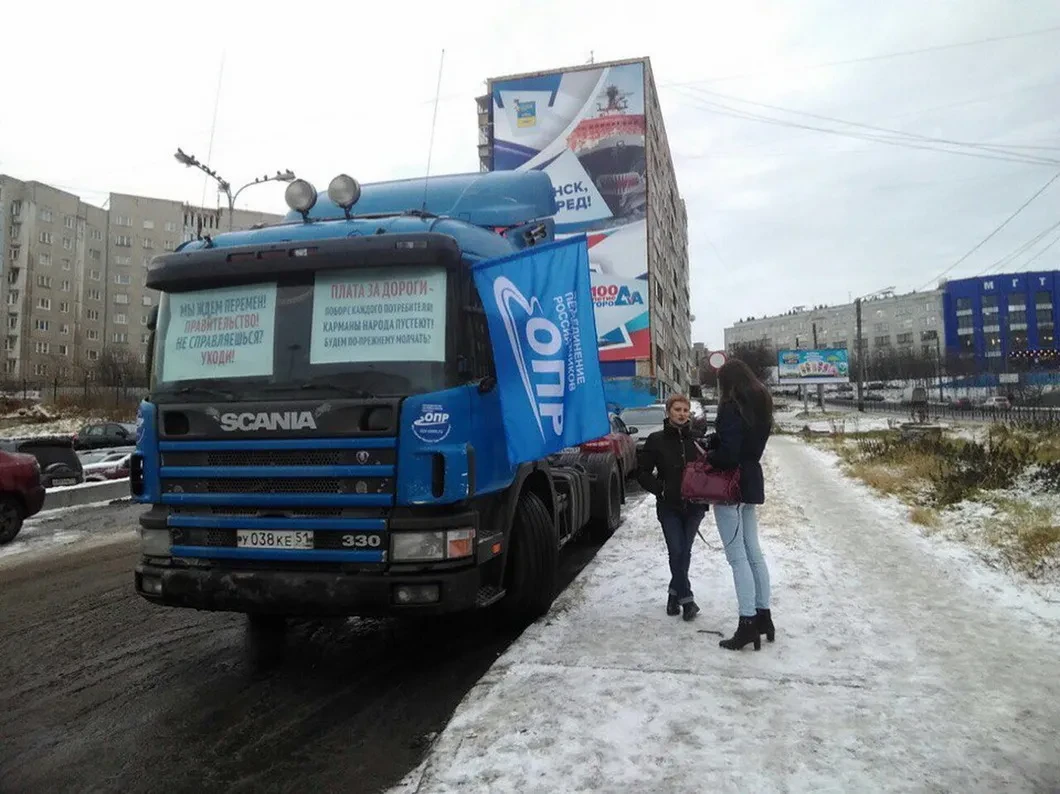
В Мурманской области в стачке полноценно участвуют только в одном поселке.
В регионе стачку дальнобойщиков поддержали, по оценкам ее организаторов, процентов 10—15 от общего числа водителей большегрузов. Всего в регионе зарегистрировано около тысячи предпринимателей, занимающихся межобластными грузоперевозками, у многих работает не по одной машине.
Решились полностью встать только в одном населенном пункте — отдаленном поселке Ёна на юге области. С 27 марта ни один из водителей там не сел за руль. Держатся, покуда могут.
«Ёнские молодцы, стоят все, — говорит Мария Пазухина, председатель областного отделения Объединения перевозчиков России. — Сколько простоят, не знаю, мы себе сроков не устанавливали, по идее — до выполнения наших требований. Но остальные, большинство, ездят. Особенно те, кто работает на сетевые магазины. Поддерживают протест многие, но присоединиться не могут себе позволить».
В публичных акциях участвуют человек 50 в общей сложности. Акции эти разовые, точечные. Так начало протестов отметили, выбравшись на федеральную трассу в район поселка Пушной — в 60 километрах от Мурманска. Там полсотни водителей простояли несколько часов. Претензий со стороны полиции не было. Повторно о себе заявили 3 апреля, проехав по Мурманску колонной из семи фур и трех легковушек.
Татьяна Брицкая, соб. Corr. "New"
Primorsky Territory
«Платон», ГЛОНАСС и губернатор
В Приморье начатый дальнобойщиками протест против «Платона» быстро приобрел общесоциальный характер. В ходе «антиплатоновского» митинга также звучали речи против системы «ЭРА-ГЛОНАСС» и губернатора.
Сперва приморские дальнобойщики, включившиеся во Всероссийскую акцию против повышения платы за проезд по дорогам, устроили «стоячую забастовку»: припарковались вдоль федеральной трассы на въезде во Владивосток, написав на кабинах лозунги против «Платона». Поначалу полиция отнеслась к происходящему лояльно, но уже назавтра здесь появились знаки, запрещающие остановку. В ГИБДД пояснили: на этом участке идет «уборка обочин». Соответствующую технику, правда, увидеть не удалось.
От митинга, прошедшего во Владивостоке 1 апреля, руководство приморского профсоюза перевозчиков открестилось, испугавшись «политической составляющей», из-за чего организаторами выступили закаленные активисты КПРФ. Неудивительно, что тематика митинга стала шире, тем более что «Платон» бьет отнюдь не только по дальнобойщикам. Поддержать автомобилистов пришли пешеходы — от пенсионеров до студентов, общим числом до 200 человек. Полиция следила не вмешиваясь.
Дальнобойщики считают «Платон» коррупционной схемой и не верят, что собранные деньги пустят на ремонт дорог: ведь они идут не в казну, как налоги, а близкой к «кому надо» фирме. Водители и без «Платона» платят транспортный налог и топливный акциз, но качество приморских дорог оставляет желать лучшего. Недавние аресты главы Примавтодора и курировавшего дороги вице-губернатора Ежова говорят сами за себя.
Другой темой митинга стала система «ЭРА-ГЛОНАСС»: оснащение б/у машины «тревожной кнопкой» (гаджет не сложнее мобильника) будет обходиться в Приморье в 27 тысяч рублей. Речь также шла о коррупции, росте цен и коммунальных платежей. В резолюцию митинга вошли требования об отмене «Платона» и обязательной установки «ЭРЫ-ГЛОНАСС» на подержанные автомобили, а заодно об отставке приморского губернатора Миклушевского.
Василий Авченко, « Новая во Владивостоке»
Иркутск, 16 км Московского тракта
Манас, Дагестан