
Translated material
The origin of giant viruses
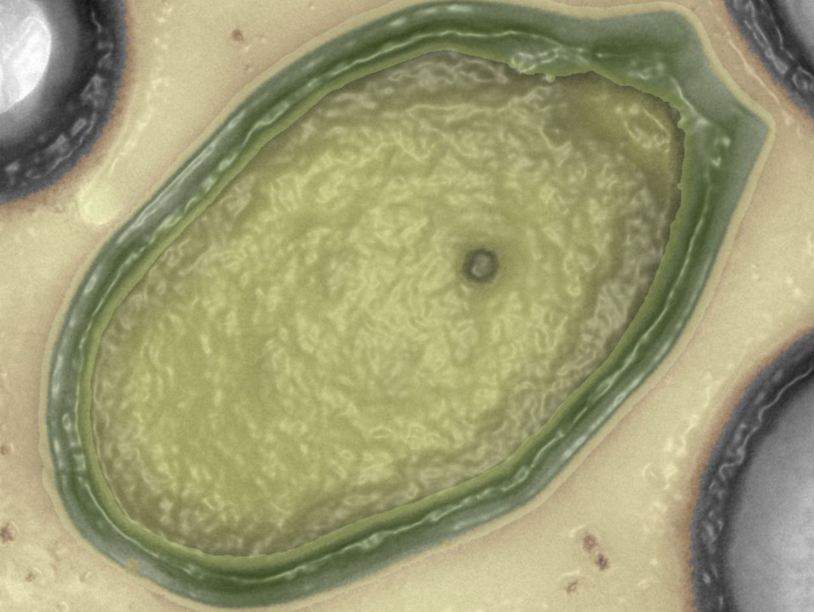
The discovery of a new group of giant viruses again made us think about the question of where such unusual viruses came from. The authors of the work lead to significant arguments in favor of the fact that these viruses come from smaller viruses and with a smaller genome, but in the course of development they managed to acquire new genes, kidnapping them in other organisms.
For the first time, giant viruses were started in 2003, when a description of the virus with a capsid diameter of up to 500 nanometers was published in Science magazine. He was actually known much earlier - from 1992, when he was discovered in one of the types of amoebas. But then, because of his size, he was mistaken for a bacterium. When the error was clarified, the virus was called mimivirus - a reduction from Mimicking Microbe Virus "Mimicing for a microbe virus."
Mimivirus champions were until 2011, when Megavirus Chilensis with a capsid of 680 nanometers was found in sea water off the coast of Chile. Later it turned out that it also parasitizes on amoeba of the genus Acanthamoeba . In 2015, a new champion appeared - Pandoravirus. Its dimensions are 1.5 by 0.5 micrometer, that is, it can easily be seen in an optical microscope. Three types of Pandoraviros are known: one was found in sea water in Chile ( Pandoravirus Salinus ), the other in fresh water in Australia ( Pandoravirus Dulcis ), and the third ( Pandoravirus Inopinatum ) was a little later discovered in the samples taken in 2008 from the patient with acantamebmary keratitis.
In recent years, several more unusually large viruses have been found in size from 200 nanometers to 1 micrometer. For example, in the same sample from the permafrost zone, Mollivirus ( Mollivirus Sibericum , 600 Nm) and Pithovirus ( Pithovirus Sibericum , up to 1.5 micrometers in length, a competitor of pandoraviruses for the title of the largest virus) were discovered. All of them multiply in the amoeba Acanthamoeba . To show how large such sizes are for viruses, we recall that the size of the capsids of the ZIK virus is approximately 45 nanometers, the poliomyelitis virus is 30 nanometers, the human immunodeficiency virus (HIV-1)-120 nanometers.
Even more important than the size, a feature of giant viruses turned out to be their genetic characteristics. The genomes of these viruses are great and contain many genes that are not found in other viruses. The mimivirus genome contains 1 181 404 pairs of bases, megavirus - 1,259 197 pairs. Even more pandoravirus genomes: Pandoravirus Salinus - 2.77 million pairs, Pandoravirus Dulcis - 1.93 million pairs, Pandoravirus Inopinatum - 2.24 million pairs. Such large genomes contain more than one and a half thousand genes ( P. Salinus has even 2556), although some ordinary viruses have only a couple of genes.
Such the dissimilarity of gigantic viruses to previously known caused the appearance of the hypothesis that it arose regardless of other viruses, and came from some unknown organisms that were not related to the three available domains: bacteria, archaeas and eukaryotes. These organisms had a cellular nature, but followed the path of parasitism, gradually lost many genes and, accordingly, cellular organelles and, as a result, “reached” the virus stage. It was possible that life on Earth arose (or was brought to the ground from the cosmos) twice - once the ancestors of bacteria, archaea and eukaryotes arose, and the other - the ancestors of giant viruses.
The new work proves that the hypothesis of the particularly origin of giant viruses is incorrect and that they are much closer to the viruses of ordinary sizes. Its authors became the international group of scientists, led by Frederik Schulz (Frederik Schulz) of the United Institute of Genoma, Evgeny Kunin from the National Center for Biotechnological Information of the National Health Institutions of the United States and Tanja Woyke from the United Institute of the Genoma.
The genetic material of new giant viruses was discovered in wastewater from treatment facilities in the Austrian city of Klostasternurg, so they are called Klosneuvirus . The virus genome consists of 1.57 million pairs of base. It was discovered using the method called metagenomic, that is, sequencing of all DNA fragments found in the sample taken from the natural environment. Using this method, you can determine the species composition of all inhabitants of this environment, including viruses. It allows you to obtain, among other things, the genomes of those organisms that cannot be cultivated in the laboratory. Most often, in this way, ocean water or underground sources, sea deposits or the bacterial population of the human body are examined in this way.
It was from the obtained fragments of the genome that scientists managed to collect the full genome of the new virus. The size of its capside is supposedly equal to 300 nanometers. Klosneuvirus , as scientists found out, has genes necessary for the synthesis of proteins with all twenty necessary amino acids.
Metagenomas of three related viruses were also found that received the names Indivirus , Hokovirus and Catovirus . These viruses are parasitized, presumably, in the body of unicellular creatures from the type of ceremonies ( Cercozoa ). This is the first time that giant viruses do not multiply in amoebas. In the genomes of all these viruses, approximately 2500 new genes of genes were found, previously not noted in other viruses. But 355 of them have an eukaryotic origin.
Based on the obtained genomes, scientists built the genealogical tree of these viruses. They came to the conclusion that Klosneuvirus and his relatives are closest to mimiviruses. It is most likely that the ancestors of these viruses once had a relatively small genome, but during evolution they seized more and more genes of eukaryotic organisms in which they multiplied. And as a result, they acquired very large (by the standards of viruses) genomes. An important fact is that borrowed genetic elements are correlated with different host organisms. If they had a common nature, it could be assumed that giant viruses came from non -viral organisms during the gradual simplification of the genome. In the same situation, it turns out that they did not reduce, but expanded their genome, assigning a little here and there.
Thus, the study proves that there is no significant evidence in favor of the existence of a hypothetical “fourth domain” of wildlife, from whose representatives giant viruses come. Some colleagues praised the evidence of a new job. “I find it very convincing,” says Max Fisher virologist from the Max Planck Society Institute in Heidelberg. “Based on the available data, I would not put money on the hypothesis of the fourth domain.” However, other scientists also express doubts. Among them, Didier Rault from the University of ex - Marseille, one of the discoverers of mimivirus. It does not seem to him that the phylogenetic tree of these viruses is built in work on reliable foundations. The geneticist Jean-Michel Claverie from the same university, which was part of the group that opened the Pandoravirus, believes that the conclusions about the evolutionary tracks of viruses can only be drawn after obtaining their isolated culture, and not based on the results of metagenomics.
The results of the study are published in the journal Science.