
Translated material
Through the eyes of another
Ivan Davydov about Jacques Margeret's visit to the Principality of Moscow
Jacques Margeret is a French mercenary who fought in the armies of Godunov and False Dmitry, the author of the work “The State of the Russian State and the Grand Duchy of Moscow,” an important source on the Russian state of the early 17th century. Ivan Davydov talks about the adventures of a Frenchman in Muscovy and his observations of the lifestyle of Muscovites who love kvas and beluga.
Ever since, in the 18th century, new Russians began to slowly discover and make fashionable their own pre-Petrine history, writings by foreigners about Russia began to be read. Firstly, probably because the structure of speech and thoughts of foreigners was clearer to an educated Russian than chronicles and temporary books. Secondly, also because the Russians wanted to simultaneously be Europe and to oppose themselves to Europe, to become a better Europe (the reasoning widespread in modern Russian propaganda that only we preserve true European values, and all the healthy forces of Europe - in other words, the ultra-right - are drawn to us, show that this desire has not gone away today). The presence of such a desire gives special value not just to the view from the outside, but precisely to the view of those whom we both despise and try to take as a model.
Pskov residents are still proud that one of Batory’s soldiers compared their city with Paris, although over the past centuries the similarity has ceased to be so noticeable.
Well, there is - although this is a completely subjective judgment - a special charm in the way a neophyte describes something that has been familiar to you since childhood, and does not seem to require any additional interpretation. In how the next ambassador, shaking in a cart along the beaten roads of the 16th century, which have not become much better since the 16th century, writes in his notebook lines dedicated to a strange, weak, cloudy beer, which the local savages call “kvas”.
By the way, the “dissertation” of the Minister of Culture Vladimir Medinsky, notorious both for its scholarly mistakes and for its complete (due, apparently, to the quality of the material) unsinkability, is the “dissertation” of the Minister of Culture Vladimir Medinsky, and a whole bunch of brochures that the minister generated based on his own scientific work are devoted precisely to exposing the machinations of those very foreigners who left notes about Russia, revealing their treachery, secret tasks and obvious customers of slander.
In general, the look of the other is still in fashion.
Ambassadors and soldiers
Our today's hero, by the way, is also mentioned by Medinsky in the book “On Russian Drunkenness, Laziness and Cruelty.” The minister remembers him with an unkind word, and at the same time proves that laziness and cruelty are even less characteristic of Russians than drunkenness. But it was not the minister who provided the French adventurer with a place in Russian literature. The place is absolutely undeniable. Many would be jealous.
“What does Orthodox mean?.. Damned trash, damned bastard! Damn it, mein Herr, I’m really furious: you’d think they don’t have arms to fight, but only legs to run away.” It is he who is slandering his ancestors—a French mercenary in Russian service, Captain Jacques Margeret. The original is in French. Alexander Sergeevich Pushkin, “Boris Godunov”.
“Boris Godunov” is dedicated to the “unforgettable memory of Nikolai Mikhailovich Karamzin for Russians,” and Pushkin read about Margeret from Karamzin. The Frenchman, who penetrated not only into Russian literature, but also into Russian history, is mentioned in the last volume of “History of the Russian State.” Margeret, fortunately for us, was himself a writer and left the book “The State of the Russian Empire.” The last time it was published in a new translation was by the publishing house “Languages of Slavic Culture” (2007) with the appendix of the original text, many documents about Margeret’s life and an excellent reference apparatus.
In the 16th and 17th centuries, it was mainly diplomats and merchants who wrote about Russia (especially since merchants often turned out to be diplomats and vice versa - the British under Grozny, as we know, ended up in the Muscovite kingdom by accident, which ultimately became the beginning of a wonderful friendship). Notes of a diplomat are soothing reading, like the road from Novgorod or Arkhangelsk to Moscow. The ambassador moves without haste, sharing his (rather wild - Muscovy was not the epicenter of the interests of educated Europe) knowledge about the past of this vast country and describing what he saw along the way. Rivers, forests, sleighs, frozen carcasses of pigs in a sleigh, a drunken priest, drunken farmers... The inevitable kvas and the inevitable beluga. Kvass is annoying, but I like beluga. Distances that amaze the imagination. The tedious details of diplomatic bargaining: who should dismount first, how many titles of the autocrat should be listed in documents. To go to an audience with or without hats, sit or stand at a reception, whose health to drink first - your sovereign or the tyrant of Moscow...
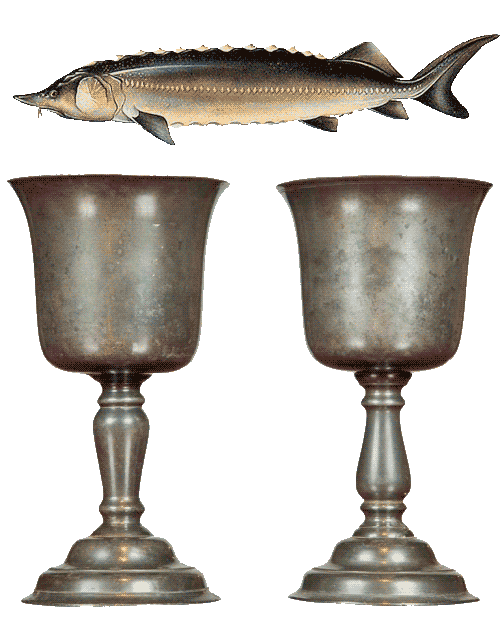
But even in this confusing descriptive part there are passages that immediately explain how Margeret’s essay differs from other notes of ambassadors who visited Muscovy: “It should be noted that in the summer everyone rides on horseback, and in the winter on sleighs, so they do not do any exercise, which makes them fat and corpulent, they even honor the most pot-bellied, calling them the Portly Man, which means a nice person.”
For a professional mercenary, who before Moscow managed to serve and fight in France, the Holy Roman Empire, Transylvania and Poland, military exercises replaced fitness, and the sight of the Portly People clearly amused Margeret.
Warrior's word
Margeret was a warrior, he came to Russia to fight and came successfully - Russian history was tied into a knot. The Troubles began. There was no shortage of battles. He fought in Godunov's army against the first False Dmitry. Then he entered the service of the victorious False Dmitry and became the head of his personal guard: his soldiers, dressed in European style, marched with halberds around the Kremlin. I witnessed the first attempt at Western-style modernization; False Dmitry is, after all, Peter’s real predecessor, albeit an unsuccessful one. Karamzin describes how angry the boyars were when the new tsar preferred the company of artisans to their society, running around jewelry and weapons workshops. He describes, either without feeling the historical rhyme, or, on the contrary, mocking the readers, including the crowned ones.
Margeret saw balls in the Kremlin chambers, at which the Russian nobility gasped and sweated from shame, watching Polish women in seductive dresses dance with strange men. I saw the famous tank of False Dmitry - a fortress on wheels decorated with images of monsters, which Muscovites called hell and burned immediately after the death of the impostor. He could probably have accompanied the tsar on his planned campaign against the Turks, but instead he calmly watched as the rebels, inspired by the rebellious boyars, killed False Dmitry and destroyed his chambers. The personal guard and its commander did not sacrifice their lives for the tsar, although Margeret devoted several pages of his essay to a rather stupid proof that he served not a swindler, but the real Demetrius, the son of Ivan the Terrible.
The State of the Russian Empire moves from a measured narrative of geography and customs to pure, bloody, exciting action, becoming a story of the battles Margeret fought and the betrayals Margeret witnessed. Or he didn’t just watch - after the death of False Dmitry, his personal guard was allowed to calmly leave Moscow with all their property. Considerable property, for the young king was generous to those on whom he counted on relying. This gave rise to various rumors, not always pleasant for the Frenchman’s honor.
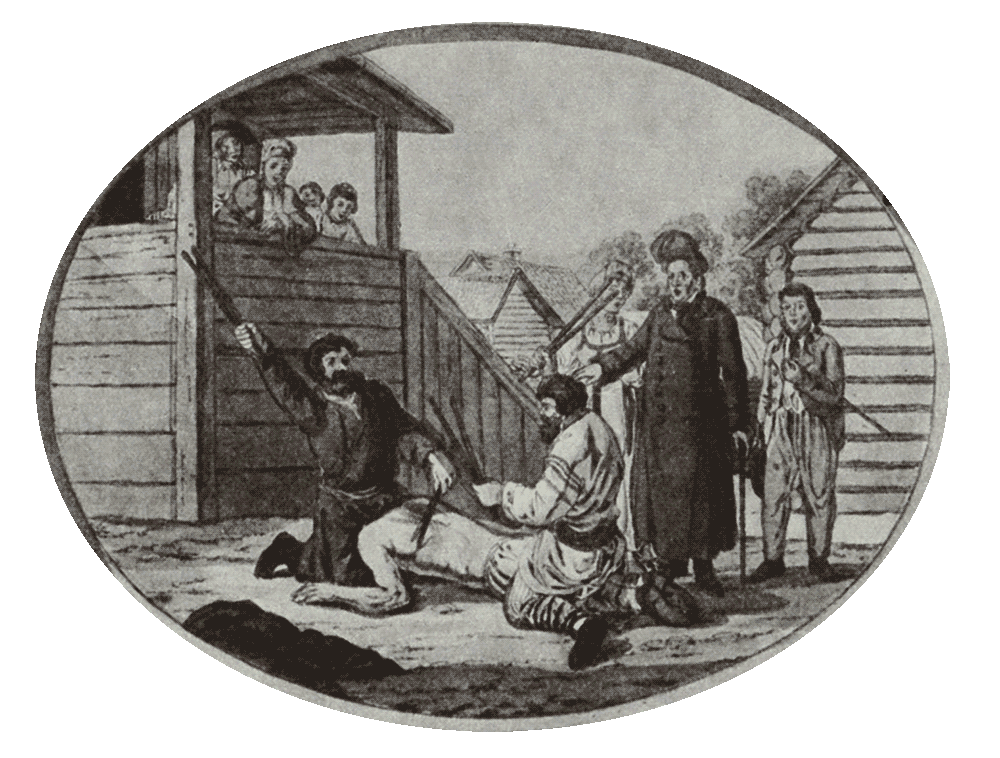
Punishment of a servant with batogs in the presence of the landowner. Engraving by H. Geisler. Late 18th century
Image: historian.rf
By the way, about honor. Margeret manages to distract herself from the stories of battles in order to marvel at another custom of the Muscovites: “There are no duels between them at all, since, firstly, they do not carry any weapons, except in war or on some journey, and if someone is offended by words or otherwise, then they must demand satisfaction only through the court, which sentences the one who injured the honor of another to a fine called “dishonor,” that is, compensation for damage to honor." The following describes in detail the process of punishing a convicted person with batogs.
He fled to Poland, returned, fought in Russia again, getting confused, like everyone else then, about the sides of the conflict: Russia was collapsing, the combatants ceased to understand with whom and for whom they were fighting.
In 1611, Jacques Margeret left Russia forever and settled in Lithuania, and in 1613, when the Russians were choosing a new autocrat, the Frenchman wrote a rather lengthy letter to King James I of England. Margeret described in detail the catastrophic state of Russia after the Time of Troubles, arguing that the country - or at least its northern regions - would be very easy to capture even with a small army, if he, Jacques, was put in charge Margereta. “There is no doubt that your army will be greeted with joy by most of the people of that country,” the Frenchman wrote for some reason, and this is really offensive. There were no armies here that we would greet with joy.
The king did not answer the letter, the Russian north remained Russian. There is no information about Margeret after 1621. However, by that time he was already an old man - he was born in the middle of the 16th century.
" Margeret :
Where, where? Allons... send me back!
One of the fugitives :
Go ahead yourself, if you want, you damned infidel.
Margeret :
Quoi? quoi?
Another :
Kwa! qua! You love, overseas frog, to croak at the Russian prince; But we are Orthodox.”
This will not go anywhere - neither from Russian history, nor from literature. Although, of course, there is nothing of the kind in Margeret’s notes.