
Translated material
Blood and exotic. How Europeans designed the image of the East
In the “sentimental journey” of Viktor Shklovsky, the best book about the Russian Revolution, the most incredible chapter - about the adventures of the author in Persia, where he turned out to be the commissar of the Russian army in the fall of 1917. It casually mentioned a certain L.L., the old acquaintance of Shklovsky, who "was in a panic, he arrived east and waited for the east of a colorful tail, and saw the east of the clay, straw and completely naked."
The author himself, despite all the adventures where he was involved-both by the tendency of character and by coincidence-albeit not in a panic, but also somehow not particularly cheerful: "I yearned in the east, as Gogol was yearning for Palestine, waiting for the rain at the boring station Nazareth." When I re-read this chapter, and I do this to strengthen the spirit regularly, every three or four years, I always remember Brodsky, who managed to see one boredom, monotony and dust in Istanbul.
And it seems to me that the poet was an incarnation of L.L., as well as a little incarnation of Shklovsky - and those tens of millions of people of the conditional “West”, who were waiting for one “East”, bright and exotic, but were on another, monotonous and boring. Plus, blood flows in this "East". However, this was always known about this in advance.
The idea of a sacred war
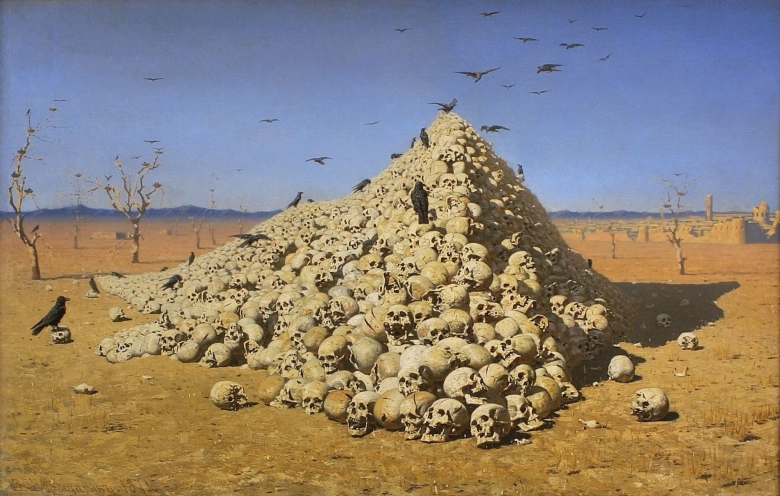
Both of these mental constructions - extreme exoticism and extreme cruelty of the East - have been created by Europeans for centuries. As a result, by the middle of the century before last, “Vostok” was made in almost all details - carpets, harems, scammers, picturesque beggars in rags, gloomy fanatics with burnt -shaped tours and pyramids of severed heads burning like coal. The latter somehow especially occupied the residents of the continent, on which, for example, in the XVII century thirty years there was a war, which destroyed more than a civilian population as a percentage of more than Hitler and Mussolini and others.
But the images are stronger than reasoning, the emotional truth beats deeper and rude rational. Moreover, the pyramids of heads - and other horrors - were in the east. And today they are, on a scale, almost the same as in some XIX century. It’s just that then only rumors and rare messages of random correspondents reached them about them and America, and now everything is in sight - here youtube, here is Instagram, Twitter and Facebook. And, of course, those who cut off their heads use all this no less than those who - potentially or in reality - can cut off their heads.
Subscribe to read the whole
Make a subscription Redefine.media to read Republic
Subscribe [you can pay for a Russian or foreign card. The subscription is extended automatically. You can unsubscribe at any time.]
Where are the money subscribers going