
Translated material
Once again about the rake
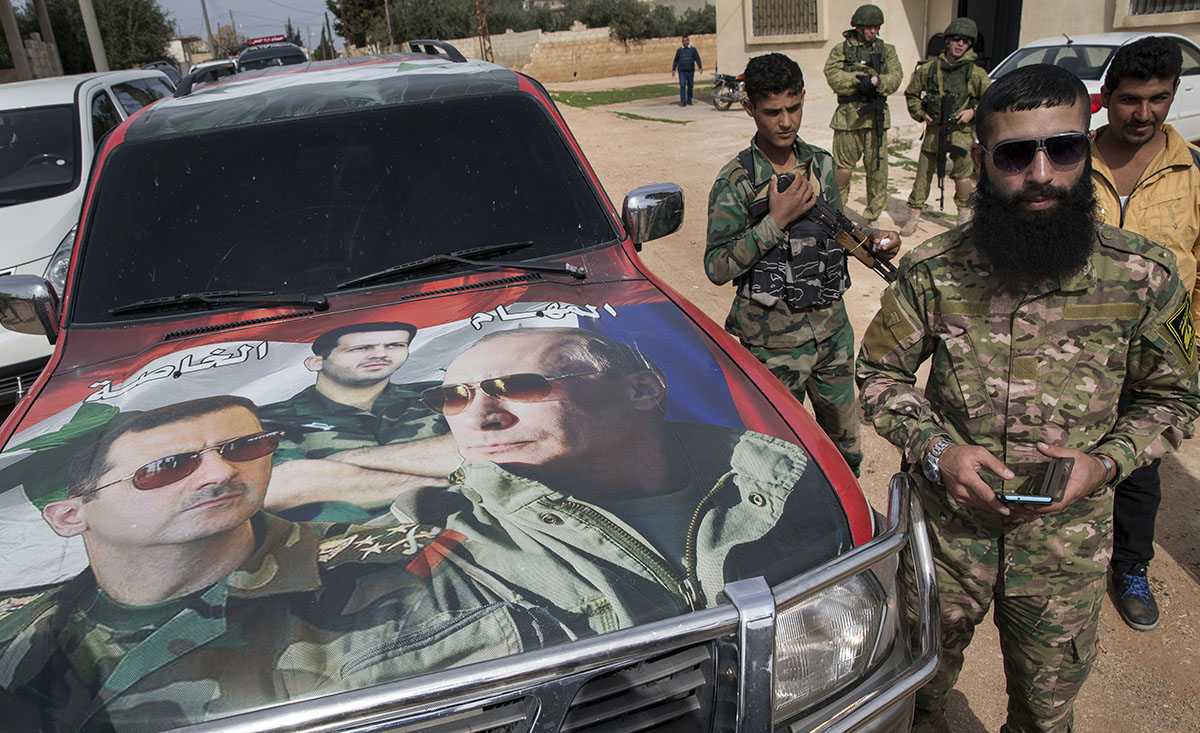
The monstrous chemical attack in residential quarters of the city of Khan-Sheikhun in the province of Idlib sharply changed the position of the United States and the European Union regarding the armed conflict in Syria, which has been going on for six years. The likelihood of a direct military intervention of the West in Syrian affairs has grown significantly, and the chances of the dialogue of Moscow and Washington fell noticeably. Of course, the official representative of the Russian Foreign Ministry, Maria Zakharova, will always find what to respond to opponents in the same laid -back manner, in which Russian politicians have long been communicated with the world. But it is important not what words have already spoken or still uttered or court political scientists admitted to the television cameras. It was time to admit that the entire Russian foreign policy of the latter has at least 20 years in itself a significant flaw, which seems to be not even due to the personalities of our leaders, but with some more deeper.
Why does Russia support the out -of -out outcasts over and over again, friendship with which does not bring any benefit, and for the sake of this it constantly destroys economic and political interaction with the West, as soon as it begins to develop?
Who was protected
In 1999, democratic Russia, which signed the partnership and cooperation with the EU and joined the NATO program “Partnership for the Peace,” for the first time, turned her back to the west - in response to the beginning of the NATO bombing of Yugoslavia. The reason for the intervention of the North Atlantic Alliance in the conflict in the Balkans was, if anyone forgot, the murder of 45 local residents in the Kosovo village (it is likely that some of them were fighters of the Kosov liberation army). After fierce disputes about the degree of guilt of the Yugoslav military, Belgrade left Rambuye's agreements and banned the activities of international peacekeepers in Yugoslavia. The answer to this was the NATO operation "Union Force". A year later, the President of the country Slobodan Miloshevich, who was so beloved by Russian leaders, was overthrown by his own fellow citizens and went to the Hague, where, alas, he died before the UN International Court of the UN officially recognized him as a military criminal. I note that Yugoslavia was not particularly needed by Russia either before or after these events (in 1998 it took only 0.87% of Russian foreign trade turnover), but our relations with the West were spoiled for three years.
In 2003, a completely different Russian leadership could not endure the glaring violations of international law, expressed in the invasion of the US troops and the coalition they collected in Iraq, which was then ruled by Saddam Hussein. It is characteristic that even Russia did not question the involvement of the Iraqi government in the murders of tens of thousands of own citizens - mainly in the Kurdish areas - or the fact that Iraq had previously committed unprovided aggression against Kuwait. However, the pathological, which has not yet been eliminated since the USSR, the desire to put sticks in the wheels of any American initiative has again led Russia to confrontation with the United States. The mutual understanding between the leaders of the two countries that developed after the meeting of Vladimir Putin and George Bush Jr. in Ljubljana and a call from Moscow to Washington after attacks in the United States in September 2001 was destroyed.
Iraq, too, did not have much economic importance for Russia (in 2002, trade with this country provided only 0.14% of our foreign trade). Hussein, unlike Milosevich, was convicted and hung at the end of 2006. The new “reboot” in Russian-American relations began only in 2009.
What was neglected
There were stories and other properties - when the Kremlin with amazing ease made direct economic benefit to the sacrifice to political phantoms and phobias.
In 2004-2005, when Russia barely became close to Germany and France due to general disagreement with the American operation in Iraq, another unforgettable event occurred-the presidential election in Ukraine. The Kremlin at that time fiercely supported Viktor Yanukovych, who eventually lost the elections, while giving rise to a wave of popular indignation. Europe, of course, supported the democratic choice of Ukrainians, as a result of which the relations of Moscow and European capitals deteriorated sharply. Ten years later, Yanukovych, who nevertheless became president in the next election, applied armed force against his people, as a result of mass protests was overthrown and fled to Russia, as they say, with billions looted in his homeland. Moscow provoked separatist unrest in the Donbass, took Crimea from Ukraine - and received economic sanctions and almost complete freezing of political dialogue with the EU and the USA.
In 2004, the volume of trade in Russia with Ukraine amounted to $ 16.8 billion, in 2016 fell to $ 10.2 billion, and our turnover with the EU against the backdrop of the crisis caused by Ukrainian events decreased over $ 217.3 billion (!) Over 2013-2016. The restoration of relations with Ukraine or Europe has not yet been expected.
Russia, it seems, is already accustomed to living in an illusory world, which it itself has created, to maintain its leaders in the feeling that they represent one of the superpowers, although this has long been not so
Who we cling to
At the end of 2010 and in 2011, in a number of North Africa states, spontaneous speeches of citizens began against corrupt authoritarian regimes. Moreover, in some countries they have held power for decades. By that time, Russia had close relations with Libya, which since 1969 has been ruled by a local theorist and practitioner of “sovereign democracy”, and part -time a famous international terrorist and accomplice of terrorists Muammar Gaddafi. When an uprising broke out in Libya, Moscow, contrary to custom, did not support the “fraternal leader” - as a result, Colonel Gaddafi was killed, and not in the most humane way. Events in Jamahiria, according to many informed experts, in many respects provoked a well -known “castling” in the Russian leading tandem, announced in the fall of the same year*. This, in turn, prepared the soil for the subsequent Crimean adventure of 2014 and, in general, for further aggravation of relations between Russia and the West. As a result, an economic crisis that is ongoing in the country, which has every chance to turn into a long chronic stagnation.
The trigger of a new aggravation of relations between Russia and the West was the war in Syria and the figure of President Bashar al -Assad, whose policy led to the death of almost 500 thousand Syrians and fleeing 4 million people. What is happening in this country in recent years is enough for Syria to never recover as a single sovereign state, and its territory for decades has turned into a nursery of terrorist movements. Personally, the author has no doubt that the current Damasian ruler will end his political career no less sad than his colleagues from Yugoslavia, Iraq, Ukraine and Libya.
However, it is important not when and how it will happen. More importantly, another question: why Russia is a European country in its history, with a richest culture and deep humanistic traditions, economically closely related to the Western world - why does it support the out -of -out outcasts over and over again, friendship with which does not bring any benefit, and for this constantly destroying economic and political interaction with the West, as soon as does it begin to take shape?
What is the country's leadership trying to achieve all this? To wean the West from attempts to make a coup with us? So, after all, no one did and is not going to. What do we hope for? To the fact that China will save us? But it was the leader of the PRC who first spoke in Davos with a fiery speech in defense of globalization (which Donald Trump did not really believe in recently), and then went on a visit to the Florida estate of Trump
Mar-A-Lala, not insisting like some, so that the American president finds time for the first meeting with him in a certain “neutral” territory.
Russia, it seems, is already used to living in an illusory world, which it itself has created, to maintain its leaders in the feeling that they represent one of the superpowers, although this has long been not so. The state with the economy, which is 1.7% of the world, cannot be the Rules of the United States, the EU and China to countries that correspond to 24.7%, 22.7% and 15.4%. It is precisely because the history of our country after 1991 did not become the history of the successful economic modernization and the formation of a modern legal society (in this regard, the 2000s can be considered a continuation and consequence of the 1990s), Russia loses (or has already lost) that economic motivation in foreign policy, which today follows more and more countries-both developed and developing. Yes, we love to talk about the fact that the “damned West” seeks to establish control over these or other markets, trade routes or sources of resources, but we ourselves do nothing in this direction. But over and over again we support the allies, out of cooperation with whom it is impossible to extract any advantages and benefits. Such irrational behavior is probably called to show that Russia is a “non-Europe”. But it is unlikely that in the future it will serve the good service of our country and its citizens.
Rumaning to the aid of every terrorist and dictator, of course, it is possible to imagine himself the leader of an independent country - and independent not only from the Western "dictatorship", but also from any moral limiters. But still, Russia will act as the patron of all those who do not have the future - and destroy its own?
* A temporary agreement on peace and self -government in Kosovo, signed in 1999 in the castle of Rambuya, France.
Photo: Pavel Golovkin/AP/TASS