
Translated material
In the same car with Lenin in 2017
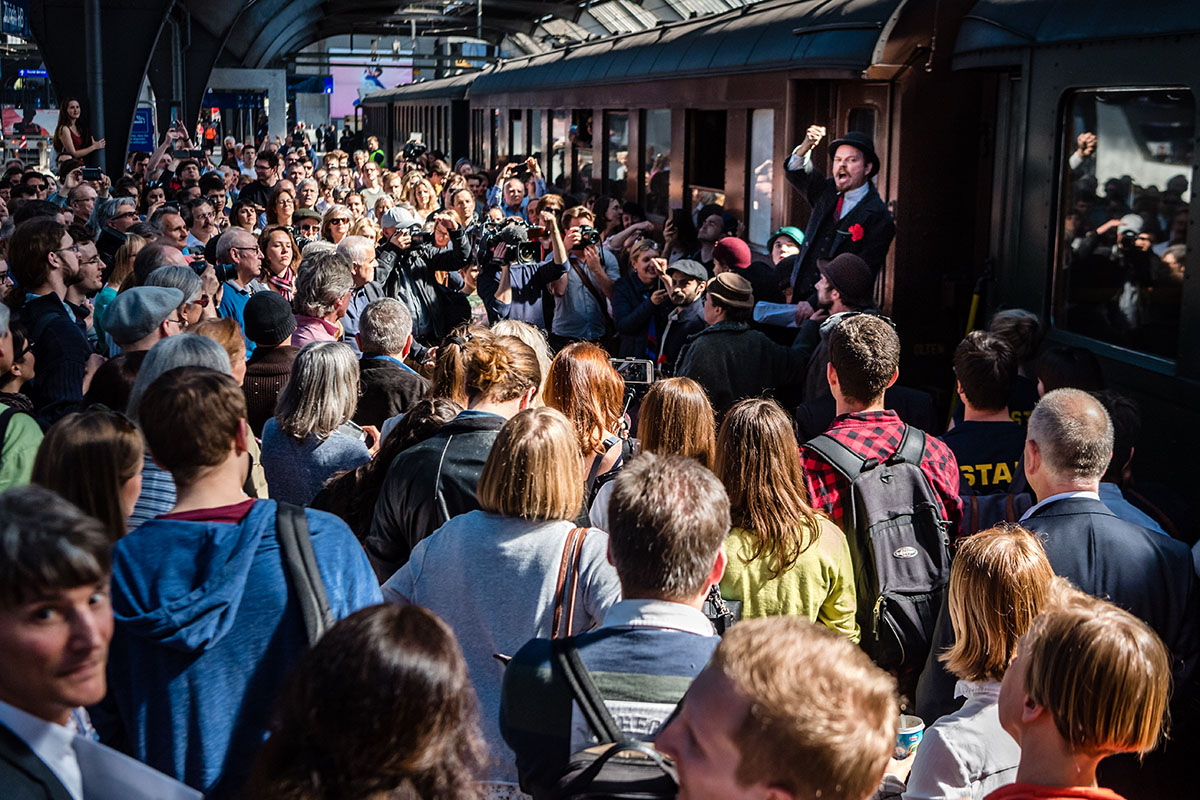
No, not often a little Switzerland had to stand at the origins of big events. But in 1917, it was such a chance that the “leader of the world proletariat” personally gave her. By February 1916, Vladimir Ulyanov (Lenin), having managed to live in Geneva and Bern, settled in Zurich, where he safely completed his work called "imperialism as the highest stage of capitalism." A year flew by. Having surprised to learn about the February Revolution in Russia, Ilyich made a historical decision. “It's time, my friend, it's time,” he told his wife Nadezhda Krupskaya. Well, to his friend Inessa Armand - too.
In April 2017, the events of a hundred years ago came to life on the platform of the Zurichsky station, thanks to the theater ensemble of Thorgevsky & Wieener from Basel, which staged the performance “Zurich-Petrograd: one-way ticket” with the assistance of the Swiss federal railways (SBB/CFF). The fellow travelers of Lenin, Krupskaya, Armand, Clara Zetkin, Sarra Ravich, Karl Radek, Grigory Zinoviev and several more enthusiasts of the revolution (in some cases at the same time and future victims) performed by 14 actors, became almost 400 passengers of an unusual train who went from Zurich to Shaffhausen on the border with Germany. This production became part of a large-scale cultural and historical project, which, by the centenary of revolutionary events in Russia, was invented by three Swiss universities-Baselsky, Berns and Zurich-at the expense of the Swiss National Scientific Fund*.
After Ilyich’s programmatic speech on the platform, disputes about the future of the revolution (and not only) move to wagons. The very first Lenin decree is on the ban on smoking in the reserved seat. The leaders of the leader are violently discussing whose turn to go to smoke to the toilet.
One of them, Karl Radek, does not appear “on the stage” immediately-he is hidden somewhere for a long time: as an Austrian subject they can take him to the front, besides he stole his caps. Practical Nadezhda Konstantinovna is lucky with smuggling products and forces comrades to hide chocolate with the words "I need to save Ilyich." But the affairs of everyday life do not protect her from the controversy with a friend-man-in one of the wagons, Krupskaya enters a verbal skirmish with an exalted Armand: "Nadine, have you ever loved passionately?" - "Yes!" - "Whom?" - "Revolution, Comrade Inessa."
"I hate them all!" - The author of the play Maria Thorzhevskaya answers the question of her own attitude to the characters traveling in a “sealous carriage” (and this, as we recall, is a collective image of all three trains on which Lenin got from Zurich to Petrograd).
Working on the script of the performance, Thorzhevskaya re -read the memoirs of Lenin's associates, many historical documents, works by Ivan Bunin, Zinaida Gippius, Mark Aldanova.
"Is this the same train?" - Passengers often asked. Honest answer: No, not the same. But still, it’s not like that: the steam locomotive of 1904, wagons of a little later - everything corresponds to the era to the smallest detail. And, by the way, the train rushes into a bright Soviet future surprisingly quickly: the average speed of a steam locomotive at the beginning of the 20th century is 70-100 km/h.
So that all the passengers could see the performance, his episodes alternately played in each of the five wagons. Having begun with a joyful booth and songs, by the middle of the way the action flows into the tragedy, ending with a monologue of a person who is about to be executed, although he does not fully believe in this ... as he did not believe in the tricks of fate and the Swiss Friedrich Platen, who organized Lenin from Zurich a hundred years ago, who created the Swiss Party of Communists, which dedicated the life of the revolution, which dedicated the life of the revolution, He moved to the Soviet Union, who made a career there and ... arrested in 1937, and five years later, who died in a camp near Arkhangelsk.
How would the course of history develop if the train with Lenin did not start off from the platform of the Zurichsky station? “This issue is often heard today,” says Basel University, Benjamin Shenk, Professor of Basel. - I will not undertake to say unequivocally, but most likely, the history of Russia would have developed differently. And the history of Europe too. Lenin with his categorical determination brought something new to the history of the Russian revolution. I can hardly imagine that without his energy would come to the events of October 1917. ”
* Full information about the project-on the website www.revolution-1917.ch .
Photo: © Matthias Käser, © Lioudmila Clot