
Translated material
Cunning investment
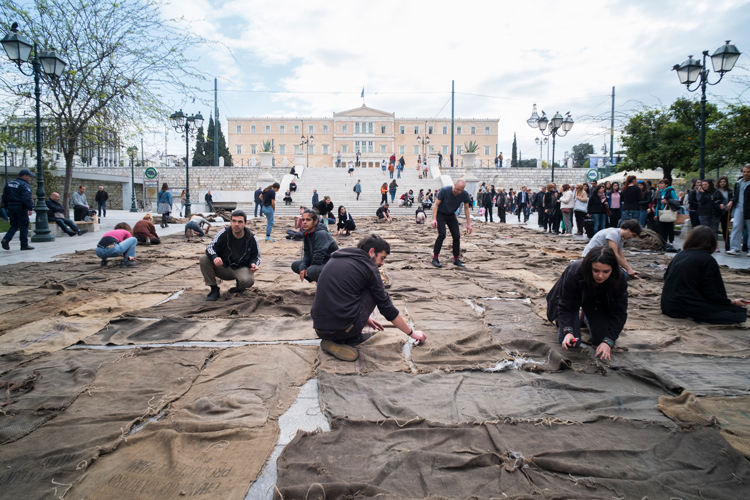
In Athens , “Document-14” under the working name “Learning from Athens” was opened. Initiated in Kassel in 1955 by the artist Arnold Bode, the “document” is the most politically and socially significant event that sets the trends of the next five years and indicates the problem areas of modern culture.
The artistic director of the 14th edition of the exhibition is Adam Shimchik, the co-founder of the Warsaw Gallery Foxal and the former director and leading curator Kunsthalle Basel. According to Artreview , in 2016 he took the second place in the list of the most influential people in the field of contemporary art (immediately after Hans Ulrich Obrisist), and in 2011 the New York Times released the material about it, calling the rock star among curators . This year, 18 curators from around the world work with him in the team.
For the first time, in its history of the “document” is equivalently distributed between the two cities - the traditional cassel and Athens. Over the past 20 years, the exhibition has repeatedly tried to break out of the small German city, mainly focusing in the so -called global south. “Document-13” (2012) posted separate projects in Egypt, Afghanistan and Canada; “Document-11” (2002) was presented to the Cassel on four continents: in Europe (Vienna and Berlin), Asia (New Delhi), South America (Saint-Lucia Island) and Africa (Lagos). They say that the curator Katrin David wanted to take out “Document-10” (1997) to Tehran, but did not receive permission for this. Thus, Athens are not the first exit of the “documents” outside the cassel, but for the first time the two parts of the exhibition are equivalent and complementary.
The exhibition in Athens is distributed between four large venues (Museum of Modern Art, Conservatory, Benaki Museum, Extraordinary Arts School) and almost 40 locations, where about 160 artists are represented, is a polyphony that does not always read the connections between individual sounds: the impact of work on the exhibition is 18 people.
“Document-14” tells about the mutual influence of culture and time, about the transformation of societies in time and space. In the catalog, the curator refers to the film by Gi Deborah “On the passage of several people through a fairly short moment in time” (1959) and to the book of Malcolm Lauri “At the foot of the volcano” (1947) and, based on these sources, offers to read the exhibition to use the “Space-Comer-Combinity” coordinate system. It seems that the curator has an ambition to connect the past, present and future. According to Shimchik, to understand his exhibition, you need to forget everything studied earlier. These words of the curator sound too pathetic (as well as a number of other statements and gestures made at a press conference ) for such a conservative presentation format.
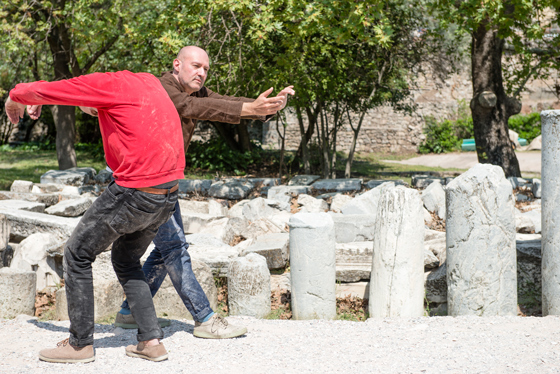 © Angelos Giotopoulos Prince Goalm. My dear country. Performance. 2017
In addition to exhibitions, many performances, concerts, radio, film and public programs are held in the city. Contemporary art always fits perfectly into the picturesque historical sites, in this case, undoubtedly, winning from the neighborhood with the natural and historical zones of Athens.
On the advice of Shimchik, which he gave guests at a press conference , the inspection should start with the most remote and small locations like the Yannis Tsarhis Foundation, the restoration of which took upon itself the “document”, the hill of Philopapper or the Agrarian University. It is there that the whole essence of his curatorial idea is manifested: each location has a soul, intimacy is felt, there are local legends and stories, often told by the inhabitants of Athens or the young guides “Documents”, about the site or artist. One of these stories is the full persecution of the artist Elizabeth Wilde and her daughter Vivian Sus , who, like a mosaic, develops only after visiting three sites. At the age of 15, Wilde and his family fled from Nazism from Vienna through Zagreb, Venice, Switzerland, France, Belgium and Holland in Argentina, where she married and where her daughter Vivian was born. In 1962, fleeing the military dictatorship, the whole family moved to Switzerland, and in 1996, Vivian and her daughter returned to South America, where they again encountered violence. On the hill of Philopappu in a tiny house and the adjacent Terasse near the old Orthodox chapel, the work of the mother and daughter are placed. There are also several works of Vivian in the conservatory, and at the school of elegant arts you can watch a video about their life called “Vivian Garden”.
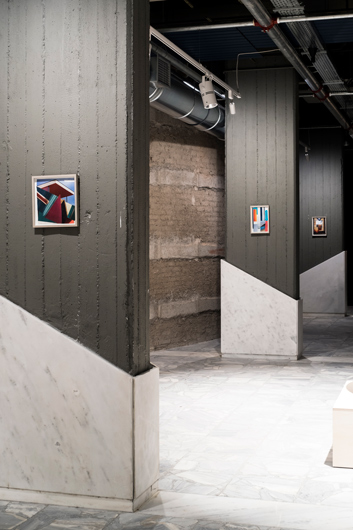 © Mathias Voelzke Elizabeth Wild. Collages. 2016–2017. Type of exposure
Attention is also attracted by the abundance of sound works. The musical dominant is not accidental. No wonder the Greeks attached such great importance to this type of art, even feared it. In the 4th book of “State”, Plato recalls Socrates’s saying: “We must beware of introducing a new type of music art-here everyone is at risk: after all, there is no change in the techniques of music art without changes in the most important state established-this is what Damon claims, and I believe him.” Music, painting and gymnastics - pillars of Hellenistic culture - form the basis of “Documents”, which is largely relied on on the teachings of ancient Greek philosophers. So, at the exhibition at EMST , the National Museum of Contemporary Art, the “International” sounds - the episode of the “Good Symphony” Arsenia Abrahamov, in the conservatory, tools from the “Exit” series Gillermo Galindo include, among other things, metal pipes, blood, lattices, a bed from the refugee camp near the cassel.
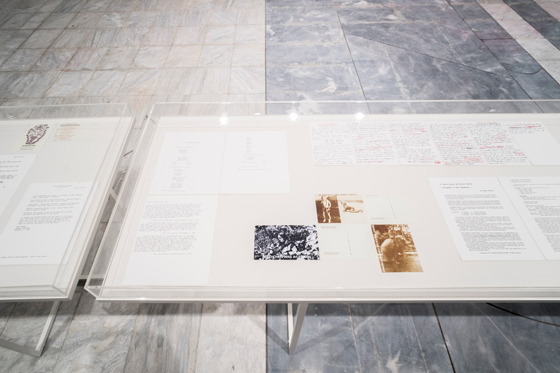 © Mathias Voelzke project Guillermo Galindo. 2017. The type of exposition
In general, a significant place on the “document” is given discussions about migration and borders, including personal stories of migrants and refugees told from the first person. The exhibition once again raises the theme of the colonial essence of the dominant discourse of European culture - the path that the former curators of this regular exhibition Catherine David (1997) and OKVI Envezor (2002) have already been paved. However, this time is important that many participants belong to “marginalized” categories in terms of nationality and legal status: refugees, migrants, ethnic minorities, devoid of statehood. Comparing their art with the works of modernism and archival materials of different years, the “document-14” simultaneously denies the adopted history of European art and emphasizes the unifying influence of colonialism on modern art.
So, the Mobile Theater of Yoara Nango , installed in the courtyard of the conservatory, is the conductor of the votes of the Sami, gypsies, women and other minorities. Sama, which belongs to the artist, is the indigenous people of Northern Europe, colonized and repressed at once by several states: Norway, Sweden, Finland and Russia.
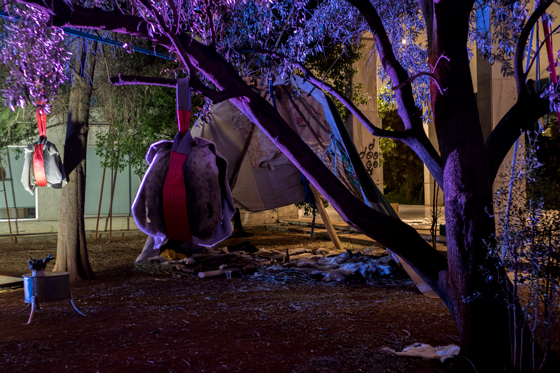 © Mathias Voelzke Joar Nango. European everything. 2017
The artist Khiva K , who was born on the Kurdish territory of Iraq and fled from the country 20 years ago, in his video “Prafrot (blind as native language)” moves along the fields, paths and city streets, balancing the mirror structure on his forehead, following the path that he himself once walked from Turkey to Athens. The artist moves blindly, only mirrors help him go forward. The fragility of the mirror structure, extreme tension and blindness are metaphors denoting barriers to the refugee. The video is located in the building of the conservatory, and the design is exhibited separately on one of the small sites.
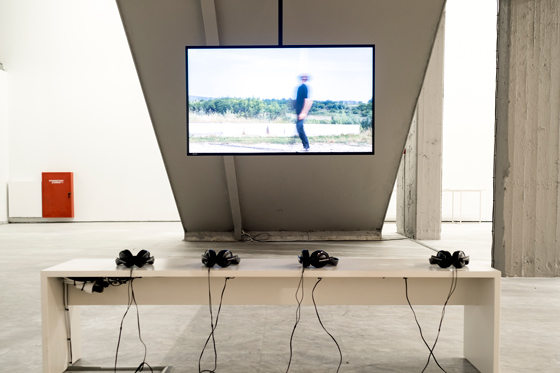 © Mathias Voelzke Khiva K. Pracize. 2017
In the Benaki Museum, the physical world connects to metaphysical, reality is intertwined with imagination and dreams, each medal has two sides. For example, the director, writer and artist Reee Rosen invites us to imagine ourselves with the Evo Brown on the day of suicide.
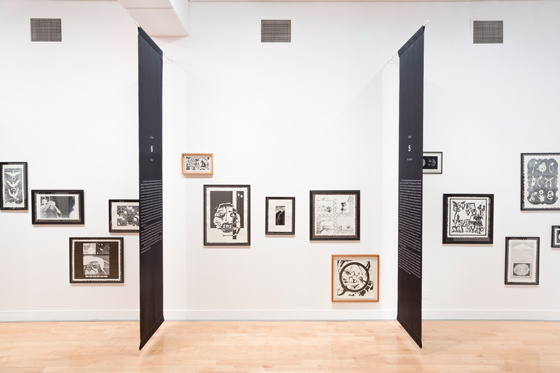 © Stathis mamalakis Rone Rosen. Live and die like Eva Brown. 1995–1997. Type of exposure
According to my colleague, curator Kate Strain (director of Kunstferain in Graz, Austria), “from a poetic point of view, it is impossible not to admire the“ Document-14 ”-it is all permeated with love. It is felt what kind of warm and close relationships connect the curatorial team and artists. ” By the way, for the first time in the history of “Documents”, artists received fees.
But in contrast to love and respect for the artists, “Document-14” expresses unprecedented arrogance in relation to the audience. The guide for the exhibition does not give volumetric information about artists and their work, many sites are not so easy to find, not to mention the fact of finding works of art, which, in turn, are not accompanied by text. It is quite difficult to understand the context of an unprepared (and often prepared) viewer. It is absolutely not clear where to go and what to look-at some point you fall into a state of panic. There is no clarity in the catalog either: only artists who created new works for the “documents” are listed; Cross links between work, artists and sites are not always read, although they are often necessary to “study with Athens”. As planned by Shimchik, to study in this case means "forget everything and start with a clean sheet." Intuitive training can work in many areas, but can this be discussed in the case of history?
In addition to the press conference that took place on the first day of viewing for professionals and the press, curators do not turn to the audience anywhere. Perhaps these appeals do not make sense and the entire context is set out in detail in the textbook (Reader) and the Catalog (Daybook) , in the speeches of the public program and the official journal "Documents-14" South as a state . I admit that this is the concept of the exhibition, but this approach does not work at all. We see four absolutely canonical exhibitions that declare their radicality only by trying with all their might to confuse the audience.
“Take an owl to Athens”-an expression equivalent to “go to Tula with your samovar”, and therefore the owl, the Emblem “Documents-14” and at the same time a symbol of wisdom, one of the attributes of the goddess Athena, ironically expresses the dilemma of the “Documents” in Athens.
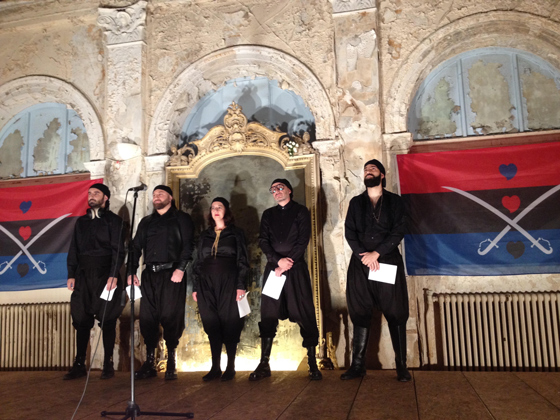 © Ekaterina Krupennikova Promotion of the curators of Athenian Biennale against Documents-14
“Document-14” assumes the role of the “guide in unusual places” of the city, offers to re-look at historical museums, parks, educational institutions, libraries; Many of them have been in a state of decline and desolation for a long time. It is known that the “document” financed the opening of the Museum of Contemporary Art (in the architectural sense of the most ugly museum, which I have ever seen), which, despite the fact that they began to create it for a long time, had been long-term construction-the Greece in a deep crisis simply did not have money. It is remarkable that the collection of this museum will be presented in the summer in the Fredericianum Museum - the main site "Documents" in Kassel. The Germans complain: "Why is a second -rate collection to our beautiful museum?" This radical gesture accurately emphasizes the concept of Shimchik about the cycle of spaces and the time and the need to abandon prejudice in order to understand the meaning of the exhibition.
In the midst of the economic crisis, in which Germany plays a key role, the transfer of a good half of the “Documents” to Athens is undoubtedly problematic. The local art scene does not meet the exhibition with the 37-millionth budget with the open arms, rather rejecting it: the whole city is painted by graffiti with statements against this exhibition project. The day before the opening of the “Documents”, the team of the Athenian Biennale made aggressive anti -colonization and anti -globalization manifestos. This project was “frozen” due to the crisis, but in April 2018 it is still planned to resurrect it under the name “Waiting for the Barbarians”. There are rumors that one of the founders and curators of the Athenian Biennale Poka-Yio was invited to the Kurator "Documents-14", but eventually refused to work with Shimchik and his colleagues.
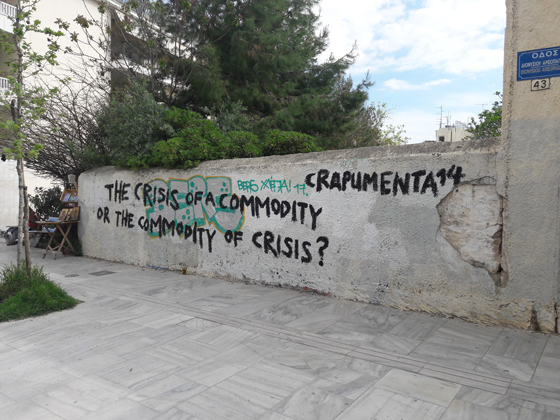 © Kris Dittel Graffiti against the international project: “Consumer crisis or crisis consumption?”, And the word CRAP (garbage) was added to the name of the exhibition (Documenta-14), it turned out to be Crapumenta-14
One of the leaflets (another form of protest against the “documents”), which caught my eye, asks the most important question: “Who is studying from Athens and what?” And on the back: "European countries learn to oversee and manage the migration crisis." An open letter of Greek activists to the organizers, participants and visitors to “Documents-14” was published on the E-Flux website:
“One of you complains about the bodies outlawed. At the same time, remaining silence, he supports the elimination of spaces for thousands of bodies that inhabit this city in autonomous dwellings. These squatered houses are constantly in jeopardy. Every day we hear that we will be forcibly evicted. This threatens not only our main human needs, but also our mutual support networks, the space of autonomy and public cultural practice. In these buildings, artists and activists coexist along with thousands of refugees who came here from the countries tormented by the war in search of a new life worthy and free.
The silence of the “Documents” is unacceptable and only contributes to the mayor of the Cammines, the state, the Church and non -governmental organizations opposing us and drive thousands of people in segregation concentration camps, prepared by the very bodies that, as your director says, he tries to protect. This violent act of the separation of “legal” bodies from the “illegal” power of the state and the “document” is still silent. ”
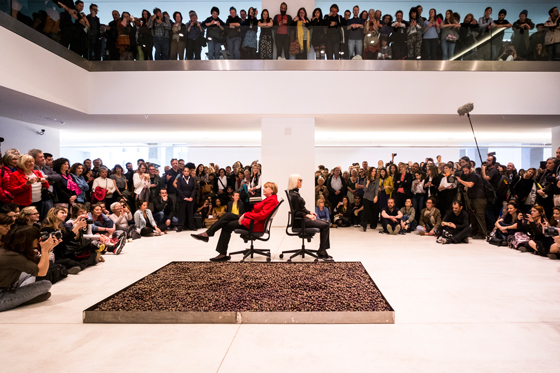 © Mathias Voelzke Martha Minukhin. Payment of Greek debts by Germany with olives and art. Performance. 2017
The mockery also looks like that the exhibition refers so much to the problems of migration, but still refugees must pay 15 euros for entrance tickets, and not every working Athenian can afford such a trip to the museum.
What brought with me the “document” to Athens besides contemporary art and crowds of art tourists? Do guests of Athens know that a month before the opening of the international exhibition, the Museum of Modern Art was not sure that he was ready to accept the “document”? Or that the employees of the Islamic art museum Benaki have not received a salary for two months? From this point of view, the names of artists and the titles of work on a thick, expensive paper look like a stupid and rude joke over the deplorable position of local institutions and their dependence on the “documents”.
Is it not a “document” to another colonializing project of Germany? Whether it will become with the political and economic perspective of humanitarian aid or, rather, the cunning investment of Germany into the dressing of Greek ruins and turning them into new fashionable areas and resorts and another debt obligation of Greece, we still have to find out. In the meantime, from the first day of the opening for the general public, groups of elderly German tourists are already running along the sites.