
Translated material
Scenes of violence
In St. Petersburg, a retrospective of paintings by Vasily Vereshchagin, the founding father of military reports, opens
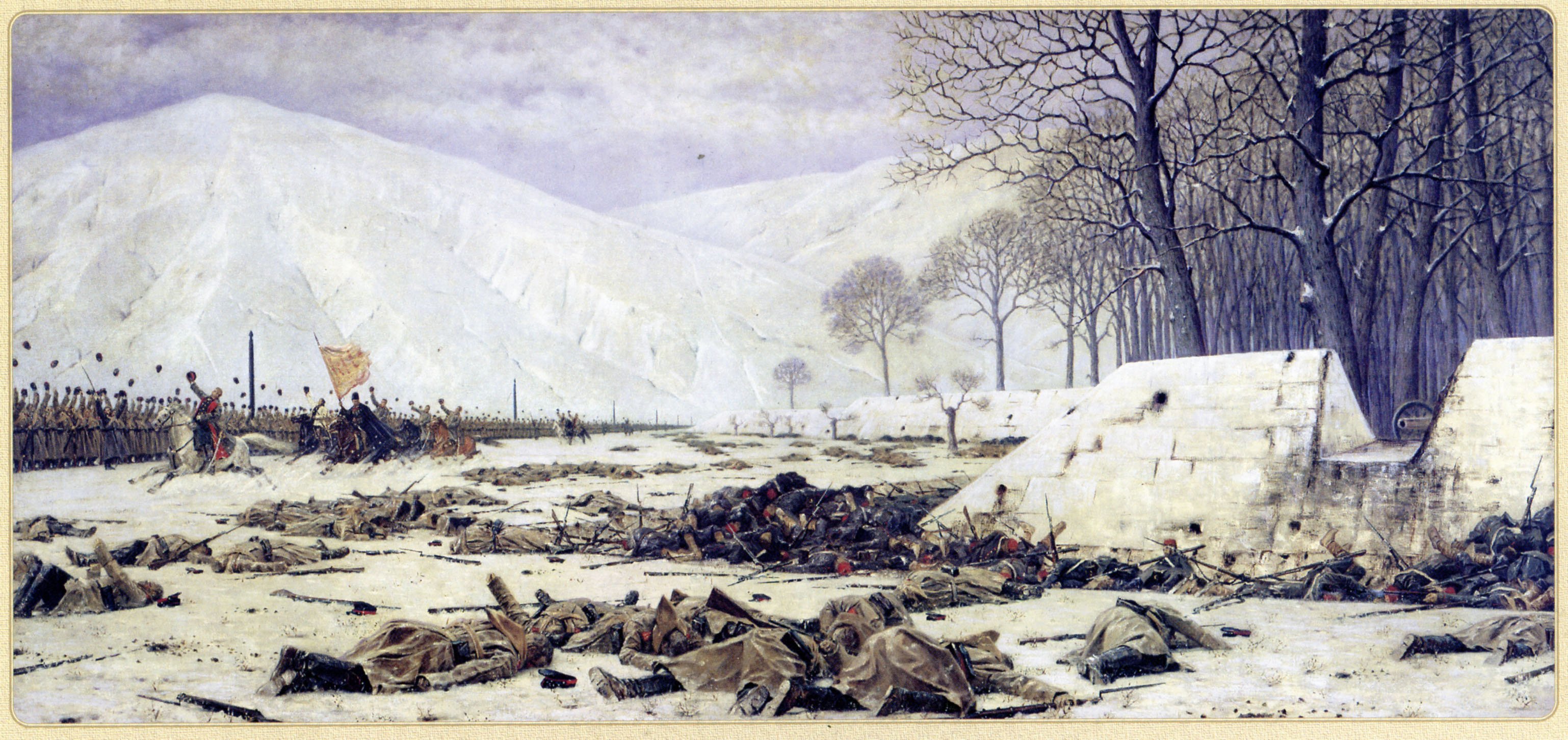
The exposition, which will open the doors in the Russian Museum on April 20, is dedicated to the 175th anniversary of the birth of Vasily Vereshchagin-an artist with whom an incredible metamorphosis has occurred: it turned from the dissident into the author of textbooks that became elements of the Soviet interior.
The exhibition may not seem so exciting out of habit. There is no need to wait for surprises: “Apotheosis of the War”, “Let them enter”, “At the door of the mosque” (the people are called “The elevator does not work”), “Everything is calm on the spike” - illustrative material for the school lesson. In fact, the Russian Museum started the most topical exhibition of the season. In Russian art there was never anything more relevant and uncomfortable than Vereshchagin’s work - another thing is that their fate was bizarre.
The failed archaist
Vereshchagin stands among the Russian painters apart. Not a mobility and not a miriscus. Not a Western and not Slavophile. Born in Cherepovets, then the county city of the Novgorod province. The older brother is also relevant today, although in a different, somewhat ironic sense: Nikolai Vereshchagin is the creator of domestic oil and cheese and cheese and cheese (this he came up with Vologda oil and Slavon cheese). Having served some time in the Navy for some time, Vasily Vereshchagin first studied at the Academy of Arts, then left for Paris, where he was engaged in the workshop of the painter Jean-Leon Zheir-the main opponent of the impressionists, a few anecdotal academician.
Sometimes the inscription works almost as in a comic book: on the frame of the “mortally wounded” one can read: “Oh, they killed, brothers ...”
In the same period, the peers of Vereshchagin admire Degas or Kurba. Repin seriously thinks that he creates something in their spirit (and actually writes Khokhlomsky “Sadko”). A pure naturalist Shishkin diligently learns in Germany to distinguish Olch from Grab. Vereshchagin takes lessons from the most severe archaist of European painting - all his further work will rotate around the Zhirom style and its techniques. Even the plots are similar: Napoleon (one has an emperor at the Egyptian Sphinx, for the other in burning Moscow); East (the "Arab market of the concubines" of one and the "Turkestan series" of the other); Allegoria (the at all anecdotal “truth selected from the well” by Jerome-a disheveled girl with a whip naturally climbs from under the ground to the viewer in which the mother gave birth-and the “apotheosis of the war”). Vereshchagin would become a Russian archaist living in Paris if his life had developed differently.
Military correspondent
In 1867, Konstantin von Kaufman became the commander of the Turkestan Military District: not only the conqueror of Central Asia, who included the Kokand and Khiva Khanate, Bukhara Emirat, the Ili region and Turkmenistan, but also the patron saint of art. He took with him a whole detachment of Batalist artists, Vereshchagin among them, designed to capture the conquest of Turkestan for magazines and newspapers. Now it may seem strange, because at that time there was already a military photo report: he was born ten years earlier, during the Crimean War, from where Briton Roger Fenton sent pictures to The Illustrated London News. But the photograph required a long exposure, allowing you to remove only types of camps and portraits of soldiers. And most importantly, the photographs of Fenton were not in its pure form reports. These were the inserts in the magazine that captured the places of events, which were mentioned in the article, their information content was minimal. Fenton, like his followers, severely complied with the Code of Professional Ethics, implying that the horrors of military operations cannot be removed in any case. Vereshchagin violated this code, thereby creating his own artistic method.

In Turkestan, the Parisian academic training connected in it with the function of a military correspondent: Vereshchagin was in Samarkand during the uprising, traveled all over Central Asia, traveled to Tien Shan, ended up in Western China during the pacification of Dungan. He really saw what a person who took up a weapon is capable of. He really knew what violence was. Unlike Jerome, his teacher, Vereshchagin had an texture. Unlike Fenton, he was not limited to anything but his skill. He did not write what he did not see: the same “apotheosis of the war” is a view of the mountain of human remains, which the artist encountered after the massacre of Chinese Muslims.
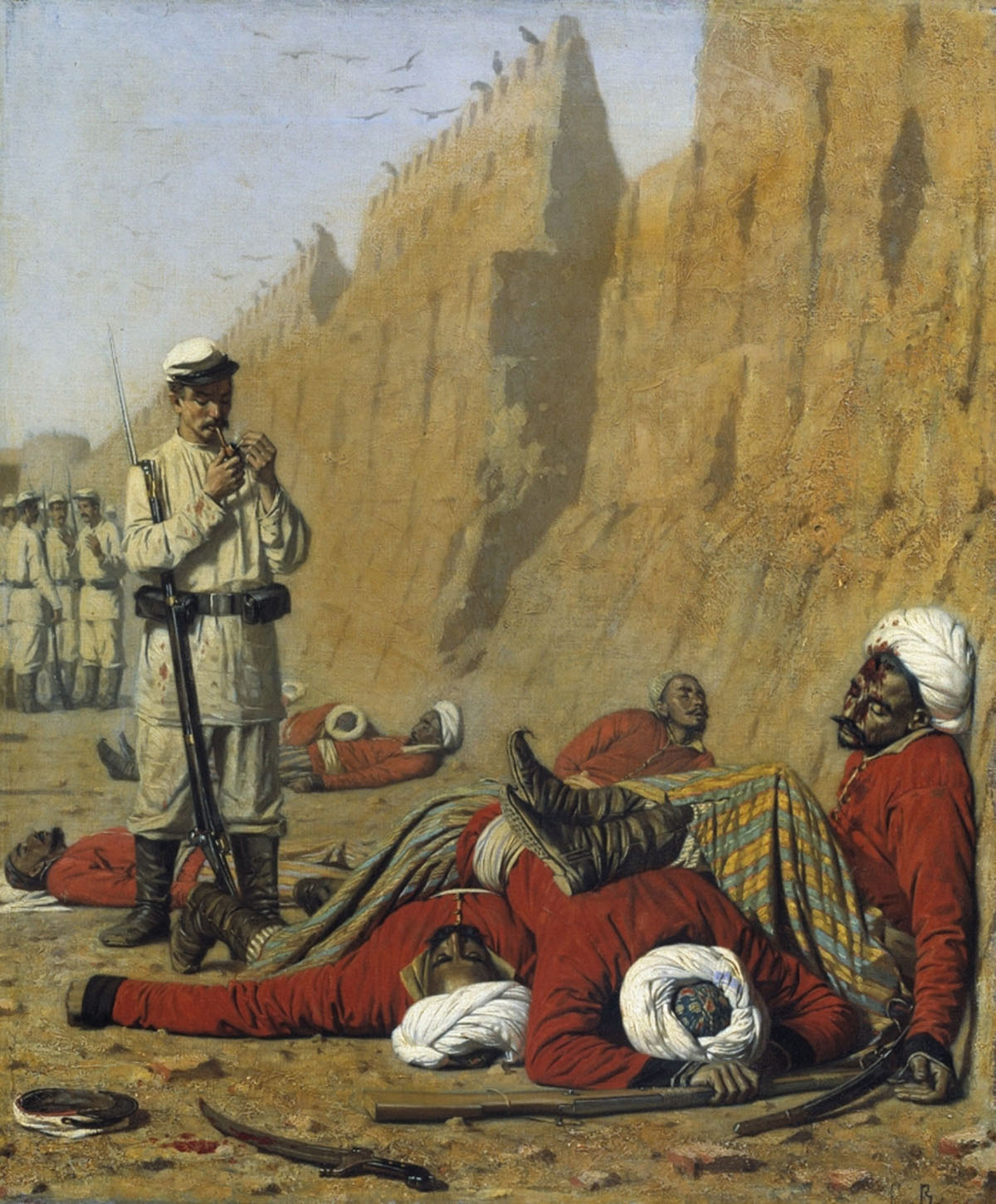
However, for all his journalism, Vereshchagin was not a journalist. Unlike their colleagues who sent military drawings to magazines, the author of the Turkestan series worked for a long distance. Pictures on the plots of the conquest of Central Asia were written already in 1871 in Munich. Vereshchagin chose a special way, terribly ambitious, but the only true one. Not the court battalist, like Franz Rubo, the author of the panoramas of “Defense of Sevastopol” and “Battle of Borodino”, not romance, like Eugene Delacrois, who turned recent events into capacious metaphors (“Freedom in the barricades”). His works are magazines themselves, comprehending historical cataclysms after some time. The “Turkestan series”, say, Vereshchagin accompanied characteristic inscriptions that were rarely remembered. The “Apotheosis of the War” was suggested by the text: “Dedicated to all the great conquerors - past, present and future.” Sometimes the inscription works almost as in a comic book: on the frame of the “mortally wounded” one can read: “Oh, they killed, brothers ...” in the literary science itself
The most literary painter appeared in richnichnaya culture.
Hostage of reputation
The Central Asian series of Vereshchagin was first exhibited in London, in the crystal palace, and only then left for St. Petersburg. There was a scandal that determined the whole further reputation of the artist.
If you believe the memoirs of his son, Vasily Vereshchagin Jr., Alexander II faded, seeing these paintings, and accused their author of slandering the Russian army. And the heir to the throne, the future Alexander III, as if even said: "Either Vereshchagin Cattle, or a completely obsessed person." It also says that Vereshchagin in despair destroyed several of his works.
There are no complete faith in these memoirs, they have been refuted many times by both contemporaries and researchers, but rumors about this went. The newspapers about Vereshchagin wrote precisely as a truth -seeker, a human rights activist with an easel. Critic Vladimir Stasov found in him the embodiment of his dreams of "truly folk art." The image of a dissident artist, who did not spare colors, arose to openly describe all the horror and meaninglessness of the war.
Naturally, when the next war erupted, Vereshchagin went there. The Turkish series is even worse and clearer than Turkestan. “Skobelev under the spike”: In the background, the cavalry joyfully jumps, and most of the canvas is occupied by mountains of corpses in the snow. “Everything is calm on the spike” - a freezing sentry at the top of the mountain. Finally, “in Turkish Polekitskaya”: a landfill from corpses and bodies of the wounded is another allegorical manifesto.
After the Russo-Turkish war, the artist, who balanced between art and journalism, was captured by his social mask-and it seems, he himself understood this. He spent the last 20 years of his life in search of a new nature and texture. I went to Palestine, wrote based on traveling to gospel plots. He traveled around the Russian North, visited the Philippines, in Japan, sailed to America. He tried to find himself as a historical painter, writing a cycle of paintings “Napoleon in Russia” deprived of the usual pathos. He tried in every possible way to go over to the side of “pure art”, but did not succeed.
The death of Vereshchagina looks more logical and tragic-in a new war, in a terrible battle of Port Arthur, at the Petropavlovsk battered on an armadillo, along with the commander-in-chief of the Russian fleet, Admiral Stepan Makarov.
Death completed the image of the artist. Alexander Benois, in his “History of Russian Painting”, compared him with Leo Tolstoy, who also showed a war in “Cossacks” and “War and Peace” in a new way, but clarified: Vereshchagin’s work is “a step forward but mechanical”. Vereshchagin was considered an artist who put not so much talent as skill in the service of great goals.
Vereshchagin’s paintings performed the functions of photography in the eyelids when the technique did not allow the shooting of battles, and ethics - cruelty
Universal model
The heroic death and halo of the dissident provided Vereshchagin with a place in the Soviet pantheon, next to Radishchev or Herzen. Nothing makes the rebels and victims of the tragic confrontation with the power more safe than the inclusion in the plan of monumental propaganda. Vereshchagin was replicated, and skill, pathos, and platenness were disappeared from each new reproduction from his work. Vereshchaginsky canvases have become an integral part of the landscape, outdated.
However, today the “mechanistic step forward” sounds completely different. The paintings of Vereshchagin performed the functions of photography in the eyelids when the technique did not allow to shoot battles, and ethics - cruelty. When the technical capabilities expanded, and the professional code changed, military photography acquired exactly the form that Vereshchaginsky work had. It comes to literal rhymes: compare the most famous picture of Vereshchagin - “The deadly wounded” - and the most famous photograph of Robert Capa, “The Death of the Republican”. Kapa also shows the landing in Normandy in Vereshchaginsky: these are not human flows flowing with machine guns at the ready, but wet backs and pants, chilled figures, frightened faces. Just as Vereshchagin, the current idol of exotic photography Steve McCari shows the strange and motley - “another” - the world of India, the Philippines, Brazil, Afghanistan, the similarity is seen even in the palette. Now Vereshchagin in the original is indistinguishable from the next World Press Photo. He created a universal model of military visual art: a news report from hell.
In today's Russia, the theme “The Artist in the War” was unexpectedly updated recently: it was launched into the sphere of public discussion by the writer Zakhar Prilepin, who first published the book “Pillars”, which was the stories of Russian writers who wore weapons, and conducting the thought “Good should be with fists”, and then went to fight on the Donbass. The case of Vereshchagina is probably the most expressive counter example. Anyone who saw hell on earth considers it his duty to tell about human cruelty without borders. There is no other “artist’s duty” in the war.
Photo: press service of the Russian Museum