
Translated material
Offshores at the Big Road
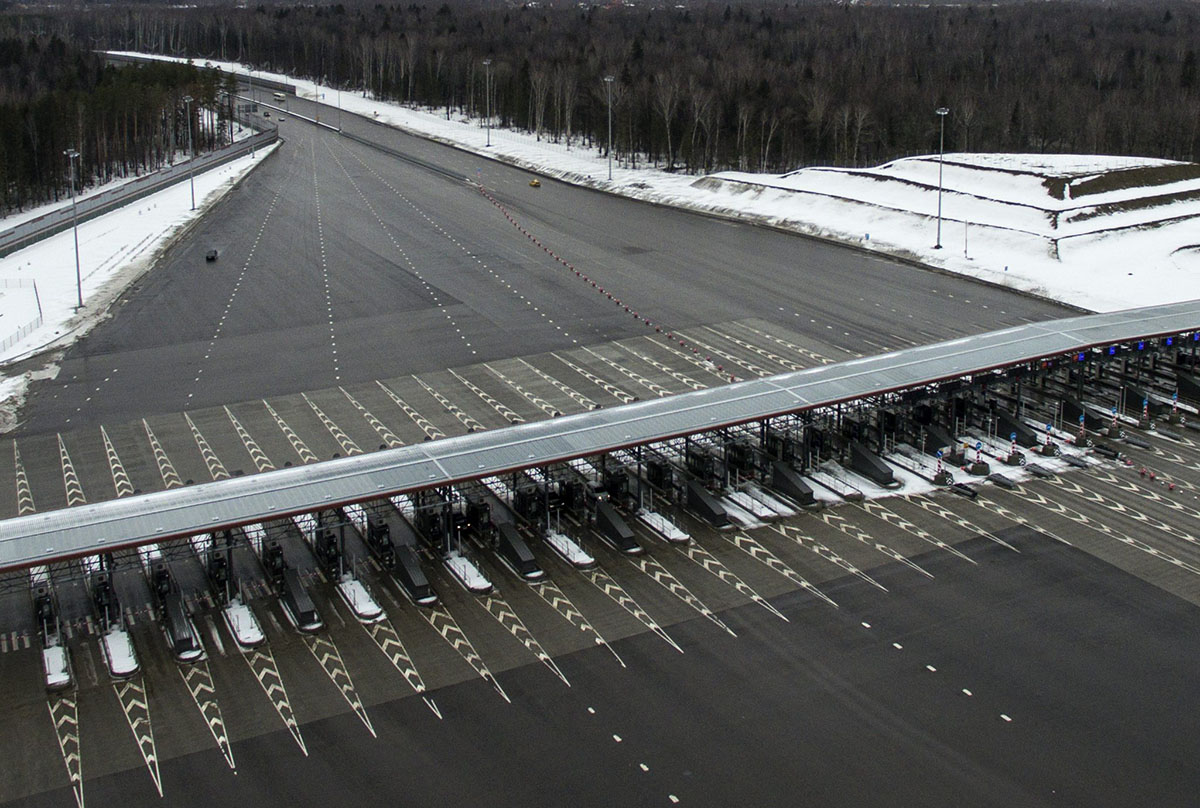
Materials to the Prosecutor's Office of Paris (and at the same time in the corps of investigative judges of the prefecture Nanter, where the Vinci Group’s subsidiary was registered in the Russian project) was sent by the French non -profit legal association Sherpa, specializing in economic crimes. Its lawsuit concerns the project for the construction of a 43-kilometer paid section of the M11-St. Petersburg highway through the Khimkinsky forest. The project, as you know, was implemented, despite the numerous protests of the inhabitants of Khimki, whose peak came for the summer-autumn of 2010. Sherpa puts forward the assumption: it was decided to build the road after the French contractor in the person of Vinci probably shared shares in the North-Western concession company (SZKK), specially established for the construction of the highway, with people from Vladimir Putin’s closest encirclement, in particular with businessman Arkadium Rotenberg.
Now, French investigators have to check whether it is true that (hereinafter - the quote from the complaint of Sherpa, the text of which was at the disposal of NT) “with a high probability, with the help of confusing schemes, Vladimir Putin himself received a reward for the services rendered by Arkady Rotenberg to the Vinci group”.
The birth of concessionaires
The fact that the initiative of the construction of the M11 highway came from Vladimir Putin himself, for example, residents of Zelenograd near Moscow, near which pass the route, are convinced: in 2015 they sent the president, as well as to the government, the Ministry of Transport and the Federal Antimonopoly Service (FAS), in which they were outraged by the high cost of the fare (more about the tariffs for the use of the highway - A little lower).
Sherpa has an assumption: a tender for the construction of the head section of the Moscow-St. Petersburg highway from the very beginning was fictitious, that is, organized specially “for Vinci victory”
The story with the road, in any case, at the very initial stage, is actually connected with the name of the president: just during Putin’s visit to France on September 22, 2006, the then Minister of Transport of the Russian Federation Igor Levitin and the leadership of the Vinci company signed a protocol on the construction of the highway. It is noteworthy that a year before, in 2005, the Federal Road Agency (Rosavtodor) mentioned Vinci as a company that is interested in building a road.
On October 18, 2007, a tender was announced for the construction of the head segment of the road. Three companies took part in it, including the SZKK, created in September 2007 with the participation of the Vinci group, and the “metropolitan tract”. Another company - a tender participant - Aeru Highway BV - had no experience in building roads, it was engaged in transformers. A year later, in October 2008, Rosavtodor, headed by Oleg Belozerov at that time (now the president of Russian Railways), announced the tender as failed-"in connection with the insufficient qualifications of some participants." The news looked strange, because the preliminary selection of applications in itself involves an assessment of the qualifications of applicants. Rosavtodor did not give any explanations on this subject. (However, the tender conditions were really so strict that even such industrial giants as Hochtieff and Bouygues, successfully building roads in Europe, for some reason could not participate in it). As a result, the tender was canceled, and the government directly entered into an agreement with the SZKK without a second procedure.
Sherpa’s claim contains an assumption: a tender for the construction of the head section of the Moscow-St. Petersburg highway from the very beginning was fictitious, that is, organized specifically “for Vinci victory”.
Favorable partnership
The project for the construction of the road was declared as a "public-private partnership." According to the “concession agreement on financing, construction and operation on a paid basis of the Moscow-St. Petersburg highway on a section of 15–58 km”, signed in 2009 between Rosavtodor and SZKKK, the company was supposed to build a 43-kilometer site and received the right to charge a fare. The validity of the agreement is 31 years. During this time, the total construction costs - 66.081 billion rubles* (≈ € 1.65 billion at the then rate) - as the compilers of the agreement were sure, must pay off, after which the road will cross the public administration.
According to the site of the paid road www.msp-chighway.com, two-thirds left the total construction costs-44 billion rubles. (67%), the rest is for servicing a credit line and paying VAT.
The road turned out to be expensive: a kilometer cost about € 25.3 million - at an old exchange rate of about 40 rubles. for € 1. At the same time, according to RIA Novosti **, the average cost of a kilometer of the road in the EU is € 4.9 million, in Russia - € 12.6. (By the way, in the distant French overseas territory - the island of Reyunon, a check is also being conducted in relation to Vinci - she also built the road there and also, according to the estimate, 10 times higher than the standard).
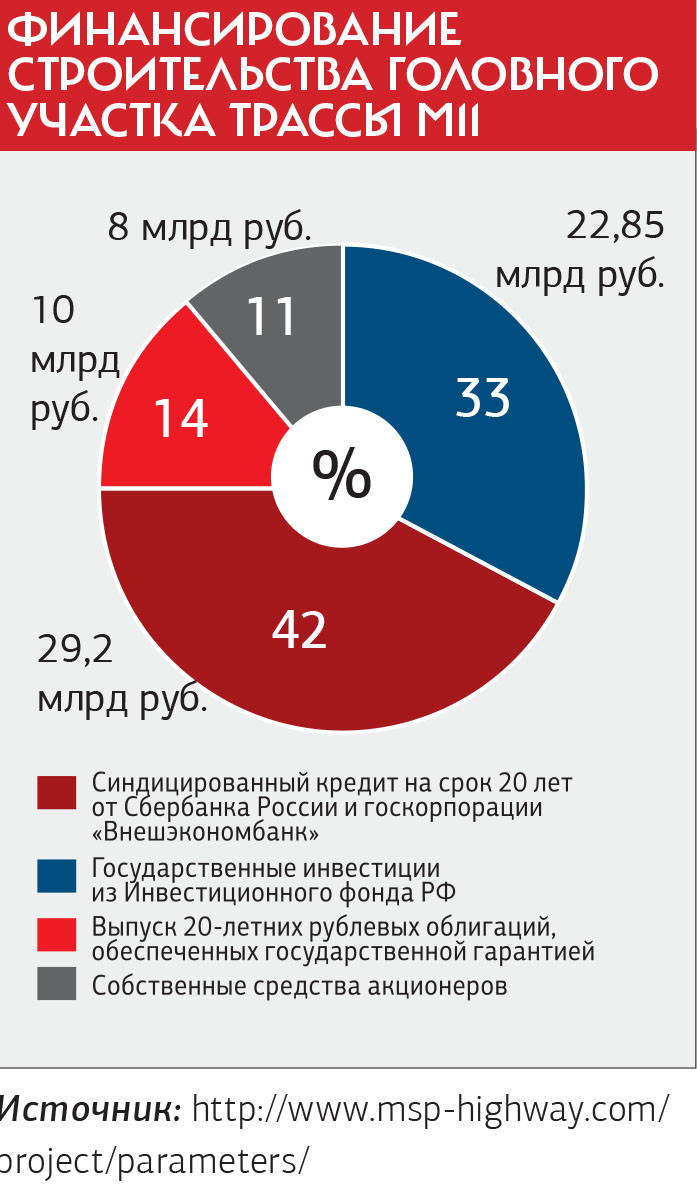
In detail, financing for the construction of the M11 route in shares is shown in the diagram: 75% of the funds are allocated either directly from the state authorities or with the participation of state structures.
Moreover, in total it turned out even more than necessary - 70.05 billion rubles. The difference is almost 4 billion rubles. - Half of those 11%that the shareholders themselves pledged to introduce to the common moshna.
At the end of 2014, an alternative to the Leningrad highway was put into operation (at first they drove free of charge). Of course, this solved the problem of traffic jams on the way to Sheremetyevo Airport, but the payback of the project raises questions: among local residents of those who want to ride a highway with a breeze - too expensive. So, getting from Moscow to Sheremetyevo on a passenger car per hour of peak costs 250 rubles, to Zelenograd - 300 rubles, and to Solnechnogorsk - 400 rubles. A year after the opening of the road, the Governor of the Moscow Region Andrei Vorobyov admitted that "the track is actually empty."
However, even if the road instead of profit so far brings the concessenger only losses, they, according to informed sources of the magazine, obliged the Russian state. “In the standard concession agreement of this type, there should be a clause on the compensation of the difference between the real and predicted profit to the concessionaire at the expense of the state budget,” the source explained NT, which participated in the discussion of the project for the construction of the highway from potential investors in 2009.
Is there such a clause in the concession agreement on the construction of the M11 site? In the Parisian office of Vinci, the NT correspondent did not answer this question, offering to get acquainted with the previously published commander of the groups group. “There is no agreement in public access, Sherpa’s association was not able to get this document, and we ask the French prosecutor's office to oblige the Vinci group to present it to the investigation,” said Sherpa lawyer Julien Larer-Genevae.
Who are these concessionaires who do not care any losses?
Khimkinsky forest in Panama Dossier
SZKK LLC, on a parity basis (50 to 50) belongs to the French construction company Vinci and Russian participants, the composition of which has changed since 2007. The names of the final beneficiaries and the distribution of shares between them in Vinci do not disclose.
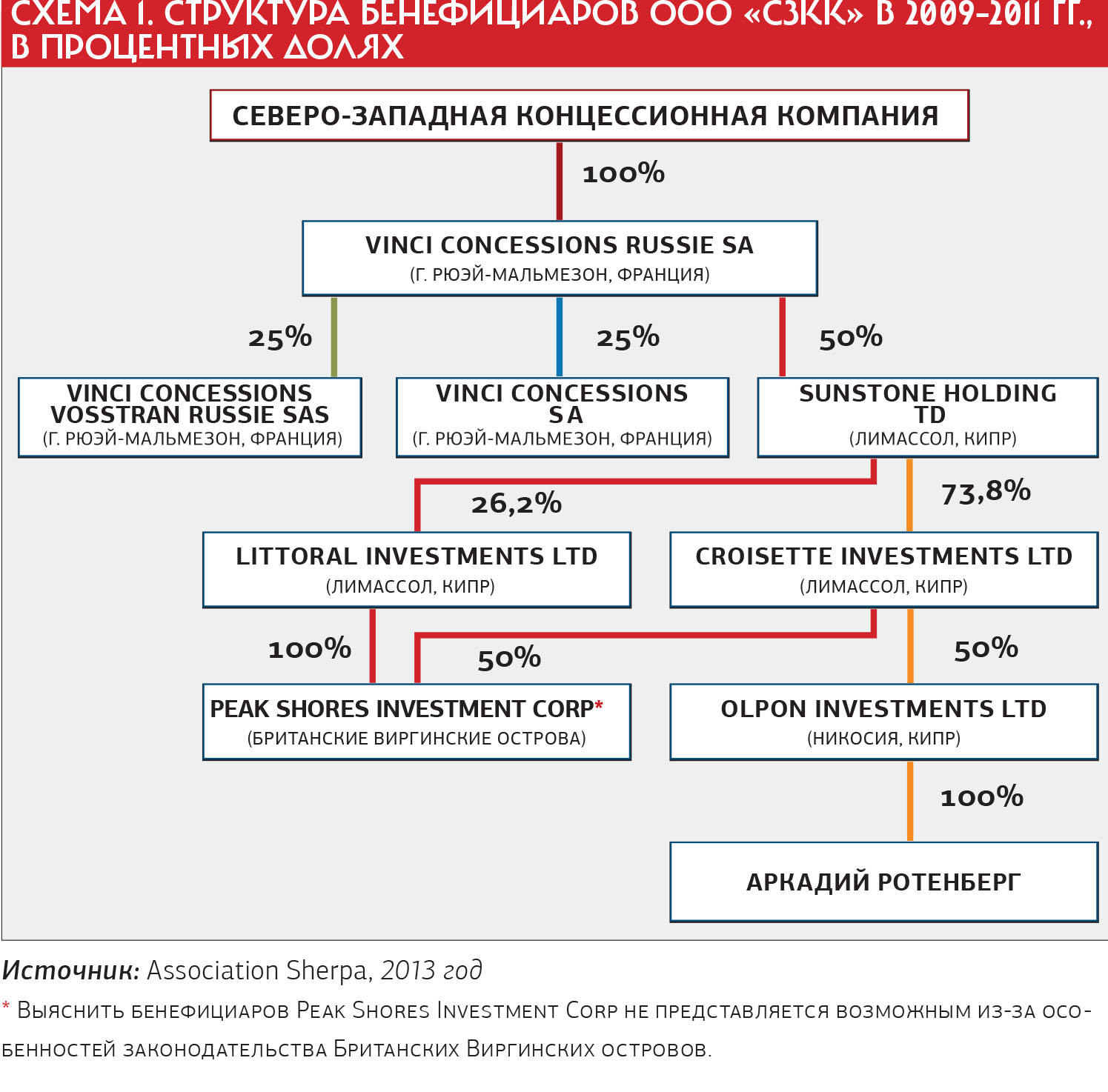
Among the former to study the insignificant “North-Western concession company” began the international non-governmental organization CEE Bankwatch Network (see Scheme 1). Having studied the data she had, NT calculated that about 18% of the SZKK shares in 2009-2011 through offshore companies were controlled by billionaire Arkady Rotenberg. (Interestingly, the value of 17-18% remains in the future, only the beneficiaries of this share are changing). It should be explained that 18% of the funds raised is about 11.9 billion rubles, or almost € 300 million at the old rate.
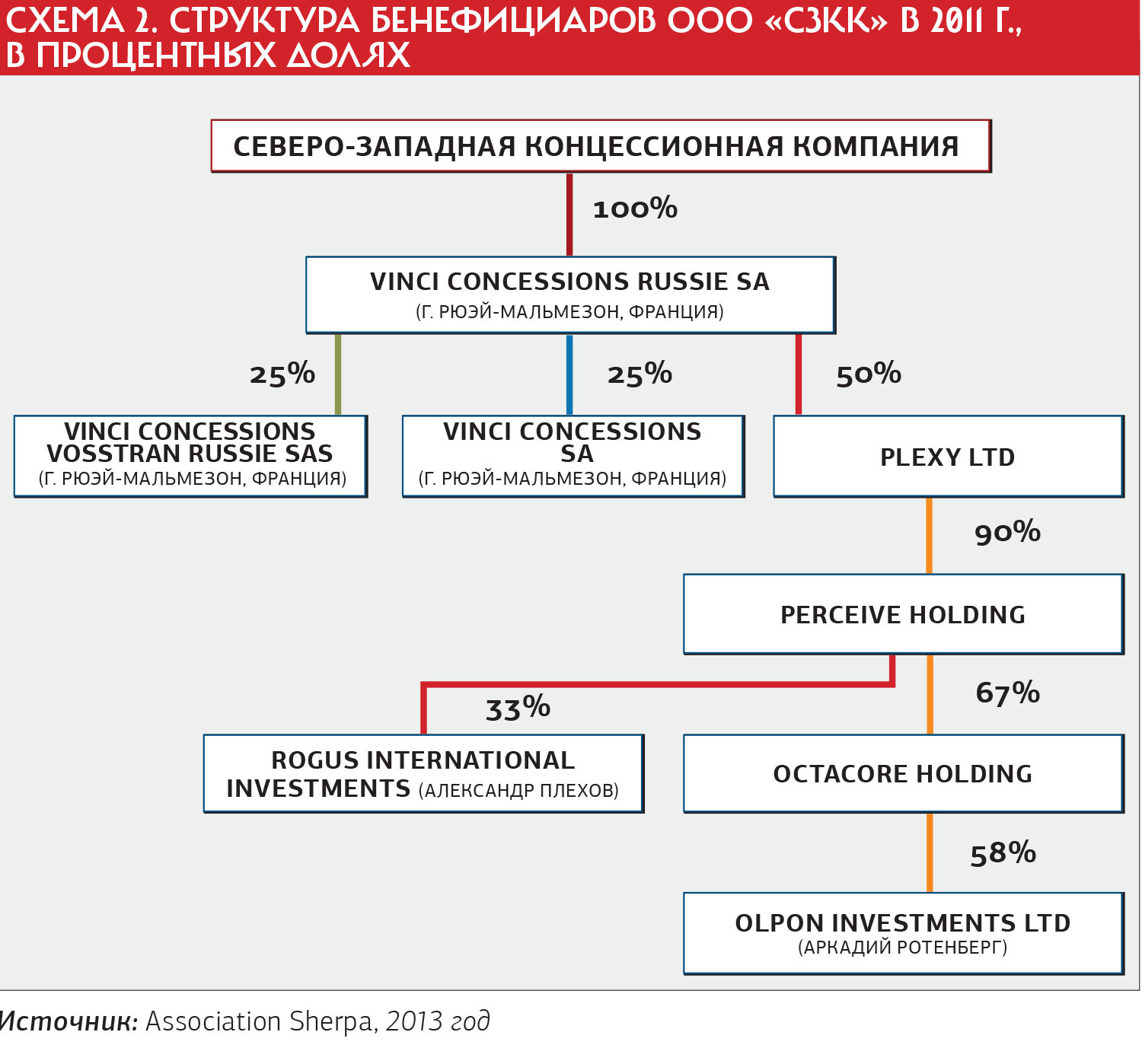
In 2011, the structure of SZKK owners changed (see scheme 2). Sherpa failed to install all the beneficiaries, but Arkady Rotenberg among them remained. At the same time, his fellow countryman, the St. Petersburg businessman Alexander Plekhov, joined the company of concessionaires, in the early 2000s-business partner Oleg Malinin, deputy chairman of the Bank of Russia, owned by the Kovalchuk brothers.
Officially, the billionaire of the plechips (158th place in the “rating of billionaires-2016” with a state of 3.2 billion rubles.-data of the Site “Business Petersburg”) holds the position of executive director of the Vital Development Corporation, producer of biochemical reagents registered in Cyprus. Until recently, this surname said little. Fame to the entrepreneur came last year when he turned out to be one of the characters of the Panama Dossier ***.
According to the study of the International Consortium of Journalistic Investigations (ICIJ), in 2012, Alexander Plekhov received by proxy from a vinoceller businessman Sergei Roldugin, a childhood friend Vladimir Putin, a 100% shares of the offshore company Sonnette Overseas Inc., registered on the British Virgin Islands ****. In addition, according to ICIJ, Plekhov was a shareholder of Sunbarn Ltd (also British Virgin Islands).
Redistribution
In 2012, the composition of the owners of the SZKK changed again. Alexander Plekhov dropped out of them, and Arkady Rotenberg and his son Igor became the co -owners of the company according to a different scheme. PLEXY LTD was sold to Mostotrest, which is engaged in the construction of transport infrastructure. Mostotrest, in turn, 38.6% belonged to the Cyprus offshore Marc O'Polo Investments Ltd, and he was 68.5% to the father and son of the Rotenbergs. Thus, their share in the Northwest Concession Company began to make up about 13%.
Mostotrest had two more co-owners-about 30% belonged to the Transfininggroup management company-the structure of the non-governmental pension fund (NPF) Welfare, established by the Russian Railways, and about the same number of N-TRANS groups (until 2008-Severstaltrans), which belongs to the general, commercial and executive directors: Konstantin Nikolaev, Nikita Mishina and Andrei Filatov.
At the same time, the N-TRANS group of companies is not alien to the current assistant of the President of the Russian Federation Igor Levitin: in 2004, he went to the post of Minister of Transport of the Russian Federation precisely from the post of its general director. The Sherpa Association suggests that “Mr. Levitin’s personal interest in the M11 motorway project was not limited only to the choice of the route, but was present in the conclusion of the contract with the SZKK.”
In 2013-2014, the Brownian movement of the offshore shares of the Northwest Concession Company continued. In October 2014, Arkady Rotenberg (obviously, under the influence of EU sanctions introduced due to the annexation of Crimea), handed over his share to Marc O'Polo to his son Igor, which belonged to the Mostotrest shares. Six months later, in April 2015, Rotenberg Jr. Sells all MARC O'Polo shares (and therefore shares in Mostotrest) of TFK Financial OJSC, whose shareholders are the management companies of the already mentioned Zheleznodorozhny NPF “Welfare”. Then, in 2015, the shareholders of N-TRANS also got rid of the share in Mostotrest-they also sold the TFK Financial shares.
Presumably, the NPF “Welfare” received a share in concession through Mostotrest, it is not accidental. Until August 2015, the railway monopoly was headed by another old acquaintance of Putin - Vladimir Yakunin. He was replaced by the former Deputy Minister of Transport of the Russian Federation Oleg Belozerov, who led Rosavtodor in 2004-2009. According to the investigation conducted by the St. Petersburg publication "Fontanka", Belozerov was affiliated with Arkady and Roman Rotenbergs.
Thus, the shares in LLC SZKK, no matter how they mummage, are simply moving from one close to the President of the Russian Federation to others.
"Blocking", "conspiracy", "favoritism"
Based on the results of its investigation, the Sherpa Association came to the conclusion that the contests for the construction of the M11 road, in which the French group Vinci participated, were held with gross violations of the law for its victory. In the actions of Vinci, Sherpa experts saw a violation of the five articles of the criminal and commercial codes of France, including the "bribery of foreign officials" and "trade in relations."
“The totality of elements suggests that Vinci has committed an offense under Article 435-3 of the Criminal Code of France, namely, the bribery of foreign officials, which excluded a transparent competitive tender,” the document that is at the disposal of NT. -There is no doubt that the contract for the construction of the Moscow-St. Petersburg route was received in exchange for the “commission”, therefore, such offenses as “favoritism” (in accordance with Article 432-14 of the Criminal Code of France), “conspiracy” (Article 420-1 of the Commercial Code of France) take place. We are also talking about "hiding the trade trade"-Article 433-1 of the Criminal Code of France. "
Sherpa filed the first complaint with the Paris prosecutor's office in 2013. Three years later, on November 22, 2016, the prosecutor’s office interrogated as part of a pre-investigation check of the famous fighter for the Khimkinsky forest Evgeny Chirikov. A complaint to the corps of investigative judges of the Nanter district was sent in May 2016, and now a decision is being made to appoint an investigative judge, NT said Sherpa lawyer Julien Larer-Genevuea.
Why is the prosecutor's office in no hurry with the initiation of a criminal case?
“Such things are drawn in France for years,” Julien Larer-Genevua explained. “This is due to the fact that the prosecutor’s office and judges send requests to Russia, and Russian justice does not answer them, or is not answered on the merits.”
"I'm not guilty"
Firms and people whom French wrestlers with corruption suspect bribery and money laundering, dismiss or remain silent from accusations.
“Such things are drawn in France for years. This is due to the fact that the prosecutor’s office and judges send requests to Russia, and Russian justice does not answer them or is not answered on the merits ”
“Having learned about Sherpa’s complaint (in June 2013), the Vinci Group of Companies immediately began to cooperate with justice in order to demonstrate the erroneous nature of its statements,” Emelin Uar, an employee of the press service of Vinci, said in response to NT request. -Sherpa demarche did not lead to the persecution of any company from the Vinci group. Vinci resolutely refutes Sherpa's statements and states that its new initiative (a lawsuit in the corps of investigative judges of the Nanter Prefecture. - NT) fits into the framework of other slanderous accusations. ”
However, Julien Larer-Genevae considers the position of Vinci at least strange. “When someone considers himself slandered, he immediately goes to court, so it is not clear what Vinci awaits,” he remarked in a conversation with NT.
As for Russian defendants, from the involvement of the President of the Russian Federation in corruption schemes back in 2013, his administration disranked. To the direct question of the CAPA agency: whether Vladimir Putin is the beneficiary of the offshores related to the North-Western concession company, the same direct answer was received, signed by the deputy head of the press service and information of the president Alexei Pavlov: “V.V. Putin has never been the founder or co-founder of any legal entities either in the territory of the Russian Federation or in offshore zones. ”
NT sent requests to all Russian defendants in the investigation of Sherpa Association with a request to comment on assumptions and accusations contained in her claims. Most of them were not received at the time of signing the number.
Olga Antonova, official representative of Arkady and Igor Rotenbergov, told the magazine that there would be no comments on this case, since “to us (Rotenberg. - NT), it has not the slightest relationship.”
From the apparatus of the assistant to the President of the Russian Federation Igor Levitin was informed by phone that he himself did not give comments, since this is the prerogative of the press service of the presidential administration.
Photo: Mikhail Japaridze/TASS
* Data newspapers "Vedomosti" ( http://www.vedomosti.ru/business/articles/2011/29/rotenberg_idet_pod_zemlyu ); On the SZKK website, the project cost is indicated vaguely: “More than 60 billion rubles”.
** https://fr.sputniknews.com/infographies/20100831187331323/ .
*** “Panama Dossier” (“Panama Documents”, “Panama Archive”) is an informal name for the leakage of confidential documents of the Panama Law Company Mossack Fonseca, which in 2015 the anonymous source handed over the German newspaper Süddeutsche Zeitung. During the year, a group of international journalists under the control of the American non -profit organization “Center for Honesty in Society” (CPI) under the project of the International Consortium of Journalistic Investigations (ICIJ) studied materials. The publication of the investigation results took place on April 3, 2016, publicity was placed by the presence of hidden property of politicians around the world and related conflicts of interest. The materials mention, in particular, 12 acting and former heads of states.