
Translated material
They burned again
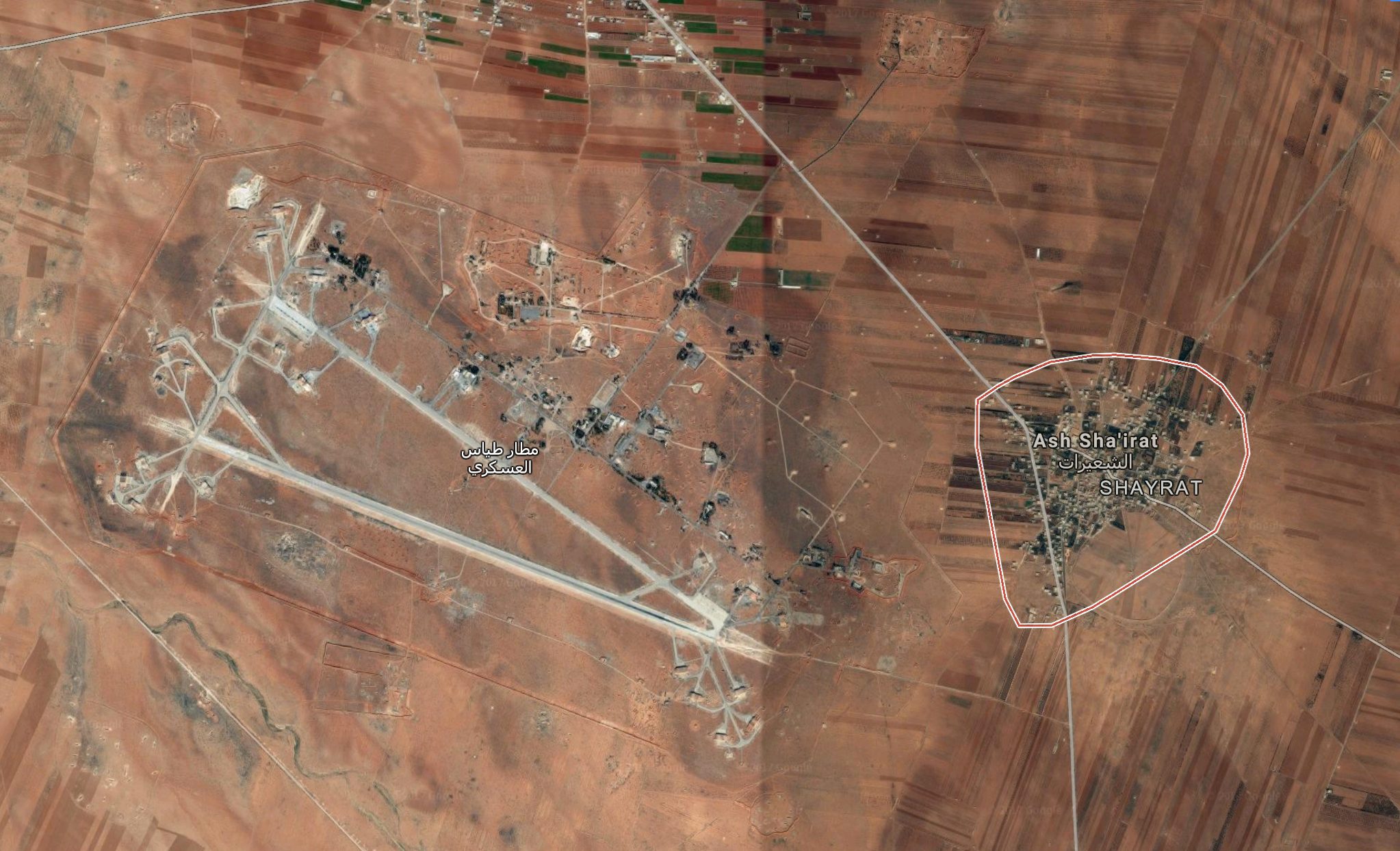
The independent investigative group Conflict Intelligence Team (CIT) , using the photos of the Prochremlian mass media, found that the objects found at the Syrian air base , which were previously assumed, were containers with chemical weapons, turned out to be somewhat different containers, also Russian -made - for prohibited international conventions of cassette ammunition. Now it turned out that such ammunition is again used by aviation of the forces of Bashar al -Assad and, apparently, they were recently delivered to Syria from Russia.
CIT experts made their conclusions by analyzing and comparing the marking of similar objects that were shown at different times on the air of the Russian Channel One and the Russia channel and the images of which were published in Komsomolskaya Pravda and other publications.
. @rianru @bm27_uragan in photographs from the Shayrat airbase visible BKF containers for AO-25RT cassette subbotes, not chemical weapons. pic.twitter.com/iznhbb5pa
- CIT (@citeam_ru) April 8, 2017
On April 7, the Shayrat airfield, where these photographs were taken by Russian correspondents to prove that the official Damascus did not have fighting poisonous substances, the US armed forces inflicted a missile blow . According to the Pentagon, it was from this base on April 4 that the aircraft of the Syrian government Air Force flew out, dropping bombs with poisonous chemicals into the city of Khan-Sheikhun in the province of Idlib . Dozens of civilians became victims of this raid.
Conflict Intelligence Team previously reported on the use of cassette bombs in Syria , which has repeatedly accused of international human rights organizations, reminds the analyst of Conflict Intelligence Team Kirill Mikhailov . In an interview with Radio Liberty, he tells how and to what conclusions he and his colleagues came this time. Briefly their essence comes down to the following:
1. The objects similar to containers for chemical weapons, noticed in the photographs from the Syrian Airfield Shayrat, turned out to be blocks of the BKF AO-25RT for cassette ammunition.
2. The Syrian government Air Force again began to use these ammunition in 2016.
3. The last time the cassette ammunition was used by the Syrian government Air Force in 2013-2014, which indicates that they could be placed by the Russian Federation after its direct entry into the war in Syria.
-The Russian official media published photographs that show that the marking of suspicious containers at the Shayrat Assadian air base, from where, apparently, the aircraft bombing Khan-Sheikhun took off, differs from the labeling of familiar Soviet containers with chemical weapons. They wanted to prove one thing, but proved completely different?
- After the American missile blow was inflicted on the Shayrat base, a lot of personnel from this air base were published in Russia. In general, it is always, when some Syrian and Russian objects in Syria become objects of the attention of Russian media, they can be seen on them a lot of such interesting things that, as a rule, falls into the lens of photo and film chambers. So, in fact, it happened now. Some Internet users have noticed that the objects we are talking about are very similar to BCF-P-P-P blocks, which, including chemical weapons, “R-55”, that is, Zoman, is delivered, including a chemical weapon. They are really outwardly identical, except for the markings. And after many paid attention to this, including our team, Russian journalists in Syria (Evgeny Poddubny from VGTRK, Alexander Kotz - journalist of Komsomolskaya Pravda) rushed to photograph these same containers to prove that this was not a chemical weapon at all. Indeed, specifically these containers are not a chemical weapon (which, of course, does not mean that it is not at all at the air base at all). But these are precisely these containers, who initially accepted Assad for the evidence of the innocence of the troops of the troops, who, in fact, turned out to be cassette ammunition!
- Let's recall what cassette ammunition is.
- They are prohibited by the International Convention signed in 2010, and by definition are indistinct. However, the USA, China, India, Brazil and Russia refused to sign this convention. Cassette ammunition is opened, as a rule, in the air and dose a certain area with the so -called "Subboteen" of a small caliber weighing from 0.5 to 2-3 kg. There are, in fact, there are a lot of them in every block, the "air bomb". For example, in Russian blocks of such sub -devices about 100 pieces in each. One of the serious dangers is that, especially if ammunition was stored for a long time, as is often the case with Russian and Syrian weapons, their significant part does not explode. And they can fall into the hands of people who do not know what it is and what to do with it, including children.
They can fall into the hands of people who do not know what it is and what to do with it, including children
For example, representatives of the same Syrian civil defense in the territories controlled by oppositions, better known as “white helmets”, are forced to walk and collect these ammunition after each such airborne, to deliver them to safe places where they get rid of them. And sometimes from them the opposition fighters themselves can even make hand grenades! Such an interesting way of supplying weapons of the opposition ... jokes jokes, but this is a really dangerous thing. And, as a rule, if cassette ammunition is used near residential quarters, then this is in any case a violation of the Geneva Convention on the inadmissibility of an attack on civilians.
- Apparently, these cassette ammunition, as you write, were recently delivered from Russia to Syria?
- We assume that, most likely, from Russia. Who else has such a large number of Soviet weapons? We carefully studied these BCF AO-25rt BCF blocks. Unlike the previously known Cassette Bombs RBC-500 AO-25rtm, they are different. Different markings, they work a little differently. If the bomb cassette is reset simply from the plane, then the BKF blocks are plunged into the so -called “Small -sized cargo container universal” (KMSU) suspended under the plane. This container is revealed in flight and scatters the contents, while remaining under the wing of the aircraft. BCF blocks fall out of it, which, in turn, are also revealed and dotting the space below with the already small-caliber bombs of AO-25RR. And it is precisely such ammunition in the BCF front-line containers in Syria that Eliot Higgins, the founder of the Bellingcat group , when he studied these bombs back in 2013. Their photos were published by the Syrian blogger Rosan Gazavi. After that, their use stopped for a long time.
Photo from Aleksandr Pushin Shows 80mm Rocket Pods, KMGU Submunitions Dispensers, 500kg-Series Bombs and An Electronic Jamming Pod FOR SU-22 Pic.twitter.com/6rqxg5xkpf
- Thomas NewDick (@combatair) April 7, 2017
And now we saw the same blocks again. Their photographs were published by the Syrian media activist Mahmud al-Alush , living in the north of the province of Homs, where several cities are controlled by the Syrian opposition. And we saw similar blocks that began to be used again in September 2016. When they had just studied these photographs, when it was not yet clear, they were connected with the last use of chemical weapons in the Idlib province or not, various satellite pictures were found, which show that this same pile of these same containers appeared on the basis of Shayrat in September 2016! Which means that in September-October the intensive use of such ammunition of Syrian government aircraft began.
Why do we think that the aviation of Bashara Assad? There is additional evidence - there are a lot, in different photos from this air base last September, we met these same KMSU containers, from which, I recall, BCF blocks are thrown out. Moreover, at the beginning of 2016, a photograph of the Syrian Su-22 ready for the combat flight was published with a Castu container suspended under it. This is one of those aircraft that, incidentally, at the request of the Pentagon and the Syrian opposition, and struck a chemical weapon in Khan-Sheikhun. So if at the beginning of 2016 a photograph of such a Su-22 was published, this means that, most likely, the Assad Air Force was then preparing to resume the use of cassette ammunition, which we already saw in September last year in photographs from the Earth.
The Ministry of Defense of Russia acts on the principle of "on you, God, that we are worthless"
This also proves that very often Russia supplies Assad with a rather outdated equipment, including outdated aviation containers-blocks. Such containers are no longer used by Russian aviation. Russia supplies Assad with old T-62M tanks, old BMP-1 infantry fighting vehicles, old howitzers. In general, the Russian Ministry of Defense acts on the principle of "on you, God, that we are worthless." Most likely, according to the same logic, Assad and cassette ammunition are supplied.
-In recent days, did something new to the use of chemical weapons on April 4 in Khan-Sheikhun has become clear?
- There was a Pentagon’s report in which American military analysts refer to their own sources, radio reconnaissance, their own geating and reinforcing their conclusions by the statements of local activists. It says that, indeed, on the morning of April 4, Syrian government aircraft struck the Khan-Sheikhun. Namely-the Su-22 aircraft, one of those that were based at the Shayrat air base. But the Pentagon did not provide direct evidence, citing the fact that they need to keep their own sources secret, for intelligence reasons. Therefore, I and our CIT team continue to believe that independent experts who will ever arrive in the city of Khan-Sheikhun and at the Shayrat air base should be put in this story. I hope that, nevertheless, under international pressure, the Syrian and Russian sides agree to allow international experts there. From the UN, from the organization for the ban on chemical weapons, which previously repeatedly investigated in Syria the use of chemical weapons with various sides.
-From Syria itself, did any other interesting military information of the military family come to you for these days?
- Now I know that the American and Jordanian armed forces are being prepared to block and ensure the safety of the northern border of Jordan, in connection with the onset of Syrian opposition detachments in the formation of the Islamic State terrorist group in the south of Syria. In addition, the Kurdish militia detachments surrounded the city of Tabka (Ea-Saura) and are trying to recapture it from radical jihadists. It is interesting that the Assad forces have already tried to take this city last summer, but suffered a very serious failure. And then there was even a suspicion that during that operation the Russian military died there, but this was not confirmed.
The rebels captured two T-62M Assad tanks, which were delivered from Russia literally in January
And one more interesting fact. In the course of recent battles in the province of Hama, a couple of tens of kilometers south of the very city of Khan-Sheikhun, the rebels from the Free Syrian army captured two Assad tanks of the T-62M, which were delivered from Russia literally in January. They even survived the N-2200 railway marking, according to which, for example, Russian tanks calculated during battles in the Donbass in 2014-2015. Many are joking on the fact that, they say, in this way, Russia supplies the technique of the Syrian opposition! In this regard, I recall, of course, the winged phrase of one Finnish general, said by him during the Soviet-Finnish War of 1939-1940. When he was asked: “And who supplies you the most equipment?”, He replied: “Well, of course, Russians!” Apparently, in the Russian army, certain traditions are preserved. Only now, the Assad forces are already going to Moscow supplied by Moscow - but in the end it still ends up with the enemy!
-

Alexander GOSTEV
The editor of the RS information service, international observer, author and editor of the heading and podcast "Atlas of the World"
Gosteva@rferl.org