Date
Author
Алексей Ферапонтов

Preserved copy
Translated material
Self -destruction algorithms
They are constantly trying to forbid people to kill themselves. Under the Investigative Committee, an interdepartmental group for the search for propaganda of suicide on the Internet was created, social activists conduct webinars for teachers where they teach to recognize “death groups”, and Facebook creates algorithms to recognize records for suicide. Samizdat “Batenka, you transformer” tells how artificial intelligence learns to identify suicidal behavior in social networks and why this will not save anyone.
The early Sunday morning of January 22, 2017 Naika Venant from the suburbs Miami launched her last broadcast on Facebook Live. Over the past year, a fourteen -year -old girl changed fourteen foster families and several times unsuccessfully tried to restore relations with her mother. About a thousand people for more than two hours watched, as Naika tells why she decided to commit suicide, then prepares a strangle from a scarf and hangs in the bathroom of her foster parents. Viewers of the broadcast reacted differently: someone tried to dissuade, someone mocked the girl and called the whole production to attract attention, someone posted video parodia as a joke. According to the local department for family and children, the mother of Naika also watched the broadcast, but she thought that all this was not seriously. Only one of the spectators called the police, but in evil irony he gave them the wrong address: by three in the morning the police reached the place, but the girl was already dead.
This case was not the first and not the only broadcast of suicide on social networks. The thirty-year-old Los Angeles actor Frederick Jay Boddy shot himself in his own car while the police tried to get to him. A student from Mumbai named Arjun Bharadvazh launched a broadcast and stated that he was writing “instructions on how to commit suicide”, and after one minute forty -four seconds jumped out of the window of the nineteenth floor of the five -star hotel Taj Lands End. The tendency did not bypass Russia: even before all the “blue whales” and online stamps, the media periodically wrote about the teenagers who committed suicide, leaving hints on it on their page . Handing notes became customary to write on the Internet.

To prevent suicide, Facebook in early March announced that he would use artificial intelligence to determine users on the verge of suicide and offer them support. The social network contains detailed information about more than two billion of its users. It will be treated with algorithms, and then the pattern recognition technology will highlight posts “with a high probability containing suicidal thoughts” and transfer them to the analysts for human intervention.
A couple of a week later, the Russian Network of VKontakte announced such plans. True, the emphasis is on the analysis of the images: “dangerous” content, according to the development of the developers, will simply stop falling into user tape. First of all, we are talking about the symbols of "death groups." The pages of the authors of “dangerous” pictures will be blocked: at the next entrance to the user's social network, they will ask that he was prompted to post a particular picture, and depending on the answer they will be sent either for the help of psychologists or to the support service.
Attempts to teach technologies to fight suicide have been going on for quite some time: back in 2007, a group of researchers from New Zealand University of Queen Victoria tried (quite successfully) to analyze the recordings of myspace.com users to determine those who are on the verge of suicide. Among other things, it is known that machine learning algorithms are much more effective than professional doctors can distinguish a real suicide note from fake (78 % accuracy versus 63 %), and for suicidal tendencies, for example, the duration of vowels during conversation. These searches do not arise from scratch: as a recent study showed, in fifty years of study of suicide, scientists have not achieved any visible progress in its forecasting. The traditional risk factors identified over the past half a century - depression, stress, the use of psychoactive substances - provide accuracy no higher than an accidental guess. According to the author of the study, Joseph Franklin from the University of Florida, "Information about previous suicide attempts helps to increase the accuracy of the forecast about the same as buying a second lottery ticket helps to win a jackpot."
The main problem of previous works is an extremely narrow methodology: most of them concern only one risk factor and do not take into account the complexity of their combinations at all. It is difficult to imagine that someone tried to correctly predict the likelihood of suicide for the next ten years from a single person if he was diagnosed with clinical depression. But this option sounds more believable: the clinical depression in an elderly person who has lost his wife several years ago has an income below the average, previously attempted suicide and often visits doctors due to numerous health problems, can increase the risk of suicidal behavior over the next few hours, days or weeks. The problem is that such combinations have never been tested in research - this would require too complex mathematical models.
A bit of probability theory. Based on dry statistics (suicide level - thirteen cases per hundred thousand people) and knowing nothing about a person, we can say that an abstract resident of the United States will commit suicide with a probability of 0.013 %. Of all the traditional risk factors, the most “strong” is the previous story of suicide attempts: it increases the basic probability of 4.2 times, that is, to 0.057 %. Another powerful risk factor, the presence of suicidal thoughts will increase the accuracy of 0.205 %. Even to achieve a probability of 50 %, you need to increase the accuracy of two hundred and fifty times and take into account many factors, none of which can be considered comprehensive. In addition, it is impossible to unequivocally talk about the causal connection of the factor and events: problems with the dream, which are considered a risk factor, may well be just an indicator of deeper problems.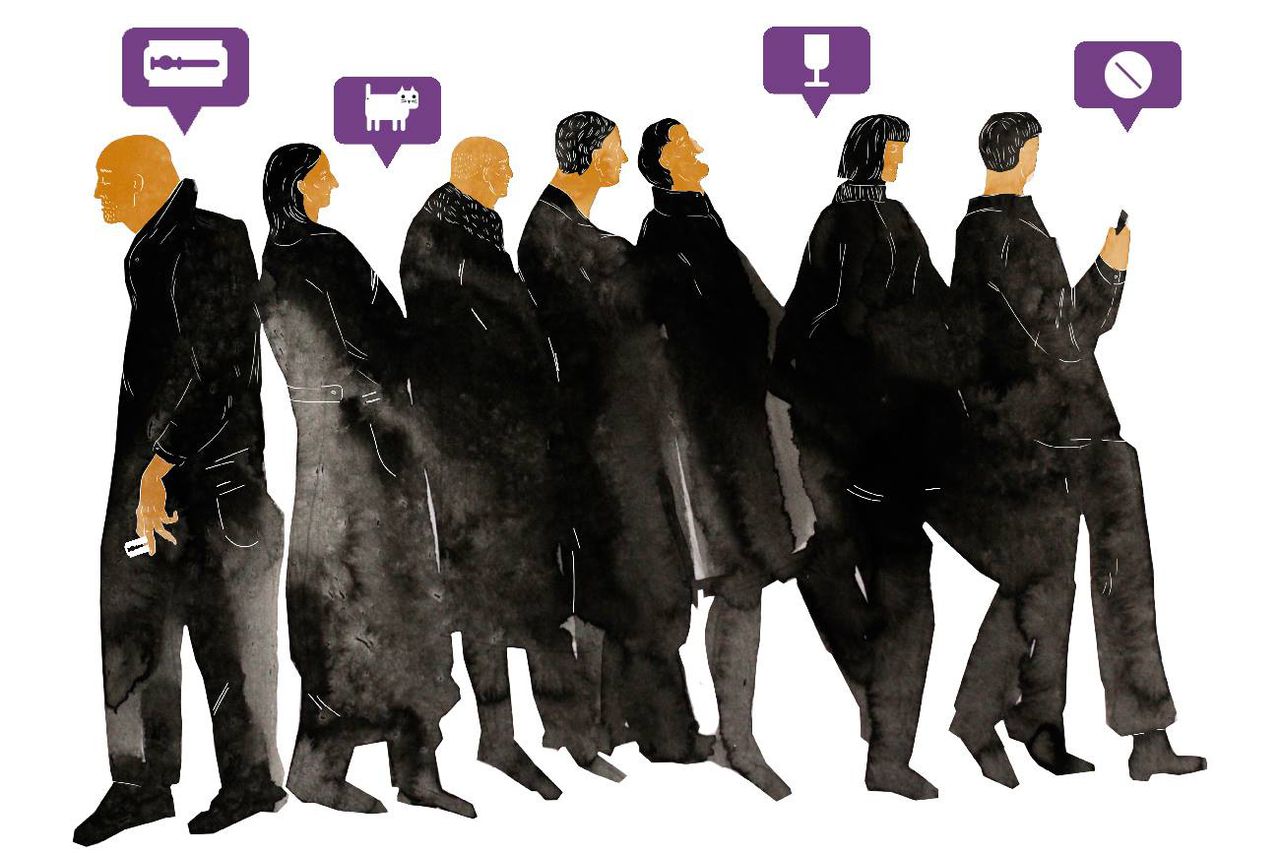
If you throw a coin and try to guess, it will fall or with a birch with an eagle, the forecast accuracy will be 50 %. The prediction of suicide based on one factor gives an accuracy of 58 %. This approximately corresponds to the accuracy of the forecast of an expert psychologist observing the patient. Using a computer, you can achieve accuracy of 80-90 %.
One of the most large -scale research in this area was the work of psychologist Jessica Ribeiro from the University of Florida. Ribeiro has been involved in the problem of forecasting suicide since 2009, heads the university “risk laboratory” and works, including with the US military departments, which are also concerned about this problem - wars of wars relate to groups with increased suicide levels. From the databases of several medical institutions, researchers chose three thousand two hundred people trying to commit suicide. For these data, they “set” the machine learning algorithms that have identified combinations of factors, most likely indicating suicide. The results were encouraging: artificial intelligence was able to predict whether a person would commit suicide over the next two years, with a probability of 86 %. For one week ahead - 92 %.
The ultimate goal of the Ribeiro research program is to develop a system that could with high accuracy to determine the risk of suicide for any person at any stage of his life. She expects to achieve this goal over the next ten years. It is possible that already in the near future the level of risk of suicide can be calculated in the same way as the risk level of cardiolois-something like a Score scale, but automated. This scale will be used when developing a warning system for doctors that would help them warn and resolve critical situations.
“Machine training will always be a step behind how adolescents communicate.” © Megan Moreno, pediatrician from the Children's Hospital of SeattleThe introduction of such technologies and systems will pose many new ethical issues to humanity. How will access to patients with patients be organized? What can be considered a sufficient condition for intervention? Who to notify in the event of a crisis? In addition, an obvious obstacle to the introduction of such a model can be uneven technological development of different countries. As of 2017, when the duels of military-like robots are held , a person is about to transplant a person (or a body that is more convenient), and Facebook knows how often you use public transport and how many outstanding loans you have ... So, as of 2017, only sixty member states have a sufficient amount of data necessary to assess the situation and the correct forecasting.
Social networks are everywhere, but their analysis is complicated by the fact that the language there changes too often. As Megan Morino found out, a pediatrician from the C children's hospital, after blocking the “Instagram” of one hashtag associated with self -overion or suicide, several new versions appear instead of it. For example, when they banned #SELFHARM, #SELFHARMMM and #SELFINJURY, as well as specific slang options - #BLITHE and #CAT arose. Ordinary users and self -harma lovers can use the last, which does not at all simplify the task of artificial intelligence.
“I think machine learning will always lag behind how teenagers communicate,” says Dr. Moreno. It seems that in order to catch a criminal, you still need to think as a criminal. However, given that artificial intelligence very quickly learns to everything that a person can, self-assembly robots will not make themselves wait long.