
Translated material
The time was good
Madness, scams and squandering in Russia of the XIX century
The publishing house “New Literary Review” came out “Meetings and acquaintances” - the memoirs of the writer Alexandra Sokolova (1833–1914), Mother Vlas Doroshevich (which she, however, refused), swindler, as well as a very observant and witty person. In this book you can find many portraits of contemporaries and fascinating household and criminal stories. Svetlana Voloshina at the request of Gorky read these memories and tells about wild priests and landowners, cruelty of Nicholas I, the wastefulness of Count Sollogub and other remarkable stories.In this amazing book, you can find literally everything: from the "Vasiloks" Emperor Nicholas I (i.e. his love affairs) to the life of "intellectual drunks" in Moscow slums. There are stories of Smolny pupils, worthy of novels of the type of Petersburg Secrets; There are household sketches dedicated to the famous contemporaries of the author - from Gogol, Dostoevsky, Tyutchev and Count Sollogub to the musicians of Tchaikovsky and the Rubinstein brothers; There are adventures of all kinds of people-wild landowners, feral priests, good publishers, actors-soldiers, journalists, abandoned lovers and other people with a diverse, but certainly difficult fate.
Fascinating separately, these stories in the mass give a strong accumulative effect. By the middle of the book, the intrigued reader acutely feels, firstly, the pride and admiration of its heroes-compatriots, capable of amazing in the scope and determination of the quirks, and secondly, some envy, because such figures among our contemporaries, spoiled by globalization, media and minor practicalism, will not be found.
“... so to let their fortune to live and live as well as the rich bar of those times did, at present, they no longer know how ... The horizons are already ... there is no grandmother of the former! ..” - Sokolova herself sadly. This remark is fair not only with regard to the ability to lower conditions, but also to live talent - and this talent in all of his diversity Sokolov perfectly describes in his memoirs.
There are many eccentrics and originals in the book in the book, but residents of the Tambov province performed leaders in the widespread expanses of Russia. In this regard, the local governor P.A. was most lucky. Bulgakov, who constantly received some “surprises” during his reign from the Tambovs, and catch up with the authorities for these surprises.
So, in the 1840s, the royal surname traveled around Russia. The governors were reported in advance about the route of the tsarist journey with the schedule of stops, “including one of the most modest and worst villages of the Tambov province, it was honored to take under the canopy of his rural church of the sovereign ... Father Ivan, and in his youth, was not distinguished in his youth, and in his youth, no courage, and over the years, and over the years, and there were almost no courage fertilized. " A blasphemous priest was to say a greeting word to the sample, he began to rest with horror, but under the pressure of the authorities he learned speech by heart. On the eve of the tsarist arrival, it became clear “that, under the slightest hint of a solemn situation, Father Ivan falls into complete prostration”, but since there was nowhere to go, the souffler-alert was hidden to help him in the altar: he will read the speech, and the “ill-fated father Ivan” will repeat it.
After the prayer service, the priest, “as he himself subsequently transmitted, forgot and where he, and what his name is ... forgot everything except that something threatens him and that some inevitable misfortune is approaching him,” and only mechanically repeated everything that the frightened Suffler also said.
After several incoherent phrases, told by Father Ivan and amazed the high-ranking audience, “the theologian in the altar ... exclaimed in a fallen but still clear voice:
- You will be completely lost, and I'm with you! ..
- You will be completely lost, and I am with you! - A prophetic voice sounded a completely stunned father Ivan. ”
It was not a matter of speech itself - the insane priest repeated the exclamations of the bewildered souffler, and the governor, despite surprise, and then the fun of the retinue, later got pretty good.
“ - I don’t know, on purpose, they did all this or God believed it to them so ... But they threw out the articles that so far, if I only dreamed that I was in Tambov, so I jumped as scalded,” the former governor later recalled.
Another “article” was the story of a wild landowner who was bored in his homeland and wished to find a new service.
Sokolova remarkably describes the morals of the deaf province of the first half of the 19th century: “In those distant times when the province was remotely distant from both capitals, in the villages they were aligned and healed almost until completely dull, and there were landowners, who did not know any trip, except for their long life, and no entertainment, and no entertainment, and no entertainments, and no entertainments, and no entertainments, and no entertainments, and no entertainments, and no entertainments, and no entertainments, and no entertainments, and no entertainments, and no entertainments, and no entertainments In addition to more or less fundamental drinks and cores in the company of their own clerks or local church honor. Their neighbors torn over such landowners, the elders and managers mercilessly fooling them, and in their rare appearance in the noble elections around them, hunters were grouped to convenient and cheap entertainment. ”
“One of these landowners, someone Protasiev ... Quite accidentally finding himself in the noble elections, immediately attracted attention with his unusual, almost men -shaped look. His beard merged with dense bucks and began almost from the very eyes, the gray curls on his head formed a thick, peculiar hat, and, all overgrown with his hair, he was a cross between a completely wild man and a well -pronounced monkey. ”
The unfortunate governor recalled how, having greeted the landowner, he was frightened, then he was surprised, and then his heart “clenched, as if in anticipation of some unknown trouble”-and the foreboding was justified.
“There is nothing to say that with a general tendency to get along a bored province to have fun at the alien expense of Protasiev quickly became the subject of universal attention.”
After one dinner, when “everything that was possible was eaten beyond measure was eaten,” the nobles spoke about the boredom of the village life; Protasiev complained. The helpful interlocutor invited him to enter the public service and assured him to be a spent, but doubtful landowner that such capable people are needed everywhere:
“ - Again, there are such places, in which no special knowledge is supposed to be ... but at least the maid of honor! What is easier? - without wrinkling suggested Balagur. “It is only required that the representative appearance and the ancient noble coat of arms.”
A representative nobleman with a pedigree from Mother Catherine was delighted, and Balagur continued to give valuable advice on how to submit a petition:
“ - And go directly to the highest name. What are you afraid of? You don’t get a harassment of something, but you want to bring the fatherland ... So and so, they say, I wish to take the first of the Freily vacancy available to be cleansed, and if at this moment there is no one, then I ask me to enroll the first candidate. ”
The delighted landowner, having recorded all the valuable instructions in the book, immediately got down to the case, putting on his petition “the track record of it about finding it many years ago in one of the army cavalry regiments, as well as a decree on resignation”.
Soon the Tambov governor was urgently called to St. Petersburg - the petition came directly to Nicholas I, who decided, according to his famous habit, to understand everything personally. Bulgakov was saved by ties in high circles: he was helped to achieve his personal audience with the sovereign, and the governor, being an excellent storyteller, changed the king’s anger for mercy, mocking both him and the empress, describing the “animal” candidate for maids of honor.
The “articles” of the Miracles-Tambovites did not end: the subjects of the governor then gave the king a petition on the stamp paper, correcting the title “all-abrasive, sovereign, all-obvious” to the “omnipotent”-as Augustus ended, and the matter was in September; That, rejoicing at the heir to the heir to Alexander Nikolaevich, at the sight of him, he was jumped in tarantasses and sang him loudly by name.
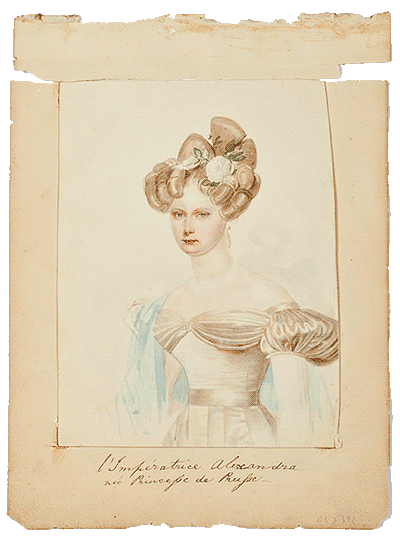 Empress Alexander Fedorovna. Figure B. Sirby. The beginning of the XIX century
In “meetings and acquaintances” there are many portraits of titled persons, in terms of brightness and drawing characteristic features of reminiscent of a deck of cards. Despite the fact that Sokolova recalls the imperial persons with exceptional goodwill, and the wife of Nicholas I Empress Alexandra Fedorovna looks at all a meek angel, the defender of the offended and offended (though this democracy and kindness spread exclusively on a special nobility), the emperor himself looks like an extremely unpleasant man.
The petty and vindictive nature of Nicholas I was clearly manifested in his (numerous) stories with adultery. When the next “heroine of the tsarist whim” - often a lady married - refused the imperial “mercy” rendered to her, the king remembered the insult for a long time and even after many years he could refuse an aged and impoverished lady to help. So, the secular beauty was not lucky to Princess Nesvitskaya: the poor thing was unhappy in marriage, but she refused the royal proposal. Her lover-a certain adjutant outbuilding-quickly realized that “there were many pretty women, and the emperor is alone,” and “brought to the attention of the sovereign that he was ready to forever abandon not only the connection with the Princess Nesvitskaya, but even from an accidental meeting with her, just not to lose his mercy of the sovereign.” Nicholas really liked such devotion, the career of the adjutant outbuilding went uphill, and the princess was left alone. Many years later, signing the papers of the Commission of Processes about the help of Nesvitskaya, who had fallen into the poverty, Nicholas I suddenly saw her last name - and the petition immediately torn, crying out: “This one?! Never ... and nothing! "
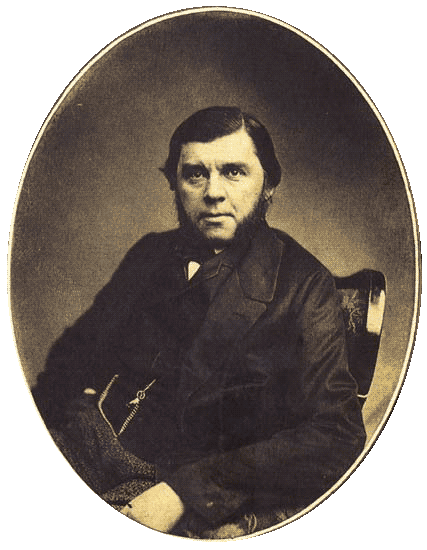 Photo portrait Vladimir Sollogub, 1856
Sokolova’s “artistic” memoirs of Sokolova: the famous writer Count V.A. Sollogub quite justified the aristocratic image, spent the money wide and lived in debt. “There was more debts from the Sollogub, on the Russian proverb, more than hair on his head, and he was so related to them and recognized his extreme debt with such ordinary, almost mandatory phenomenon that, listing somehow the number of annual parish of his, he preserved here the opportunity to increase his unpaid debts and preservatively said:“ Well, I owe another thousand or three more or three more or three more or three or three or three four!""
In addition, the graph writer, who was “pedantically clean and squeamish to ridiculous”, did not tolerate untidy people and somehow spat in the hat of the state adviser-an extremely unclean man, saying that he had confused his hat with a spittoon.
The composer Serov, the father of the future famous artist, was extremely untidy. After the success of his opera, Rogneda, Prince Odoevsky, enthusiastically stated that “he was so grateful to Serov for this evening by pleasure that he was even ready to kiss him, despite the fact that even the insects filling her, probably, probably walk on the Kaloshas.”
Another composer - Dargomyzhsky - was "a nervous man to soreness, shuddering at the slightest knock and terribly afraid of dogs." An adult is already the son of the friends of Dargomyzhsky had fun over this fear, "surprisingly well able to imitate the bark and grumbling of a large dog." Once, the joker “climbed under the table and there with increased grunts began to grab Dargomyzhsky by the legs, and despite the fact that the brilliant composer knew very well that Shilovsky was fooling around under the table, he picked up his legs and, smacking his lips, held out a hot bone under the table.”
The stories of unhappy love and family dramas, the unfortunate (in full accordance with the famous quote from L.N. Tolstoy), deserve a special mention. A desperate wife, exiled to the murmur of muzhn in the village with children, sends him a “hellish car”, exploding and killing not only her husband, but also standing nearby. The respectable mother of the large family suddenly learns about the incest - the intimate connection of her husband and her daughter, begins the lawsuit, achieves that the ex -husband is recognized as dead and “completely deleted from the list of living people”, and he has mourning all her life. A few years later, when the offended “deceased” tried to impose a ban on the marriage of his daughter, the “widow” calmly appeared in the call to the chief of staff of the corps of the gendarmes A.E. Timashev, where she stated that she was not obliged to fulfill the “frog requirements of her deceased spouse,” and presented all the papers about her husband’s burial.
No less fascinating are the early memories of Sokolova about life at the Smolny Institute and small Smolyans. Without falling into the usual silent nostalgia for former pupils, or sentimental heart -the therapy, the author lively writes about the structure of the Institute of noble girls, which was divided into two halves: “Nikolaev”, i.e. Noble, and "Alexander" - Meshchanskaya. The “aristocratic” half had many privileges, and also waged brutal wars with the “philistines”, whose tactics and maneuvers were not very different from those that were practiced in the later “SKKI” Republic.
Sokolov writes about a peculiar approach to education, when "was recovered for a sloppy hairstyle incomparably more strictly than for a poorly learned lesson." So, one of the best students at the final exam called Alexander Nevsky by the Polish king, because she did not hear the tips.
I must say that the life of Alexandra Ivanovna Sokolova (1833–1914) was so dramatic and full of adventures and adventures that her taste for dramas and feuilletons is quite understandable. Her family belonged to the old noble family of Denisiev (late Lyubov Tyutcheva, Elena Alexandrovna “Lelya” Denisieva, which is dedicated to the famous “Denisyevsky cycle” of the poet’s poems, - Kuzina Sokolova; she also described the grandiose scandal in Smolny, who was waiting for the Freily Shifra of the Naskhovnoye, as well her aunt, the inspector of Smolny). The marriage of Alexandra Ivanovna was a perfect Mesalliance-the writer Sokolov was from the circle of bohemia, which gave her a lot of material for essays that did not give way to Gilyarovsky's essays talent. Apparently, in the “warehouse”, which was brightly described by her, the place of meeting the lowered “intelligent drunks”, quoted in the original in Kant, Hegel, Shakespeare and Byron, - her husband also met.
Sokolov threw her eldest son Sokolov; Later, adopted by the couple of Doroshevich, he became one of the most famous and richest feuilletonists.
Sokolova herself wrote excellent feuilletons and bully historical novels (reprinted in the 1990s), fascinating criminal adventures-and she knew the material perfectly. In addition to the fact that she regularly attended court sessions (as you know, after the judicial reform of the 1860s, the court became vowel), the energetic lady personally conducted several quite criminal scams-the fake bills presented by her were discharged into someone else's name (including the famous hero of the war in the Balkans of General M.G. Chernyaev).
Vlas Doroshevich mentioned these Mamenkin talents in a poisonous feuilleton: “From everything that she wrote, a bill was most fame, which was very good at some Serbian general. This literary work gave the author a glory that would flow even to the border of the Tomsk province ... ”
The end of Sokolova’s life also passed in the genre of her novels: regretting the weak and poor old age of his mother (the second son drank, his daughter was dying of tuberculosis), Vlas Doroshevich forgave her and began to help her.
Probably, the writer Sollogub, who fell into her memoirs, was right, recognizing her after the debut “serious talent”, but warning about the danger of “exchange for newspaper Pyataki”. However, it was this way that Sokolova chose: “The newspaper work that he called“ newspaper heels ”became precisely my lot, and in fiction I took the modest place of the feuilleton novelist, which, although it gave me a lot of money, did not give me glory and fame.”