
Translated material
Lenin as a progressor
Pavel Pryanikov about the book of Lev Danilkin
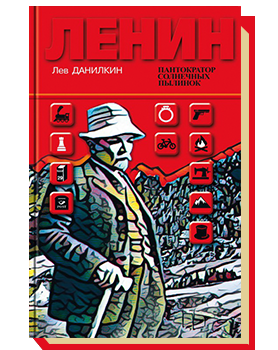
Gorky continues the cycle of materials about Vladimir Ilyich Lenin. The historian Alexander Shubin spoke about the evolution of the biographies of the leader of the Russian Revolution, and from the reader “Lenin about culture and art”, prepared in 1938 by Mikhail Lifshits, we selected Lenin's arguments about literature. Today is a review of Pavel Pryanikova, who, at the request of Gorky, read Lenin’s biography from Leo Danilkin.Lev Danilkin wrote a large, on 780 pages, the ethnographic book “Lenin: Pantocur of Solar Politniks”. The fate of the protagonist - Vladimir Ilyich Lenin - is woven into the story of Russia at the end of the XIX, XX and even the 21st century. The sociologist studies like himself, and the ethnographer of those who cannot describe themselves. And Danilkin for the Russians, for the entire multinational people, takes on this role of the ethnographer - after Lenin.
Lenin in his book is our doctor Livingston. With one important “but”: Vladimir Ilyich is a representative of the upper class, colonizer and cultivator of European culture in the Eurasian “Africa”-unlike his Scottish colleague, is aimed not only in study, but also to the transformation of this land. Danilkin year after year scrupulously follows Lenin and the reality surrounding him. Sometimes reality - landscape, economics, people, buildings and even animals - are more important than Lenin's path. Scenario, this is somewhat reminiscent of the famous Soviet series on the Gorky “Life of Klim Samghin”, where the picture is replaced by titers and a monotonous voice reading them: “There were two tithes on the peasant ... There are no stone buildings in the city ... Exports made stumps ...”
Danilkin’s path is true. By 2017, thousands of books, tens of thousands of scientific works were written about Lenin. The chance to find something new in the archive-zero. But few tried to immerse the leader in the context of that time. What did Lenin see in his estate, in which he was forced to steal time after expulsion from Kazan University? These two years of the landowner land made it peasant and pushed into the arms of the Marxists, who saw the advanced class, only arising in Russia, the proletariat. So, it’s true, we will look not only at Lenin, but how and why in his economy they sowed buckwheat and sunflower (and not rye). And why did the proletariat take Bolshevism so easily? Danilkin includes Dickens and describes his St. Petersburg representatives: “For Russia, the 1880–90s, as for England of the 1840s, was characterized, exactly in Marx, the commissioning of a person, its transformation into the appendage of the machine. Labor was painful, inevitably led to the destruction of the body and physical injuries. As expected in anti -utopias, these establishments [factory - approx. Ed.] Meded 12–13-year-old half-workers-e-gate, who were rotting alive among the dust, darkness and toxic evaporations. ”
Lenin studies this "parallel to Russia." His life is a research epic, from theory to practice: the landowner, lawyer, statistics and economist, writer and journalist, and then - politician. Don Rumata, the progressor is who Lenin is in this book. Only in the novel of the Brothers Strugatsky Rumat is saved from the world of medieval archaic, and in the world of Vladimir Ilyich did he remain to continue - civilize autochthonons. Colleagues-rescuers from a distant planet for him are an advanced European teaching-Marxism.
Danilkin often deliberately simplifies the plot so that the modern, especially young reader with a picture consciousness can personally see what happened more than a hundred years ago, as if on a neighboring street. The writer walks in the Lenin places - Ulyanovsk (Simbirsk), Kazan, Petersburg. “There was now a burgger in this house, and there was just a shop with Lenin ... The square was paved up, and there was impassable dirt with a fork ... Let's go further, this courtyard, which Vladimir Ilyich left the bacons ... And now we’ll visit Parvus’s house on Ungersers, 80 ...” If you throw these expeditions in the XXI century, the book would have lost a hundred and fifty pages. But then it would be just the next biography of Lenin.
 The writer takes on an overwhelming task of conducting an absentee examination of a Lenin character. After all, hundreds of no less stupid Russians were then armed with Marxism - why did Vladimir Ilyich only managed to get the winner? The most interesting thing is Danilkin Lenin in the days of defeat. Here they take away a “spark”, and then a loss in a dispute with the Mensheviks. In these defeats, suspicion is gradually laid first, and then Lenin’s persistent dislike of the intelligentsia. The landowner’s life raised a hatred of the peasantry in him, party life (especially in exile) - as they would say today, to the “liberals”, or, as they said then, “people of free professions”. From the side it seems that Lenin himself is the intellectual himself, but this is not so: he lives on part of his mother’s pension according to the loss of the breadwinner (i.e. his father Ilya) - and this is stable 30–40 rubles a month (multiply by 1200 to transfer to current rubles); They also gives their family estate. Lenin does not need a “free profession”, he always has a living wage, and he can afford to completely surrender to a political struggle, and not to earnings. In this sense, he is an aristocrat in life, and in spirit, and in a passport (a hereditary nobleman from both parents).
Other heroes of the era fly next to Lenin. They are not registered with Danilkin carefully, rather - as the scenery in the play, against which Lenin himself looks deeper. But the statists say a lot. The most deeply and with love is a working grandmother. He seemed to leave the revolutionary film "Youth of Maxim." It can be seen that Danilkin himself sympathizes with the proletariat as a class, and not the classmates and fellow travelers. The most harmful character is one of the ideologists of the Bolsheviks of Bogdanov, “suffering from tunnel thinking,” as Lenin spoke about him in irritation. “I have long been morally excluded,” the sensitive proximity of the reprisal of Bogdanov scratched the earth. ” “Scratched the earth” - Danilkin switches to thieves jargon; He would have met Bogdanov in the current campaign in Leninist places - he would probably hit him.
The post -revolutionary Danilkin looks at Lenin already as our contemporary. The case was done, Dr. Livingston founded his state: “Lenin himself did not invent anything and did not even drive a car, but even before the revolution he used to peer into a crystal ball predicting the future. He swallowed fantastic novels about aliens, showed interest in various kinds of paranormal phenomena and alternative technologies; After 1917, this passion received a new impulse. On the last pages of the book there is even one of the favorite expressions of the Eurasian Dugin about the "solar leader". A little further quotes cosmist Morozov, who dreamed of reviving the ashes of the ancestors. Leo Danilkin on the pages of his book Lenin accurately revived.