
Translated material
Russian bee against tick-tick
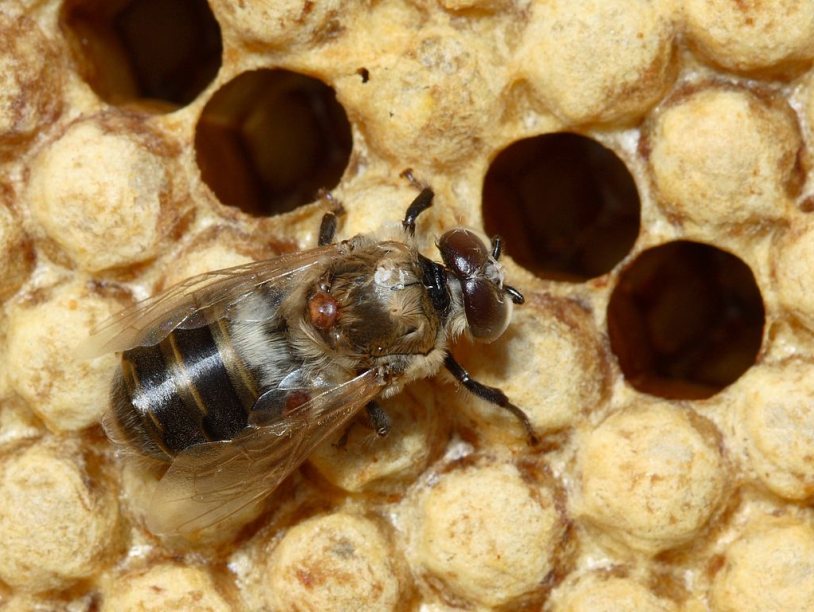
Modern honey bees suffer from numerous threats, the most serious of which is the spread of the parasitic tick Varroa Destructor ( Varroa Destructor ). The Latin name, meaning the "destroyer", he received due to a disastrous action on beeswear families.
Varroa ticks multiply only in bee hives. They have a flat body, 1.8 per 1 millimeter. Females are orange-brown, males are white. Only females winter, being on adult bees. Having completed the wintering, they lay eggs in cells where bees larvae develop, while preferring drone larvae.
Varroa tick on a bee (photography under an electron microscope)
Ticks are attached to adult bees and their larvae, eating hemolymphs, which weakens insects. In an adult bee, the tick is usually located on the back, where it is most difficult to get an insect. But the main damage is inflicted on the larvae of ticks that develop on the pupa of bees. A bee from such a doll comes out smaller, often with defects in the development of wings, antennae and legs. With severe tick damage, the doll dies.
Varroa ticks on the dead dolls of a honey bee
The destructive effects of the Barraa tick on the pupa of bees are explained by the fact that the tick infects them with a viral disease causing wings deformation ( Deformed Wing Virus , DWV). The virus was first allocated by honey bees in Japan in the early 1980s and is currently distributed all over the world, it also amazes the wild species of bees and bumblebees.
Ticks injured by ticks increases the likelihood of penetration of other infections. With the mass infection of the hive with a tick Varroa (more than 20 % of the population), the entire bee family dies.
Bee with a pathology of the development of wings
Initially, ticks were parasitized on the Chinese wax bee ( APIS CENA ), however, from about the 1960s they began to hit the honey bees ( APIS Mellifera ), rapidly spreading from Southeast Asia around the world. Now these ticks are not found only on the apiary of Australia and the island of Maine, and even then thanks to strict quarantine measures.
Researchers under the leadership of Entomologist Zachary Huang from the University of Michigan in 2015 established that Barroa's ticks can change their smell, imitating the smell characteristic of a particular type of bees. This is achieved by changing the proportions of hydrocarbons released by ticks. As a result, ticks that previously lived in the families of the Chinese wax bee, if necessary, acquire the smell of honey bees and vice versa. Moreover, for such a change, they need only a few days. Such a quick adaptation, according to scientists, allowed the strokes at one time to go to parasitization on honey bees, and now helps them spread.
Various phytoncides and chemical plants give only a partial effect in the fight against Varroa tick. Moreover, ticks quickly produce stability to poisons, so beekeepers are recommended to change the drug used annually. The heat treatment of bee families in special chambers or just in a bath at a temperature of 46 ° C to 49 ° C for about 15 minutes is also used. Here the beekeeper should show special caution, because if the temperature reaches 50 ° C, not only ticks, but also bees will die.
Since the 1990s, the U.S. Department of Agriculture has been searching for bees that are resistant to the Barroa tick. The main applicants for this role were the so -called “Russian bees”, the descendants of bee families, brought at the beginning of the 20th century from the Primorsky Territory.
Entomologists suggested that the bees of the Primorsky Territory, due to the close neighborhood with the original area of the tick Varroa, were the first of the honey bees with this threat (according to the calculations of scientists, this happened around 1900) and were able to develop mechanisms for the confrontation of the tick. For experiments from 1997 to 2002, 323 bee uterus were sent from the Primorsky Territory to the United States. After selection for several years, 18 queens were recognized as suitable for further use. Since then, the breed of Russian bees has spread widely among American beekeepers and has been in steady demand.
Studies show that without the additional use of anti -iclic drugs of the Russian breed family are also affected by ticks, but the number of parasites grows in their hives more slowly than in other bees. In 2009, Denmark joined the Russian breed bees breeding.
However, beekeepers note a number of shortcomings of the Russian breed. Bees from the Primorsky Territory are used to calling in more severe winters than the bees of the United States and Europe. Therefore, during wintering, they economically consume food. This turns into the fact that in the spring, Russian bees three times slower than other breeds increase the number of colony. Therefore, they begin to fly later and do not pollinate early flowering almond trees, the plantations of which in California are critically dependent on the presence of pipe bees. By the number of honey produced, Russian bees are inferior to the popular Italian breed.
Recently, the Journal of Economic Entomology has published a new study in which the infection with the tick of Varroa of the Bee Family Family and others was compared. It was conducted by the employees of the Center for the Study of the named after Karl Hayden Bee Research Center) of the US Department of Agriculture. If earlier the number of ticks in the hive was estimated, now they calculated how many working bees with ticks flies and flies out of the hive.
The comparative stability of the Russian bee to the Barroa tick is not explained by the features of its physiology, but by behavioral mechanisms. These bees pay much more attention to cleaning cells with brood, removing tick larvae. Therefore, the reproduction of the Barroa tick in the hive decreases. But, unfortunately, ticks can penetrate the hive on bees returning from the collection of nectar. As the Scientific Director of the Center for the Study of Bee Gloria Degrandi-Hoffman and her colleagues found out, this path becomes the main one for infecting the colonies of Russian breed.
The situation is aggravated by the fact that in very infected hives, bee families begin to collapse, and individual working bees can go to other hives, bringing ticks with them. In addition, healthy strong families of bees often resort to robbery, capturing honey from the hive of a weak family. During these raids, they can also become infected with a tick Varroa. In both cases, the cleanliness of the bees of the Russian breed, which prevents the reproduction of ticks on the larvae and dolls, becomes ineffective.
Degrandi-Hoffman and her colleagues found that in the area where in the hives with Russian and European bees there was a similar amount of workers infected with ticks, in all the hives the same level of infection with ticks was observed. Where the workers of the Russian bee were infected to a lesser extent, there was also the level of infection in their hives below. Therefore, the use of Russian breed can be useful in areas where ticks are well controlled, or on apiaries where there are no bees of other breeds.