
Translated material
Türkiye: version 2.0.1.7
The referendum on April 16 finally brought Turkey closer to Russia: in terms of power, President Recep Erdogan is now quite equal to Vladimir Putin. And they voted for them, as it turned out, people from similar strata. Why did Erdogan need to change the constitution and in which state the Turks can wake up tomorrow - the New Times found out
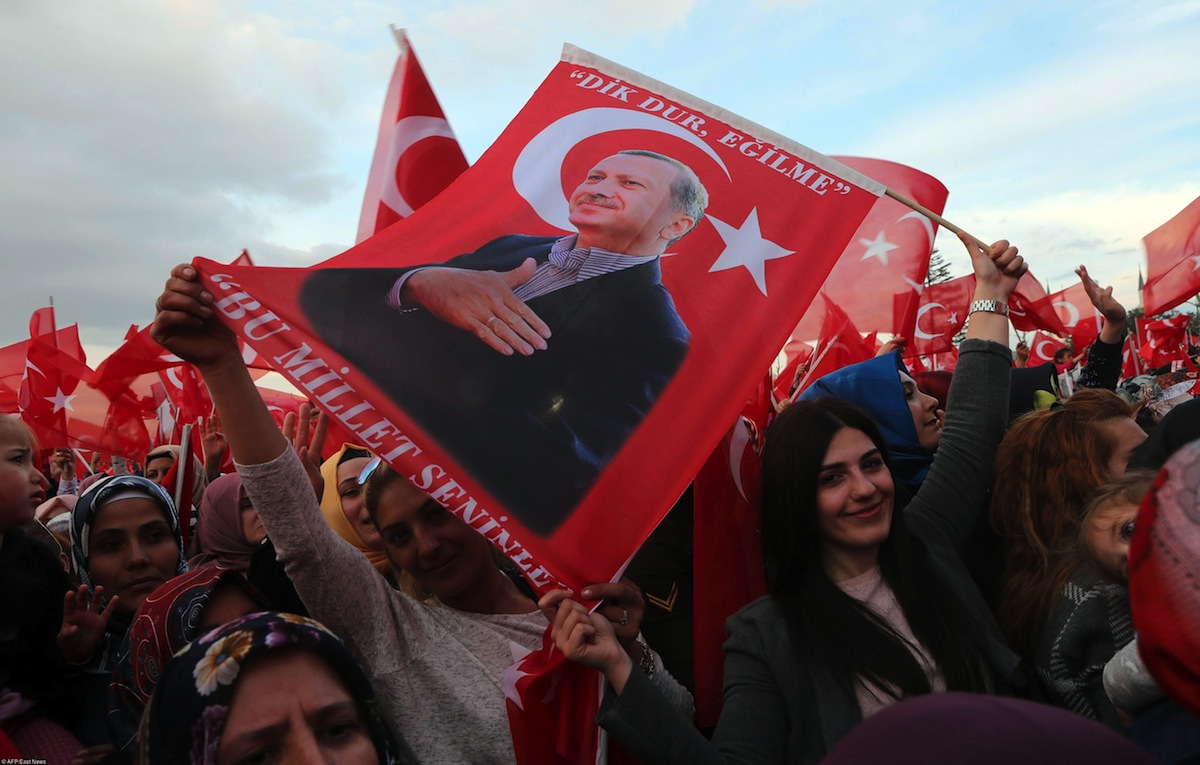
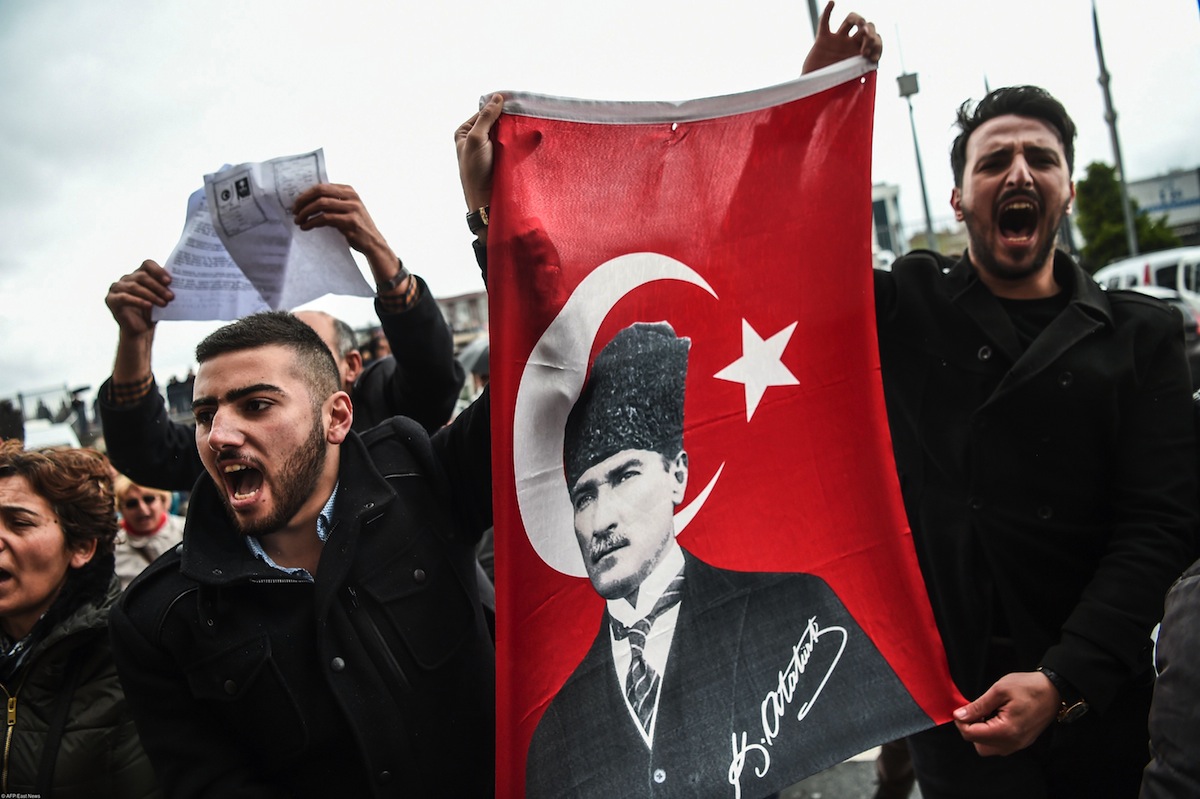
On April 16, the referendum split Turkey into two equal camps: against reformatting a country from the parliamentary republic to the presidential one - now Erdogan will be able to dissolve the parliament, plan the budget and propose laws - about 49% of voters spoke, a little more than 51%. The advantage was a little less than 1.5 million in the vote, which for an almost 80 millionth country-a scanty*. The opposition demanded a conversion of 60% of the vote due to violations, including reports that, shortly before the closing of the plots, unheated ballots were allegedly thrown. Foreign observers made several remarks to the vote, complaining of his “insufficient opacity”, but at the same time did not make charges of falsifying the results of the referendum.
Residents of megalopolises voted against the constitutional reforms of Erdogan: Istanbul (52.82% of 9,207,590 voters), a resort of the descendants of Orthodox Greeks and Armenians (69.27% of 2,790,403 people). For them, the concentration of power in the hands of Erdogan for many years means Islamization of Turkey. But in Ankara, where the positions of the Republican Party, which defends the secular character of the state, the opponents of Erdogan reforms gained only 39.24% of 3,415,697 votes - for many foreign observers are strong.
Erdogan has long been called either the Sultan, then the dictator, but for all 14 years that he heads Turkey, his position was very vulnerable and shaky
Another curious detail: supporters of the reform of the Constitution were no longer in Turkey itself, but among the Turkish diaspora in Europe - there, good Erdogan gave the maximum percentage of voters. Like, however, the Turkish hinterland. For the inhabitants of the province, Islamization is a kind of revenge for past grievances. They remember the times when any hint of commitment to Islam could put an end to a modest career, or even bring to prison. In the 1990s, even the main Islamist today, Erdogan, served a short time for a publicly read poem about bayonets-ministries, barracks and Muslim fighters. In that secular and democratic Turkey, the verse was considered extremism. Five years later, Erdogan “extremist” first became the Prime Minister, and then the President of Turkey. The pendulum swayed the other way.
A bad example
Partly the current Turkish schism resembles the Russian situation in 2011-2012, when society was divided into a white -open “creative class” and a continuous “Uralvagonzavod”, which begins immediately abroad of large cities. And this is not the only similarity.
In 1993, the First President of Democratic Russia Boris Yeltsin also transformed the country from parliamentary to the presidential, having shot a rebellious parliament from the tanks.
The term of powers of the deputies of the Turkish parliament after April 16 increased from four to five years. Familiar?
The President of Turkey received the right to appoint and dismiss ministers and vice presidents. In Russia, too, all the leaders of the law enforcement agencies are subordinate to the head of state, and not the government and, moreover, not to parliament.
Erdogan became the supreme commander (previously this function was part of the duties of the head of the General Staff). This was always the case in Russia, besides, the Federal Assembly endowed Vladimir Putin with the right to start a war at any time.
Four of the thirteen supreme judges of Turkey are now appointed by the president. In Russia, all judges of the Supreme and Constitutional Courts occupy their seats on the proposal of the president.
The President of Turkey from now on is not obliged to leave the ranks of his political party and may combine party and state activities. Putin, recall, at one time was declared the leader of United Russia, without even joining the party.
Analogies can be continued for quite some time, and the further, the more understandable: Recep Tayyip Erdogan on April 16 achieved what Vladimir Putin has been using for a long time.
But there is also a fundamental difference: in Russia, the president assignment of additional powers did not meet serious resistance. In Turkey, almost half of the population opposes.
The fight against weakness
There is not a word that adopted by opponents of the Erdogan reforms predict the opponents of the Erdogan reforms. All fears are associated with the personality of the Turkish president.
From the legal (but not from the actual) point of view, Erdogan had very little authority (by Russian standards) for the time being. Having become the head of government in 2003, he first encountered that annoying fact that, with all his desire, he could not allow the transit of the American military, who were sent to the war in Iraq. Then he had to retreat. (Compare with the Russian situation when the Kremlin simply did not pay attention to the objections that sounded in society against the arrangement in Ulyanovsk of the transshipment American base to supply the US military contingent in Afghanistan.)
At first, the relatively young Erdogan was forced to maneuver between the military (the threat of army rebellion in Turkey was always relevant), the Republicans-their main opponents in parliament, nationalists who were little by little turned from politicians into mafiosi, and a network of the founder of the Khimizet public movement Fethullah Gulen.
Erdogan received an even stronger “blow to the back”, while trying to close the “Kurdish question”, while trying to close in the 2000s. Part of the power bloc and nationalists greeted his course on the discharge of tension and the introduction of elements of cultural autonomy in Kurdish areas. How this confrontation ended is well known today.
The sharp cooling of American-Turkish relations at the time of the presidency of Barack Obama is also partly the result of the fact that Erdogan lacked authority. The very first black cat ran between NATO allies, when Türkiye did not succumb to American persuasion to introduce troops into Syria and move regular units on Rakka, which became the unofficial capital of the so -called “Islamic state”*. In 2013, the Turkish General Staff opposed such a development of events, proposing an alternative plan for creating a buffer zone along the Syrian-Turkish border. Strictly speaking, the current actions of Turkey in Syria are the implementation of the same plan.
Byzantine traditions
The Islamist Erdogan solved his problems in a visiting one. The Turkish domestic policy resembled the "fight of the bulldogs under the carpet" no less than the Russian one.
The army front was broken by the hands of the Gulenists, who had a strong influence in the law enforcement system. There was an Erdogan’s secret threat to the regime in 2007 in 2007 in 2007, Erdogan, rather than a participant, was more about the secret of the secret-nationalist organization Ergenecon. And five years later, he already watched the defeat of the Gulenists who fell in the judicial corps and the prosecutor's office.
Erdogan’s opponents and competitors were weak, but he himself acquired little from this in terms of authority. By 2014, his only achievement in the procedural issues of Turkish policy was direct presidential elections - Erdogan ceased to depend on the favor of the parliament and won these elections. However, in the next 2015, his party of justice and development (PSR) lost the parliamentary majority and could not agree on a coalition with political competitors. It was possible to return the party position only six months later by re -election to parliament.
And in the summer of 2016 there was a military coup, which was quickly depressed and untied Erdogan's hands. The blood spilled by the putty gave him a reason to try to take control of all political institutions in the country, which was done.
In the Russian media, Erdogan has long been called either the Sultan or the dictator, but in reality for all 14 years that he has headed Turkey, his position was very vulnerable and shaky. The prime minister, and then the president more often had to retreat than to insist on his decisions. And if you consider Erdogan as an Islamist, who pushed Turkey on a non -somocratic path, then we must admit: in this he has associates - army secularists who tried to make a military coup in July last year.
Clear dictatorship
Oddly enough, the reforms of Erdogan can completely arrange many international partners of Turkey. It is an unpredictable past, it is not clear how the arranged country, where, in addition to the official state, there was also the so -called deep state, in which the anti -democratic part of the national elite and security forces unofficially controls the executive branch. More recently, this deep state was able to sabotage any decisions of the authorities. Now foreign leaders have to deal only with Erdogan. He is also not the most predictable person, but in any case there will be more certainty.
Most likely, now Türkiye will not soon be in a single European political space, and Europe has lost a chance to slowly push a wild partner in the right direction
On the other hand, the past referendum greatly hit the plans for the integration of Turkey into Europe. In the queue for joining the European Union, Ankara stood for more than half a century (Türkiye became an associated member of the EU back in 1964. - NT), and Erdogan himself was a hot supporter of this project for a long time. In the 2000s, he was climbing out of his leather to fit Turkey under European standards. It did not work out in a good way, I tried it in a bad way, blackmailing the EU with refugees from Syria: you are a visa-free entrance to the Schengen zone, and we will not let the crowds of migrants into a prosperous old woman in Europe.
Today, the prospects for European integration of Turkey have become very ghostly. Most likely, now this country will not soon be in a single European political space, and Europe has lost a chance to slowly push a wild partner in the right direction. However, even before the referendum on April 16, this chance was small.
What to expect from the new Turkey to the Russian layman? He is scared by the upcoming Turkish Islamism, but this country is interested in most Russians only as a cheap resort. This interest is mutual: the Turks are also beneficial to regular and guaranteed filling of hotels by tourists from Russia, for which Erdogan Islamism will remain in some parallel reality. Much more Russian travelers are disturbed by the abolition of charter flights to Turkey, which our media were talking about again, after Erdogan supported the American blow to Syria. But the threat does not come from the Islamists. And not from the Turks at all.
* The turnout at the referendum amounted to 88.29%, in total, 55 million of 78.9 million Turkish citizens had the right to participate in national vote.
* “Islamic State” (IGIL) is an organization banned in Russia as terrorist.
Photo: Adem altan/AFP/East News, Ozan Kose/AFP/East News