
Translated material
Korean puzzle
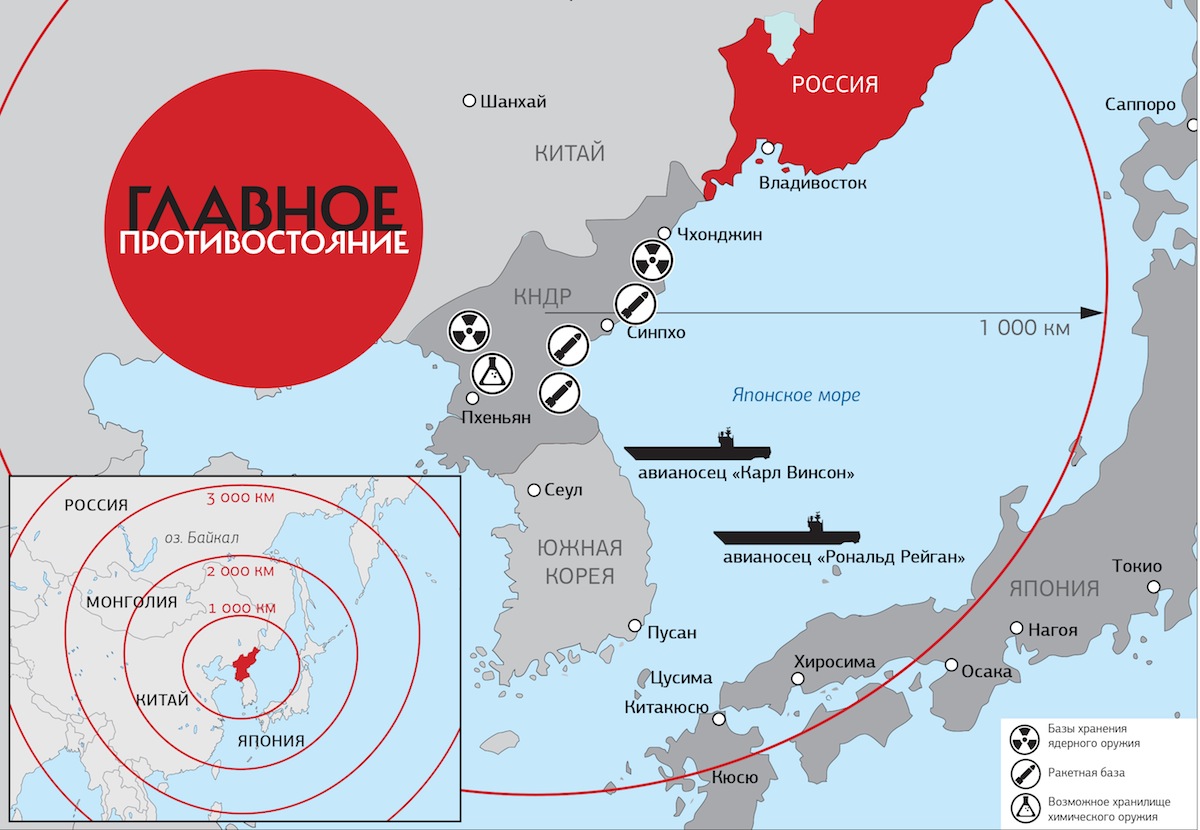
Not every leader can be sure that the list of holidays of his state lies on the written tables of the leaders of the great powers. But the North Korean ruler Kim Jong -un - maybe. Today, it is this North Korean list that is better than a top -secret intelligence station indicates the days when a nuclear war can begin. In the tradition of the DPRK mode, conduct nuclear and missile tests on solemn dates. The next, sixth in a row since 2006, the underground test of the nuclear device was dedicated by April 15 - the birthday of Kim Il Sen, the founder of the dictatorial dynasty. However, the United States promised to prevent testing by any means, including the military. A grouping of the Navy, led by the Karl Vincon aircraft carrier, went to the shores of the Korean Peninsula - in addition to the Ronald Reagan aircraft carrier, which is constantly there. In addition, according to some reports, an order has already been given an order to relocate there and the naval union with the Nimitz aircraft carrier. In response, representatives of the DPRK promised to deliver a preemptive blow to objects in South Korea.
April 15, the Apocalypse did not happen. Pyongyang conducted the test-however, not nuclear, but a ballistic missile, but-unsuccessful. And at the solemn evening on the occasion of the birthday of Kim Il Sen, the guests were demonstrated by the video clip on the destruction of American cities by North Korean missiles. Further “Third Kim”* has not yet gone. But the denouement has not yet come. It is no coincidence that Robert Litvak, an expert of the American Center Woodlon Wilson, called what was happening "a slow Caribbean crisis." The North Korean dictator remained in the reserve of another date - April 25, the day of the Korean People's Army ...
Means of blackmail
The North Korean Nuclear Center in Yonben was opened back in 1964 with the help of Soviet experts. In 2003, the DPRK left the agreement on the non -proliferation of nuclear weapons (day), publicly announcing the intention to focus exclusively on a peaceful atom. Many experts then called not to dramatize this decision too much: they say, Pyongyang in 1993 had already left the day, but not even a year has passed since he returned to the contract, again subordinating himself to control and checks by the Magate. However, the departure of 14 years ago was irrevocable. Moreover, on February 10, 2005, two years after the start of six -way negotiations on the North Korean nuclear program **, the DPRK openly announced the creation of a nuclear weapon to the country. The exact number of nuclear ammunition Pyongyang is kept secret, foreign experts speak of two dozen. One way or another, the nuclear program became for the rulers of North Korea, whose economy lies in ruins, and the population starves, the ideal means of self -preservation and at the same time blackmail of the world: either you feed us, or we do not answer for ourselves.
The policy of “strategic patience” did not interfere with the DPRK from time to time to experience nuclear ammunition and launch missiles - in violation of several strict resolutions of the UN Security Council
The world community was surprisingly unanimous in the desire to “denuclearize” the DPRK. And just as helpless. Negotiations with Pyongyang were drawn endlessly. At the same time, Moscow and Beijing were told as a mantra: a problem has no power solution and cannot be. Washington-both under Bush Jr. and under Obama-adhered to the concept of slow strangulation of the regime as a result of the strict sanctions of the UN Security Council, including the ban on the Import export of weapons and the freezing of assets. In April 2016, the former patron of the DPRK-China also joined the sanctions, introducing the embargo to the import of North Korean coal. Everyone’s logic is this: let's get patience - despotism will collapse by itself from internal contradictions. However, the policy of “strategic patience” completely did not interfere with the DPRK from time to time to experience nuclear ammunition and launch missiles - in violation of several strict UN Security Council resolutions at once. Moreover, in recent years, the DPRK missile and nuclear program has developed so rapidly that experts began to discuss how quickly what Kim would have what he lacks was a means of delivery of nuclear weapons. Pessimists talk about 3-5 years, optimists - about 10-15. Now Pyongyang is already launching missiles with a range of up to 2.5 thousand km. A little more, they resemble pessimists, and it will be possible to talk about the presence of full -fledged intercontinental ballistic missiles (ICBMs) in the North Korean regime capable of reaching the coast of the United States.
Outdated schemes
Since the beginning of the 1960s, strategic stability in the world has been ensured by mutual nuclear deterrence of the USSR and the USA, which in turn was based on guarantees of mutual destruction. Each of the parties had the ability to cause another “unacceptable damage”. Robert McNamara, who, before becoming the US defense Minister, developed the theory of nuclear deterrence, defined such damage as the destruction of 1/4 of the population and from 1/2 to 2/3 of industrial potential. Life quickly proved the speculation of these calculations. Subsequently, Maknamara himself admitted that already at the time of the Caribbean crisis, he abandoned his own theories, according to which the United States should have been inflicted on a disassembly of the USSR. However, the restraint worked: the parties were held within the framework and did not try to resolve contradictions with the help of a global war. Still, both Western democracies and communist dictatorships considered the existence of their own countries the highest value.
The situation around the DPRK missile and nuclear program says that the old approaches to ensuring security have outlived themselves. How Kim Jong -un dates back to the prospect of the complete destruction of the subordinate people, whether it is a restraining factor for him is completely unclear. It is possible that for him, as a leader, not to show slack and not give in to “American imperialism” - more important than avoiding a nuclear war. And then it turned out the most unpleasant for the great powers: the fact that their armies are repeatedly superior to the army of Kim Jong -un, does not have such a significant significance. The readiness of the probable enemy burn his own country in a nuclear flame outweighs all their military power. Before Donald Trump came to the White House, everyone agreed: “Kim of the Third” is better not to touch. But the 45th US President, deciding to check whether the DPRK leader is ready to arrange a nuclear war, turned the situation over.
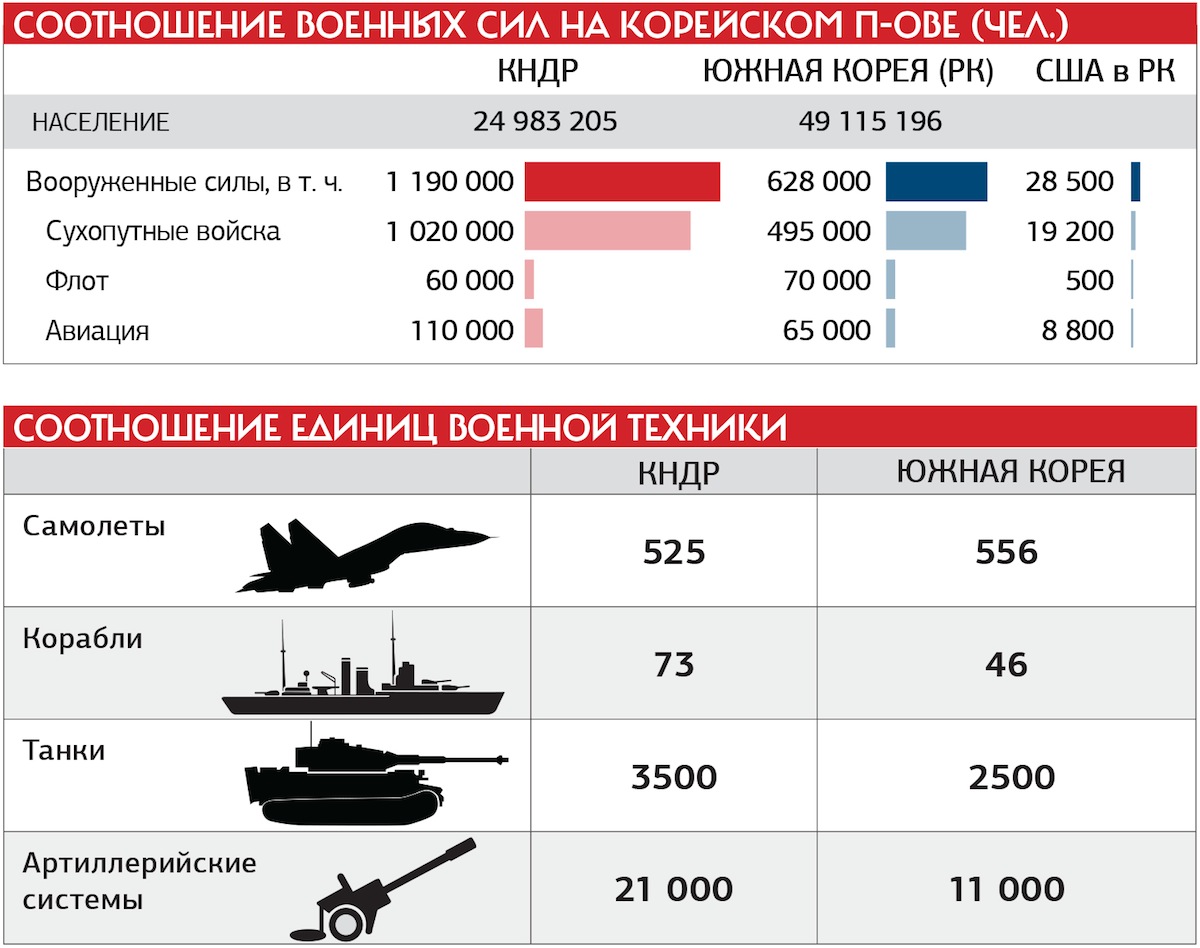
The Korean peninsula is already perhaps the most militarized place on the planet. On an area of about 2/3 of Poland, more than 1.8 million military personnel armed with thousands of tanks and artillery systems are opposed to each other. US tough statements raised bets in a military confrontation at the level unprecedented over the past 30 years. If we keep in mind the number and weapons of the Korean People’s Army (KNA), then it is not so difficult to predict what forces and means will be needed by the United States in order to defeat the army of Kim Jong -un: these are at least four aircraft carriers and strategic bombers that can provide a blow to approximately two thousand cruise missiles. As a result, the Americans most likely be able to destroy the vaults of nuclear ammunition, as well as the starting positions of about 1 thousand missiles of various range. However, at the same time, it is almost impossible to prevent a blow to the multimillion-dollar Seoul, located only 40 km from the line of separation of two Koreans-the so-called “38th parallel”. Because in this case, Kimu will not need either a rocket or atomic bombs: Seoul is within the reach of 20 thousand North Korean artillery guns. By the way, it was this circumstance that stopped Bill Clinton in the early 1990s, who wanted to punish the DPRK for leaving the day. “No one knows what amount of damage will be unacceptable to the DPRK. But everyone knows that she may well cause the unacceptable damage to South Korea, which means that the United States has hands, ”says Michael Kofman, a military expert working at the Kennan Washington Institute and the Center for Naval Analytics.
The illusory of attempts to force Pyongyangs to nuclear disarmament is also indicated by the professor of the Institute for Research of Peace Research in Oslo Pavel Baev: “At first glance, the idea of restraining Pyongyang attracts with its minimum: after all, no one sets the task of changing this prohibitively totalitarian regime. But, alas, in fact this “minimum” is imaginary. As the launch showed - albeit unsuccessful - a ballistic missile, it is impossible to achieve such a restriction either with the help of American aircraft carriers or Chinese economic sanctions. ”
Hope for China?
However, some elements of classic deterrence still did not obsolete themselves and in the situation around North Korea may be effective. “Suppose Kim Jong -un is useless to intimidate the imminent retaliatory blow, especially since we do not know what damage to him is unacceptable. But if Kim clearly understands that they simply will not allow him to use his weapon, preventing his nuclear ammunition and rockets at starting positions, he may be applied. And this is called “restraint for the prohibition,” explains Michael Kofman.
“No one knows what amount of damage will be unacceptable to the DPRK. But everyone knows that she may well cause unacceptable damage to South Korea. This means that the United States is connected "
However, as the expert believes, today the Americans press not only Pyongyang, but also through him - on Beijing, trying to persuade the Chinese to additional economic sanctions against the DPRK. “Trump uses the threat of force to force China to punish North Korea,” Kofman explains. If such a tactic is successful, then "Trump can be congratulated on the reasonable application of the principles of deterrence." The Russian expert, the leading researcher at the Institute of the Far East, Vasily Kashin with Kofman, agrees only partly: “Americans are trying to get the consent to the actual blockade of the DPRK - with the termination of oil supplies, the sea blockade, the termination of air communication, the prohibition of export of North Korean labor.” However, such pressure on Beijing, Kashin is immediately stipulated, "if it bear fruit, then not immediately."
And the situation, meanwhile, develops rapidly. The second aircraft carrier group of the United States will be off the coast of North Korea this week. The rates are so high that it is unlikely that it will be possible to get out of a conflict situation without loss. One of the two - either Trump or Kim Jong -un - will not be able to fulfill his threats and inevitably lose his face. An alternative is a serious military conflict, up to the nuclear. Maybe, really, it was necessary to listen to the cynics that they just offered to feed the “Kim of the Third” ...
* Kim Jong -un is the third representative of the ruling DPRK dynasty. He is the son of Kim Jong Ira and the grandson of Kim Ir Sen.
** In six -way negotiations under the auspices of the UN, in addition to the DPRK, Russia, the USA, China, Japan, and South Korea took part. In total, seven rounds of negotiations have passed from 2003 to 2009. In 2009, the DPRK announced the way out of negotiations.