
Translated material
No love. The series "Girls" as a window to feminism
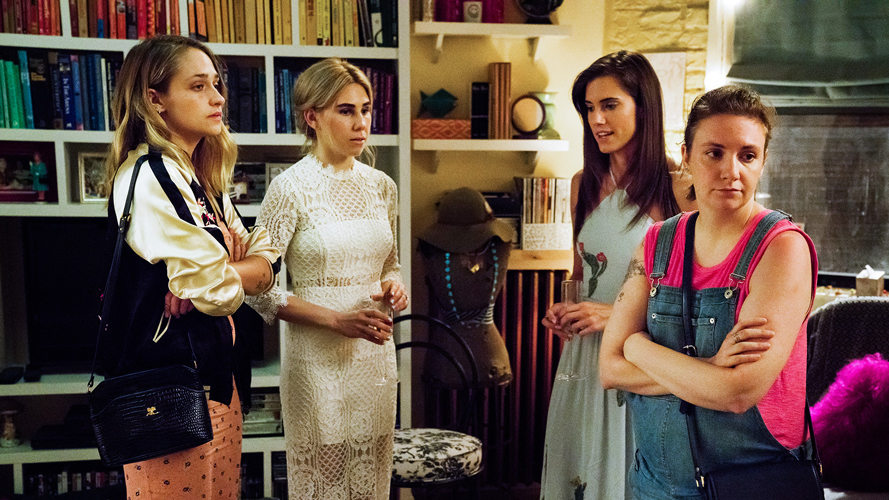
Last week, the last episode “ Girls ” (“Girls”, the HBO channel, from 2012 to 2017, was released, a series that managed to break the wall of stereotypes, the traditionally surrounding the image of a woman in mass culture, was released on the screens of America. Unfortunately, the focus of all the tabloids and even more or less respected media now is now a slightly different topic: Lina Danam, the creator and main character of the series, lost weight. The new, which greatly lost in the dimensions, the actress’s body cuts the eyes of both skeptics and fans. Inviting! The star of the series, which could not boast of its neglect of imposed standards of beauty, succumbed to the temptation of these very standards! "History!" - shouting journalists. “ Fuck You ! " - answers Lina.
Why is the Lina, for whom running training became part of the treatment of obsessive -compulsive disorder and endometriosis, has the full right to be scattered to the left left and right? The dimensions of the dimensions, and the achievements of “ Girls ” in terms of cultural and ideological is difficult to overestimate. Taking advantage of the narrow place, which was allocated experiment in the framework of the popular culture and the serial genre, Lina made a small social revolution, and on the banner that the chubby girl carried through the masses of nothing suspecting millennials, “feminism” is listed.
Mass culture does not recognize hybridness and diversity. On the surface yes - it sparkles with all the colors of the rainbow. But at the ideological level, the product of popular culture always has one goal - to justify, justify and strengthen the existing system. The mentioned colors of the rainbow only cover it with an additional layer of glaze that meets fashion and time requests.
Any cultural product, representing “live together” as a task, to a funny easy one, can today be considered a crime against humanity.
A good example is the film -filled series of Twilight novels. The heroine, Bella Swan, is at first glance a real rebel. Even if we forget about Christian standards, the story of a girl who feels uncomfortable in his own mortal body, and especially surrounded by her recent mortal peers, has endless potential to captivate adolescents. It seems that this story is aimed at encouraging and developing non-such-caches. In fact, this winding path leads everything into the same swamp. The trilogy teaches girls (and, judging by the ratings, some boys) the same thing as every Hollywood love story: there is no greater good than love; There is no more absolute love than monogamous heterosexual relations enshrined in a marriage contract; There is no greater miracle than the miracle of childbearing; There is no greater sin than the interruption of this miracle in the way of its implementation. It would seem that the merits of “Twilight” include at least the installation to “live together” - people, vampires and werewolves, let's live together. But in the world where tolerance requires serious intellectual effort, the superficiality with which the trilogy approaches this problem, leads out of itself. “Let's live together,” they say “Twilight,” “with those who, by and large, are no different from us. Unless with its unimaginable beauty, fabulous power and distant (but who is now interested in) ties with the devil. ” Any cultural product, representing “live together” as a task, to a funny easy one, can today be considered a crime against humanity.
It’s not that the series about four white girls who in half of cases meet with white boys are deprived of all these shortcomings. “ Girls ” , however, managed to use the resources of the genre of a popular show for a point, but fierce attack on the prevailing standards.
 © HBO
© HBO" Girls " is not the first excursion of the popular culture into the dark kingdom of female completeness and its surrounding complexes. Hollywood has long been able to find a place for puffy girls and women, but this place does not look too seductive. From the “Devils” (“ She - Devil ”) through all the painful dressings of black actors in women suffering from obesity (“The House of Big Mom”, numerous films made by Tyler Perry, “Norbit tricks”, etc.), the fullness became a sign of a sign of a comic character. A hint of the psychological depths that Hollywood heroines are usually awarded with a “normal” figure is replaced by a series of stamps moving from film to film: speaks only about food, wears underwear the size of a sail, shows miracles of clumsiness.
The Bridget Jones Diary in 2001 was an attempt to give a full girl with a relatively complex inner world. Unfortunately, the film, like the book, in its stereotypical idea of completeness has not gone very far. Firstly, Bridget remains a comic figure whose problems are called to cause laughter, and secondly, Bridget is trying to drop these unfortunate several pounds and finally become a normal, handsome person, without undermining, but strengthening the existing beauty standards.
He only talks about food, wears underwear the size of a sail, shows miracles of clumsiness.
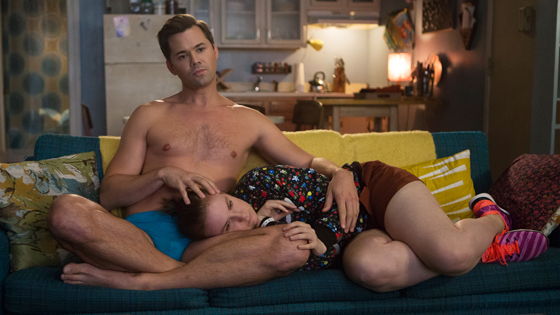
" Girls " teaches its young spectators a completely different lesson. The main character Hannah (Lina Danam) says: “I do not want my body to be perceived as funny” - and does not spend the slightest effort on changing it. She is not going to feel shame behind the flat layer of cellulite, covering her hips and stomach. Hannah undresses often and with joy, and few of the spectators will find quite free thought in themselves to restrain a condescending smile when, in the first series of the first season, she tries to pull off her tights, lying face down on the couch. The message of the series is that this smile is the problem of the viewer, not Hannah. The absurdity, not natural, but culturally constructed, illusory absurdity of the Hannin body, is the topic to which the series returns again and again.
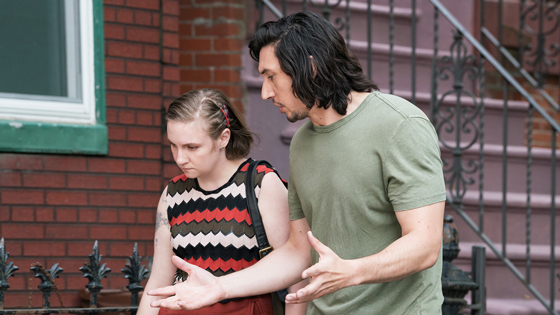
“ Girls ” is not a fantasy about how the whole advanced youth of New York suddenly found the strength to stop judging the world through the prism of unrealistic standards. Rather, this is a story about a girl who did not agree to take on the role that these standards imposed on her in every possible way. Hannah constantly repeats that the development of a positive attitude to her own body was not a simple task. When asked by Adam’s boyfriend (Adam Driver), whether she made attempts to lose weight, Hannah replies: “No, I didn’t do it because I decided that I would be guided in my life with other interests and worries.” Each time her body becomes the subject of ridicule, Hannah declares something in the spirit: "Thank God, I have already learned to love my body and overcame my sensitivity to criticism." That is, there is also evolution of views: Hannah admits that Body - Positive did not come by itself, it took an intellectual effort.
 © HBO
© HBOThe complete absence of concrete references to where the heroine drew inspiration, is perhaps one of the largest misses in the series. If everything is clear with Shoshanna (Zosya Mamet), her idols - the heroines of the series “Sex and the City” - look at the audience from a huge poster on the pink wall, then in the room of Hannah we see only a vast collection of books turned into roots inside. From her statements about Patriarchate and the role of women in society, we can conclude that at the Obernian college, where the heroines of the series Hannah, Jess (Jamim Kurke) and Marnie (Ellison Williams) met, the theory of feminism did not bypass her. The very fact is that Hannah (like Lina) is a graduate of the first college in America, who began to accept women and blacks for training, plays an important role in the formation of the character of the heroine. Hannah found that place in culture and discourse, where the body does not seem a joke or a curse. This position is still difficult to compete with the enormous influence of Hollywood. But the series " Girls " managed to make it much more visible - and more achievable.
What else “ Girls ” refuses to follow the standards of any story about girls - this is in relation to the wedding and marriage. Even in the time of Aristotle, civilization came to the conclusion that there are only two types of stories: those that end in death, and those that end in the wedding. Variations are possible, death can be both physical and metaphorical (professional, loss of influence, etc.), the wedding can be replaced by any positive denouement that hints that two will live happily ever after. " Girls " does not want to fit into this scheme. Two of the four heroines of the series get married and get up suddenly.
Hannah undresses often and with joy, and few of the spectators will find quite free thought in themselves to restrain a condescending smile when, in the first series of the first season, she tries to pull off her tights, lying face down on the couch.
In both cases, the decision on marriage is later realized as a mistake that crippled the life of not only a couple, but also many in its environment. And the desire to get married is portrayed as imposed and coming from the outside. In the case of Jesse in the first season, the wedding becomes the result of a conversation with the former employer Katherine (Katherine Khan). Exhausted by jealousy (Jesse and her husband had a platonic novel), Katherine comes to Jess home and explains why Jessin, a life that leaks among love escapades is the wrong and unhappy life. To find real and correct happiness, Jess needs to find a permanent partner. Jess jumps out not only because Katherine presented her this lesson, but also because he seemed familiar to her. The story should end with a wedding. The purpose of all life and the source of all happiness is a permanent partner and true love. Jess, like many of us, confuses this propaganda with the truth. After the honeymoon at the very beginning of the second season, Jess says Hannah: “I have never been happier,” and a little later, discussing his bliss: “That's what happens when the pursuit is finally behind.” This refers, of course, the pursuit of a man. At the same time, girlfriends are sitting on the sun -flooded lawn, playing with charming puppies to the accompaniment of laughter coming from the playground. It's time for music and inscriptions " End " . But in " Girls " everything is just beginning.
 © HBO
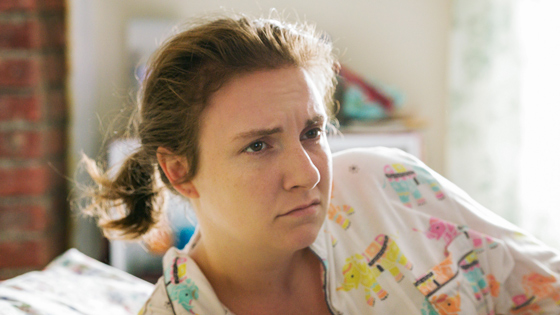
© HBOTwo series of puppies will be handed back to the store, and Jess will not sit on the lawn, but in Hannina Bath (along with Hannah), mourning his impulsive marriage and pulling out large brackets of disappointment into the water. Life refused to fit into the stencil. In the penultimate season, Jess will converge with Adam, and although these relationships can be called mature and serious, the series does not give the audience the wrong guarantee that they will not end soon. The series insists: “Life is not a search for an ideal partner, and if you are convinced of the opposite, do not listen ” (by the way, I recommend that all fans of Girls see how beautiful Jess discusses feminism and women in art ).
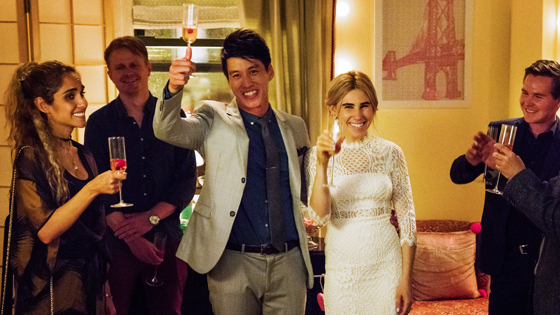
Another heroine, Mernie, receives a similar lesson, but two seasons later, but the betrothal of Shoshanna plays a different role in the penultimate series of the last season. Here the party about the decision to get married - a parody of the usual happy interchanges. Showranner Lina Danam, as it were, says: “I know how you are programmed. I know that each of you in heart hopes for a wedding. Please!" Only in the line of version, the wedding becomes the lot of the superficial character (“Sex and the Bolshoi”, remember?), Whose consciousness was so mired in these imposed expectations that she is ready to break with her lonely luna girlfriends and enter a new circle-normal married women.
 © HBO
© HBOHannah never gets married. Moreover, to the disappointment of all fans of the serial genre, it does not reunite with Adam - love, as many people think, of her whole life. It focuses on other things: on her career and her newborn son. If we take into account that “ Girls ” came to this world after several generations of series, whose heroines failed the Behdel test with a bang, Hannah’s reluctance to go in cycles on love matters can be called a small revolution. Of course, the ending of Girls could be much more radical. The series ends in the middle. None of the friends finds paradise on Earth. It seems that all the problems that they tried to solve over six seasons remain unresolved. We find ourselves in the same place where we started - this is the radicality of maneuver. The life of a girl in popular culture is a quest with a clear beginning and a clear end. Lina, on the other hand, exhibits this construct, stuffing us with expectations and dreams, as unlikely. To accept and love the ending of “Girls” means to accept your life as it is now, at this very moment, and stop to suffer in anticipation of a grand final that will give everything the point. There is no sense, friends, and never was.