
Translated material
Cure for sanctions
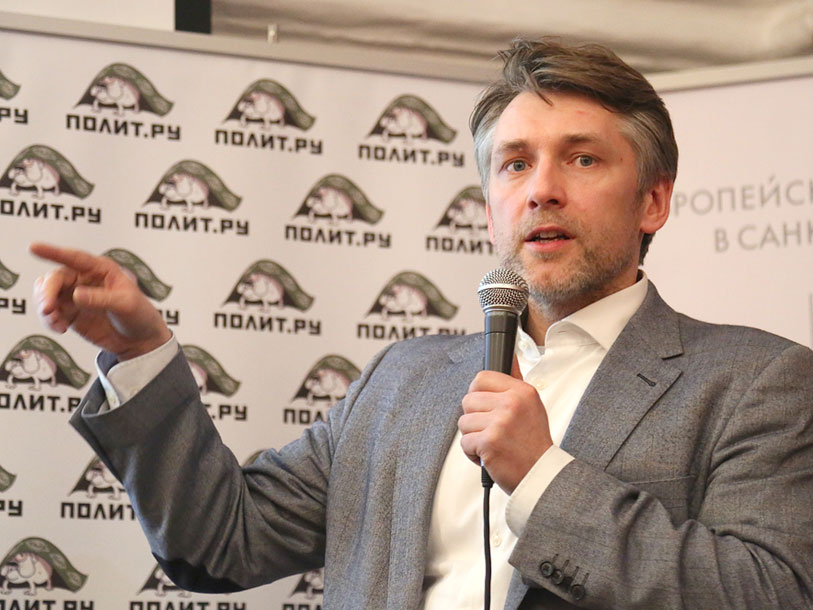
On April 24, at the Ivan Turgenev library in the Public Lectures Polit.ru project, the dean of the Faculty of Economics and Professor of the European University in St. Petersburg, Maxim Buev , performed as part of a joint university with the European University in St. Petersburg . The theme of his lectures is “How to make our economy invulnerable to sanctions? " .
The famous American businessman, founder of the Bridgewater Associates investment company Ray Dalio formulated a model of a modern economy, according to which there is a long -term trend - this is an increase in the economy due to the growth of performance, that is, labor and capital. If you look at the great perspective - 100 or more years, then it all grows. Inside this growth, there are short debt cycles, the duration of each of which is 5-7 years, and there are long debt cycles that occupy from 75 to 100 years and lead to the fact that a long shoulder accumulates in the economy. In such intervals that arise when the economy falls and then begins to grow again, the process of getting rid of excessive debts in the economy leads to the so -called “lost decades”. For example, this is exactly what we recently observed in America, for Japan it was the 1990s, but there is an opinion that there the “lost decade” stretched for two.
Despite the fact that he did not come up with anything new, Dalio’s ideas are also interesting because they are consonant with what the Soviet economist Nikolai Kondratyev wrote about the last century, who formulated the so-called “waves of Kondratyev” in the 20s of the last century. These are very long cycles of the economy - from 45 to 60 years, and they are associated with technological revolutions, debt deflation, demographic shifts.
An important component of the development of the economy is a loan. It is important to understand that this is always a duty, and each time it creates a wave, a cycle: first we consume and invest more than our income allows us, and then, over time, we must repay the debt, and therefore we will have to consume less than our income allow. Therefore, the growth of loans in the economy should correlate with the growth of production. Accordingly, the Central Bank since the late 1990s, using the regulation of the rate, has been trying to somehow regulate the process of loan growth in the economy and not allow it to overheat. It is difficult to set the desired level of interest rate, and this adds new impulses to the economy. The phenomenon as the demand for loans, which, however, is not very well studied, is also no less important.
Accordingly, this is the wave development of the economy. The Central Bank regulates the rate, we have short -term periods of growth and decline, but each new growth period begins with a higher level of debt. That is, the decline ends, growth begins, but there is no getting rid of the accumulated debt. This leads to the fact that each new mini-cycle begins with a higher level of debt.
At the same time, we know that the Central Bank reduces the rate when the situation worsens, and this cyclicality leads to the fact that at some point the Central Bank should lower the rate, but cannot do this, because the rate is already at zero. At this moment, what happened in the United States in 2008 comes. Typically, this is struggling through a decrease in expenses, refinancing the debts of borrowers, a review of the interest rate and other actions aimed at ensuring that banks can return at least something. You can also give rich people taxes or start printing money. Typically, a combination of all these things spurring the economy, and a new small cycle begins. At the same time, this leads to the fact that the ratio of money and loans becomes like in the United States, there are only 3 trillion dollars with living money, and everything else is loans that make up about 50 trillion dollars. Therefore, more attention should be paid to loans, not money.
The growth of performance as the main economic trend can be stimulated in several ways: long investments, increasing the norms of participation in the economy and improving the quality of labor. It is these three things that underlie the long -term growth trend.
For the past three years, Russia has been living in the conditions of sanctions. After Russia adopted the peninsula, the European Union, the United States and a number of other countries, following the referendum in the Crimea, have introduced economic and sectoral sanctions against the Russian Federation. The Russian economy turned out to be a nonsense to this and all this time has a negative impact. However, this situation could turn out differently.
After the accession of Crimea and the outbreak of the Civil War in the Donbass, sanctions were imposed on a number of Russians: a ban on traveling, freezing accounts and so on, which did not affect the country's economy. But among the sanctions against companies was the closure of access to capital markets, which worsens the situation for development, as it deprives the opportunity to lend abroad, and also introduced restrictions on technology imports, which reduces labor productivity. That is, a blow to two most important resources for achieving economic growth.
The consequences of imposed sanctions were also inequal in the effect and degree of negative impact. If a decrease in exports from the European Union, as well as the devaluation of the ruble, did not particularly affect the economy of the Russian Federation, then the decrease in imports and the payment of external debts led to a decrease in the volume of internal investments (to 8.4% in 2015), investments collapsed. In addition, sanctions added a tangible share of uncertainty to the existing picture.
The lack of investment in production, modernization and new technologies are the most powerful and negative trend. And in conjunction with a number of specific national characteristics This effect only intensifies. These are insufficient volumes of investment in fixed assets that do not allow stimulating the growth of the economy, this is a very small volume of external investments and internal ones.
Strong uncertainty, unclear priorities of economic policy and poor market predicability are impeded in Russia. Long investments in Russia are almost absent, and this is a big problem for the economy that requires attention and solutions. The national cultural feature can be considered traditional myopia in planning, which is also not in the benefit of the country's economy.
Only two solutions remain. This is either an improvement in the investment climate through the liberalization of the economy and the political sphere, or the development of risk management culture. The second requires the creation of the necessary financial infrastructure, which will allow players in the financial market to diversify in relation to risks.
Risk management is possible through hedging, but so far it has not taken root in our country. The word itself is scared, but also the need to spend money in order to level uncertainty and risks. Understanding the advantage of such an approach has not yet come to Russia, the risk culture is in principle absent, and without it it is pointless to try to achieve something.
Therefore, it is quite logical of all this is a recipe for a stable economy: to develop capital markets, which will take time, but it is necessary to do this, develop a risk management culture, develop trading and give the opportunity to issue loans not only to banks. It is also necessary to create conditions for the emergence of financial consultants -“Edavizers” who can instill a risk management culture and lay the basis of understanding. And finally, it is necessary to pay due attention to strategic modeling. This will get rid of shocks and soften any fall.