
Translated material
After the battle
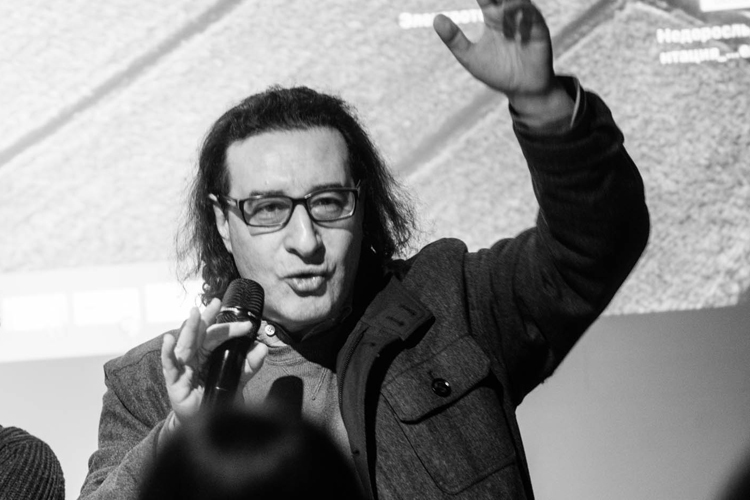
Colta.ru begins a series of publications based on the events of the spring session of the Institute of Theater , the educational project of the Golden Mask festival aimed at preparing young theater professionals, the study and critical analysis of new forms of theater and new theater practices. In the near future, on colta.ru there will be a decoding of two “academic conversations”: the program “The Institute of Theater” in the “Stanislavsky Electr theater” - the discussion “The Borders of the play. Where is the performance today? " and dialogue between Anton Getman and Pavel Gershenzon “Times of typical buildings. Theatrical co -product as politics and artistic practice. ”
Today we publish the monologue of the Khudruk “Electro Stanislavsky” Boris Yukhananov about the examination in the field of culture, with whom he performed last week at the “Theater Institute” as part of the Phantom of Expertise - a series of open lectures and round table with the participation of Oleg Aronson, Marina Davydova, Marina Karas, Viktor Misiano, Mikhail Ratgauza and Ilya Oskolkov-Censer. The more complete decoding of the “Ghost of the Expertise” will be published in one of the closest numbers of the magazine “Theater.”.
Let us take two functions for starters - close, it would seem, but at the same time seriously different from each other: censorship and examination. Censor, in fact, is a child of the algorithm. He works with a clearly formulated instruction and, as a result of his activity, should remove everything that is described from the censored object. Censor is a mechanism. Speaking of examination, we mean something exactly the opposite - something, initially and forever opposing the instructions. This is where the whole mystery is located, all the complexity and problems of our subject: an expert, an expert is a living organism that is engaged in understanding the process and working with all the universe of often changing, mobile properties.
Where can you get such a person where the potential of genuine examination in the field of the theater is located? The only, in my opinion, its source is theaterology, that is, theater studies. For me, as a director (smiles), it hurts about it, bitterly, but I must admit: only theater science is able to give rise to specialists who have proper qualifications in order to carry out such activities - absolutely necessary not only to the art of the theater, but also to the state.
The state in itself is unable to give an expert assessment of the processes taking place in culture in general and in the theater in particular. He simply does not have the appropriate organs for this: the official does not have the time or the ability to realize the complex processes that occur within a particular form of art. So there is a constantly reproducing gap: on the one hand, there is an official, on the other, a theater that is unattainable for him in the essences of his artistic act. Even being nearby, the official cannot touch him-in a sense, he cannot even see him and, accordingly, hear him. This paradoxical situation of the theater’s unattainability provokes hysteria - it sometimes turns into a comedy, and sometimes a high tragedy: a small person is one on one in front of a large challenge, which he cannot really answer. The paradox described by me should be treated with maximum seriousness - the existing gap must be eliminated as soon as possible.
The state in itself is unable to give an expert assessment of the processes taking place in culture - it simply does not have the relevant authorities for this.
In a sense, it looks like the device of a Roman water supply: if there is no one of its links, the water spils. This is a link in our case - an examination. It is she who should provide a connection between theatrical art and the apparatus of bureaucracy. But in order for this link to arise, a lot of serious investments are required - human, financial, and communication. The state needs to cultivate the masters of expert assessment, otherwise the collapse of the interpretation of communications between the government and theatrical art will grow and will eventually turn into a disease that can finally corrode the art management system. The art of this disease does not obey due to the presumption of the autonomy of the artist - a very significant idea developed by blood and then in the 20th century. The state should cherish it as an apple of an eye, because it is the independence of the artist that guarantees the productivity of culture for the development of society.
The role of the expert is to understand all the intricacies of the complex, mysterious process of modern culture - and signaling these subtleties, about all its losses and acquisitions, providing a dialogue between an official and an artist, between society and art. In the absence of an examination, this dialogue cannot take place. Instead, a command type of management inevitably arises, inevitably causing a rejection in response, or we embark on the path of compromises, simulacra, deception, mimicry - a path leading to a split consciousness. An expert assessment not only avoids social schizophrenia, but also gives the state the opportunity to finally take part in public life, from which it is turned off today by definition.
In order to carry out expert functions in all the necessary completeness, it is necessary, of course, to build a difficultly organized organism. Here I would like to especially focus on the second function of the examination - a public assessment of what is happening on the territory of the actual culture, an assessment addressed primarily to society. Without this public activity, the expert has a danger of being only a communicative appendage, which is responsible for the connection between the state and culture - only participation in the general ecology of sociocultural life is able to ensure the correct development of the potential of the examination institution.
Let us return to the aspect that I spoke above: what, in fact, is the specialty of the theater examination, what is her knowledge? Why are specialists from related fields of culture to be incapable of implementing it, even a high title of high titles - musicologists, say, or philologists? The reason is very simple: a person should spend a rather large part of his life on the knowledge of the diversity of theatrical art. He must go to Europe and make sure that everyone is rotting there alone. He must return to Russia - to make sure that they are rotting together, together. He must realize the variety of these decay processes, take samples, understand what types of penicillins should be used in each case - and only having spent on these research for many decades, he can get the right to engage in examination.
I will allow myself a paradoxical metaphor. While a specialist from the Timiryazev Academy is engaged in agriculture, his comrade Rabbi chooses the best place to create a golem, while everyone has their own care, everything is fine. But even if the best soil scientist decides to engage in the production of golem, this can lead to irreversible consequences. He does not know how to sculpt him, he does not know the letters that need to be pronounced to revive the golem - and even if he overhears them at the rabbi, something monstrous will turn out at the exit. So with the theater examination.
Today, we are unlikely to realize the seriousness of the situation in which our state is completely absent from the institution of professional examination in the field of culture that is completely necessary for it. As a result of this situation, the culture is unattainable for the official - and vice versa. The consequence of this is an endless war, in no way formatted game of interests and ambitions, when objective criteria are forced to obey a variety of subjective impulses and, in the end, simply cease to exist. There is a monstrous perversion of everything and the whole-the lower ones begin to command the highest, the low or illusory interests of individual social groups come to the fore: against the backdrop of such a rattle of the battle, it is difficult to survive, and there is no question of achieving some harmony.
The culture dies, and life, obeying the war, leads us to catacombs and caves. We obscure from each other gadgets and simulacracs. We are in vain waste precious communicative substance, our productivity, our talent for war with each other. What are the prospects? If nothing is done, in the end we will all overcome each other - and it is not known whether we will arise again. In inviolability, only a huge country with its reserves of water and forests will remain. Do you like this prospect? Of course, I understand that it is very important - to save, not to sell forests and water. But who will use all this? We will not remain.