
Translated material
The Ministry of Justice of Russia refused to give Gorbachev a summons for the court in Lithuania
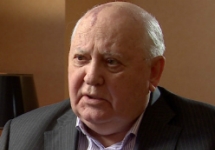
The Ministry of Justice of Russia refused to present to the ex-president of the USSR to Mikhail Gorbachev a summons to the Vilnius District Court for interrogation as a witness in the case of the suppression of protests on January 13, 1991. Such information is transmitted by DELFI.LT with reference to the court message.
Moscow motivated its refusal by the provision of the Russian-Lithuanian legal assistance agreement, which allows for a refusal to legal assistance if one can entail a threat to the country's sovereignty and security or contradicts the legislation of the country that received a request.
Meanwhile, back in January it was reported thatGorbachev himself confirmed the receipt of the agenda . Then Judge Ainor Cornelia Matsyavichen, the leading process, announced at the hearing that three summons were sent at the same time: the traditional mail to the address of the Gorbachev Fund, e-mail, as well as through the Ministry of Justice. The summons indicated the dates of the nearest court hearings, the consent of the interrogation was expressed on the video, and it was proposed to indicate the contact person with whom the court could contact the upcoming interrogation.
The response to the court came from the Gorbachev Fund, the judge said. The paper signed by personally former Soviet leader said that the agenda was received on December 28, 2016. However, no other information was contained in the letter. In particular, Gorbachev did not explain whether he was ready to personally arrive in Lithuania or intended to testify from the video.
The intention of Judge Matsavichen to interrogate Gorbachev became known on October 17, 2016. On the call of a politician, the victim Robertas Povilitas was insisted in court, whose father Apoinaris Poslavitis died when suppressing protests. Poslavitis Jr. demanded that the prosecutor’s office begin a separate investigation against the ex-president of the USSR and assign the status of a special witness to the former Soviet leader. This status would oblige Gorbachev to personally arrive for interrogation in Vilnius.
The prosecutors, however, objected that the available information did not allow Gorbachev to suspect that he knew about his intention to use the army to suppress protests and that he did not take measures to prevent power shares. Therefore, the judge decided to interrogate the former Soviet leader in the status of an ordinary witness.
Since 1992, Lithuania has been trying to receive the testimony of the ex-president of the USSR in the case of crimes against demonstrators, but he still refuses to communicate with law enforcement officers. In May 2011, the Prosecutor General’s Office of the country turned to the Russian authorities for assistance so that they independently interrogated Gorbachev in the case. However, the politician was never questioned.
Now the Vilnius District Court is considering part of the case of suppression of protests. There are two in the dock - former Soviet officers Gennady Ivanov and Yuri Mel; Over 60 people living abroad, mainly in Russia, are judged in absentia. All defendants are charged with war crimes and crimes against humanity. There are almost 500 victims and about 1000 witnesses. The volume of the case is 709 volumes, of which only the indictment occupies 13 volumes.
On the night of January 13, 1991, Soviet troops stormed the Vilnius television tower and the building of the television and radio committee of Lithuania. 14 demonstrators were killed. On July 31 of the same year, at the customs post of Moidininkai, seven police officers and customs officers were killed on the border with Belarus, who guarded the Lithuanian border, not yet recognized by the Soviet Union.
In August 1999, five accused of dispersal of demonstrators in Vilnius were convicted. All of them were charged with the creation of anti -state organizations, and three - also calls for violent violation of Lithuania sovereignty. The convicts appealed the verdict in the ECHR, but the court rejected their complaints.
In January 2016, it became known that the Prosecutor General’s Office of Lithuania accusedthe ex-Minister of Defense of the USSR Dmitry Yazov . According to the indictment, at the end of 1990, Yazov, along with the now deceased head of the Ministry of Internal Affairs Boris Pugo, the chairman of the KGB, Vladimir Kryuchkov, as well as the secretary and member of the Politburo of the Central Committee of the CPSU, Oleg Senin, created a group of 160 military and politicians to return Lithuania to the USSR. In January 1991, the prosecutor’s office claims, this group arranged a force action.