
Translated material
Tourpot in a hot spot
Air ticket for the Moscow-Damascus on the Internet cannot be bought, rooms in Syrian hotels in online booking systems have long been available. The reason is not only in the lasting seventh year of the Civil War in Syria, but also in the sanctions with which the Western world has overlaid the regime of Bashar al -Assad. The author The New Times was able to get to a given point on the world map only in a roundabout way and not on the first attempt
Before the Moscow Bureau of Syrian Airlines, the number indicated on the website could not be called, but the company’s office on the Frunze Embankment in Moscow works. Inside the exemplary order, on each wall of the spacious room, portraits of the president of Assad, and employees, as it seemed, even more than necessary. Every now and then phones call, but no one is in a hurry to pick up the phone.
There is not a trace of eastern cordiality in the manager's gaze.
“Departure to Damascus on Mondays, back on Sundays,” he reports dryly.
The pleasure of flying to Syria is expensive - about 30 thousand rubles. back and forth.
- Do you have discounts? Promotions, special offers? - So he pulls the phrase - “burning tours”.
“If you buy now, for a month and a half, there will be a small discount, but keep in mind that the tickets are irrevocable,” the manager answers with an impenetrable face.
From the gate turn
Tickets to Beirut - the capital of neighboring Lebanon - cost much cheaper, and to Damascus from here only 100 km with a small one.
At the Beirutsky bus station Charles Hlau, taxi drivers frantically surround the arriving passengers, loudly and loudly announcing the destination points. I hear “Esh-Sham”-Damascus in Arabic-and I immediately agree. The place in a relatively comfortable minibus costs $ 20.
The road to the border point of El-Arida passes mainly in a mountainous area. Spring is already on the plains, and here in some places snow still lies, which, it seems, will not melt even the hottest rays of the low sun. Along the road, and the closer to the border, the more often the symbols of the usual European life are found: hypermarkets, McDonalds, KFC and even Starbax. All this seems to be some kind of absurdity-it is difficult to imagine that here, very close to the bridgehead of one of the most serious geopolitical conflicts of recent times, people can live a completely ordinary life.
“I instructed you,” Abu Majid says seriously when we get into the car. -If you do something bad, I will answer
Crossing the Lebanon-Syrian border is a task for a tourist for obvious reasons is not easy. Officially, the rules of entry into Syria have not changed, but at specialized tourist forums they write that visas should be issued in advance in the consulates of the Arab Republic in their country. Another restriction has been established for Russians (male): in addition to the visa, it is necessary to obtain official permission from the Russian Ministry of Defense (that this is so, NT was convinced by our own experience: our attempts to send a special commander to Syria ended in failure to failure because the Syrian embassy in Moscow, before issuing him a visa, demanded permission from the Foreign Ministry of the Russian Federation, from where we were politely transferred to “coordinate” to “coordination” to Deflows - NT).
If there were no problems with Lebanon out of Lebanon, the border guard stamped the passport without unnecessary questions with a roar, then, with the entrance to Syria, everything went wrong from the very beginning.
At the checkpoint (checkpoint), the situation of tidy poverty reigns, the line is mainly from the Syrians returning from earnings.
- For what purpose are you going to Syria? - the border guard asks with suspicion.
“Tourism,” I answer with a smile.
The interlocutor with undisguised indignation turns to the approaching colleagues, who immediately begin to verify information from a passport with some lists in massive stationery folders. In the end, the border guard decides to use the right to refuse entry without explanation:
- You cannot enter the Syrian Arab Republic.
- Why?
“You should contact the embassy,” he returns his passport and defiantly turns away to the monitor.
The driver of the minibus guiltily pats the lost passenger on the shoulder, and someone in a civilian with a hissing radio on the belt offers to help with the search for transport in the opposite direction.
Attempt No. 2
Morning the next day, again the bus station Charles Hlau. Finding a car to the Syrian tartus - this time another route is chosen - there is no labor, several passengers are already sitting in the cabin besides the driver.


On the road that leads from Beirut to the Lebanese Tripoli, we are going along the coast of the Mediterranean Sea to the MasnaAA checkpoint. Frudes in a different way slowly talk, filling the already smoked interior with clubs of tobacco smoke.

I speak with a neighbor - the stocky brunette Abu Majid, who, according to him, works in the field of medicine and seems to even supplies medicines for state orders. Support for such a person at crossing the border can be useful. I explain to him that I plan to relax at the famous Syrian sea resort, but I'm afraid that they may not let Syria. Abu reassures: it is unlikely that there are so few tourists, moreover, the proximity of the Russian military base should affect the attitude of border guards.
To leave Lebanon and this time did not work. With the same dexterous movement, without unnecessary questions, the border guard set a stamp about the exit.
Syrian checkpoint - a battered building with barred windows; The red-white-black Syrian tricolor with two green stars in the middle flutters in the wind. In the spacious hall, the checkpoint is not pleasing. It seems that there are more border guards and service personnel than those who want to cross the border. Everywhere, the garlands of the Syrian flags and portraits of Assad.

The clinic of the red crescent, where the wounded were delivered, are numerous ambulances, each with an open - as if ripped - a bloodied chip of the salon. On the threshold of the hospital, crying women find out something from people in white robes
I feel dejavu: in the gaze of the border guard the same distrust as his colleague in El-Arid; Around him, colleagues gather, passing each other a passport of a citizen of the Russian Federation. Gradually, the tonality of the conversation is heated, phrases become more chopped, pronounced through the teeth. Sneak up with a gesture, I ask Abu Majid: Come on, they say, I will pay them? He shows: no.
It seems that the border guards launched some kind of program on the computer, they are looking for a good reason to refuse to enter. The tension is growing. The seal has already hung over an empty page of the passport, but did not sink. The guardian of the border decides to record the contacts of Abu Majad and, just in case, dials a dictated number.
The oval visa finally appears in the passport.
“I instructed you,” Abu Majid says seriously when we get into the car. -If you do something bad, I will answer.
- Do not worry, everything will be fine.
Homs ruins
Having spent the night in Tartus in a room without light and hot water, I go to the resort Latakia in order to move from there to the Syrian Stalingrad - Homs.
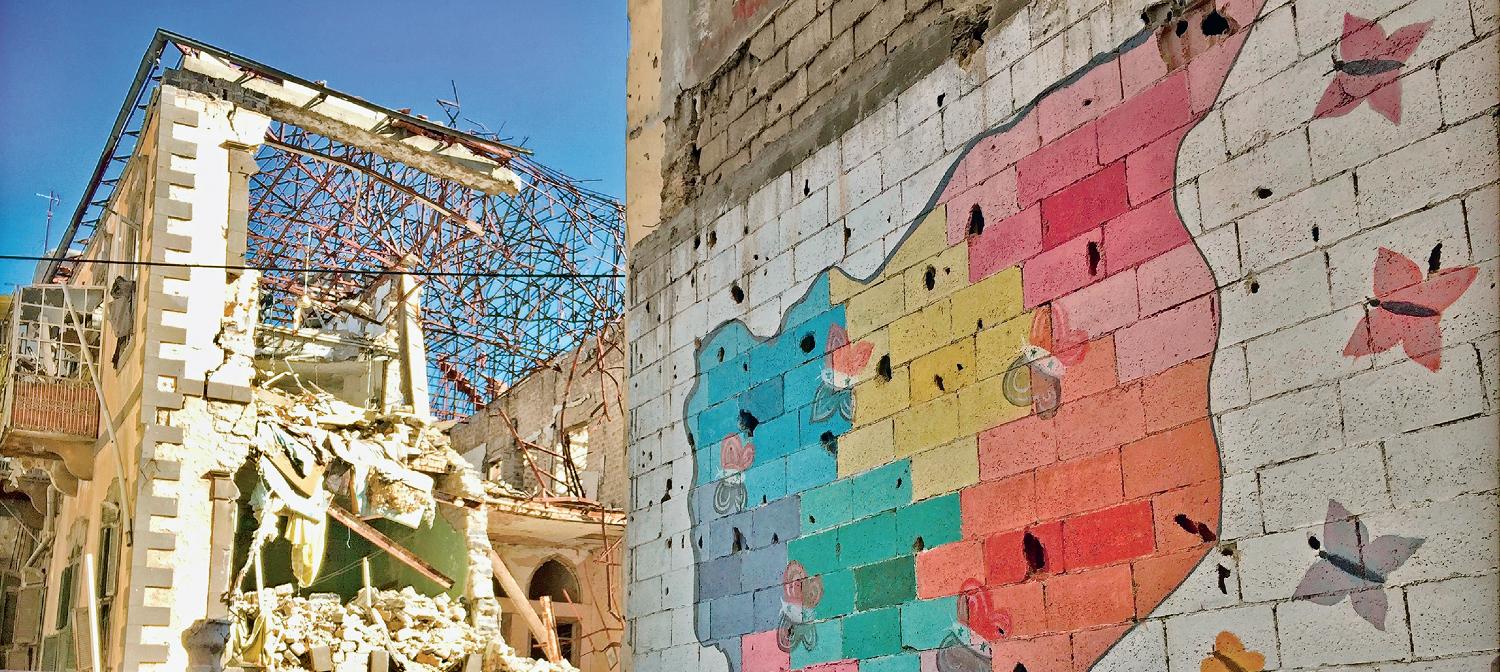
Five years ago, during the last arrival in this city, the Baba---AMR quarter was considered the main focus of resistance to the Assad regime almost throughout the country. Then there were fighters and supporters of the so -called free army of Syria. Today, life is gradually being revived in the destroyed quarter. People disassemble the rubble, rake debris, albeit an unfinished but at least a little retreating war. In some places, like snowdrops in the spring, shops are timidly appearing, on the half-empty shelves only the most necessary-bread, water, cigarettes.
Here and there, on narrow streets, wiped with funnels of shells, Syrian soldiers are on duty behind the embankments of sandy fortifications. Very young, they sip almost a drink sacrificed on the front line - mate and, supporting a leisurely conversation, let the fluffy clouds of tobacco smoke into the air.
The representative of the ubiquitous “Shabihi”*is catching up with one of these posts of the author of NT. A light -eyed brown -haired medium -sized brown -haired man seems aiman and emphasized politely is interested in plans:
“They called me from the hotel in which you stopped.” What would you like to see?


- I want to take a walk around the quarter and, if possible, visit the refugee camp.
I am looking for a smartphone in the memory of the smartphone and show the “guide” of a stop frame from a report of one of the Russian television channels on the delivery of humanitarian goods to the Homs. By the way, two days earlier, another humanitarian convoy was fired in another city area-al-Waire, which is controlled by militants associated with al-Qaeda* Group Jebhat An-Nusra* (renamed Jebhat Fatam Ashham*); Several people were killed there. Ayman suddenly agrees to help. We sit in a tinted small-leaf and slowly go along the streets of Baba-Amra.
Refugees - 160 families from Palmyra - are located in the school building. Children are running in the courtyard, around women and children, several men are sitting dumbly under a low canopy. Obviously, thanks to the presence of aiman, the director of the camp Midhat answers in detail each question and leads us to all floors. We look into the classes filled with mattresses, which are covered with gas burners, into technical rooms, we go to the roof littered with construction garbage, which opens a joyless view of the city.
Somewhere there there is a destroyed house in which the world-cacerist-Kannibal Abu Sakkar *** “Shabiha” lived-militarized pro-government formations in Syria. “Shabiha” - militarized pro -government formations in Syria. Haiman will also offer to see what remains of his apartment. The frame of the double bed, a dusty cradle, a too large cabinet and a wall clock, the second shooter of which is still moving in its orbit. Raising a piece of the destroyed wall from the floor, I break the glass of the dial.
In the morning, the roar of explosions is waking up, shaking not only the glass of hotel windows, but also quite thorough walls of the building. Later it turned out that six suicide bombers attacked military facilities in Homs; According to the first information, more than 30 people died.
Due to the cordons of the cordon to the nearest place of the attack, you can’t approach the next site, but the aircraft wairenet on al-Waar, where the Jebhat al-Nusra militants settled, added to the front-line impressions-then they then took responsibility for the explosions in Homs. Combat aircraft with a roar rush over the empty streets of the city, the released rockets are whistling with a whistle to the target and explode in the visibility zone ...
The clinic of the red crescent, where the wounded were delivered, are numerous ambulances, each with an open - as if ripped - a bloodied chip of the salon. On the threshold of the hospital, crying women find out something from people in white robes.
A jerk to the capital
The bus to Damascus slowly crosses the hilly area. Ahead below - a huge city by local standards, over which black smoke swirls here and there - there are fights.
Numerous checks seem to never end. Behind, with a dozen checkpoints on which they watched documents and examined the bus by an electronic detector responding to explosives.
A convoy of the Russian military passes along the highway: an armored personnel carrier, armored trucks without rooms, and concentrated faces behind thick glasses.
During the next stop, two civilians enter the bus and persistently offer the guys in Khaki's clothes to transfer back - so that they are not visible, and everyone else is asked to pull the curtains on the windows. Women are barely audible - it seems that they pray, men try not to show anxiety. A children's cry is heard from the tail of the cabin.
The driver gains maximum speed, the bus, twitching and trembling, rushes along the empty highway so that it seems to be falling apart, even if it does not become the target of the militants in this sheated area. To the right and left - the charred skeletons of buildings, the rickety signs, the sparkled road signs.
Finally, we pass the last checkpoint, then there should be a relatively safe part of the Syrian capital.
It is difficult to believe, but the authorities control only a small part of the capital, where, among other things, the residence of the head of state is located
Fog and the future
The taxi driver who volunteered to give up from the bus station to the center of Damascus, warns that he is forbidden to communicate with foreigners, and, sticking out his tongue, depicts scissors near his mouth with his fingers. Nevertheless, he cannot be silent for a long time. He complains that he is forced to spend the night with friends and relatives: the Guta quarter, where his house was occupied by the militants.
Blocks along the entire route, inspections, tension in the viscous air of the eastern city ... It is difficult to believe, but the authorities control only a small part of the capital, where, among other things, the residence of the head of state is also located. The center of Damascus, the once favorite place of tourists from all over the globe, is unusually empty. Families on the past arrival of places are as if shrouded in bitter fog. It is difficult to imagine that this militarized city saturated with anxiety is the same Damascus, the bright pictures of which pop up in memory. And behind this fog there are future transformations that cannot be avoided, despite the obvious military successes of the Assad army in certain provinces of Syria.
The porter behind the persistent of the first hotel in the path near the market of the market of the Suk al-Hamidiya warns that there may be interruptions in electricity and hot water.
The sun outside the room on the fifth floor slowly sinks beyond the horizon, the ancient city synchronously plunges into darkness with sunset, which is scattered only by the headlights of cars rushing along the streets.
* * *
In the arrival zone of Moscow Sheremetyevo Airport in the early morning, little bitter in the morning.
A customs officer carefully studies a passport.
- Is this all the luggage? She asks, looking at the backpack in surprise, again and again leafing through the pages of the passport and each time holds his gaze on the Lebanese stamps. It seems that taking into account the trip to Syria, the conversation will be long. But only one question sounded:
- For what purpose did you go to Beirut?
- Tourism.
Photo: Arslan Khasavov
* “Al-Qaida”, “Jebhat al-Nusra” (“Front of al-Nusra”, “Jebhat Fatam al-Sham”)-organizations banned in the Russian Federation as terrorist.
** "Shabiha" - militarized pro -government formations in Syria. “Shabiha” - militarized pro -government formations in Syria.
*** Abu Sakkar-one of the commanders of the Jebhat al-Nusra group, became widely known in 2013, when a video appeared on the Internet, on which he eats the heart of a Syrian soldier. Killed in April 2016.