
Translated material
"Subject to immediate destruction"
How the Lords fought: British special forces - Hitler's personal enemy
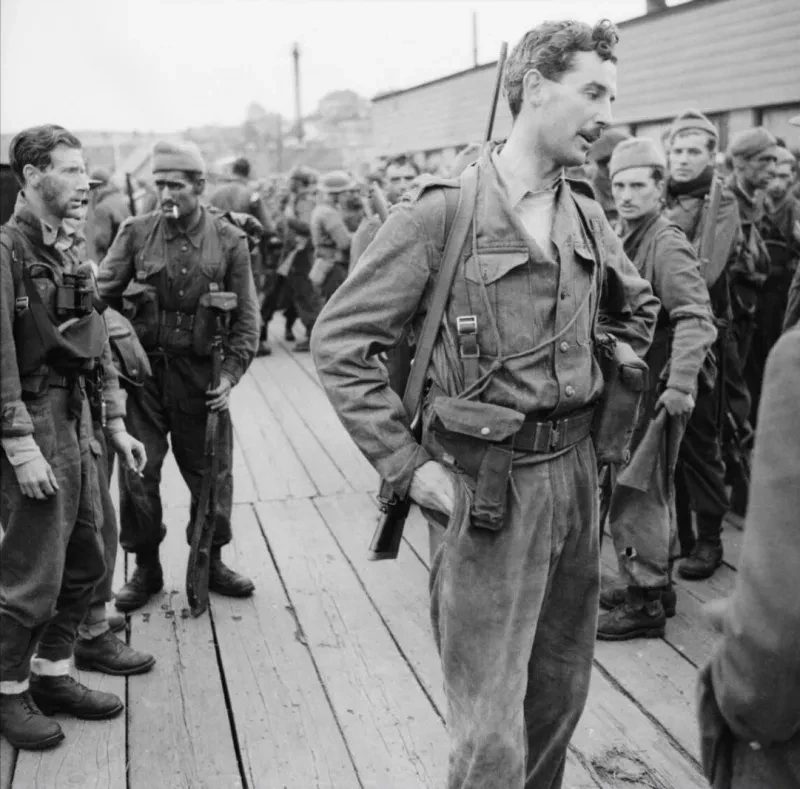
Colonel Simon Fraser, 15th Lord Lovat, 4th Baron Lovat, head of the Scottish Clans of Freseers, on August 19, 1942, stands on the plank of the pier in the port of New Hayven, where he had just returned with his commander after the raid on Diep. A tall man with thin facial features is hung with a weapon, dressed in a jacket with a lined collar and baggy pants, he relaxed his hands in his pockets, and you can’t say that he returned from hell.
Look at people behind him. One, with a cigarette, burned to the very fingers in the lowered hand, with unshaven cheekbones, looks abruptly into the void in front of him, as if he still sees nightmare scenes on the coast. Another, low in a cap, with his left hand holds the butt of the Lee-Enfield rifle, and below his leg, he has a round hole. Perhaps he tore his pants on the barbed wire, but rather the bullet pierced the leg and did not hit her leg.
So they stand on a summer morning at New Hayven’s berth in anticipation of trucks who will take them to the base, surviving soldiers with their commander, who has a pistol in a tarpaulin holster and a white sweater under the jacket with a named monogram “Lord Lovat”.
The raid through the La-Channel on the French DieP was perfectly planned: escort destroyers, landing vessels, cover aviation, smoke curtain, four zones of landing on the coast. But the plan, which looked logically and harmoniously on paper, turned out to be chaos from the very first minutes. The destroyers in La-Channel flew into German ships and tied a battle with them, the roar of which woke the entire coast. The Canadian division landed successfully, but not there. Churchill tanks, powerful machines with armor 15 centimeters, crawled from landing barges to a rocky beach, cut off the stones of the caterpillar and stood up. For some reason, no one in the plan foresee these stones. The coast, about which intelligence reported that it was empty, in fact turned out to be stuffed with defensive structures and snipers, which shot Canadians and British accumulated on a narrow coastal strip. There were 50 American rangers there - the first Americans who entered the war on the Earth of Europe.
Commandos Simon Fraser, Lord Lovat, took the battery on the flank, blew up German guns and left the sea to England, without losing a single person. There were no other parts without loss that day.
It is known that the Germans immediately destroyed the captivity of the political instructions and Jews. But it is less known that there was the third category of persons subject to immediate destruction: English commandos. This was Hitler's order.
England, having entered the war, had almost nothing for the war. After the disaster in the Dunkirka, even England did not have rifles in sufficient quantities. In 1939, the Comandos did not have at all, they did not exist. But there was Simon Fraser, Lord Lovat, who had an addiction to the war, which was not waged by huge masses of troops with guns and tanks, but small detachments of trained athletes with painted black faces, armed with a machine gun of brands and pistols with silencers. He gave his deer reserves and all 80 thousand hectares of his gigantic estate for training the first English commandos, who were exhausted by a rage of thirty kilometers, not anyone, but the graduate of the results Randolf Churchill, the son of the Prime Minister.
Lord Lovat, as part of the English commandos, did not exhaust, there was also Lord George Jellico, the 2nd Count Jelliko, who received the first injury in January 1941, when Stalin still attached an indestructible friendship with Hitler. In Crete in 1942, he blew up 20 German aircraft, but more on that another time.
In the meantime, about Lord Lovata and his commandos from the 4th detachment. In the photographs, you will rarely see giant men with huge bigeps hollows among them. There are more often people of ordinary growth and addition. They were trained not to break their heads with bricks, but to think well in the conditions of night and darkness, chaos and danger. In these often low, strong people, an amazing endurance was developed by training, which allowed them in the rear of the enemy - in the cold Norwegian islands and in a hot Libyan desert - to move for ten hours with a load of 36 kg.
During training, they did not use idle ammunition, only combat ones. There were no clerks and cooks in the parts of the Commandos, all that was necessary, they had to do it themselves. Once, during the exercises conducted in a storm at the rocks of Wales, they were put on landing barges and launched to the shore. It was possible to land in only one way: jumping on a rock at the moment when the barge took off in the wave and was at the highest point. Two fell off and drowned.
The ideas that were proposed and discussed at the headquarters of the combined operations of Count Mountbetten, another aristocrat who had an addiction to the action of the Commandos, were considered crazy. Mountbeten was a science fiction writer: he offered to build landing vessels that could move around the water and land, and also a aircraft carrier 600 meters long from reinforced ice. There was an idea to seize a train in France, to fill it with explosives, to enter it into the port where German warships were based, and to blow up. There was an idea to attack the villa in Africa, where Rommel stopped, and kill him. Surprisingly, some of the crazy ideas were still implemented. On the villa, where Rommel was supposed to be, the commandos came at night and, finding the back door locked, politely knocked on the front door. After they were opened, the usual hell began on the villa. But Rommel was not there.
Another idea was that the two commandos at night on the kayak penetrated the port of Bulony, where there was a German ore carrier with 5500 tons of copper, and blew it up. Oddly enough, they succeeded.
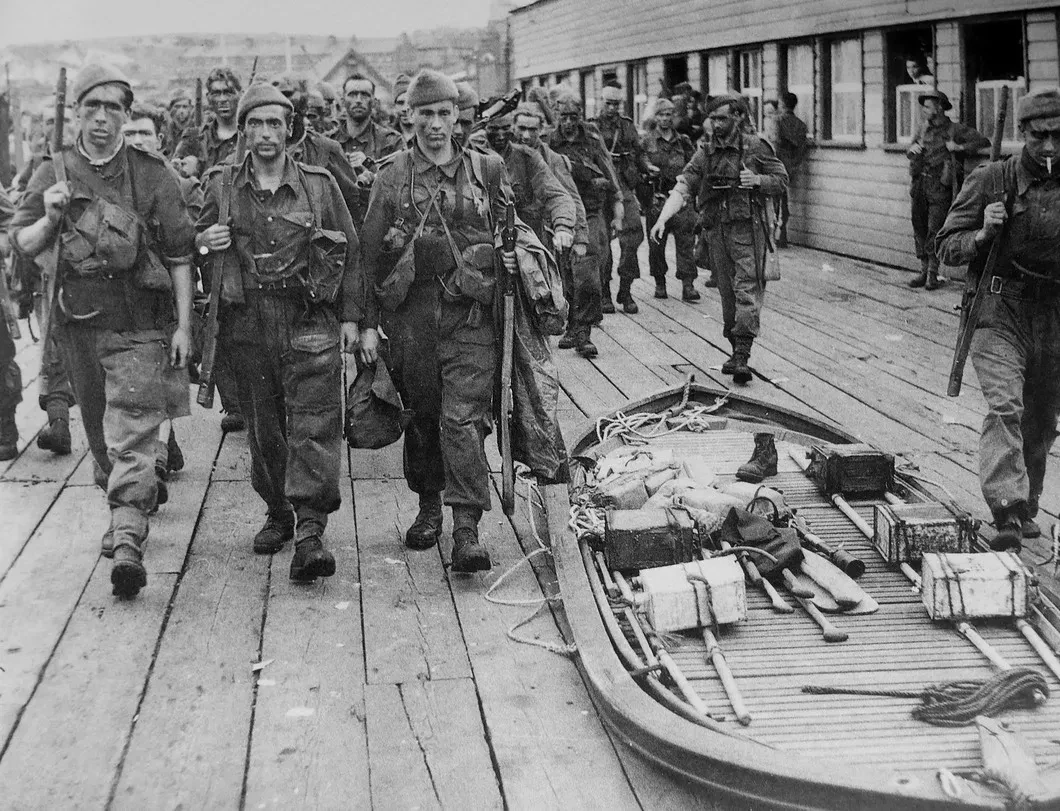
Lord Lovat, standing on the pier among his people after a nightmarish raid on Diep, where the Yu -87 dive right on the beach, the tanks were burning, and every second Canadian from the landed division was killed, never lost his self -control, as befits a gentleman. Through the La-Channel and other water barriers, he crossed more often than others go on vacation. He landed with his people in the Norwegian Islands, where they blew up the oil storage, and participated in the raid on Saint-Naser, where the British brought the destroyer loaded with 4 tons of explosives, who broke the gate into the dry dock and exploded there later, when German officers examined him. There is no need to imagine the daring raids of the commandos with the Lord at the head as a cinematic plot, where impeccable heroes beautifully pass through the walls. All this was always a pitch hell and terrible chaos, when the motors stalls at the most inopportune boats at the most inopportune moment, ships with people burned with bright torches at night, planes fell into the water from the sky, and those who fell through the commands from the shore, as their ships went to England, and heard the officer’s order: “Do not give up until the cartridges end.”
On June 6, 1944, in Normandy, Lord Lovat once again landed with his commandos on the coast, where they were met by machine -gun fire. The Scottish lord, a descendant of the knights, the owner of the Bofor castle, armed with an American carbine, jumped off the landing barge and went to the shore to the waist in the water to the sounds of the bagpipe, on which he played, standing on the deck, his personal peel Bill Millin. The order of Simon Fraser to play on the bagpipes during the landing puzzled the million, and he said that there was no such thing in the charter. "Ah, this is the English Ministry of Defense, and you and I are Scots!" -answered the 15th Lord Lovat. Millin was the only one of the huge invasion army who was in Kilt, that is, in a checkered skirt, under which he, as is customary for the Scots, had nothing. He jumped into the water after his commander and remembered for the rest of his life the perpetrating cold of the Atlantic under his Kilt. In addition to the bagpipes, he had no weapon with him, except that the dagger of the commando on the right thigh. On the shore, he did not lie down, but walked, playing, and the German snipers did not shoot him because they thought that he was crazy.
Under the text
On June 12, 1944, six days after the landing, Simon Fraser, the 15th Lord Lovat, was seriously wounded by a projectile that killed several officers next to him. He was treated for a long time after injury. After the war, he was engaged in politics. In 1994, two of his sons passed away. Before his death, which followed in 1995, the Lord Lovat was forced to sell his family castle Bofor, which was owned from the 13th century.Count Mountbeten died in 1979 at the age of 79, when the Irish Republican Army blew up his yacht.
Volynik Bill Millin survived them. He died in 2002.