
Translated material
Operation "Bodigard"
The best hoaxes and hoaxes of the second front
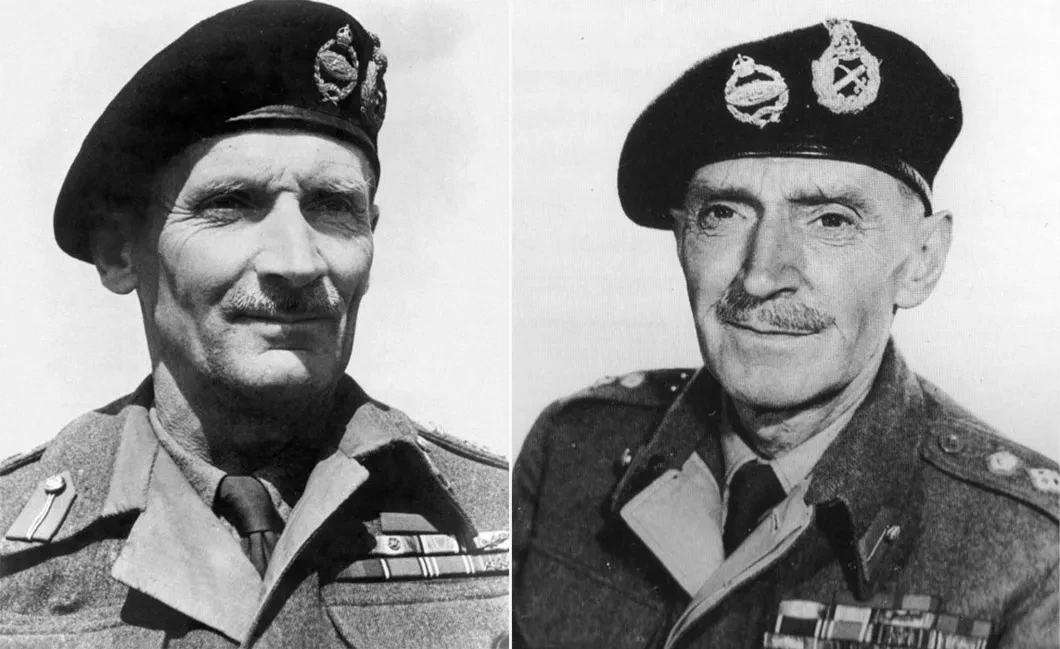
It was a rare success for an unknown and unlucky actor: to play Montgomery himself, but not in conditional decorations, but in life, in front of very preferential spectators from German intelligence. For Cliftton, James, who served in the financial corps of the British army, was the best offer for all twenty years between world wars.
The acting super -task was not easy: it was necessary to portray Bernard Montgomery on trips to Gibraltar and North Africa, while Monti himself in England was preparing the landing of the ground forces in Normandy. But his appearance in Gibraltar and Africa was supposed to convince the German command that the blow would be delivered from the Mediterranean Sea, from the south of France, and not from the north at all.
At first, for a month, Clifton James studied the speech and manners of his protagonist and tried to quit smoking and drinking. Monty did not tolerate either one. And on May 25, he flew to Gibraltar on a personal plane of Prime Minister Winston Churchill.
At the reception at his honor at the headquarters of the governor, the actor convincingly talked about “Plan 303” - capturing France from the south. On the same evening, the German agent, present at the headquarters, sent information to Berlin, and Clifton James still flew to Algeria, where he publicly appeared with the commander of the Mediterranean Sea Henry Wilson for several days. In Algeria, he was “D” until the day.
The whole operation "Copperhead" took five weeks. And then, as it always happens, Churchill’s plane turned into a pumpkin, and Clifton James returned to a boring army accounting, where he served before demobilization. And no one knew anything, there was no one to tell how he flew side by Churchill, how he sat next to Montgomery, repeating his gestures. And then in Europe this began that the authors of witty hoaxes forgot everyone. And after demobilization, Clifton James could not find a job and lived on benefits.
Only in 1954 did he write the book “I was an understudy of Monty”, according to which the film was shot four years later. It was a kind of moral (and material too) compensation for an unknown actor: he played himself and Montgomery, and his surname entered the military encyclopedia.
Mystifications and talented hoaxes in that war of the Allies had plenty of Monti's double. And if the operation to land the troops in Normandy was called “Overlord”, then the strategic misinformation campaign was called “Bodigard” and consisted of many local campaigns-“Fortyudu-sver”, “Fortyudyud-yug”, “Titanic”, “Moonlight”, “Wendetta”, “Copper head” ...
What is there, even the choice of a place of landing - and he was not just the result of the work of the strategists of the union troops, but a little hoax. It was impossible to explore the coast occupied by the Germans of France. And then British radio asked the citizens with a request to send postcards and personal photographs from pre -war leave on the Norman coast of France to the editorial office. As if these photos will be included in the exposition of the Museum of Art and Archeology of Eshmol in Oxford. Then these photos were carefully studied at the headquarters. The structure of the coast was determined by thousands of trifles, up to the shoes of happy pre -war residents. And when they chose a place - they began to convince the enemy with all their might that the landing would not be there.
Clifton James Dali Dali in that performance one of the main roles, and a hundred second -plan actors - retired military - sat at microphones for days, imitating radio converters and putting on the air of disinformation. One of the places where the Allies wanted to delay German forces was the coast of Norway. And these second -plan actors endlessly discussed on the air a harsh climate and skis. The meaningless dialogs flew to the German headquarters, where they meticulously studied, made reports and made conclusions. (400 thousand German soldiers transferred to Norway to the Trondheim area is an undoubted success of the performance, bouquets and ovation.)
Of course, in addition to retired officers sitting at the microphones, agents also acted-all this was called the operation “Fortyud-Severs”. And there was also “Fortyud-yug”-the participants of this campaign should have convinced the enemy that the main blow would occur in the Kale area-three hundred kilometers from the Norman beaches and forty kilometers from the British Duvra.
It was in the Duvre that the mystifiers of the Second World War came up with a huge Potemkin army. Tanks and planes, fuel trucks and gas stations were cut out of plywood. The double agent Arabel (aka Garbo, aka Alaric, aka Juan Pujol) to Berlin encryption with a detailed description of the preparation for the attack on the feces of the 150,000th army. Before feeding the Germans to this semolina with lumps, he sent 500 encryptions to Berlin with reliable information about the plans of the Allies. And he earned a reputation as an agent who can be trusted. So he painted the power of plywood tanks in detail until the day “D”. And only two hours before landing in Normandy he sent a “lightning” to Berlin that the allies changed the landing site of the landing.
However, probably, the day before it was no longer possible to change anything. At night, British planes dropped strips of foil in the area of Kale. They were recorded by German radars, and the illusion was created that the armada of warships was moving to the shores of Kale. And 28 canheries with balloons attached to them entered the strait. The balloons were glued with metal reflectors: they caught signals of German radar stations and reflected in an enlarged form. The complete impression was created that a powerful navy was moving through the Pa-de-Kale. And the Germans opened fire on foil.
And in the Governor area, meanwhile, not foil poured from the sky, but the mannequins on parachutes. Another marvelous feint is a false landing. People, of course, were there too, but they obviously played mannequins: two hundred mannequins and several hundred cunning devices imitating shooting and explosions were relied on one officer and three soldiers - nozzles, wouvusels in the Second World War. Actually, people were needed in this phantasmagoria only to turn on amplifiers. And then random shooting, explosions, screams and soldier mat began.
On June 6, “The Fox of the Desert” Erwin Rommel, who at that time commanded the Army Group “B” in northern France, at that time celebrated at home, in Germany, his wife’s anniversary and was going to return to France no earlier than June 8th. So, the operation "Bodyard" was really brilliant.