
Translated material
Uncle Vasya and Lend-Lease
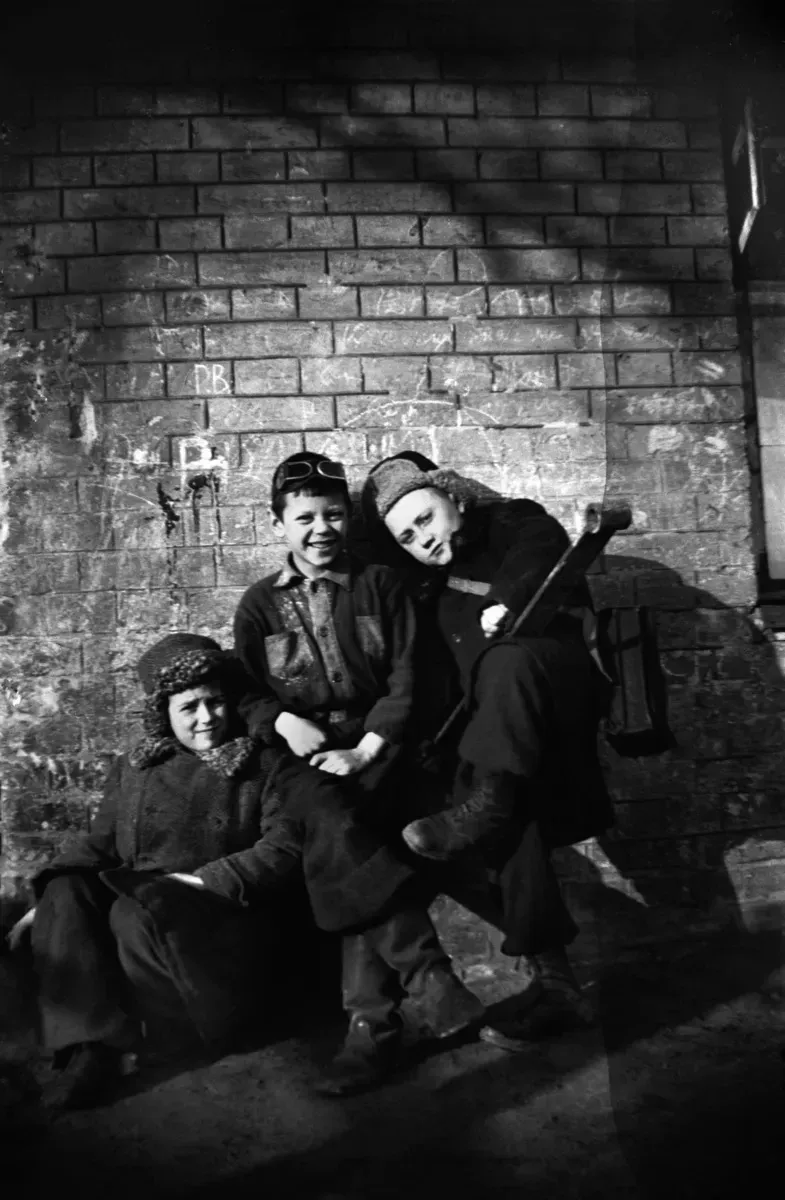
Anechka as an American gift
Uncle Vasya Tsygankov, the theater driver, during the war and after it drove a variety of cars, the brands of which I list without order: first domestic one and a half and ZIS -5, and with the forty -second - only American ones: “Willis”, “Chevrolet” (cargo) with two leading axes, “Studybekker” with three leading osios, mac. “Bedford”, “Dodge Three quarters”, “Ford -8” (he still struck on the third, would not lie, transmission).
Mostly, Uncle Vasya Gypsy rode on trucks.
He lived alone, but sometimes from the next room in a communal apartment an Anechka lifters moved to him-a laughing woman, pleasant, as I now understand, a nabris, quiet, but not unrequited, one of some kind of some kind of some
indefinite age. The children in the courtyard told her “aunt Anya”, and when they grew up, she was already called “Anechka” as the youngest. She took our newspapers out of the box when her parents left on tour, in which her mother usually accompanied her father after being wounded, because he could not put a toe on his left, leisure leg. Anechka hung on the wall in the walls of German still pictures, depicting joyful blondes with smiles of pets who had just embarked on a wonderful path of debauchery. Anechka survived the occupation at first in his native Dumer, where Kolya left to fight her, as it turned out later, who had disappeared first in German prisoners of war, and then in ours.
With Uncle Vasya, they sang beautifully “straighten, lads, to about it ...” and, having drunk in a gastronom at the corner of Khreshchatyk and Lenin, a bottle of vodka for 21 p. 20 kopecks. (Tsygankov’s wine did not drink), they listened to the Baron von der Pshik plate on the pavement, sometimes up to twenty times in a row. In the place where the baron “got into the Russian bayonet”, the record was jerked, and if they were busy, the paterlex repeated it for five minutes until the plant ended.
At another time, Uncle Vasya shifted the needle with a finger unbroken from the motor oil, and she, having jumped the groove, was in the words "... barons were not weaned ...". Every morning, starting from April, if the spring was warm, it opened the window of the first (right under our) floor to the garden-the so-called courtyard where the chestnuts grew, and together, as if with someone together or three, he sang on the motive from the film “First Glove”: “If you want to be healthy, hang out, as stood up, as you got up!”
Uncle Vasya did not lock the door. He pressed it eight times with a folded pill of paper so that it would not open from drafts, and went to the theater garage of courtyard No. 17 on the parallel Khreshchatyk Pushkinskaya Street. Sometimes towards him in a dark corridor from the kitchen, where they washed at a cast -iron enamel shell, the small daughters of the deputy director for the economic part of Levchenko, Oksana and Lena were healed. They were completely different from each other, but since the girls were twins, Uncle Vasya confused them. According to a communal habit, in the dim light of the corridor, seeing an adult, they pressed against the wall, but seeing that it was Uncle Vasya, boldly jumped out to meet
Tsygankov, grabbing them under mice, carried them to the door. They pulled out, laughed and ran away.
I have no need to come up with pictures of Uncle Vasya Tsygankov. Its windows have always been open and lined with a cloak, which played the role of curtains only when Anechka came. And then not at once. Sometimes he went out into the yard through the window and watched our wretched courtyard football, evaluating it in the same way as it happened when he took us to Dynamo’s stadium at the Dementiev Peku and his finites at the corner pillar, at the Semi -Lesse, Beskov, Bobrov.
“The game was equal,” he told us instructively. - We played two shit.
Uncle Vasya rarely changed the accurate formulations.
I remember how, leaving the yard to the street, he met People's Artist of Ukraine Lavrov, prone to a strict assessment of people and circumstances, however, ironic and good, in any case, to me. In the evacuation in Grozny, Lavrov ordered a small PPSh machine as a theatrical carpenter and gave it to me for my birthday. Father was lying in the hospital, and Yuri Sergeyevich and I walked along the Sunzhi, and I saw how the covered and open cars drove somewhere men, women, children-all. So, I remember February 23, 1944 - the day of the deportation of Chechens.
Uncle Vasya easily recognized the People's Artist Lavrov, despite the fact that he had just tonsured a fashionable hairdresser “from Western Ukraine” Lenya, who created “salon” in a small for two chairs
Hotels "Pervomaiskaya" on Lenin.
“You, Vasya, would have made a couple of left walkers,” Lavrov said sternly, “and bought new pants for himself, otherwise you have only Galife from furniture at home.”
- A weekend in order for a person to spend, not earnings. Would you like to share philosophy, Yuri Sergeevich?
- No, Vasya, maybe later.
Uncle Vasya loved to “divide philosophy” in the “cockerel”, a small sawing pavilion located to the right of the colonnade of the pompous entrance to the Dynamo stadium.
I remember this stadium almost as much time as myself. It was preserved in the few family photographs that survived during the war, which my mother rushed in a suitcase, frantically gathering in the evacuation, as many thoughts then, unnecessary.
As for Tsygankov’s atmosphere, I, sometimes without demanding, visiting Dyadi Vasya’s room smelling of cold cigarette butts, to get a chirza ball that flew out the window, I can attest that Galifa was not there as furniture. But it was what caused us sometimes specially bullet the ball into the open window in the absence of the owner. In addition to a sofa, upholstered by an eternally cold cracked dermatin, a round table covered with a sticky oilcloth, and a pre-war buffet of the Bozhenkovsky factory, there was a real, the American dark green Army two-cylinder Harley-Davidson. Uncle Vasya rolled him, half -wrapped, on the boards, gathered “Like Lyalechka” (toy - Ukrainian) and never rolled back again. I wanted to be at home.
I won’t say about other women, but Anechka loved to sit in a wide leather saddle and turn the steering wheel, bending to it with a fairly rather chest, as if for speed. Vasya understood - she wanted a beautiful life. We also wanted to. At least see. But he fenced off this life with a cloak.
Then Anechka disappeared.
Somehow, my mother lay down her own not thin breasts on a wide windowsill and asked Vasya down why she was not visible.
Vasya looked at the window of the second floor and said a phrase that his mother did not understand.
Any quoting of direct speech from memory is not accurate, but the meaning was like this:
-I got Anechka according to Lend-Lease, Neonila! There was an agreement. If she did not die from love for me, but remained whole, then I had to return it. Or pay. Kolya came from the camps, and she returned with him in Piseer.
Everything is honest. Uncle Vasya paid for his landing lice with loneliness. In any case, until my departure to St. Petersburg.
What uncle Vasya did not know about Lend-Lease
The front driver, who traveled the whole war on American cars in an American leather jacket, knew a lot of Tsygankov about Lend-Liz. But much less than now we know.
Allies, mainly Americans, put us 409 thousand first -class cars. Under the terms of the contract, we had to pay only for those that survived in the war. These and other figures became known to me thanks to the unique book of Professor Bulat Nigmatulin “The Great Patriotic War of 1941-1945. Victims of peoples. The battle of the economies of the USSR and Germany. " In this stunning imagination, the volume of information is the whole picture of the war in numbers.
Since Uncle Vasya Tsygankov remembered the Lend-Lease, allow me to bring several of these same numbers to your presentation for the help of the Allies (mainly the USA) to the Soviet Union during the war.
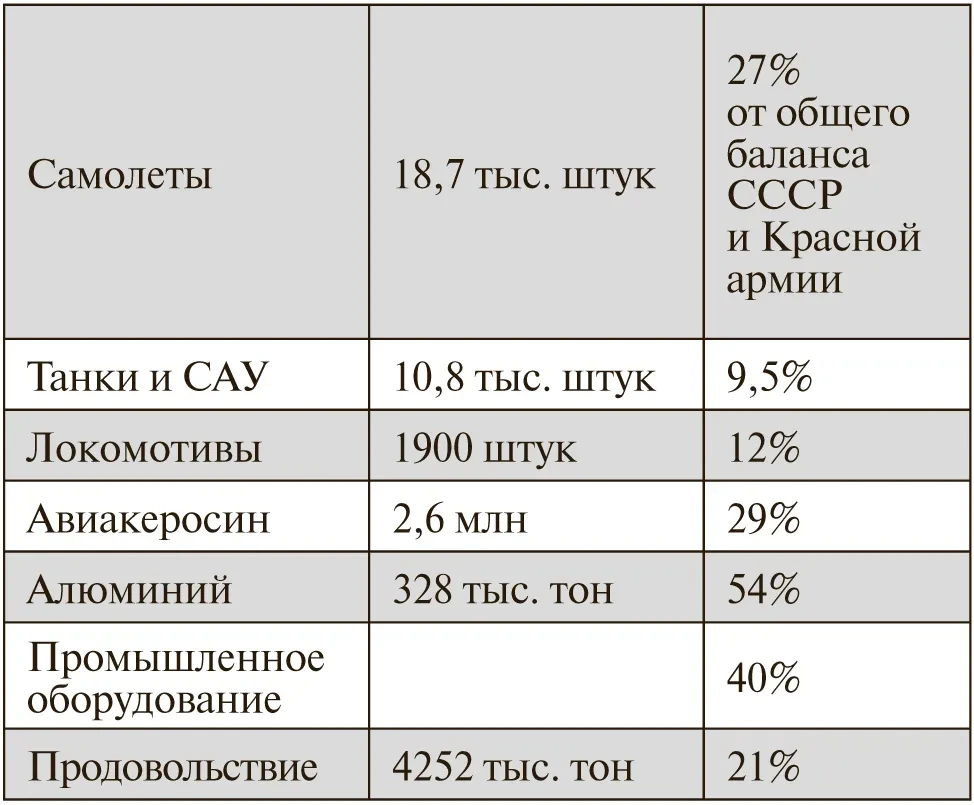
The allies provided us with over 18 million tons of cars, machine tools, metal, weapons, rails, food in the amount of $ 11.3 billion, which is equivalent to about 140 billion dollars in 2006 prices. (The debt was repaid in 2006 by the amount of just over 700 million dollars.)
I remember well cars and food. Father, as a disabled person of the second group, sometimes brought brown boxes of ceremonial cardboard with “American gifts”. There were stew and canned ham in rectangular banks, milk powder, egg powder, jam, bosses, sugar ... Sometimes he received something from clothes. (A fur vest with buttons, similar to halves of football balls, is still alive, like transparent protective glasses, probably for turners, it is not known why the wounded actor who got into the apartment.) In each package we received, a block of cigarettes, soldiers' Camel without a filter with honey, until you light, smell. From the silver foil, which the packs were lined up, we made fixes so fashionable in the post -war courtyard.
Drama drama and "Ceseta"
Having received a prize for the Ukrainian record for swimming and digging money, I became the happy owner of the Red “Java 350”, but fell on it, focusing God without damaging, and decided to sell the motorcycle to my friend Bore Ratimov from superstition. And I bought myself after the exhibition, cheap, handsome-motho-Roller "Chezeta", with white sidewalls on wheels, a margin behind a seat, a starter (you will remember this starter, then it was very rare).
My yard friend, the technical genius of Borya, put the “Java” in order, and she was immediately stolen by Vaska - the son of the hero of the partisan war and the chairman of the Supreme Council of Ukraine Sidor Artemovich Kovpak.
He guarded the sannish dad in Pechersk, near the building, where he was now glad, and when Kovpak got out of the car, probably “Seagulls”, shouted across the street above the head of the guards:
- Your Vaska is a thief! He stole my "Yava"!
The next day, the motorcycle was in the courtyard next to my “Cheteta”, but relations with the President of Ukraine were spoiled.
“Chetta” in the story of Lend-Lis appeared not by chance. Her fate was directly connected with the help of allies.
On it, I also fell, falling on the oil spot on the paving stones of the current street Grushevsky. I slipped on the ass, wiping my pants, and a scooter rumbled nearby. I was just a happy owner of the only “Chemite” in Kyiv with a starter (!), And now I wanted to get rid of it.
The buyer was Yura Dymov, an old dudes, a large, mustachioed man with bulging stupid eyes. He successfully eluded the then fashionable articles for parasitism, affecting the artist-designer of the showcase for the holidays. Being a supporter of socialist minimalism, on the eve of May 1 and November 7 he went around grocery stores and ordered directors to buy 30 linear meters of Kumach and a white plaster bust of Lenin. Having installed on the sculptural portrait of Ilyich, covered with red matter, he was with wallpaper nails (on which, as well as on the “low -fat”, by April 1 they reduced prices) pinned the kumach rays emanating from the leader’s head. Ideologically the design looked flawless and was not expensive.
Dymov believed, traveling on the beauty of the “Chezeta”, to cover not only the central part of the city, but also Pechersk with Podol, which would provide him with more frequent visits to the Dynamo restaurant, which used the inhabitants of bad glory. Trading the "Chetta", he invited me to this restaurant. Two beauties were sitting at the next table - my neighbor Valya Zhuk (later the wife of the famous Polish film director) and another Valya - Kambala, a one -legged prostitute, who was very popular among secret workshops, cultural figures and farmers.
Due to the interest of reducing the price of Motoroller, Dymov wanted to show me his irresistibility. He wrote a note to the ladies on a napkin and asked me to betray it. Valya Zhuk, turning the piece of paper, read: “Come to our table. We have fun in us and there is something to drink. ” Taking a pencil from the waiter, she inscribed on the back: "It does not depend on which table."
It was a lesson in dignity, which I remembered two days later. Yura Dymov came out of Sberkassa on the corner of Boulevard Shevchenko and Krasnoarmeyskaya, gave me money for a scullet, receiving the keys and documents in return. The deal took place.
-Take me home to the round-UNIVERTITY. I will pay.
- What are it about. Included in the price.
He sat in the back seat. I turned the starter’s key (!), And immediately there was an explosion in the carburetor. Black smoke from burning rubber and isolation across the miraculous “chaze”. An aunt ran out of the Dnieper restaurant in a apron with a bucket of dirty water, in which potato cleaning floated-lushpikes like a place. She flooded the fire. I wiped it on the apron of my hand and left. Yura Dymov, looking past me at the monument to Lenin, said:
- So I think, why do I need a scooter?
I silently climbed into my pocket and returned the money. "It does not depend on which table."
With an effort pushing the dead, the dead, charred “chambers” (he helped Dymov helped), we approached the theater courtyard.
Uncle Vasya Tsygankov in a lilac T-shirt, cap, Galife and boots sat on two bald slopes at the open door garage, where he repaired someone's “Willis” slowly, so as not to part with his favorite car. Seeing our procession, he shot the cigarette with a cigarette butter and said, without greeting:
- What the Germans have, that the Czechs have a weak wiring. That's what I will put you.
He entered the garage and returned with the wires of unprecedented beauty in a motley braid covered with a transparent film.
- American! From "Willis". And do not sell him.
Lend-Lease later entered my life again.
While Uncle Vasya Tsygankov changed the wires, Dymov, like the enchanted, watched his hands. Then he pulled a piece of camera from somewhere with the inscription “Made in USA” and ordered to go to the booth at the gate to the shoemaker Ibrahim, the uncle of one-armed Vova Bek, the chieftain of the gang of hooligans from Tereshchenkovskaya street to glue the diffuser.
- Back!
"Chetta" started and rushed quietly. Yura Dymov restored the sticky lushpikes and said:
“But still, the fire was and must be dropped.” At least a little.
“Okay,” I said, as always trying to get rid of unpleasant things as soon as possible.
“And I would not sell,” said Tsygankov. - With such wiring.
When Dymov left, Uncle Vasya slapped me on the back of his head and uttered the phrase that he regularly pronounced when he went to football with us.
- The game was equal ...
I understood him correctly.