
Translated material
The police are engaged in nonsense
The Russian police are arranged so that it spends a lot of time and effort on any nonsense. But they are not enough for the necessary work
The Russian state spends a lot of the police - about 10% of the federal budget, which is comparable to other countries. But this money is consumed incorrectly, because the police themselves are incorrectly arranged . It is super -centralized - this prevents it from organizing the work normally and forces to produce mountains of paper reporting. Both leads to the pugging of the States - now almost a million people are serving in the police. For the same money, Russia could have a more compact and effective police. And the police are a more worthy salary.
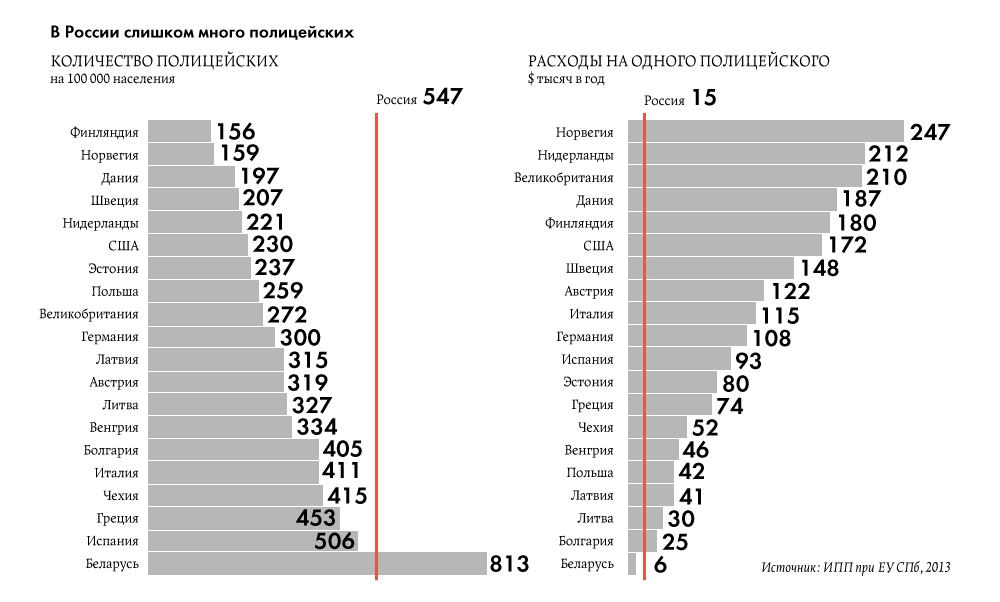 Source: IPP under EU SPb, 2013
 People in uniform
Most people serve in a uniform police - about 350 thousand. These are those whom we see on the street - people in the form in which the Police is written. Contrary to cinema ideas, they rarely catch criminals (only “on a hot trace”). Their task is to ensure social security: to suppress hooliganism, regulate the road movement, simply to stop people from the commission of all kinds of nonsense.
Read also Judges despise people, a respectable Russian does not trust the judges, but when he is in court, he feels like an idiot. Both has its own scientific explanation
Russia is one of the few countries where the unified police are divided into services, each of which theoretically engages in only one thing. This is a road-patrol service (traffic police)-it monitors the order on the roads. The service of district authorities and inspectors for minors (UP and PDN) - they monitor the order in the territory entrusted to them. The patrol service (PPS)-she monitors order on the streets and leaves for the challenges. The duty unit - takes a message about crimes with citizens. Need -eaten security protects especially important objects, reacts to the alarm operation (during the last reform it was transferred by the Russian Guard, but how its work will be organized in practice, and how it will now interact with the police, it is not yet clear).
Such a division looks good from Moscow, where the Ministry of Internal Affairs is the chief chief of the PPS, the chief chief of the UP, and so on. In real life, the tasks of these services are crossing all the time. Either the PPS is thrown to help the district police officers, then the district police officers are driven to patrol the streets. Either private security replaces the PPS, then the PPS goes to the alarm, because they are simply closer. And then they all work together an operation of the Vorticar-Antterror type.
And this corresponds to world practice. All over the world in cities (and we have the majority of the population in cities), a universal soldier in uniform: today he regulates the movement, tomorrow patrols the street, the day after tomorrow - goes home and practices complaints of neighbors against each other. This is in the order of things - fixed in the instructions and in life.
Due to high specialization, we pay more police officers than we couldOur artificial division not only complicates the handling: the boss is forced to go against the instructions all the time - to hore tasks that are not included in their duties. It is much more important that it interferes with the interchangeability of employees. Still, the district police officer is one qualification, he is an officer, and the patrol is another, he is a sergeant or an ordinary. And since there is no interchangeability, versatility, we are forced to support one of the largest uniform police in the world. That is, we pay more police officers than we can.
Another unprofitable feature of our police is its militarization. The police inherited the army system of titles, which is not suitable for it: the army solves much more homogeneous problems. The organization according to the military model complicates communications, forces to waste time on unnecessary procedures such as daily divorces, which eat up to 10% of working time.
The police reform in Russia should provide for the transition to universality. This, of course, is not an easy task, you won’t solve in one day - it will take about 15 years.
People in civilian clothes
The smallest part of the police are just those who catch criminals and investigate crimes. In English -speaking countries, they are called Detectives or Investigators, and in Russia - operational authorized ones. They do not wear forms, in many countries the form is not provided for them at all. In Russia, it is, hangs in a cabinet in an honorable place, and put it on only on holidays (like Gleb Zheglov in a famous series - instead of pajamas). The operative works with people, starts agents among them, so he does not need to shine.
About 100 thousand people serve in operational units in Russia. This is our assessment, in general, this figure, as far as is known, was not published. We interviewed investigators and we know that in the work of one investigator there is a little more than one operative. Investigators and interrogators in the police are 70 thousand, they can go both civilians and form depending on local traditions.
Beach of operatives - Wild bureaucratization: We work day - two draw upIn the police department of a small city of operatives there will be no more than 10. Some of them have a specialization: one works in missing (“losses” in jargon), a couple of people - according to economic crime (“along the BEP” line), a couple of people - by drugs.
Beach of operatives - wild bureaucratization. Of course, this is not only in Russia, this world is like this: we work for two days - we draw up a day. But we seem to come out the opposite: we work - two decorating .
Bureaucracy not only takes time from the operatives, but also subjugates their work. No one will check how the operative speaks with people, but the boss will certainly flip out the operational affairs and see what is focused there. When the operative reports only to his boss, control can be relatively informal, which is required for such creative and difficult work. But when every day the check can come almost from Moscow, you have to "hide behind the papers." In general, since this work is evaluated in centrally - according to the set of indicators lowered from Moscow - operatives are forced to adjust their lives to these indicators. That is, some crimes (beneficial from the point of view of reporting, for example, serious economic or heavy violent) will be actively investigated, while others (less profitable, for example, small fraud or small thefts) - push it. This is the essence of the so -called “stick system”: he quickly revealed the correct crime - he earned a good “stick” in the reporting.
In general, building the work of all operational divisions of the country under the principles of assessment is a completely vicious practice. Yes, there are murders and other serious crimes - they are in special control in the whole world. But in general, both the practice of work and its results can be very different in different places. The presence of a vertical forces the operatives to build a paper wall among themselves and the authorities. The authorities, by the way, in parallel loses contact with reality and begins to live in a paper world. This must be gradually eliminated, reducing petty control over operational work, transferring real responsibility to the leaders of the lower level.
People with the bosses
Another very large part of the police is the headquarters. This is a generalized name for assistants, secretaries, analysts, etc. with different bosses.
On the one hand, their existence is quite justified: the police must be led around the clock, so there are many bosses there. In the standard police department, the head of two or three deputy-for the police, by investigation and in all. Zams in the police have two or four deputy. This is not a whim. At least one of the bosses should be in place at any time. To build a normal duty schedule (if there are other responsibilities), six to nine people are the necessary minimum. And all eight bosses need to maintain a document management, which also exceeds all reasonable limits due to the need to constantly report up .
A significant part of this turnover is also secret: that which all over the world grifles as official information (the operas talked with the agent) is protected as a state -ownier. And this requires additional employees (flashing, issuing-wrap, mark in a special journal, etc.).
The main claim here is not even that these headquarters are numerous - at least 200 thousand (this is along with the bosses, but excluding the necessary backophys - accountants, personnel officers and others), but that people in uniform are sitting in them. That is, in their status, they are no different from the people of the "land" - operatives, patrolmen, etc.
This status gives the right to numerous benefits, of which the most employees really use one - early pension.
I recently talked with a former policeman who served in Chechnya and in the north. He is 31 years old, the pension is 29 thousand rubles. Life is just beginningIf you at the age of 17 entered the educational institution of the Ministry of Internal Affairs (experience), and then, for example, rose to the deputy chief of the precinct service, then at 37 years old - welcome to retirement. It is good by Russian standards-20-30 thousand rubles.
I recently talked with a former policeman who served in Chechnya and in the north for a long time (there is a faster experience). He is 31 years old, the pension is 29 thousand rubles, he married, enters graduate school - life is just beginning. Therefore, many former police officers find themselves in business and in the civil service .
But it is one thing when operatives or patrols (people of the “land”) receive an early pension, who had an irregular working day for 20 years, poor working conditions, at times risked their lives. And another - when the staff of headquarters receive the same pension - clerks who spent the same 20 years from eight to 17 in the office.
Hence the deep resentment of the "land" on the "headquarters". Now one person “on earth” in the police accounts for approximately 0.5 boss or staff worker. It is clear that it is necessary to simultaneously reduce the number of such employees (due to the decentralization of the police, informatization and optimization of workflow, the rejection of those who are pre -war practices), and for the remaining special statuses of a civil police officer - a person who will work before an honest pension of 55 or 60 years .
Alien work
The number of headquarters and the work of the police as a whole is also greatly affected by the fact that the police often perform the functions that are not inherent in it. Licensing of private security enterprises, issuing resolutions for weapons, driver’s license, passports, control over the legal trafficking of drugs, product quality control, trade permits and the like. If at the beginning of the list there are functions that are also police officers in the world in some places, then at the end it is already quite exotic police.
Being busy monitoring everything, the police do not do what he should do - as is customary in developed countries. The police today in Russia reacts to the threat: it will come if they are trying to kill you (or, rather, they have already been killed), they are robbed, if they are noisy in the yard, they drink on the playground. But in most of the world, the police perform at least two more functions - service and advanced prevention .
In Sweden, the police will not only help the "stumbled" to find a job, but will also send him a ticket for a village holiday. So that I don't drink it on the weekendService is from the anecdotic example about the cat that climbed into the tree: they will come and remove. The car has broken on the road - they will come and take it to the service. There was an accident - two police officers arrived: one is engaged in the design - the second is immediately taken to organize movement. A traffic jam gathered at an hour-peak-a traffic controller will appear immediately. A mass event is taking place - the police put the pointers to the nearest parking lots so that people do not throw cars where it is. Our police do nothing of this now.
Read also The screws on March 26 throughout Russia have passed large -scale anti -government rallies. About eight hundred people were detained in Moscow - more than in any mass action in recent years
Expanded prevention - identification of risk groups and work with them. With difficult teenagers, with drinkers, with drug addicts. In Sweden, for example, the police will not only help the "stumbled" to find a job, but will also send him a ticket for a village holiday for the weekend. In order not to drink at home, but went to where it is uncomfortable to drink strongly.
Of course, if such a prevention to introduce such a day in today's Russia, it is scary to imagine what will come out. But the experience of Finland, where everything is good now, says that nothing is impossible here. Finns, being a problematic country with northern alcoholism, with high aggression, with high household crime, with terrible criminal law, with a repressive judicial system, went this way in about 25 years-from the mid-1950s to the early 1980s.
Lying about the USSR
To make the police universal, save it from unnecessary paper work, free it from unnecessary functions, force it to perform the necessary functions, reduce headquarters and raise the salary “on Earth” - so that all this becomes a reality, the police must be decentralized first of all. Not all, of course, interregional crimes, the fight against terror and organized crime - such things should remain at the federal level. But for public order, regulation of movement, investigation of most crimes, local or regional authorities must be responsible. Otherwise, it simply cannot be in such a huge country as Russia. The Police of Chukotka and St. Petersburg cannot be evaluated on one scale, in Moscow and Chelyabinsk you must fight completely with different drugs. And it is impossible to lead everyone from Moscow - what's the point that all Russian district police officers have one common boss?
They call the police chief from the headquarters of the Ministry of Internal Affairs: "You have bad strokes on the railway." And the one: "I was asked to throw all the resources at the Pipe Plant - this is the decision of the district committee." And allSupporters of centralization refer to the experience of the USSR. But in the USSR, in fact, there was no such centralization. The Soviet police had an understandable format of coordination with the local authorities. First of all, this local authorities - the executive committee - appointed the head of the police, and the Ministry of Internal Affairs only agreed (in practice - proposed). Before the appointment of the chief, he was interviewed at the local district committee of the CPSU, he regularly reported to the bureau of the district committee. That is, both the Executive Committee and the district committee could give him official instructions.
This allowed the police chief to argue if necessary with the ministerial authorities. For example, they call the police chief from the regional headquarters of the Ministry of Internal Affairs and they say: “You have bad strokes on the railway.” And the one: "You know, I was asked to throw all the resources at the Pipe Plant - this is the decision of the district committee." And all. This was called “taking into account local conditions, another decision was made” - so the boss was freed from the “stick” vertical. And if the chapters pressed, then the first secretary of the CPSU district committee and the head of the head of the Ministry of Internal Affairs met with the secretary of the regional committee or regional committee to resolve the issue .
Until the regional and local authorities are turned off from work on the protection of public order and the fight against crime, the police will not work better. There should be many police in such a large country, and they should be different.
The author is a sociologist, a leading researcher at the Institute of Law Problems at the European University in St. Petersburg.
Police federal budget