
Translated material
Sonal foam of days
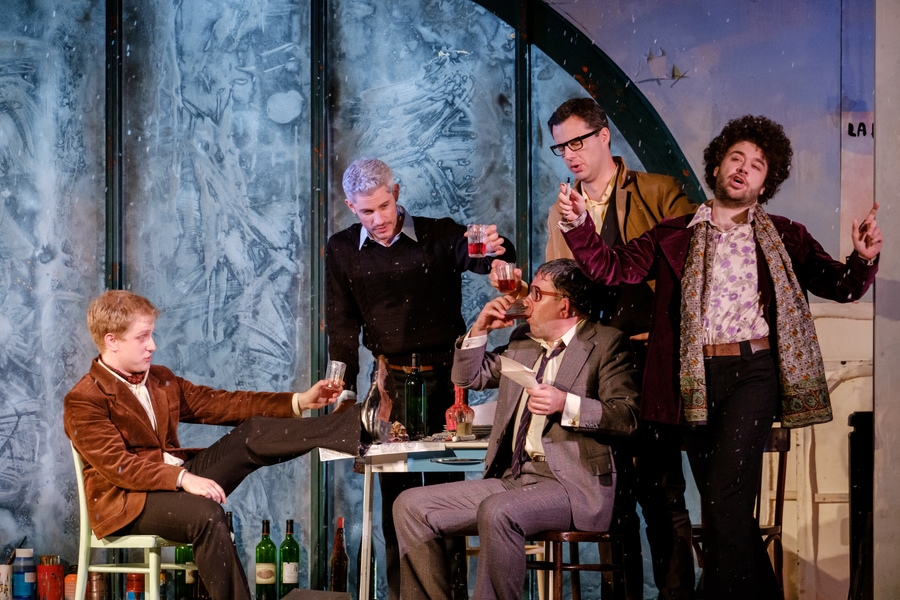
Almost a year after the sensational “travia” in Perm put another popular opera about death from consumption - “Bohemia” Puccini. Moreover, the star of that, Verdievskaya, the production of Nadezhda Pavlova this time was not a dying heroine: she loudly played the role of the completely blooming and deadless Musette. The other soloist of the Perm Theater, Zarina Abaeva, coughed. At the same time, she was instructed to sing almost in a whisper. So the barely audible (but still always audible) mims against the background of the exact, voluminous, transparent, reactive and completely non -stuffy orchestra of Cuentsis is the most characteristic detail of the new production. And it is clear who is the main one here.
Obviously, Kurentzis does not need large, luxurious voices here. He does not allow the soloists to come to the fore. In his perfectly balanced sound, they exist on equal terms with the instruments of the Musicaeterna orchestra, in which there are much more extremely detailed and meaningful “conducting“ conducting directors ”on stage on stage.
 © Anton Zavyalov
Nevertheless, the couple of Musetta - Marseille, where the Bariton Konstantin Suchkov from the Youth Program of the Bolshoi Theater turned out to be a very juicy part of Musette - Marseille. Beloved Mimi Rudolph performed by the young Italian tenor David Justy sounded less expressively. The four friends were correctly complemented by the French Bariton Bariton Crossli-Merser (Schonar) and the Bulgarian bass of Act Vachkov (Colllen).
The German director Philip Khimmelman, with whom Krentzis has already released the “Figaro’s wedding” in Perm and “all women do this” in Baden-Baden, placed the heroes of the opera in the 1968 revolutionary Paris, which the program warned warningly. This circumstance does not bring any additional meanings to the opera Puccini. Student unrest and pants of clashes become a backdrop for the stupid “foam of the days”, where the heroes of the performance, like children, throw pillows, but do not know what to do with love and death.
 © Anton Zavyalov
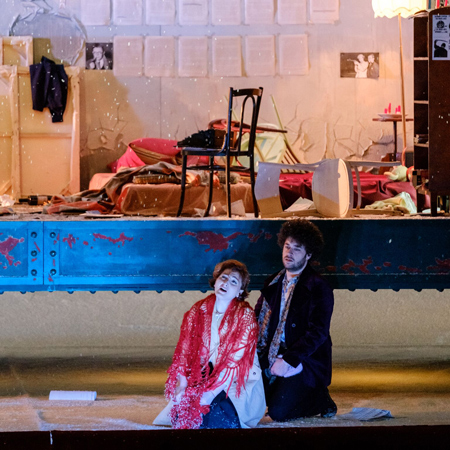
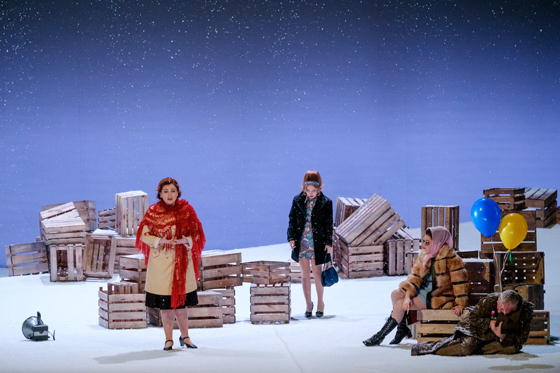
On the stage there is a mandatory set: a caricature veteran with orders and balloons, a mighty transvestite in something brilliant, civilian activists with banners, unpleasant representatives of the law and order. Throughout the performance, snow is sprinkled. The two -tier design of the artist Raimund Bauer conveniently turns the opera attic into the present, when she goes to the grates, making room for street scenes.
In the orchestra of sympathy for heroes more than on stage. Himmelman does not consider it necessary to somehow retouch the fact that four men in this opera are still complete goats, limp, infantile, striking with their steep bohemia. That I am quite approved. Mimi is also a frozen, submissive victim, to which Rudolf never even touches. Only Musette is a living one, capable of some real actions: to return Marseille to yourself, find a way to pay an account in a restaurant, drag a dying mims to the attic, find a clutch for its cold hands. However, the role has not been completed: in the finale, when the scene turns into an empty, inhuman space, Musette simply leaves the dead girlfriend with the rest.
 © Anton Zavyalov
The love of this caramelized beauty and fragrant papiture is a little non -core for the Custezis revolutionary. Perhaps this explains the strange time of the premiere - just a week before the main event of the season, the next Diaghilev festival. For example, a dance stall and a lounge zone with pillows during the joint performance of musicians from Musicaeterna and the ensemble of the famous Azerbaijani Handa Alim Gasymov at the Tchaikovsky Opera and Ballet Theater are promised there. Or the concert improvisation of Anton Batagov “Dawn on the Kama River”, scheduled for half-four in the morning (yes-yes!) In the Perm art gallery (really standing on the shore of the Kama). That's where Bohemia will be so bohemia. In the meantime, a sort of mainstream border.