
Translated material
"Hernik" Picasso. Read experience
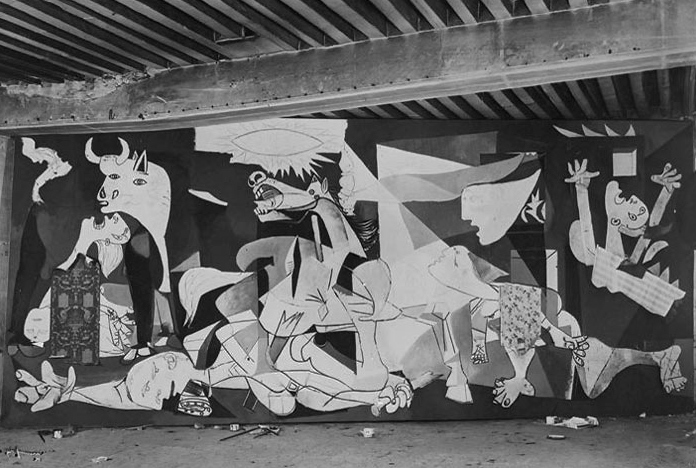
In the Moscow branch of the Servantes Institute, the exhibition"Termnika: Spain 1937 - Moscow 2017" . Three dozen artists from Russia, Spain and Latin America turned to the famous Pablo Picasso picture in connection with the 80th anniversary of its appearance. The head of the Culture Department of the Servantes Institute Tatyana Pigigerova spoke about the creation and reading of Germniki.
Pablo Picasso wrote “Hernik” - a canvas size 3.5 by 7.8 m - in 33 days. He was then 55 years old. In fact, “having passed the earthly life to half” (Dante considered 35 “half” of his path, the numbers rhyme), Picasso creates his main picture. As Don Quixote was born from the plan of a parody story, so Gertinik was supposed to become nothing more than a masterpiece of agitprop. But since Dante wedged into the conversation, we recall his idea of the “multi -minded” interpretation of poetry from a letter to the cangrand della Scale: the interpretation of historical, moral, allegorical and “anagogical” (sublime). From the reality of the first plan to the realities of the “higher order”. "Hernik" clearly deserves Optics Dante.
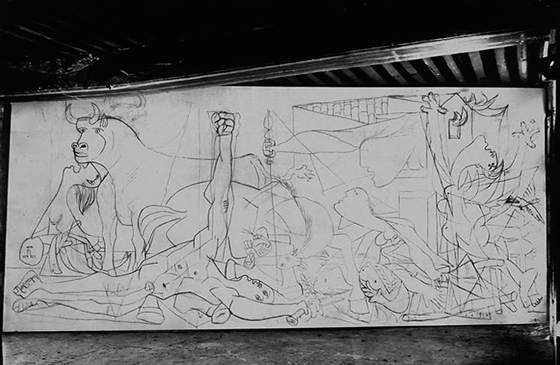 © Dora Maar Photo Chronicle of the creation of Hermniki
Historical interpretation
In January 1937, the Government of the Spanish Republic orders Picasso monumental work for the pavilion at the World Exhibition in Paris, which should open in the summer. There is a civil war. The most famous Spanish artist living in France has already been appointed director of the Prado Museum. He “leads” the museum at a distance, but is very proud of the title. For the pavilion of the warring country (whose main task is to declare the viability of the republic and raise funds for the People’s Army) Picasso's participation is the most important trump card. The Spanish Parisian never painted political paintings (the dove of the world will be born in 1949, "flying away" just from the "Germanic"), but accepts the order. As well as a fee. Republicans talk about the “gift” of Picasso, who was just paid for canvas and paints. Later, a real figure will be published: 150,000 francs, 15% of the cost of the total pavilion of Spain, 9 times more than Picasso received for the most expensive of the previously sold work.
In four months, an artist who is in a creative crisis does not write anything. And then Gernik intervened in history, or rather - on the contrary. On April 26, on Monday, the aircraft of the German Legion "Condor", the allies of Franco, for three and a half hours bomb the peaceful city. Hernik - a symbol of traditional freedoms of the Basque people (under the local oak, the kings of Spain brought the oath of freedom to respect) - becomes symbols of horrors of war of the twentieth century. “There are only five whole houses in Hermnik”, “The tragedy that is not seen by the world” - Parisian newspapers are full of similar headlines. The figures of the dead range from 200 people to a thousand. Everything, of course, is relative. Tragically relative. Gertinik compared to the Holocaust and Hiroshima, but in this first bombing of a peaceful city in the history of Europe was a special symbolic intensity. After all, the sacrifice of Christ is statistically small in comparison with the massacres of Attila or Genghis Khan.
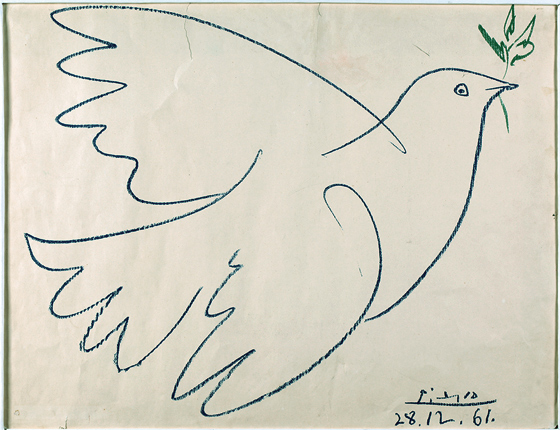 Dove Picasso. 1961 option
In the art history of Hernik, the same error is repeated: the government of the republic did not order a picture of the tragedy of Gertinika, the order was received four months before the bombing, and the topic was not stipulated. But Termnik, as Rafael Alberti recalled, "struck Picasso as a blow of bull horns." She became a catalyst, an explosion that knocked out Picasso from a crisis - to work. On May 1, the first sketch appears: a bull, a wounded horse, a woman with a lamp in her hand. The convention is limit. Details of sketches vary. It is a winged pegasis flies out of the wound on the side of the horse, and the horse itself writhes in pain, then he stomps with the hooves of the wounded warrior, then he turns into a pure children's horse (not without reason, Picasso dreams of “writing like a child”), then stands on his hind legs with a frightening grin. The bull has either a formidable appearance, then detached, then completely human, with large sad eyes. On the first day of sketches, there are only five sketches, the pace of work is growing in the rhythm of CressCendo , in addition to the original trinity, the outstretched bodies of a warrior and a woman, a sobbing mother with a dead child. Picasso himself said that he wrote this work in the “state of trance”, without stopping, 14 hours a day. “I did not let out a brush from my hands, like republican soldiers - guns,” he admits in an interview. On May 9, the first sketch of the entire composition is dated. On May 11, Dora Maar, the Muse of Picasso, the time of “Germniki”, takes pictures of the first composition on canvas - in the new workshop on Rue des Grands Augustin , 7. Her pictures will reflect eight phases of work on the picture - and this series of photographs will become a unique evidence: a monument to the evolution of the design and birth of a masterpiece.
In the first photo in the center of the composition, a raised fist of the wounded - but the triumphant - soldier, the visual metaphor of the republican slogan “No Pasarán” (“They will not pass”) is focused. The action takes place in the square, the tongues of the flame covered the house, the bodies of the victims mixed up, the frightened woman collides with the killed, a burning woman with outstretched arms falls on them from the window. Everything flies, runs and crumbles. In the second picture in the muscular fist of the soldier, a sheaf of ears arises, and behind it is the rising sun. But as they work, the frontal political statements, the language of the poster, go from the picture. In place of the sun, now a mysterious eye lamp with sharp rays, the position of the dead soldier is changing: the fist is lowered, and the body with spread hands is more likely to be crucified. A dead woman disappears, triangles are increasingly appearing in the composition, the construction of an ancient frieze with antique clarity. The bull moves from the center into a corner, curled up by a half -ring around a woman with a dead child. And in the place of a chopped tree (the only straight - and very quickly disappeared - references to the specifics of Germnika), a table angle with a wounded bird arises. The action moves inside the room - more precisely, a symbolic, broken inner space - where the door is open, the floor is drawn (either the tile, or the map of military operations), and the time froze.
In the art of the history of Hernik, the same mistake is repeated: the government of the republic did not order a picture of the tragedy of Germniki, the order was received four months before the bombardment, and the topic was not stipulated.
Picasso, until the last, tried to introduce the color elements into his work: he glued red tears to his faces, from wallpaper and colorful paper he won the dresses of three women (burning, running and sobbing over the child). The red-gold robe of the sobbing moved to the collage “Femmes à leur Toilette” , which now adorns the residence of the Ambassador of France in Madrid (looking at this work, you understand that the duend Herniki saved a masterpiece from a bad snake). In a running woman with naked buttocks at the first stages of work in her hand, a piece of toilet paper was depicted - this physiologicity sent to a series of grotesque satirical engravings “Dream and Franco's Lies”, which Picasso finished at the same time. In one of the latest versions of “Germniki”, instead of painted paper, a piece of paper of the present appears - glued to the left hand. Closer to the finale, only fragments of color remain - red tears on the cheek of running and a wound on the neck of a dead child. In June, the delegation of the republican government inspects the work. With them, Picasso tore off the last interspersed of the collage from the canvas: red scraps of paper, a tear and a wound. Everyone was applauded. “We saw Hernika acquired an amazing restraint worthy of the monastery restraint of the escur, but immersed in the horror of chaos,” recalled one of the present.
The name "Hernik" also arose only in the final of work. Here versions diverge. Someone claims that the workshop of Picasso visited the delegation of the Basque politicians and one of them exclaimed: “This is Termnika!” Other witnesses assure that the name was proposed by Paul Eluir, who was just writing the poem “Victoire de Guernica” , or Christian Zurivos, the editor -in -chief of the magazine Cahiers d'Art , by which Dora Maar photographed the stages of work. It is important that Picasso intentionally departs from a specific historical plot, but it agrees to the name - extremely spectacular - creating the ground for subsequent disagreements and disputes.
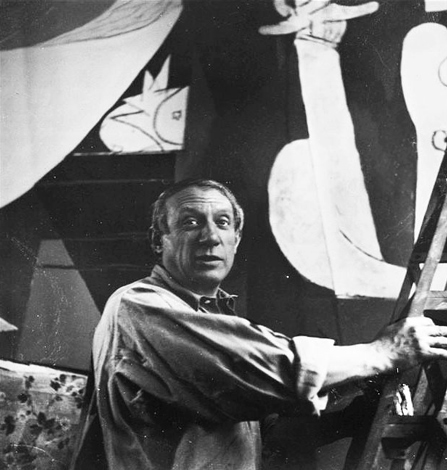 © Dora Maar Photo Chronicle of the creation of Hermniki
Disputes began as soon as on June 4 the work left the workshop and took its place in the main hall of the Pavilion of Spain. Particularly persistent Marxists demanded to remove this “Cubist something”. Louis Aragon complained that an excessive tendency to the vanguard deprived the work of the "semantic effectiveness of socialist realism." The reaction of the public was also ambiguous. Le Corbusier, who was present at the opening of the pavilion, wrote: "" Gertinika "saw mostly the backs of visitors, it seemed to them repulsive." Time sets the prism of perception. In 1937, peaceful Europe wanted to see another thing: progress, a triumph of technology, a bright future, not yet wrapped in gaping heights, which Picasso tested in his "Germanic". The press enthusiastically wrote about the pavilions of Germany and the USSR (the latter was crowned with the “worker and the collective farm”), and the Spanish pavilion - built by outstanding architects Luis Lakasa and Jose Luis Cert (the last iconic project of Serta will be the Joan Miro Foundation in Barcelona) - was not even mentioned in the catalog of the “main objects of the exhibition”.
Particularly persistent Marxists demanded to remove this “Cubist something”.
After Paris, Germnik will go on a world tour of England, Scandinavia, the United States, and then gain a temporary residence-“before the attack of democracy in Spain,” as Picasso bequeathed-in the New York Moma . Since the beginning of the 1970s, the return of the picture has been discussing. Franco, they claimed, was not opposed. But Picasso, as expected, did not agree. After long negotiations (Picasso's daughter demanded that abortion and divorces were allowed in Spain on September 10, 1981, “Hernika” arrived in Spain on board the Boeing “Lope de Vega”. The epic play was approaching the finale. On October 25, on the day of the century from the birthday of Picasso, a new exposition was opened in Prado-to Kason del Buen-Retro, a branch of the museum: “Gertinik” and dozens of sketches. The picture for the first years was hidden behind the bulletproof glass, the gendarmes were on duty next to it. Dolores Ibarruri - Chairman of the Communist Party of Spain - in another fiery speech will put an end to history: “The war is over. The last exile arrived at his homeland. ” In 1992, Germnik will move from Prado to the Korolev Sofia art center and will become his main, iconic exhibit. Now, two caretakers vigilantly guard her from photographers.
Moral interpretation
When the world survived the horrors of the Second World War, the prophetic meaning of "Termniki" gained a new sound. The title of “main anti -war masterpiece of the twentieth century” sounds formally, but reflects the essence. In the context of Spanish art, the masterpiece of Picasso stood in a row with the “surrender of nonsense” of Velazquez and Goya's “execution of May 3”. The dream of Miguel Sugasa, director of Prado until March 2017, was the creation of the “Hall of Peace” in the Salon de Rinos, the second branch of the museum, the competition for the reconstruction of which has recently been completed. There, according to the Sugasa project, all three masterpieces were supposed to be located (especially since the “delivery of nonsense” for the salon de Rinos was written). In the layout of the Norman Foster and Carlos Rubio, the Director Prado (as well as the will of Picasso, who had repeatedly emphasized Sugas) was embodied in the layout of the project. Such a “attempt on a masterpiece” gave rise to a scandal between the museums, the king of Spain assured that the “Germanic” would not leave the center of the art of Queen Sofia, and Sugasa soon resigned. Fiasco with the "Hall of the World" was one of the reasons.
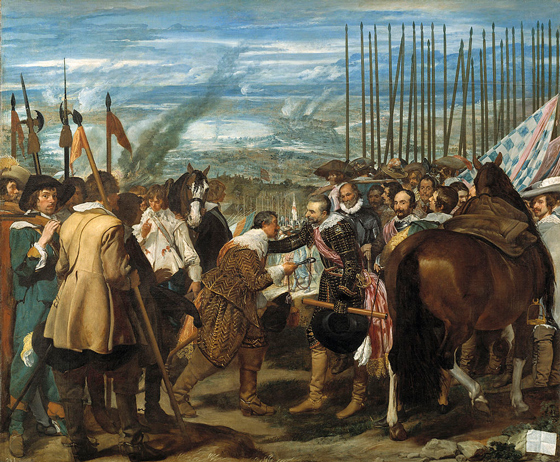 Diego Velazquez. Submission of nonsense. 1634
“Surrender of nonsense” was written in 1635, 300 years before Germniki. Justin Nassau, Governor of Breda, taken by the Spaniards after a long siege (this was one of the few victories in a series of many defeats in the war with the Netherlands, and the “spiritual” role of the event was primary), present the keys to the city of the Commander -in -Chief of the Spaniards Ambrosio Spinola. In this era, war is the main masculine business. Yes, in the depths of the picture the battlefield is smoking, but the winners and the vanquished are written by Velazquez with that degree of respect and detachment, as in its other paintings, aristocrats and jesters. The Spaniards won, but Spinola does not allow the governor to kneel. Velazquez writes not the horror of the massacre, but the nobility of a true victory. The world has not yet lost integrity, the war is still worthy of a ceremonial portrait. Goya’s war has already been manifested as metaphysical evil. The evil spirits have the “calamity of the war” “the calamities of the war” the same demonic grin. The ranks of the French, who kill the Madrid rebels in the "execution of May 3", merge into a faceless multi -legged monster. But behind the Hill of Prince Pio, where the atrocity is done, the palaces and the churches of Madrid will still rise. The matter itself is alive, evil is transient. A fearless person in a white shirt throws his hands. This is a triumph of crucifixion, but it is a triumph. The “Gertinik” Picasso is a tragic and incredible insight - and warning to humanity. Ahead of the time, the metaphysical horror that the second world, Hiroshima, will reveal all those future massacres and terrorist attacks that inevitably find themselves in the Eliping Field of Hermniki. This is not cubism and not surrealism: it is chaos, it is the death of matter itself.
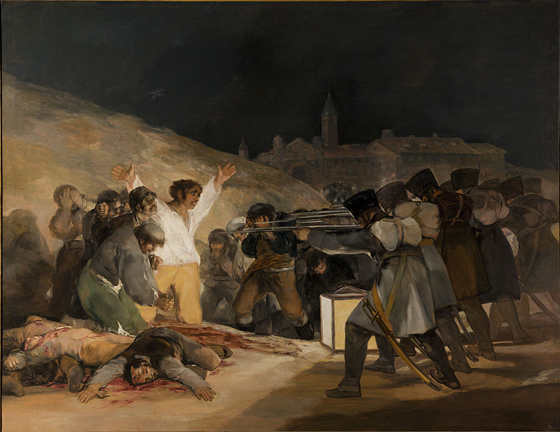 Francisco Goya. May 3, 1808. 1814
The woman who falls in the “Germanic” from the burning house has her hands raised in the same way as the hero in a white shirt in Goya’s “execution” (Picasso's sketches change the position of her hands and stops in a clear quote). Many write about this. But no one paid attention to the fact that the bull in the "Gertino" was bent in the same way as the horse in the "surrender of nonsense" of Velazquez. On the left flank of the "Gertinika" - Goya, on the right - Velazquez. Perhaps this is an accident. But the three tragedies of the war - albeit not met in the "hall of the world" - are inextricably in the minds of the world.
Allegorical interpretation
Interpretations and versions of Termniki interpreters will be enough for a whole polyphonic choir that turns into cacophony. What does a horse mean? A horse is a bloodied victim; No-these are a people who dropped an aristocrat horseman; No - this is an allegory of francism and nothing else; No - this is an allegory of a woman, seduced and pierced by a sword of betrayal; No, this is Spain itself! You are mistaken, Spain is a bull! No, the bull is the forces of evil, world evil, fascism! Exactly the opposite: he is a defender of a woman with a child, he is power. Yes, this is a minotaur, a macho, Picasso himself, a self -portrait, is it really not clear! Wait, a self -portrait is a bust of a warrior, Picasso adored antiquity. No, a warrior is Torrero - this is a soldier of the republic - this is a destroyed civilization. Nothing like that, the destroyed civilization is a house in fire. No, this is a wounded bird. A bird is a saving America! Get mistaken, everything is much easier: this is a dove from Mercede Square in Malaga, the artist’s childhood passed there. Have you seen sketches? This is the transformation of Pegasus, which flew out of the horse’s wound in early versions! Wait: she has a broken wing, she is a victim of the bombing! So, where is the bird? You can’t even see her ...
For an ideological struggle, there was not enough clarity in the picture. Picasso answered all questions about the symbolism of the characters that he had already said everything with paints and words too.
With the allegorical complexity of the picture, the Republicans initially tried to fight. Juan Larrea, the poet and friend of Picasso, even wrote to him in 1947 an official letter with a request to “confirm” that the wounded horse is a symbol of agonizing francism (imagine Florence, which asks Dante written confirmation that the lion at the entrance to hell is the republic, but the lynx is the papal curium).
For an ideological struggle, there was not enough clarity in the picture. For eternity - more than enough. Picasso answered all questions about the symbolism of the characters that he had already said everything with paints and words too. The plurality of allegories does not overshadow in any way, but only enriches the meaning.
The semantic field "Germniki" contains all the searches of the Picasso: "Avignonian girls" and the scenes of Corrida, "Minotavromachia" and "Crucifix", the triangular compositions of the blue period and the sharp corners of cubism. For all the total novelty, in “Hermnik” you can find the echoes of the “terrible trial” of Michelangelo, “Comment on the Apocalypse” by Beat Liebansky, Mosaic Ravenna, Romanesque painting, paintings by Baldung Green, “Crucifixions” with Porkenone and “Horror of War” by Rubens (there is a woman with her arms raised, and a mother with a dead baby, and lying a baby who lies. The man is a man, and Venus, extending the hand almost the same as a “mask” with a lamp). Obviously involved in the allegorical choir and Picasso's personal life. During the period of work on Gernika, he is still married to Olga Khokhlova, but the young Marie-Terez Walter just gave birth to his daughter Maya, and the new muse of Dora Maar is actively participating in the work on the picture. And here is the bull (something reminiscent of Picasso's self-portraits) looks at a woman falling from a burning house, and a woman with a child, and a “mask”, covering the path. Yes, and this bull-minotaur is located just like Velazquez in Menins. But what's on the back of the canvas? It remains to peer.
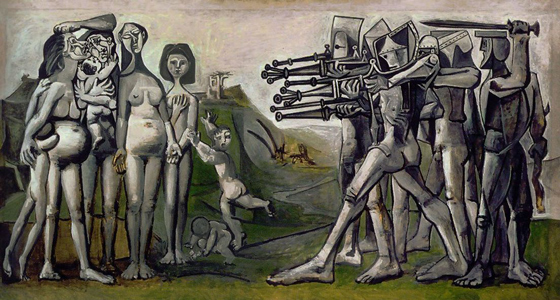 Pablo Picasso. Massage in Korea. 1951
Anagogical interpretation
Talking with the Elyuar field in the legendary cafe Les Deux Magots on Saint-Germain Square, Picasso saw a woman in white gloves playing with a knife. She dropped him vertically on a hand open on the table. The point either fell between the fingers, then stuck into the hand. Пикассо выпросил в подарок окровавленную перчатку. Так они познакомились с Дорой Маар. Именно она нашла для Пикассо мастерскую в доме номер 7 на улице Больших Августинцев, туда поместился огромный холст «Герники». В этой студии раньше проходили встречи левацкой группы Contre-Attaque под руководством Жоржа Батая, возлюбленной которого Дора Маар была до встречи с Пикассо. История этого знакомства описана у многих биографов. Но для полноты картины просматриваю биографию Батая, и вдруг невероятная деталь: тот самый чердак, «штаб» Contre-Attaque , был описан Бальзаком в «Неведомом шедевре». Невероятное, невозможное совпадение! Значит, «Герника» была создана там, где Бальзак поместил действие повести, в которой в 1831 году предсказал рождение авангардной живописи, описав портрет «Прекрасной Нуазезы» — «беспорядочное сочетание мазков, очерченное множеством странных линий, образующих как бы ограду из красок… хаос красок, тонов, неопределенных оттенков, образующих некую бесформенную туманность» — то, что осталось от шедевра, над которым персонаж Бальзака, гениальный художник Френхофер, работал 10 лет. Прошу парижских друзей прислать фотографию дома. На фасаде — мемориальная доска: «Пикассо жил здесь с 1936 по 1955 год. В этой мастерской он написал “Гернику”. В этом же доме Бальзак поместил действие своей повести “Неведомый шедевр”».
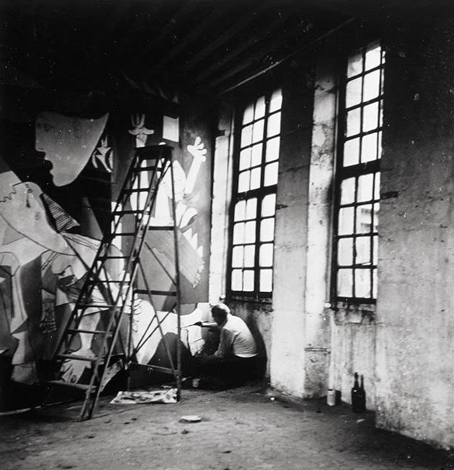 © Dora Maar Фотохроника создания Герники
Блаженны изобретатели велосипедов. Оказалось, что факт общеизвестный. Но мало кто помнит сюжет повести, историю с абстракцией и еще одну важную деталь. Герои Бальзака видят в углу картины «кончик прелестной ноги, живой ноги» — «обломок, уцелевший от невероятного, медленного, постепенного разрушения», он возникает «как торс Венеры посреди руин сожженного города». Что мы видим в правом углу «Герники»? Страшную, уродливую, искалеченную женскую ногу. Фрагмент «прекрасной Нуазезы» ХХ века. Нуазезы из «Герники». Такое совпадение не может быть случайностью. К тому же Пикассо иллюстрировал «Неведомый шедевр» Бальзака в 1927 году. Подобно Френхоферу, Пикассо не может завершить свой шедевр. Еще годы он пишет «эскизы» к законченной работе, бесконечных «Плакальщиц», «Рыдающих женщин», «Женщин с мертвым ребенком», еще более жестких и пугающих, чем персонажи «Герники». Встреча двух шедевров — Бальзака и Пикассо — на улице Больших Августинцев, 7 не могла не состояться. Это история про бесконечность и незавершенность искусства. Про недостижимость идеала и воплощения, про глухоту к пророчествам. Про миссию художника. Про боль неуслышанности. Про угрожающий хаос. Про все главное в «Гернике».
И все-таки средневековые схоласты соотносили «анагогическое», возвышенное, толкование текстов с надеждой. «Герника» написана в черно-белой гамме, но большинство зрителей вспоминают ее цветной. Это еще одна загадка картины. Цвет жив, но он скрыт под пепельно-черным ужасом разрушения. У Пикассо в замкнутом пространстве картины три источника света: лампа-глаз, свеча-лампада и окно горящего дома. Желтый, красный и синий — академическая «трехцветка», из которой рождаются все цвета радуги, все цвета мира. Над обломками меча прорастает цветок. Быть может, история потаенного цвета «Герники» — еще одна притча Пикассо. Притча о том, что жизнь все равно побеждает смерть неизвестным науке способом. Очень хотелось бы в это верить.