
Translated material
Caution, painted

That it was not obvious to me when I only arrived in America some time ago - this is what I am white. After all, it was me who was searched by the police during the Christmas service right in the temple of the Ural city of Nevyansk, because my phenotype seemed suspiciously dark to parishioners. In America, my dark fade very quickly. The university enlightens me about my whiteness - if I am in it, then I am white with a probability of 70%; I am enlightened by the city where I live now, Chicago. If I go to the subway to the north, most passengers are white, although the driver or driver is almost always black. If I go south, most passengers are black, a driver or a driver too. But most often I go north, there is my university.
As part of the Chicago Philharmonic Orchestra from the strength of one or two black musician, in the public-from the strength of 2% of black listeners, but among the caretakers and buffets of black majority. Feminism teaches how many men and how many women are in the room, in the Council of Directors, in the jury, as part of the exhibition, in parliament. America teaches to count the number of black and white, often shifting it to the number of men and women. This is the world of monstrously visible differences - where oppression is too blatantly painted in a certain color. The color-class drama burns and determines visual art, by virtue of its visibility taking the load of this unbearably frank separation, which reflects and accepts everyone who has the eyes. The visibility that structures the idea of inequality here, its obsessive visuality determines the American paranoia (after all, paranoia nests in the eyes), both of its poles, racist and political correct, which are included in a buzzing resonance, drowning out all other - economic, social, unconscious - motives.
If you are afraid of darkness, you may be a racist. The race and gender, gender and race (but less and less - class). This puzzle of intersections will not be collected in universities, state institutions and public organizations for several decades. The truth is that the proportional representation is a religion, in the service of which it is impossible to overdo it. But what is unprotected in the spaces of representation - a class oppressed group or color?
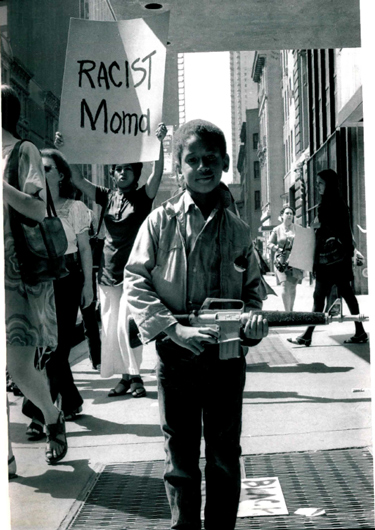 © Jan van Raay Son of Tom Lloyd with a toy automatic during the MOM picket by the coalition of art workers in 1970
In academic and public spaces, such as a personal inspection compartment at the airport, it is considered necessary to clarify whether you are a woman or a man. (Perhaps the agent? “Gender -neutral” restrooms, binding on many universities, are former disabled restrooms, next to which an additional icon has just appeared.) The idea of gender uncertainty, which does not depend on you outwardly, has become the norm and sets this social standard. How is it better to contact you - is he or it? One cannot help but answer this question, forcing the interlocutor to guess in your appearance and thus subjected the threat to get into trouble and experience awkwardness or involuntarily violate official instructions. But no one will ask what kind of race you are. Unlike the Gender, regarding the non -obviousness of which art and the Academy converge, the race continues to function at the level of visible - it cannot be noticed and cannot be covered (there are those who manage to blur their race - but this may turn into accusations of alien oppression and profit from it). Perhaps it is precisely because of this visibility and disorder that the conversation and even thoughts about the race in America seem to be much more dangerous and slippery territory.
Is there another way to determine the oppressed group, obviously painted in black, except by color feature?
Actually, this is a note about Biennale Whitney , who is now in New York. Whitney shows art-Issue-American. Those artists who have not yet become and, perhaps, will not become recognized by artists-for-frenzy-consumption. What they do is almost always connected with the American agenda - the curators themselves in the entrance essay to the catalog are talking about software Americanism. This is understandable-police violence against blacks and the Black Lives Matter movement instead of the migrant crisis, the abolition of Obamacare instead of hard savings, ku-klux-club instead of right, instead of colonialism, Trump instead of Erdogan, Afrofuturism instead of socialist utopia, civil war instead of the French Revolution; epidemic of gunshot murders instead of military conflicts with neighbors; Ultranasilia or simply magnificent visual nonsense, sometimes based on an explanatory critical basis, reinforced by virtual reality or picturesque effects, instead of eternal extraction. There are things that are nonspecific-projects for manipulation with a private culture financing system, complex speculative video historians about anthropocles, stereo, schizoinstal from tiny furniture, a utopian-economic project about an interactive acting female cooperative, on the lines of the land in the Serbia, represented in the Serbia, represented in the Serbia, represented in the Serbia, represented in the Serbia, represented Exposition of a mirror prism with snakes, distributing to everyone who wants Wi-Fi and access to the cooperative website. But still, the principle of equivalence and replacements will not help to understand what American-art-art-American is.
Outside America, American art is something completely different.
Whitney takes place in New York, but it is important for me to start this story with Chicago. From him I began to recognize American art in America. Outside America, American art is something completely different. From the inside of America, Frank Stella and Mark Rotko can be considered American artists only in the case of their black monochromes. The fact that such an understanding has become part of the American consensus about art, including abstract, consensus, which curators cannot ignore are the result of the directed efforts of black art historians, artists, theorists and activists. For several decades, they persist in the fact that some colors are not just colors, and some things in the world are not converted into a metaphor and cannot be understood in a figurative sense. The orientation and, most importantly, the success of this effort to rewrite the entire Western Art project, where racial studies were largely based on the methodology of feminism, cannot but admire. In this discourse about art, the word “appropriation” often has a different nature than for Jeff Kuns (no, it is not at all representative for American art within America). Property-theft for anarchists, and for separatist-minded black theorists of the theoretic, any appropriation of black-African art in modernism, black pop culture and African exotic in postmodernism. At first it reminded me of paranoia, now it seems to me that there is a political meaning in this. I mean, the meaning for the social group - but not for an individual subject. Western art, these theorists say, only does what is borrined, but does not want to be proper. They read the concept of cultural borrowing directly and economic, stubbornly returning it to him the literally aggressive meaning of the assignment. Where the main (that is, white) history of art reads in a figurative sense, the black history of art insists on literal reading.
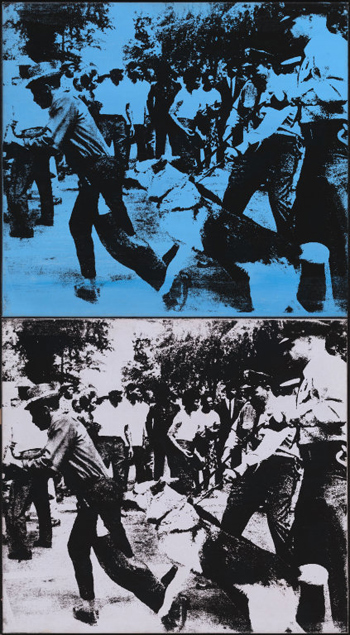 Andy Warhol. "Little Race Enjoy", 1964. Collection of the Chicago Institute of Arts
Disassembleing Andy Warhol’s series “Death in America” [1] in 1990, in the midst of postmodernism, the Black Artist of Art Michelle Wallas says that in the Warholovsky method the production of “images”, which depreciates the terrible, passing it through the media filter, the hitch occurs exactly in the place with electric stools, poisoned conservation and consumer conservation and consumer conservation and consumer conservation A car accident is placed "racial riots." This work of Warhol is hanging at the Chicago Art Institute. Walllas claims that a photograph of the black demonstrator at which the police dog is thrown is knocked out of a number of static Warhol objects. This is not a devastated iconic sign, but a “plot historical picture”, and the story is happening now, the plot unfolds in reality, and the image is not separated from its referent, directly referring to current violence. The race is not allegizes, says Walllas. It seems to me that this is a paradoxical statement - the key for the entire project of black reselling the history of American art. It is incredibly moralistic and, as it were, from the principle ignores the knowledge that was acquired in the twentieth century about the unconscious and language. It ignores the psychoanalytic idea of the subject. Psychoanalytically speaking, the race is not a category equivalent to the floor. The race, as a color of the skin, that is, as an imaginary quality that defines a certain imaginary community, belonging, or, conversely, rejection, must nevertheless lead to a symbolic, that is, to the meaning, unique to a single mental history and not separated with any community, clan, clan or community. Somewhere a word should arise, in other words, the race should be metaphorized . Only then will personal psychoanalysis be possible for the subject designated in racial discourse as one of the black, but included in the analysis as a single subject represented through the language. It is here in the doctrine of the black history of art and black criticism that I described is a fundamental political rejection of allegorization (this term uses Walllas, but it will be more convenient to replace allegory with a metaphor). The black body is not covered with the meaning, does not finally pass into the plane of the tongue or image, just as the work does not function in this system of thought and in this public space separately from its race of a certain author. Hence the eternal clarifications - a white artist, a black poet. The black body is always here, always subjected to violence. This determines the attitude to the visual.
The dismemberment of an integral image in modernism with the help of cubistic crushing or expressionist smearing was presented as equivalent to real violence, which is made by a masculine artist-modernist over the woman's body.
When, as a result of X -ray studies, it was discovered that under the colorful layer of the “black square” is the inscription “The Battle of Negro in the Black Room”, the only thing that was worried about the Russian press and art historians, this is the question of plagiarism and the porcine status of the invention of Malevich. The article by the artist Hannah Black about the inscription under the “black square” interpreted the discovery just in the spirit of feminist criticism of the modernism of the 1970s-as evidence of structural racism, laid down in high modernism with his desire for purity. The idea that for Malevich the word "Negro" did not refer to any social subject from the surrounding reality, for Black, nothing changes. The status of absolute blackness is important, expressing the “absolute freedom” of a white universal subject, at the time of birth of which the mention of another is erased, “racially and genderly defined by the subject”, whose predicate it was originally [2] .
It may seem that in this persistent letterwalk there is something from the familiar idea of insulting the feelings of believers. The idea of insult also arises from the idea of non -metaphorization of some images that supposedly never become simply meaning, always maintaining a connection with their referent. Icon - this is God; Black is the black body of a slave, which today continues to be subjected to slave -owning violence. When you insult the icon, you supposedly insult God. God in this sense as a Mother: after all, if they swear a mother, some accept it at their own expense and meet physical aggression, perhaps because they know that it was they who pulled their mother into this story. This blood ancestral paranoia (“And if you were dented on the grave of your parents?”), Through which nationalist and conservative affects are also connected, motivates activists who are flushing exhibitions in Russia and Ukraine.
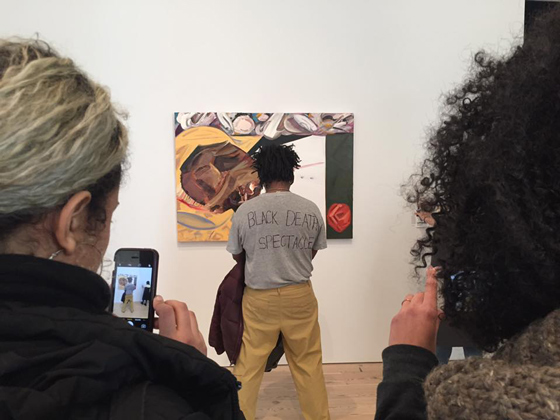 Artist Parker Bright before the picture of Dana Shutz “Open Coffin” on Whitney-Biennale, 2017
But what is the essence and difference between the actions of the Black Artist Parker Bright, who comes to the Biennal Whitney and the blocked the picture “Open Coffin” by the artist Dana Shutz (the white and commercially popular artist, I must clarify), who is in a spectacular neoexpression manner, on the verge of complete decay of the fine motive, writes the deformed face Tilla? The difference lying on the surface lies in the fact that it produces a counterford in which the crossing out of the work is articulated as a phrase and invention, and does not destroy this picture and does not smash the exhibition.
Emmett Till is a martyrdom of the movement for black liberation, and he, of course, is not the touchy God whom we know in Russia, and not offended Mother. But something, nevertheless associated with bloody, even archaic-tribe, with ancestors and rituals, relations inside the black community, which are not tired of fantasize the academy and art, is definitely left.
The fat color layers of paint, as if swollen where the mouth is expected, in the place of which is a deep gap, made in the thickness of the oil, convincingly convert picturesque matter into deformed flesh, and then, on the contrary, they make you see the raped flesh as a picturesque surface. The success of this picturesque technique is the most unpleasant in the artist’s work. In exaggerated picturesqueness, the provocative essence of the picture based on a visual document, the widely known in America, photographs of a dead black teenager from Chicago , tortured and mutilated by two white men in 1955 in the city of Mani, Mississippi, where he stayed with his relatives. These men suspected him that he molested one of them to his wife, stole from home and beaten to death, and then drowned in a local reservoir, according to some versions, having previously castrated. This detail is important because the reason for the lynching in the 19th and 20th century was often suspicions of the encroachments of black men on white women, and Lynch courts were accompanied by posthumous castration and had a bright sexual bulk. The story of the murder of Emmett Till was one of many, but she made her legendary an act that the boy’s mother, Mami Till, made her. She brought his body home, in Chicago, and put him in non -surmable for public farewell, in an open coffin. Pictures of the body were widely published in the Black Press and gave impetus to a new wave of black resistance.
The black body is always here, always subjected to violence. This determines the attitude to the visual.
The favorite technique of American feminist art historians of the 1970s was in the rhetorical equalization of images of female bodies and bodies of “real”. The dismemberment of an integral image in modernism with the help of cubistic crushing or expressionist smearing was presented as equivalent to real violence, which is made by a masculine artist-modernist over the woman's body. “Picasso loved to cut women into pieces,” they said. This rhetorical literalism in its work is also used by Dana Shutz, but only on the contrary - expressionistic violence over a thick colorful substance as a well -readable metaphor of mutilated, decaying flesh borders on unprincipled and tastelessness, but it was this quality that made many return to the issue of Emmett Tilla and who and what has the right to use it in today's America, as well What is the status of a black body in today's world.
The activist artist, who blocked the picture with his body for several days after the opening, was a sweater with the inscription “Black Death Spectacle ). Obviously, he did not want to allow the White public to enjoy this high -quality painting, sending to a terrible body and his open wound. Since in the early 1990s, technologies of video shooting and external video surveillance have become finally available, records with police violence over black ones have become increasingly broadcast-today they gain millions of views and partly stimulate the Black movement Lives Matter . But video technologies that allow you to see racial violence with your own eyes and analyze its visual nature, so far have little affected its statistics.
Who should belong to the right to identify with the victims and enjoy them? Enjoyment of identification with a black victim and projecting his fantasues on it is not only a white sin. The canonization of their own martyrs is not much different in this regard.
 Picture Given Shutz "Open Coffin" on Whitney Biennale, 2017
The arguments that the work raises questions and causes a discussion, the activist rejected the activist. Everyone who wanted to photograph the work was forced to photograph his back with the phrase about the performance of black death. В письме к биеннале Уитни Ханна Блэк, та же, что писала о расистской природе «Черного квадрата», предъявила требование не только снять картину «Открытый гроб», но и уничтожить ее, не дав белой художнице Шуц коммерчески и символически извлечь «прибыль» из зрелища черной смерти, даже если ею якобы двигал «белый стыд». Это требование не было выполнено, но оно и было очевидно риторическим: изображения картины мгновенно распространились в интернете, и вряд ли целью активистов было требовать права на забвение. Чуть позже в интернете было опубликовано поддельное письмо , в котором Шуц якобы приносила извинения, обязуясь изъять картину из коммерческого и медиаоборота и никогда более не выставлять ее. Кроме того, от имени Шуц сообщалось, что определенный процент своих заработков она будет отчислять на движение Black Lives Matter . Текст письма не встретили с восторгом даже черные критики и художники : Шуц и не думала извиняться, но, вкладывая в ее уста эти униженно-формальные слова, которые они ожидали бы от раскаявшейся белой художницы, анонимы буквально заткнули ей рот.
Именно с Эмметта Тилла передо мной стало разворачиваться американское-искусство-изнутри-Америки. Еще до того, как открылась Уитни, я увидела в Чикагском музее современного искусства работу 2005 года местного художника Джейсона Лазаруса, которая называлась «Стоя на могиле Эмметта Тилла, день эксгумации, 1 июня 2005 года». По правде говоря, эта работа выглядела как одна из тысяч постконцептуальных фотографий, которые работают с фронтальным ракурсом, заурядностью пейзажа и архитектуры, индексальностью фотофакта и — отсутствием непосредственного объекта, на место которого приходит собственно место. Но, в конце концов, это просто метод и медиум, как и живопись маслом, а особенной эту работу, как в случае с картиной Шуц, делал Эмметт Тилл, вернее, его тело, историю которого я тогда не знала. Его тело отсутствовало на фотографии, поскольку снят был момент после того, как гроб вынули из могилы (художник вроде бы опоздал на эксгумацию, которую затеяли потому, что в деле появились новые доказательства). В тот момент, когда в медиа снова вспыхнул интерес к этой истории (о которой не то чтобы забывали, особенно черные художники и теоретики визуальной культуры, в 1990—2000-х обращавшиеся к ней снова и снова), это был неожиданный способ говорить о теле Тилла — не возвращаясь к тем ужасным снимкам, собственно, к зрелищу тела.
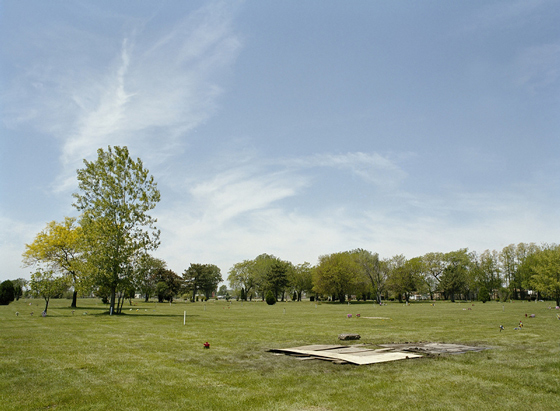 Джейсон Лазарус. «Стоя на могиле Эмметта Тилла, день эксгумации, 1 июня 2005, Элсип, штат Иллинойс», 2005
При всей постконцептуалистски-привычной выхолощенности и заурядности политически снимок оказался максимально заряженным. Изучив историю, которая для Чикаго является городской легендой, сложно не понять, насколько психически и политически инвестирована эта простая работа. Некоторые герои и иконы часто не имеют тут «федерального» значения, они привязаны к городу и его людям, к диаспорам и местам их обитания. Отчасти это результат сегрегированности местной жизни, но одновременно свидетельство силы местных сообществ, залог того, что образ Тилла, его тело, могила, гроб со стеклянной крышкой и миф (в отличие от образа, скажем, Зои Космодемьянской, фотографии мертвого тела которой также были отчасти схожим образом использованы в печати) не становятся со временем пустым идеологическим анекдотом, но продолжают быть весомым (инвестированным) аргументом в дискуссии о расе.
Джейсон Лазарус — как и Дана Шуц — белый художник. Мне до сих не кажется естественным использовать в тексте эти расовые уточнения, но, не сделав их, историю не рассказать. Работа Лазаруса, такая осторожная, хотя одновременно взявшая на себя бремя многочисленных проекций, связанных с телом Тилла, не вызвала заметного скандала. Лазарус ничего не сказал о теле. Интерпретации его работы тем не менее занимают отдельную главу в истории спора о том, кто наслаждается черным телом и кто имеет право говорить о черном — о blackness как онтологической, социальной, визуальной субстанции, вытеснившей категорию класса и даже идеи социального конструктивизма, которые были частью расовой теории в прежние времена.
Мне до сих пор не кажется естественным использовать в тексте эти расовые уточнения, но, не сделав их, историю не рассказать.
Считающийся либеральным (читай, выступающим за интеграцию и создание в искусстве пространства возможного компромисса между маргинализованной чернотой и привилегированной белизной) чикагский (черный) историк искусства Дарби Инглиш пишет, что Тилл как черный подросток и Лазарус как белый художник встречаются в этой фотографии, зафиксировавшей отсутствие тела. Статья называется «Эмметт Тилл отныне и навсегда» [3] . В фотографии Лазаруса Инглиш видит «пространство межрасовой интимности», зону оптимизма. Эту зону оптимизма в своих других текстах он пытается обнаружить, например, в поздней цветовой абстракции, в которую «запоздало», уже после ее «высокого» момента, приходят черные модернисты. В ее универсальном языке они находят альтернативный способ быть «черным художником», не связанный напрямую с идентичностями и «черным реализмом», который считался и до сих пор часто считается уделом политизированных черных художников. Инглиш, как и большинство из тех, кто пишет черную историю искусства, игнорирует иерархию медиумов или первенства исторических моментов. Но при этом он ищет возможности в универсалистских языках, пусть даже запоздалых и изначально сконструированных на «белых» территориях, — такими для него являются постконцептуализм Лазаруса 2005 года и запоздалый абстрактный экспрессионизм 1971-го. Инглиша критикуют за мягкость — и за веру в универсализм, вернее, в то, что черное и черных можно или нужно вписывать в универсалистские модели даже для того, чтобы эти модели перечитать с точки зрения черной истории искусства. Неметафоризируемость тела, о которой говорилось раньше, — тот же отказ от универсализма языка. А именно тело и отсутствует в абстрактном экспрессионизме и фотографии пустой могилы.
В противовес Инглишу с его апологией черно-белой встречи в бестелесном пространстве приводят позицию черного поэта и теоретика Фреда Мотена, который, напротив, настаивает на том, чтобы смотреть и смотреть на жуткие фото мертвого тела Тилла и учиться, глядя на них, слышать блюз — звуки «черного плача» ( black mo ' nin ' ), как он это называет, по убитому. Взамен холодного и слишком теоретичного понятия бартовского пунктума (отношения Барта с матерью, в отличие от отношений с матерью Тилла, не кажутся Мотену достаточно любовными) он предлагает антитеоретичную феноменологию звука — черной аудиальной чувственности, как бы несводимой к абстрактным понятиям белых философов. В главе своей книги «In the Break» [4] Мотен говорит про красоту этих страшных снимков, на которые следует смотреть не с исследовательским интересом, а с любовью. А заканчивает историей про похороны своей родной тетушки — под звуки громких стонов и рыданий, которые издают черные плакальщицы. Тилл для него — та самая кровнородственная фигура, отношение к которой определяется семейственностью сообществ как основой черной социальной связи. В местном мультирасовом, но статистически клонящемся в сторону белизны академическом и художественном мире Мотен, культурный радикал, поэт-проповедник с почти сепаратистской, подчеркнуто непримиримой риторикой, почитается куда больше, чем Инглиш, которого интерпретируют чуть ли не как белого коллаборациониста. Мотен, важный герой местных визуальных и черных исследований, говорит, что черным следует отказаться от любых ретрибуций, а особенно от признания белыми вины. Их долги перед черными людьми слишком велики, и вместо того чтобы белые, повинившись, открыли бы черным новый кредит, поставив их на счетчик, надо «снести все это дерьмо напрочь». В этом его «черный марксизм» действительно необычайно притягателен. Аболиционизм Мотена — отражение аболиционизма в движении Black Lives Matter , требование которого — не просто прекратить убийства чернокожих (это не сделать анализом белого взгляда), но ликвидировать институт полиции. Это правда — вина не нужна, как не нужна полиция, и дерьмо надо снести, но угрожающий радикализм Мотена функционирует на территории культуры, вызывая куда больше восхищения у крупных культурных институций, университетов и издательств, чем либеральная компромиссность и вера в универсализм Инглиша.
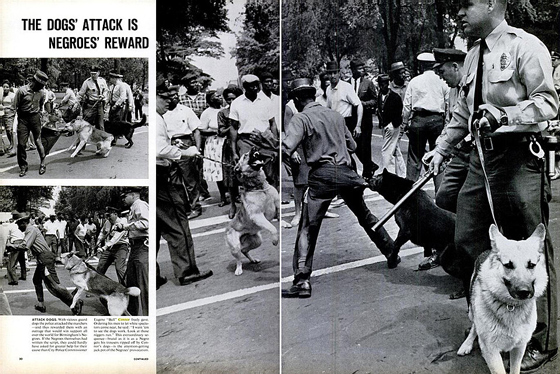 Разворот из журнала LIFE за 17 мая 1963 года
Черная поэтесса Клаудиа Ранкин, как и Мотен, отказывается считать, что между расами достигнут примирительный консенсус, — она говорит от имени «разгневанных черных в пострасовой Америке», критикуя в том числе и идею post - blackness , «постчерноты». Она желает разозлиться, и ей помогает в этом воображаемый мотив отражения и сходства. Она фантазирует о том, что думает о ней белый мужчина : «И что я услышала? “Я не обязан отчитываться перед тобой, черная девчонка”. И хотя, когда я последний раз смотрелась в зеркало, я выглядела как моя черная мать, а не так, как она выглядела, когда была черной девочкой, я подумала о себе словами из стихотворения — черная девочка — и разозлилась еще больше. И хотя я понимала, что это я думала за него, а вовсе не он сам говорил мне это, все же, когда оскорбление на самом деле нанесено, это оскорбление слышно везде, даже в воображении». Это почти буквальное определение воображаемого в лакановском смысле (и когда в этом тексте я пишу о цвете кожи как о воображаемой категории, я имею в виду именно его). Да, угнетение существует, и цвет кожи имеет значение для другого, но сам «черный» субъект ведет диалог с зеркалом, завороженный своей воображаемой идентификацией с образом черной матери, — и слова «белого другого» о «черной девчонке» возникают как фантазм.
Возможно, это тупик, но тупик, заслуживающий большого внимания.
Но что делает это сопротивление, это неприятие того, чтобы свести черное тело к означающему, с которым можно обращаться как с означающим и через него получать доступ к телу? Почему гнев, недиалектически связанный с отражением в зеркале и родственным сходством, а также предполагаемыми мыслями белого мужчины, должен оставаться в воображаемом? Влияет ли настаивание на принципиальной несводимости черного тела в искусстве на насилие над черным телом в обществе? Или все сводится к «позитивной» цензуре?
Возможно, это тупик, но тупик, заслуживающий большого внимания. Можно вспомнить психоаналитические и марксистские максимы: субъект существует за пределами понятия об идентичности, какой бы уникальной и ненормативной она ни была, цвет кожи — воображаемая категория, хотя и играющая роль в социальном конструировании различий, нет коллективной памяти предков, сообщающей потомкам о наследственном опыте рабства, как нет коллективной психики и бессознательного, потому что для них нет общего носителя; зато есть коллективное знание — дискурс со всеми его биологическими и техническими носителями, и этот дискурс действительно может быть параноидальным по веским причинам; знание о том, что черный человек с большей вероятностью может подвергнуться насилию — как говорит та же Ранкин: «Когда ты черный в Америке, надо следить за движениями, жить так, чтобы то, что белый взгляд проецирует на твою черноту, не оборвало твою жизнь, так что вечно думаешь: стоит ли идти по улице ночью? Можно ли держать в руке Skittles ? Можно вынуть мобильный? Если он случайно сверкнет в темноте, не подумает ли кто, что это пистолет? Когда уже я смогу просто быть?» Она намекает на случаи немотивированных убийств чернокожих, основанных на подозрениях, заключенных в «белом» взгляде, и на деталях, которые спровоцировали эту паранойю.
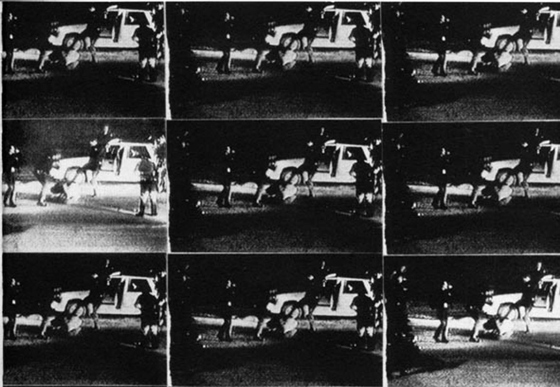 Дэнни Тисдейл. Из серии «Катастрофы». «Избиение Родни Кинга полицейскими», 1992
Рабство в Америке было отменено в 1865 году, на четыре года позже, чем крепостное право в России. Рабам были дарованы свободы — ведь начиналась массовая индустриализация, и вместо сельскохозяйственных рабов странам нужны были города и заводы, не закрепленные на земле крестьяне, а рабочие. В Америке не было Октябрьской революции, и бывшие рабы, хотя и постоянно прибавляя в юридических правах и гражданских свободах, становясь «полноправными гражданами» («Гражданин» — ироническое название книги стихов Ранкин), оставались и остаются наиболее экономически угнетенной и социально незащищенной группой, которая так никогда и не размылась и не смешалась с белым населением. Сегрегация, которую видно на уровне цвета и концентрации тел в пространстве, не даст забыть о том, что у угнетения сегодняшнего дня был генетический источник в иной экономической формации, основанной на акте фундаментального насилия.
Бывшие крепостные в России, которых не вывезли из далеких стран, а закрепили на собственной земле, никак не отличались цветом от своих крепостников, но, не случись революции, составили бы такую же печальную основу «нормального» капитализма, который якобы так и не был построен. Сейчас сложно сказать, кто из тех, кто угнетен в России, является прямым наследником рабов и кому следует требовать ретрибуций от нынешнего порядка. Критерий исторического генезиса и общинной травмы, запечатленной в теле, в этом случае не годится.
Бывшие рабы России не помечены цветом, который бы послужил основой для их взаимной идентификации и солидарности. Вряд ли русский национализм можно считать подходящей заменой. У них нет повода говорить о травме рабства, о том, как их отцы подвергались символической кастрации, поскольку помещик обладал правом первой ночи; как у матерей отнимали детей, о кровавых сценах порки, которая навсегда запечатлелась в их глазах и стала основой их идентичности. У ужаса невольничьего тела, описаний которого достаточно и в русских источниках, нет наследников — все слишком далеко, и никто не скажет, что его Эдип сконструирован через рабскую позицию их праотцев. Кажется, это могло бы помочь найти другие пути для солидарности — но этого не происходит. Можно перечитывать Некрасова, но это не так распространено, хотя еще долгое время после Великой Октябрьской революции он оставался важным автором. Теперь единственной объединяющей травмой делают коммунизм. В наиболее распространенной (либеральной) интерпретации эта травма расово и этнически не окрашена, и это не дает заметить цвет угнетения в текущий момент: мигранты также отмечены цветом, часто это оранжевый цвет спецовок. Но в России он виден контрастнее, чем в Америке, где к черному — справедливости ради — добавляют целый спектр коричневых, хотя помыслить современную трудовую миграцию в категориях цвета куда труднее, чем переходящее от феодализма к капитализму рабство.
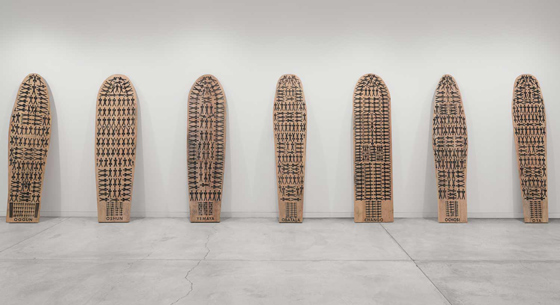 Мария Магдалена Кампос Понс, «Семь сил прибывают по морю», 1992. Работа, основанная на реальных планах размещения рабов в трюмах
В Америке, в том числе в музеях, школах, университетах и на биеннале, продолжают говорить о судах Линча, о трюмах кораблей, в которых везли предков сегодняшних жителей гетто, о коже, которая всегда выдает раба или потомка рабов и сигнализирует одновременно о его беззащитности и исходящей от него угрозе. Исследователи расы и визуальности подливают масла в огонь — заклинание раны, запечатленной в коже, поддержание неметафоризируемого статуса тела оказываются для академии и искусства важнее социальной критики. Но правда и в том, что социальная критика и культурный анализ, которые игнорировали бы черноту тех, кто угнетен, были бы слепыми.
[1] Michele Wallace, «Modernism, Postmodernism and the Problem of the Visual in Afro-American Culture» in «Out There: Marginalization and Contemporary Culture» (Ann Arbor: University of Michigan Press, 1990).
[2] Hannah Black. Fractal Freedoms, Afterall, 41. Spring/Summer 2016.
[3] Darby English, «Emmett Till Ever After» in «Black is Black Ain't» (Chicago: The Renaissance Society, 2013).
[4] Fred Moten, «Black Mo'nin' in the Sound of the Photograph» in «In the Break. The Aesthetics of the Black Radical Tradition» (Minneapolis: University of Minnesota Press, 2003).