
Translated material
“Memory of blood. Autobiography"
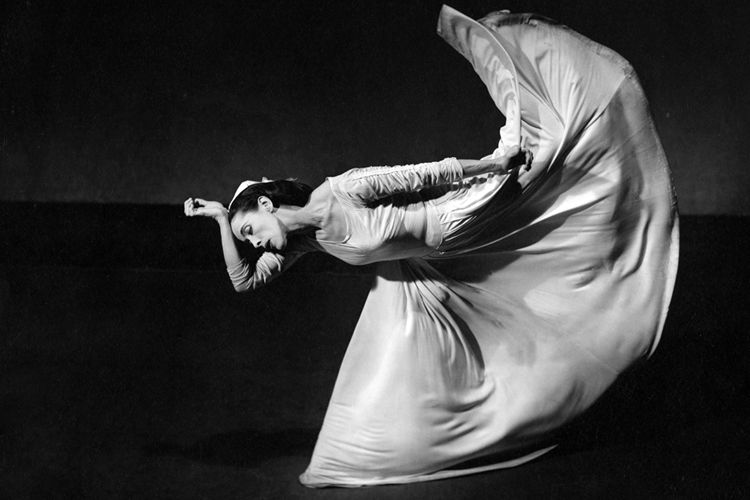
For the first time in Russian, an autobiography of the legendary dancer and choreographer Marta Graham (1894-1991) is released. “Blood Memory” opens the new Garage Dance series Museum of Contemporary Art “Garage”, dedicated to the history and theory of modern dance (compiler of the series - Vita Khlopova). The presentation of the publication will be held on Saturday, May 20, as part of the Garage Art Book Fair art fair. Today we publish a fragment of the book, kindly provided to the editorial office of the Museum of Contemporary Art Garage and the publishing house Artguide Editions.
The text is printed in the source.
I am a dancer.
I believe that we are in practice. It doesn’t matter if we learn to dance by dancing, or learn to live in the process of life - the principles are the same. In the dance and in life, the implementation of a certain set of physical and intellectual actions leads to success, a feeling of own being, and calm the spirit. A man becomes an athlete of God.
To train in something means to fulfill a certain act of Vision, an act of faith and an act of desire, despite any obstacles. Practice is a way to open the door to perfection that you strive for.
The dance has always had a magical impact on the world, and, it seems to me, the reason for this is that it is a symbol of the performance of life. Even now, when I write, the time has already begun to turn today into yesterday - into the past. The greatest scientific discoveries will change over time and, possibly, will become outdated. But art is forever, since it reveals the inner landscape of man - his soul.
I often hear the expression "dance of life." It touches me very much, because the instrument by which the dance speaks is the same by which life lives is the human body. Thanks to this instrument, the primary history of life becomes visible. He retains in his memory all the issues of life, death and love. The dance seems spectacular, simple, delightful. But the path leading to paradise achievements is very difficult. Fatigue is so strong that the body screams even in a dream. At times, a feeling of complete hopelessness comes, small deaths happen every day. Then I need all the consolation that practice has preserved in my memory, resistance in faith.
To grow a mature dancer, you need about ten years. This is a double training. First, studying and doing craft is going on - this is a school that helps strengthen the muscle structure of the body. The body is formed, disciplined, you begin to experience respect and trust over time. The movement becomes pure, accurate, expressive, truthful. The movement never lies. This is a barometer talking about the state of the soul to everyone who knows how to read his testimony. This can be called the law of the life of a dancer - a law that controls his external manifestations.
Then the cultivation of the creature begins, from which everything you want to say will come. It does not appear just from nowhere, it arises from great curiosity. The main thing, of course, is that only one you exist in the world, there are no other such and, if you do not realize, something will be lost. Ambitions are not enough; The need is what is important. Through it, legends about the travels of the soul are told - with all their tragedy, bitterness and the sweetness of life. It is at this moment that the unceasing course of life picks up the personality of the contractor and, as the greatness of the personality grows, the personal is becoming less personal. And grace appears. The elegance born of faith ... faith in life, in love, in people, in the act of dance. All this is necessary for any performance in life, magical, powerful, rich in meaning.
The dancer is revered to such forgotten things as a miracle of beautiful little bones with their elegant power. The thinker will revere before the beauty of an attentive, collected and clear mind. Everyone who goes on stage is known about a smile that is part of the technique or a gift of acrobat. We all go through the rope of circumstances. We, like acrobat, are aware of the power of attraction. Acrobat smiles, because at that moment he lives. He does not choose a fall.
At times I am afraid to walk on this rope. I'm afraid to go to the unknown. But this is part of the process of creativity and performance. This is what the dancer does.
 © Garage
People asked me many times why I chose the fate of the dancer. I did not choose her. I was elected to become a dancer, and you live with this all my life. When a young man or a girl ask me: "Do you think I need to dance?" - I always answer: "If you ask this question, then no." You can start this career only when you have only one way to revive life for yourself and others ... You will learn the miracles of the human body, because there is nothing more wonderful. When you look in the mirror next time, just look at how the ears are planted on your head, how the hair growth line goes, think about small bones inside your wrist. This is a miracle. And the dance is the triumph of this miracle.
I feel that the essence of the dance is the expression of man, the landscape of his soul. I hope that any of my dance opens something about me or about the wonderful creature that a person can be. The dance opens the unknown - myths, legends or rituals that return our memory. This is an eternal pulse of life, absolute desire. At rehearsals, and we have them every day, there are dancers, especially men who cannot stand motionless. One dancer in my troupe simply cannot help but move, he does not know how to differently. It seems that sometimes he does not know what exactly does, but this is another question. The essence of his inner life encourages him to dance. He has this thirst. Each dance is a kind of temperature schedule, a heart rate graph. Thirst is a wonderful thing, dance is born from it.
During the rehearsals of the new ballet, I arrive every day shortly before two in the afternoon and sit alone in the hall to sit a little in silence before the dancers arrived. I tease myself: they say, so I cultivate my Buddhist essence; But in fact, I am just very good here: I feel confidence, clarity and expediency. It was these elements in this order forced one writer to call the dance “majestic human behavior”. I sit with my back to our large mirrors to completely immerse myself in myself. In the hall is a mess; We are soon leaving on tour. Near the boxes for transportation are the works made for me to Isama Noguchi, which we will take with us, on them stencil inscriptions: “Spring in the Appalachian Mountains”, “Herodia”, “Night Journey”.
For me, this hall with worn floors and doors opening into the garden is a whole world. When Lila Eichson Wallace showed me in 1952, he became a guarantee for me that I will have a house and work. Lila was a great man. She understood the divine excitement of the Creator and found a way to provide support and at the same time not to make you feel awkward or in debt to her.
I will never forget how I first came to visit her in Hai-Vinds. We were sitting at the dining table, and Lila saw from a beautiful golden cup, donated to her by the Egyptian government; She said that he was from the tomb of Tutankhamun. Lila's husband, de Witt, looked at me: "So you are a dancer!" He raised his hand above my head and asked: "Can you get your hand to my hand?" It was an official reception, and I had a dress from Dior. I replied: "I can, but not in that dress." In this hall, memories of Lila often come to me, who visited me here and endowed with the light of her friendship; And other memories too. They say that the energy, once created and entered the world, cannot disappear, it can only change. Maybe that's why I feel so many traces of the presence of people in this room.
Outside the doors of my hall, in the garden, there is a tree that has always been a symbol of life, and in many ways it is also a dancer. When I entered here, it was still a one -year -old shoot, and although the wire of the gate blocked his path, it stood on its own and rose to the light; Now, thirty years later, this is a tree with a thick barrel, inside which wire has grown. As a dancer, it stretched to the light and now carries the scars of this path. You overcome obstacles, work, achieve the result. You embody curiosity in yourself, use the thirst for life - it doesn’t matter for evil or good. The body is a sacred robe. Your first and last robe in which you come to life and in which you leave it; It is necessary to treat him with respect, joy and at the same time with trepidation. And always bless it.
They say that the very first types of art were dance and architecture. The word "theater" was a verb before becoming a noun - first an action, then a place. This means that in order to interact with another person, you need to make a gesture, real effort. And you also need a tree to hide from the storm or the scorching sun. There is always such a tree, this creative power, and there is always a house, theater.
Trees can be the most beautiful things in the world, especially without foliage. There is one tree by the road leading through the central park from east to west. Every time I go there at different times of the year, it changes. Without foliage, it is old and piercing, similar to my favorite work “without a mask”-about an old woman, once very beautiful. Each time, seeing this tree, I welcome its strength and secret.
The spine is a tree of the life of your body. Through it, the dancer interacts with the world; His body talks about what the words cannot say, and if he is clean and open, he can make his body a tragic tool.
In our hall, I feel this tension, the power of the body in its calm and movement. Once a stream fled in this area, and I believe that his water is still hidden in the ground. The Greeks felt that next to the source, the embodiment of the stream of life, the goddess lives, who could be peaceful or offended. At times, a strange force is felt under our building. In our hall, right next to the piano, a sprout broke through the floor. This is another world, and we accept it as a gift.
I am absorbed in the magic of movement and light. The movement never lies. This is the magic of what I call the cosmic space of imagination. There is a huge space of space, distant from our daily life, where, it seems, at times wanders our imagination. It may or not find another planet, but it is this search that the dancer is busy.
There is also inspiration. Where does it come from? In most cases, from the excitement of life. I draw inspiration in the variety of wood shapes or rowan on the surface of the sea, in the poem, looking at a dolphin that cuts the surface of the water and floating in my direction, in everything that revives me right now. True, I do not know, to call it inspiration or necessity. Sometimes inspiration comes to me from people; I get a lot of pleasure from them and most often I feel that it is mutual. I just love people. Not everyone separately, but I love the idea of pulsation going through them - the pulsation of blood and movement.
In all people, especially in dancers, with all the power of their lives and bodies, the memory of blood speaks. Each of us inherited the blood of the father and mother, and through them - the blood of their parents and parents of their parents, and so in the depths of centuries. We carry thousands of years of this blood and her memory. How else can instinctive gestures and thoughts come to us when we are not ready for them and do not expect them? Maybe they come from the depths of the memory of the time when the world was still chaos, when, as they say in the Bible, the world was still nothing [1] . And then, as if through the ajar door, light appeared. He highlighted wonderful things. He highlighted terrible things. But it was light.
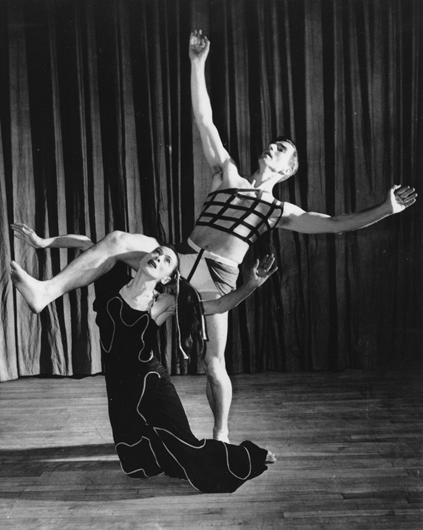 © PBS.org Marta Graham and Eric Hawkins at rehearsals in New York, 1950
William Goyen wrote in the novel “House of Breath”: “We are carriers of lives and legends - we have known invisible frescoes on the internal walls of our skull.” Often the dance is created thanks to the desire to find these hidden frescoes.
In Burma, during our second tour of Asia in 1970, I was asked to lay flowers to the grave of the Burmese unknown soldier. The ceremony was attended by our ambassador and Minister of Culture of Burma. When I laid the flowers, a membrane rose, they spoke at once. The Burmans wanted to know who taught me: I did everything absolutely correctly, with steps and gestures, appropriate for the Burmese woman of my age and position. No one taught me. Like no one taught Ruth Saint-Deni, how to touch the generations of the dance of East India in order to find the true path and spirit for his solo that were lost even by the Indians themselves.
To do this, you need to clean your vessel cleanly - your mind, your body; So say the masters of Zen to students who become too self -wisdom, too deep into the theory and numerous thoughts. They ask them: "All this is fine, but did you wash your bowl?" After all, the Buddhist students lived by alms, but how can you get the alms if your bowl is dirty? The student is asked if he is ready for the next meal. This is a clear instruction to return to the origins. It is too easy to get distracted by excess.
I think this is exactly what my father had in mind when he wrote to me, who left far from the house: "Martha, you need to keep the soul open."
I cultivate such openness, awareness and innocence in my dancers. Although, as the Latin verb educere tells us, it is not a matter of investing something inside, but the issue of extracting out of what was laid from the very beginning.
When a rehearsal begins, I will mention this sensitivity and openness. Dancers will come here with my assistants Linda Hoods and Ron Protas, whom I taught years to look after my work and who entrusted the future of my troupe. Linda came to me a child, studied with me and danced with me on stage. Ron is with me for twenty -five years, I taught it to my technique. He deeply understands the roles that I created, and intuitively knows what I want. The rehearsal always lacks one or two dancers-someone has an injury, a rehabilitation period, this is a common thing. Dancers are now able to do everything, their technique is phenomenal. But the passion and meaningfulness of movements is another.
Sometimes I tease the dancers, saying that today they seem to not shine too much that jumps showed out their brains. Nevertheless, they move with grace and a kind of inevitability, some are more powerful than others. The moment of rehearsal is a moment that cares for me. This is the present time of my life.
The only thing we have is the present. You start from the present, from what you know, and you move into the past, in the ancient one, which you did not know, but you find on the way. I think that the past can only be found in yourself, in what you live in the present, what is part of your life now. We do not know anything about the past, except what we open for ourselves. And we open it in the present. Looking into the future is like sitting in a rocking chair. It relaxes, and you can sway back and forth on the porch, never moving forward. This is not for me. People sometimes ask me if I am going to retire, and I ask them: “To retire? But where to go? " I do not believe in a pension, because this is the time of dying.
The life of the dancer is not at all simple. She is relatively short. I am not an example here, but since a certain age I could no longer do certain things. Old age is a terribly unpleasant thing. I did not want to age because I did not understand that I was old. I feel that this is a load and a terrible burden that I have to endure. Old age cannot be cherished, you can not love her. This is a difficulty that must be taken out in all possible ways.
When I stopped dancing, this was not a conscious decision. I realized that I have no power or ability to penetrate the inner world and soul of the dancer. Even earlier than I started dancing, I trained myself - standing in front of the clock, I did four hundred jumps in five minutes. Today I can't do so much! I am furious because I can’t do this. I did not want and still do not want to stop dancing. I always wanted to have a simple, straight, open, clean and beautiful life. That was my time.
I always hear the steps of my ancestors behind my back, they push me when I create a new dance, and their gestures flow through me. It doesn’t matter whether they are good or bad, they are part of my family. You reach a point in which your body becomes something else, it carries a whole world of cultures of the past, an idea that is very difficult to express in words. When I create a dance, I never put it in words. This is a pure physical risk that you long to go and have to go. The ballet that I am creating now is also a risk. This is all that I can say about him, because he is not finished yet. I do not let anyone watch him, except for the dancers with whom I work. When they leave, I am left alone with the steps of my ancestors.
Once upon a time I heard somewhere that after the death of El Greco, an empty canvas was found in his studio, where only four words were written: "Nothing pleases me." I understand him.
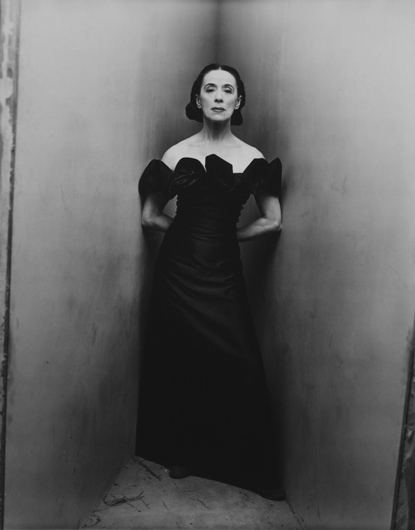 © The Irving Penn Foundation Irving Penn. Marta Graham, New York, 1948
Sometimes it seems to me that it's time to stop. I recall the image of the swan by Mallarm, a beautiful swan, who remained in the water for too long in the winter, and the ice hit his paws, caught a trap. Sometimes I think I am here too long. Maybe I'm just scared.
Американские индейцы верили, что жизнь идет повторяющимися циклами смерти и возрождения. Интересно, начинаю ли я новый цикл или это просто депрессия, которая является частью любой деятельности. Она — часть славы и часть неизбежности, а также часть неведомого.
Я провожу репетиции и даю уроки. Когда могу, я путешествую вместе с моей труппой, сижу в кулисах, обычно с Роном, и делаю замечания, которые он записывает в желтый блокнот. В зрительном зале Линда и еще один репетитор делают то же самое. Потом танцовщики слушают эти замечания.
Когда танцовщики сделали все как надо, я так им и говорю. Но иногда они искажают форму спектакля. Они отступают от формы, воспринимают ее слишком свободно, и мне приходится говорить «нет». Я провожу репетиции, показываю, даю уроки. Все это сводится к следующему: если что-то подписано твоим именем, ты должен в этом участвовать.
Есть еще одно жизненно важное дело — поиск денег. This is necessary. В современном мире ты ничего не можешь без денег. Ты можешь мечтать, у тебя в душе могут быть образы, но без средств ты не сможешь воплотить их в жизнь. Я не могу отдыхать, не зная, запишут ли мои работы на пленку, сохранят ли их, сможем ли мы выплатить ипотеку за наше здание. Ни Хальстона, ни Лилы уже нет со мной, они больше не помогают мне. И лишь Мадонна, одна из моих прежних студенток, вошла в нашу жизнь, поговорила со мной и сказала, что мы найдем способ справиться с этими проблемами.
Временами я возвращаюсь в мой дом рядом со школой после особенно сложного занятия и удивляюсь, куда делись вся моя живость, ощущение волшебства моего тела. Я думаю обо всех странных событиях, которые со мной происходили. О некоторых мне рассказывали родители, некоторые я помню сама. Кажется, я всегда чувствовала огромное любопытство по отношению к жизни, к действиям других людей, других существ. Об этом когда-то сказал Эмпедокл: «Был уже некогда отроком я, был и девой когда-то, был и кустом, был и птицей, и рыбой морской бессловесной» [2] . Другими словами, капли памяти этих прошлых личностей текут сквозь меня — не реинкарнации, не превращения, ничего такого. Я говорю о божественности памяти, фрагментах памяти, о необычайно ценных вещах, которые мы забываем и которые наши тело и ум решают вспомнить... Как у Эмили Дикинсон: «Инстинкт поднимает ключ, что бросила память...»
Чего мне иногда не хватает на занятиях — это небезупречности: некоторые никогда не достигнут идеальной техники. Поначалу я не требую признаков безупречности. Я стремлюсь к жажде жизни, любознательности, ощущению чуда оттого, что ты умеешь двигаться по-настоящему — работать над идеальной первой или пятой позицией. Там начинается возбуждение, жажда, забвение всего, кроме себя. Ты погружен в этот инструмент, резонирующий с жизнью. Великий французский поэт Сен-Жон Перс сказал мне: «У нас очень мало времени, чтобы родиться в этом мгновении». На занятиях мне этого очень не хватает. Животной силы, красоты пятки, которая несет нас вперед в самую гущу жизни. Именно в этом, а не в чем-либо еще, — секрет моего одиночества.
Я совершенно не чувствую себя уникальной, но я согласна с Эдгаром Варезом — и я использую сейчас слово, которое никогда не использую в отношении себя или кого-то еще. Это слово «гений». Варез, чудесный французский композитор, писавший для меня музыку, открыл новые грани музыкальной мощи в использовании перкуссии, я никогда раньше такого не слышала. Он говорил: «Марта, все мы рождаемся гениями, но большинство людей остаются ими всего несколько секунд».
Под гениальностью он понимал любопытство, которое ведет к поиску тайны жизни. Вот что утомляет меня, когда я преподаю, и поэтому мне нужно побыть одной. Иногда на сцене видишь человека, который на самом деле наедине с собой, — это настолько величественно, что заставляет тебя замереть. Мы все обладаем этим даром, но большинство людей пользуются им всего несколько мгновений за всю свою жизнь.
Никогда не забуду один вечер, когда я допоздна задержалась в школе и вдруг зазвонил телефон. Я была в школе одна, поэтому подняла трубку: звонила женщина, чтобы узнать о занятиях для своей дочери: «Она гениальна. У нее есть интуиция. She is unique. Это нужно развивать сейчас». Я спросила: «Правда? Сколько ей лет?» Женщина ответила: «Два года». Я сказала, что мы принимаем только с девяти лет (сейчас мы стали брать детей гораздо младше, в связи с распространением витаминов, компьютеров и домашнего обучения). Она взмолилась: «Девять! К девяти она растеряет всю свою гениальность». А я ответила: «Мадам, если ей суждено ее потерять, пусть лучше это случится в детстве».
Я никогда не считала себя гениальной. Я не знаю, что это такое. Мне больше нравится слово «добытчик» [3] , прекрасный и мощный золотистый ретривер, добывающий вещи из прошлого или из нашей общей памяти крови. Думаю, что каждым своим действием — религиозным, политическим, сексуальным — мы проявляем себя. Для меня это одна из прекраснейших вещей в жизни. Это то, что я всегда хотела делать: показывать смех, радость, аппетит — все вместе — через танец.
Чтобы работать, чтобы чувствовать возбуждение, чтобы просто быть, нужно переродиться в мгновении. Нужно разрешить себе чувствовать, быть уязвимым. Вам может не нравиться то, что вы видите, это неважно. Не всегда нужно оценивать. Но нужно открыть себя для нападения, для возбуждения, тело должно быть живым. Нужно знать, как оживить тело, у каждого свой метод. Вспоминаю великую русскую балерину и педагога Волкову, которая эмигрировала из России после революции и преподавала в Дании. Интересно, что она так никогда и не выучила ни слова по-датски, говорила только на английском. Молодой человек выполнил серию прекрасных прыжков через весь зал. Он посмотрел на Волкову в ожидании заслуженной похвалы, а она сказала: «Это было идеально. Но чересчур эффектно».
Когда танцовщик на пике своей силы, у него появляются два чудесных, хрупких и преходящих свойства. Одно — это спонтанность, которая приходит после годов тренировки. Другое — простота, но особого рода. Это состояние полнейшей простоты, стóящее всего на свете, как писал Т.С. Элиот [4] .
Сколько прыжков сделал Нижинский, прежде чем прыгнул тот единственный раз, изумив весь мир? Тысячи и тысячи, и эта легенда придает нам храбрость, энергию и веру в себя, чтобы возвращаться в зал, зная, что у нас очень мало времени для «рождения в мгновении», но мы будем работать бок о бок со всеми остальными, чтобы еще раз стать единственными. Таков мир танцовщика.
Мой мир танцовщицы видел много театров, много мгновений. Но я всегда боролась с искушением оглянуться назад, вплоть до настоящего момента, когда я начала чувствовать, что сквозь мою жизнь всегда проходила одна линия — необходимость. Греческие мифы рассказывают о веретене жизни, покоящемся на коленях Необходимости, главной богини судьбы в платоновском мире [5] . Вторая богиня прядет, а третья перерезает нить. Необходимость творить? No. Скорее как-то преодолеть, победить страх, чтобы суметь жить дальше.
[1] Библия (синодальный перевод), Бытие I, 2: «Земля же была безвидна и пуста, и тьма над бездною...»
[2] Эмпедокл. Из поэмы «Очищения» / Пер. G.I. Якубаниса в перераб. M.L. Гаспарова // Эллинские поэты VIII—III веков до н.э. — М., 1999. (Здесь и далее прим. ред., если не оговорено иначе.)
[3] В оригинале retriever (англ. «добытчик»), также название породы собак (прим. пер.).
[4] Грэм имеет в виду фразу из поэмы Т.С. Элиота «Литтл Гиддинг».
[5] Согласно греческому мифу, изложенному Платоном, Необходимость (др.-греч. Ананке) — мать трех богинь судьбы (мойр), которых зовут Лахесис («Дающая жребий»), Клото («Прядущая») и Атропос («Неотвратимая»). Лахесис предрекает судьбу человека еще до его рождения, Клото прядет нить человеческой жизни (и изображается с веретеном в руках), а Атропос перерезает нить, обрывая жизнь.
Перевод с английского Веры Щелкиной