
Translated material
Russia, Goodbai
This year, Eurovision was not shown on Russian TV, but it has not become less in our life. Since the 2000s, Russia regularly took part in the interethnic television course of the song and in it, unlike football and the economy, showed stably good results. So over the years, “Camp, funny, idiotic-bright-that is, the best television show on Earth” (as the British TV presenter Teri Vogan described it) has turned into one of the spiritual sea, which every year united the country at the TVs in a single fan manhole. In February 2017, a terrible happened-the SBU banned the Russian participant, the singer with the disability of Julia Samoilova, entering the country due to her speech in Crimea in 2015. Channel One skillfully prepared the PR bomb, prudently selecting the Russian candidate to play the English-language song “Flame is Burning” , written by Israeli authors; But the power of the explosion exceeded all expectations. The flame flared up in earnest. Russian showmen from politics exploded with indignation. Even his regular in Philip Kirkorov demanded to boycott the pan -European competition. Journalists and bloggers, wounded in patriotic feelings, began to call “Eurovision”, the victories on which they recently were proud, only “a parade of freaks and freaks”. The first channel had to abandon the broadcast of the largest European television experience, thereby suffering significant losses and casting doubt on the participation of Russia in 2018. But the Eurovision Song Contesting and the Eurovision Supervision was not lost.
Julia Samoilova - "Flame is Burning"
Appearing in 1956 as a telekonk, which was designed to combine the pop space of post-war Europe, Eurovision always tried to distance himself from the political agenda, but the politician invariably penetrated it. Perhaps the fault is too successful: participation in Eurovision has turned into a symbol of cultural integration with Europe and is perceived as membership in a prestigious virtual club. Formally, to participate in the competition, it is necessary to enter the European broadcasting union, which is its organizer: not only the countries of Western and Eastern Europe are consisted there, but also Australia, Morocco, Egypt, Libya and Syria. In the 1960s, the dictator Franco with all his might sought to get the right to conduct “Eurovision” on its territory in order to demonstrate the connection of Spain with Europe, which turned away from the authoritarian right-wing regime, and achieved its own in 1969 . In the early 1990s, participation in the interethnic television course became for the countries of the former USSR, including Russia, a symbol of farewell to the Soviet past and entering the new world. It is significant that the first of them won the “Eurovision” was won by Estonia , which overtook everyone in the integration procedure with the EU.
In the mid-2000s, the political subtexts of the pop competition lay in the field of tense relations between Ukraine and Russia. In 2005, the Ukrainian hip-hop band Grinjoli performed on Eurovision the “Orange Revolution” hymn in Kiev in Kyiv at once Bagato, but did not achieve much success, taking the 19th place out of 24. In 2007 at the competition in Helsinki, Ukrainian Camp-Verka Verka Verka Verka in the national team in languages from the languages The Euro Queen “Dancing Lasha Tumbai” , in which particularly sensitive ears heard the phrase “ Russia , goodbai”, considered a hint of the “orange revolution” and a farewell with Russian influence. In response to Eurovision, 2009, which took place in Moscow, the Ukrainian singer Anastasia Prikhodko spoke from Russia, who sang on a mixture of Russian and Ukrainian about how “you broke my share and left it on the edge”-and in this heartbreaking ballad, which was cut by Russian shopmakers, it was possible to see the appeal of the tormented by political crises of Ukraine To the "Western partners." The transparent hint of the deteriorating Russian-Ukrainian relations saw in the singer Jamala, who sounded in the last Eurovision School of Eurovision, the dramatic ballad. It was dedicated to the Stalinist deportation of the Tatars from the Crimea, in which the Jamala family suffered, and was clearly associated with the recent attachment of the peninsula to Russia, not recognized by Ukraine and most other countries. Despite the fact that the rules of the competition are prohibited by any political gestures, “1944” sounded at Eurovision 2016 and won. Some Russian politicians considered this the next turn of the information warfare against Russia.
Jamala - "1944"
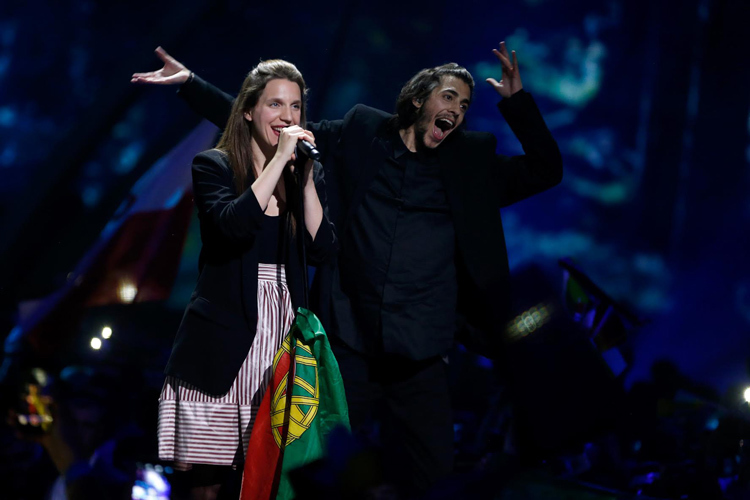
Fortunately, in the winning song of the current Eurovision there is not a gram of politics and reasons for conspiracy theories. The representative of Portugal won the competition - for the first time in the half -century history of its participation. The 27-year-old singer Salvador gathered under the accompaniment of the piano and trembling violins, dressed in a baggy jacket and the most similar to the fucked pop artist, performed in his native language the sad romance of “Amar Pelos Dois” , written by his sister Louise. This song is radically different from the loud Euro-step-by-one, who has established at Eurovision thanks to the successful activities of Swedish composers and producers who make voiced hits-one-days not only for Sweden, but also for Russia and other countries (this year for Azerbaijan, Switzerland and Croatia). Suddenly this year, at the competition, held under the motto of Celebrate Diversity - “Placing the variety”, with the complete unanimity of the audience and the professional jury, the most non -standard (not counting the wild Romanian hybrid of Jodl and rap ) the song that grew out of the Portuguese Fadu. The top was taken not by national prejudices and thought-out PR cords, not shocking artists and circus performances , who were also present in the competition, but a modest melody, reaching the hearts of millions. This proves that the remaining ridiculous and vivid “Eurovision” is not a “parade of freaks and freaks” and at the next competition, which will be held in 2018 in Lisbon, there will be even more cultural diversity and musical diversity. But what will not happen is most likely a song in Russian.