
Translated material
Virgo in trouble
Anita Sargsyan fought with sexism in video games for four years, and Trump supporters - with her

They wrote a lot about Anita Sargsyan in 2015, and Time magazine included it in the list of 100 most influential people of the year - it was a key figure in the so -called gamergate, a high -profile sexist scandal in the video game industry. Then Sargsyan and its like -minded people who opposed the discrimination of women in video games, became victims of bullying from part of the game community. At the end of April 2017, Anita Sargsyan again became the heroine of the news: she completed the project about sexism in games and the new began-about pop culture, politics and social problems. "Medusa" tells what the history of the gamergate is important, to which it led and how it is connected with the victory of Donald Trump in the American elections.
In 2009, Anita Sargsyan, a student at the Faculty of Political Science and Sociology of the University of York, started a Feminist Frequency video blog-a project on pop culture and harmful stereotypes. Three years later, she decided to devote a separate series of video games and how women are presented in them, and launched a collection of funds for the production of the cycle from five videos “Tropes vs Women in Video Games” (“ Trails against women in video games”). The blogger was not sure of his priesthood and decided to start with a minimum list of sexist gaming cliches - one at a time. The demand for feminist criticism of the video game was much higher than the blogger suggested: the project collected the necessary six thousand dollars per day, so that Sargsyan decided to expand it. In total, almost 160 thousand dollars invested in the production of Tropes VS Women on Kickstarter.
However, not everyone was delighted with such a view of the games. The first video has not even come out, and Sargsyan has already begun to act insults and threats. On large game forums like Neogaf and Sabreddite Kotaku in Action (where Sargsyan and her activities are actively discussing ) groups of her opponents arose, whose participants began to sequentially attack the girl on the Internet. The project was demanded to be removed from Kickstarter, complained about her channel on Utube, accusing him of “propaganda of terrorism”, edited a page about her on “Wikipedia” on an insulting manner, and photoshopped bruises on her face. Later, Sargsyan published on her blog a selection of insulting tweets in one week, telling that she receives such messages every day. At the same time, the trolls helped make the project successful: many claimed to be invested in it on Kickstarter to support Sargsyan.
The first video from the promised series was released on March 7, 2013, on the eve of International Women's Day. He was dedicated to the image of “Virgin in trouble” (three videos were released on this subject)-the archetype of the beauty who was patiently waiting for the hero-saving hero. Anita Sargsyan explained that this is not a criticism of a video game as such: “You can love games, but at the same time celebrate and analyze their problematic or ambiguous aspects.” The project lasted a little over four years; During this time, the 21st video was released, the last - April 27, 2017. Each of them was gaining on Yetube from hundreds of thousands to several million views.
Why Sargsyan criticized video games - and for which they criticized her
Anita Sargsyan and her supporters drew attention to the fact that games are traditionally considered male entertainment. Therefore, the developers focus mainly on the male audience and its tastes - more precisely, on how they are represented. As Anita Sargsyan emphasized, in most games female characters somehow demonstrate and fuele a sexist attitude towards women - the heroines look weak, helpless and mainly sexy. In fact, even gamers themselves are tired of the endless objectification of the heroines in games. According to a survey conducted in the United States in 2015, more than half of the male teenagers believed that women in games are too often depicted as a sexual object.
Sexism in games can be found even in the code. For example, in 2011, users found the Feminist Whore expression in the DEAD Island code (“feminist whore”). Apparently, so among themselves the creators of the game called the ability of a heroine named Parn, allowing her to more effectively kill men. According to Sargsyan, sexism is also sinned by the hits who are especially praised for the plot and study of the heroes: Bioshock, The Last of Us, Grand Theft Auto or The Walking Dead. In particular, Sargsyan criticized Grand Theft Auto for the lack of positive female characters and the opportunity to kill women engaged in prostitution, and Bioshock, The Walking Dead and The Last of US - because women in them are a burden for the main character. Sargsyan also reminded that in the third series of The Witcher you can play for a woman from time to time, but the heroine’s opponents will shower her with insults during the game.

According to Sargsyan, such techniques can be found in many video games - from the legendary Super Mario Bros., where the hero needs to be saved by a passive and helpless princess, to Metal Gear Solid V, where a sniper who is fighting in Afghanistan and North Africa is only dressed in underwear. “There are not many dialogs in the game,” the creator Hideo Kojima explained it, “therefore we tried to emphasize the character of the heroes through appearance. Weapons, cars, sexuality are what the guys like. ” The model, singer and actress Stefani Justen, who became a prototype for the heroine, admitted that she was first surprised by the outfit of her character: “But, I think, this fits into the world of the game. I believe that Mr. Kodzima had good reasons to dress silently like that. ”
The approach of Sargsyan also raised questions. Journalist Jeff Rownner noted that in his video, Sargsyan concerns well -known problems: “People of a certain sense of her views may seem radically feminist, but in fact all her opinions and judgments are capital truths. These are the most basic foundations of any academic course of sociology. ” Sargsyan was also criticized for a tendency to “white feminism”, which does not take into account the problems of less privileged women, noted that many games of the games are not as one -dimensional as she claims, and also reproached that her rhetoric could lead to censorship.
#Gamergate
Attacks on Anita Sargsyan and disputes about sexism in video games remained the internal problem of the gaming industry until #gamergate had not happened. In August 2014, the former boyfriend accused the developer of the Games of Zoe Kuinn of cheating on him with reporters for the sake of a positive review of her game Depression Quest. Quinn herself called the whole story "The Porn of the Former Boyfrand." Nevertheless, the news caused a violent reaction: the discussion about professional ethics quickly moved to the role, place and rights of women in the gaming industry. The community was divided into those who saw the problem of sexism both in the games themselves and among their creators - and those who considered women and their opinion the threat of the current industry.
Against Zoe Kuinn, Anita Sargsyan, their like -minded people and other developers who spoke about the problem of sexism in the industry, a mass campaign under the hashtag #gamergate unfolded. Harming went beyond the Internet. Its main tool was the so -called doxing - the publication of personal information of the victim (home address and personal phone) amid threat to physical reprisals. Due to the insults and threats, Anita Sargsyan and Zoe Kuinn even had to temporarily leave his own houses. The Verge devoted to this publication with the heading “Trolls that deny the existence of women's universalism, survived Anita Sargsyan from their own home.”
Two developers, Israel Galves and Grace Lynn, who also criticized Gamergate, became victims of the so -called matching (from SWAT, assault squad of the American police). In his case, attackers call the police and report a serious threat to a certain address (for example, the capture of hostages). Gamergeaters “set” the police on Galves and Lynn; The first managed to warn the employees of the department, but 20 armed police officers broke into the second. In October 2014, Sargsyan had to cancel his performance at the University of Utah: the unknown promised to arrange a terrorist attack on him.
Leading media actively wrote about all this (as well as the problems of the video game industry); Gamergate has become one of the main events of 2014. In September next year, Anita Sargsyan and Zoya Kuinn performed in the UN with a speech about cybertraise.
What does Trump have to do with it
Gamergate was not just the first large and organized antifeminist online movement-he outlined the beginning of a new political era in America. His core was 4Chan users - a kind of “incubator of trolls”. In his essay “4Chan: the key element of Trump's take-off”, the publicist and the author of the web comics, Dale Beran trains the history of the site from the closed community to the largest world imageboard. He writes that visitors to the site are mainly ultra -conservative men who are annoyed by the spread of liberal ideas and the struggle for the rights of various social groups, including feminism. The author believes that the main emotion of this audience is a bitter disappointment and anger at the world that has changed, but they are not. According to Beran, this audience also constitutes, if not the main, then an extremely active part of the electorate of the current American president on the Internet. “They perfectly understand that Trump is a laughing stock, which is why they chose him,” Beran claims.
According to The Guardian, the intersections between gamers and the sympathizing with Donald Trump alternative right are so great that they cannot be a coincidence. In particular, Gamergate was actively supported by journalist Milo Jannopoulos, an opponent of political correctness ideas, an idol of ultra -conservatives with 4Chan and Reddit, and a person who was forever banned on Twitter for his persecution. Having become the editor of the alt-right Breitbart site, Yannopoulos devoted several columns with headlines like “aggressive feminists destroy the video game industry” at once, Zoe Kuinn called the “professional victim” and promised to write a book about the Heimergate-but did not write.
“The cultural confrontation that began in the gaming industry now has a serious representative in the White House,” the game journalist Matt Lis wrote on the pages of The Guardian. A week after the inauguration of Trump, Zoe Kuinn joked on Twitter: “I realized that my heavy parting with the boyfriend was so angry that he helped to born a new era of American fascism.”
How video games have changed
Despite the protests of the supporters of the gamergate, the video game industry began to change: after bloggers and large media, sex developers and publishers drew attention to sexism in games. This, of course, is the merit of not only Anita Sargsyan and its like -minded people: the appearance of the Feminist Frequency blog and the Sargsyan series about video games was not so much a revolution as an relevant reaction to changes in society. This is also confirmed by statistics: according to the latest data, almost half of the gamers in the world are now women. In the UK, in the midst of the gamergate there were even a majority - 52%, but among the developers of games - only 12%, which influenced the plot, and the schedule, and the development of the characters. True, it is worth considering that women play more on mobile platforms - in games that are considered more “female” or at least gender neutral, such as puzzles. But still, among consumers of games as a whole, now more than 44 years old than male teenagers under 18 years of age. All this suggests that the demography of games is changing, as well as the attitude towards them.

In 2014, the authors of the Assassinʼs Creed series presented a new Assassinʼ Creed Unity joint mode: it had four characters to choose from, and all four were men. The creative director of the company, the developer of the game Ubisoft, explained that the team was thinking of adding a woman to the number of characters, but decided that it was too long and expensive. There was a PR scandal, and Ubisoft officially stated that she welcomes the ideas of diversity and will try to present more heroines in the future. In the next series of the game, Assassinʼs Creed Syndicate, released in October 2015, there were already two main characters to choose from - brother and sister Jacob and Ivy Fry .
Another vivid example is Tomb Raider games. Her main character Lara Croft from the late 90s to 2010 was the owner of “hot” and unrealistic proportions: large breasts and hips, a thin waist and dress code from tight shorts and top (which she wore in the heat and a cold). In the restart of the series in 2013, the heroine of the game is already more like a real woman with realistic proportions and clothing, the corresponding situation.
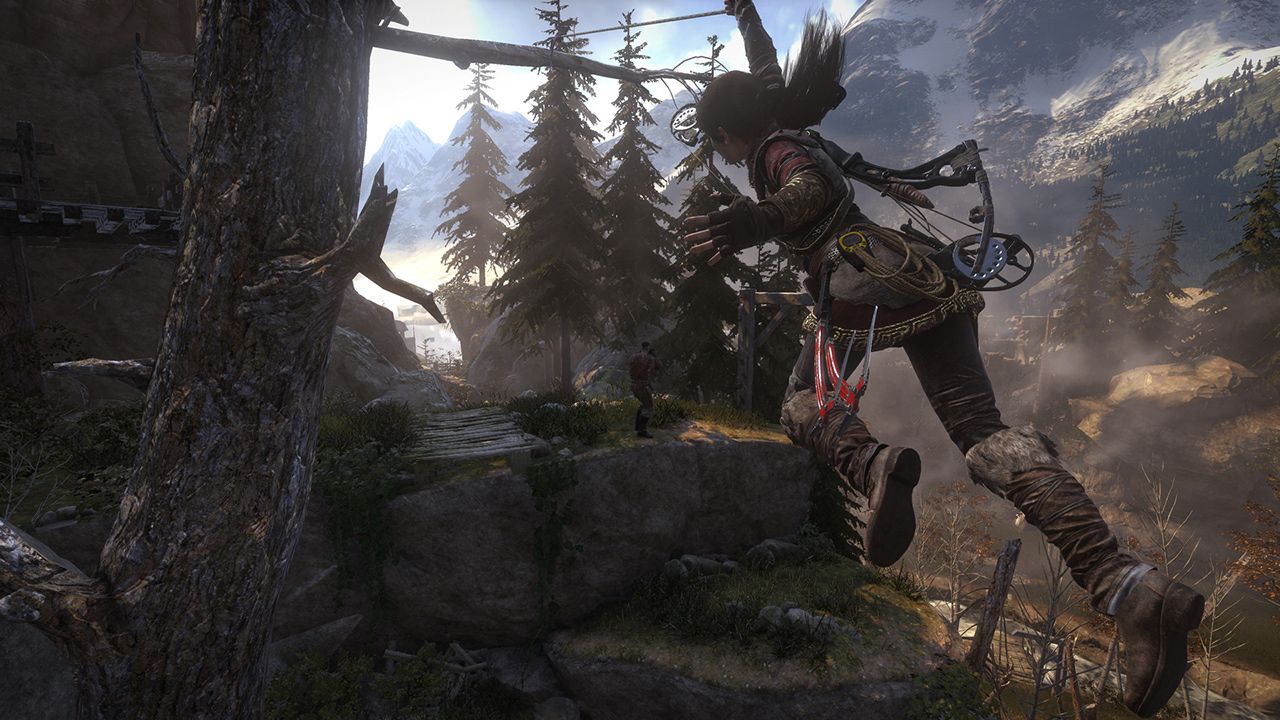
Over the past year, the games have become noticeably more expressive heroines - like Emily Kolduin in Dishonored 2 or African American Kassandra in the third “mafia”. In the recent Horizon Zero Dawn release, the main character is the inhabitant of the post-apocalyptic world, who is able to independently kill a dinosaur robot. And the creative director of the team working on UNCHARTED 4 said that they fundamentally wanted to pay more attention to female characters-although this caused the discontent of some participants in the focus groups.
“We have done our job, and the project can be finished,” Anita Sargsyan wrote at the end of April in a post on the final release of Tropes vs Women. “Among the creators of games and gamers, discussions are now being discussed that there was no question of before: about whom the games are being made (for everyone!), About their influence on people, about what they tell us about humanity, compassion, race, gender and sexuality.” At the Nordic Games gaming conference, Sargsyan, who is now in Sweden, called on the industry not to dwell on the achieved: "The more in the games there will be heroes with whom the most diverse people can identify, the more we will all value and respect each other."
On May 4, Anita Sargsyan launchedFreq Show - a new video blog, now on wider topics: from cinema to politics, transfoby and racism. “For me, everything has never rested only in games. We are talking about social justice: feminism is a way to talk about all urgent problems, ”she explained. The first issue was dedicated to “Vaytvni” - how little (or incorrectly) people with any color of the skin, different from white are represented in cinema. The second episode of the show was released on May 18, Donald Trump was its main character.
Vasily Sonkin, Olga Strachovskaya