
Translated material
Tremple, Racon and Syavka
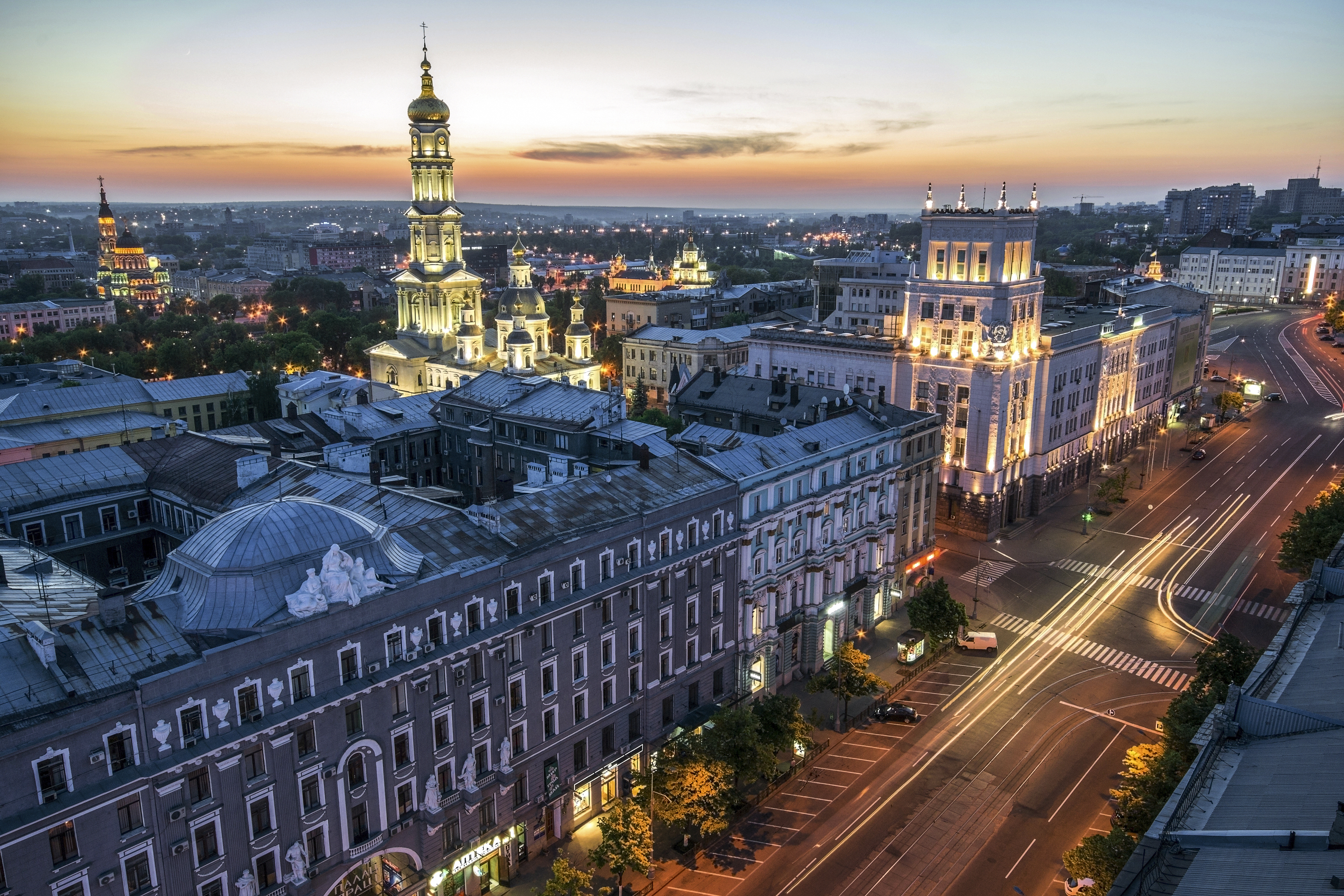
Last year, the “Odessa language” was heard in “On top of the barriers”. In early May of this year in Kharkov, I was offered to talk about the "Kharkov language". Teachers of the Kharkov National University and a popular musician participate in the conversation.
Once Boris Slutsky wrote such verses about Kharkov:
How did you say in the horse bazaar?
What kind of tongue did I find out under the carts?
………………………………… ..
Everything that was eaten there, was drunk, dressed,
In Ukrainian was always called.
Everything related to culture, science,
All sorts of figs, and miles, and pieces -
It was always called Russian
With "g" Friciting in the form of a load.
This is how the poet was described by the lively speech of the Kharkovites. But is there a special Kharkov language? And if it exists, what are its properties? I talked about this with the three Kharkovites. My first interlocutor is a historian, teacher of the gymnasium and the Department of Media Communications of Kharkov National University Igor Solomadin:
- Probably, it makes sense to speak the Kharkov language. There are specific Kharkov words that you often hear not even from the Kharkovites, but they were born in Kharkov, such as Tremplele - this is a clothing hanger, because there was a factory that produced these things, it bore the name of its owner Tremple. Then there is a specific Kharkov name for a chocolate cake very tasty, which was called "Delis". Because at Sumskaya in one of the confectionery this cake was put up, the inscription was made, probably the owner tried to write in French, but reduced it, he wanted to write “Delicates”, it turned out “Delis”, and it went to the people like Delis. I still remember very well how my parents said Delis, the neighbors said Delis, still say Delis. There is also such a word denoting a bad person with criminal inclinations or semi -criminal inclinations, it sounds like “racon”.
Igor Pomerantsev: I know these words, because my mother is from Kharkov, although I grew up in Chernivtsi. So I thought all these Kharkov words are completely normal. Only then did I find out that, for example, the word "Sygavka", that is, a bully, is Kharkov.
- About the word "Racon". It is really very famous. Although the opinions diverge here. There is such a legend that this word came from the name of Bursa named after St. Irakli, which was on the Bursatsky descent, and the Bursat trigger leads to the market, which now exists - this is the central market. When the hungry Bursaks allegedly went down to enjoy the pies, they did not really disassemble where to pay, where not to pay, they just grabbed what was bad. And the merchants, knowing their habits, hid the edible and shouted to each other: rockets are coming, rockets! On behalf of Irakli. As it turned out, this is a legend, no Bursa named after St. Heraclius existed in Kharkov. Where does this word come from, frankly, it is difficult to say. We even had disputes with local historians. Some say that this is from the word "Heracles", "Rakla" - Hercules. There are words of later origin and I did not even know that they were Kharkov descent, although for me now it is doubtful. For example, the word “ampulus”, this refers to a rod for a ballpoint pen. In addition, in Kharkov it was often possible to hear words for Yiddish, now this no longer exists. I remember these grandparents in the central regions of Kharkov after the war, those who survived, those who returned from the evacuation, they retained this culture, was interesting to hear a specific emphasis, the words on Yiddish, which were interspersed with a specifically Ukrainian accent, specifically Ukrainian and Russian reprimand. That is, Kharkov is a polycultural city, since both Ukraine and Russia are in contact, and Jewish culture, when it still existed here, also had a very great influence on intonation. Because language is not only words, it is also specific intonations, interjections. Suppose everyone has already filled the Kharkovsky soreness: and sho, do you need it? It looks a little like Odessa, but thanks to “Sho”, “Shokanya” you will recognize the Kharkiv resident in distant lands.
- How did Russian and Ukrainian languages get along in Kharkov? Did they live a separate life or mixed up?
- Most likely mixed in my memory. Kharkov was largely more than the Ukrainian city before the Second World War, let's say even more precisely to the Holodomor. But the Holodomor dragged many Ukrainians, although the Holodomor was not in Kharkov himself, but in the suburbs, in the villages near Kharkov. The people who lived in the villages around Kharkov came here, worked here in factories, in factories, like maintenance staff. Often, it was Ukrainian speech that sounded, in my memory, Ukrainian speech was associated with rural life, with rural people. It was normal in the perception of the Soviet authorities. Although officially propaganda paid a lot of attention to the Ukrainian language, I mean the 60-70s, there were a lot of newspapers in Ukrainian, radio broadcasts, television, all this was. But there was one interesting thing, I know the story of one Kharkiv citizen, who suddenly decided that he would speak in his daily life exclusively in Ukrainian. And he was a designer, an engineer, worked in one of the design bureau, and he began to speak Ukrainian with his colleagues. Paradoxicality was that if a cleaning lady or plumber spoke Ukrainian, this was perceived absolutely normal, but if an engineer spoke, and even with his colleagues and superiors exclusively in Ukrainian, this was perceived as a challenge to the system. His story was rather complicated, as a result, he lost his work, even was to some extent repressed. So, as you can see, if you are not from the village, but a person who is engaged in some kind of intelligent work, then it was strange to hear Ukrainian speech from this person. Exceptions were made, of course, for journalists who worked on radio Ukrainian or on television. As for the mixing of languages, this happened and occurs constantly, it is the so -called surzhik. Surzhika many shy and shy to this day. Honestly, I even like him, I like it, in the sense that if you understand that this is a surzhik, and that there is a literary and Russian language literary, then you understand the difference between these three ways of communication, then this is normal. Surzhik has its own charm, even some modern authors of Ukrainian use it as the language of their heroes, it turns out a rather interesting, lively speech.
- Before the war, outstanding Ukrainian writers and poets lived in Kharkov. Does the city remember them? Did they stay in the cultural, literary memory of the city?
- This memory remains, she lives. We have a very good literary museum, which is all dedicated to what is called the "executed revival." There are many interesting meetings of the most interesting, not just lectures, but, as they say now, quests, games, immersion. I sometimes go there. People with children come there, and modern writers come there. There were recently writers Yuri Andrhovich, Sergey Zhadan, they opened the library right on the street in front of the museum. The House "Word" is the place where our Ukrainian writers lived. Almost completely the inhabitants of this house were repressed. Now a very interesting site has been prepared, on which you can literally travel around the apartments, look where someone lived, what happened to him, what was the relationship inside the house. That is, this house exists, people live there, including, by the way, one of my friends. Now there is a process of recreating this memory. As for the general public, this is not entirely available to her for a number of reasons. Now the Kyivians shot a film about the House "Word", they are doing a lot of how to create something like a memorial near this house. Young architects, designers, there is a movement - this is very cool. But what is not: Oksana Zabuzhko once said that Kharkov could conduct literary festivals, dedicated, suppose, to the writer Mycole Khvylany, this, unfortunately, was not. In addition, there is another side here: in Kharkov, after all, not only Ukrainian writers lived, but also lived writers who wrote in Russian, and this is generally little-known. Some enthusiasts are working on it, trying to do something. This is necessary, it is necessary to show. From my point of view, Kharkov is an unconditionally Ukrainian, but Ukrainian city with a multifaceted culture.
- In Kharkov, one of the largest Ukrainian writers lives and works - Sergey Zhadan. Does he have many readers and fans here?
- Yes, perhaps, Zhadan is the most popular of writing people, the most popular in Kharkov. I was convinced of this more than once, because I myself often went to his performances, we simply maintain very good friendly relations. I invited him to my students in the gymnasium, he spoke there several times. Moreover, the first time it was in 2007 or 2008, the children themselves asked me to call Zhadan. This was completely surprising for me, because I well remember the situation of the early 90s, when the Soviet Union had just broken up, independent Ukraine was experiencing the first years of starting, and the attitude to Ukrainian culture was, if not neglecting, very alerted among part of people. And suddenly 2007, the guys tell me: let's call Sergei Zhadan to us. It turned out that they know his poems, moreover, some compose the poems themselves inspired by Jadan. It was very cool. When he came to us for the first time, such a wonderful communication, he read his poems, was a bit a full hall. Then one of our students Vasya Skakun began to read his poems. Zhadan literally heard. After we finished our communication, he went to Vasya and said that he would help him publish poetry in the Ukrainian language that Vasya read. So Zhadan, it seems to me, is doing the tremendous work, attracting young people to ensure that it is susceptible to poetry as such and Ukrainian poetry, in particular.
- For three years, Kharkov is a front -line city, the war affects the language landscape?
- Many guys who are on the forefront, goodobats, those who are volunteer, they never had a language problem. They have a purely practice, performance of work. The task is different, the task is to help those who are on the front edge, and no difference, says a person in Ukrainian or Russian-it doesn’t matter, it is important that he is a patriot, a patriot in a good sense of the word, in the pristine sense of the word that really risks his life, risks his health, protecting Ukraine.
- Over the past three years, the Ukrainian language strengthened its position in Kharkov?
- Yes, I think that I have strengthened significantly. Again, I judge students at the university, judge by high school students in the gymnasium. Significantly more young people speak Ukrainian. For me personally, it is not difficult to speak Ukrainian or in Russian. Once at one time, back in the 90s, I decided that I need to be three-language-Russian, Ukrainian and English, this is the necessary minimum. I communicate with the current guys, especially with university students, and they made the same choice. They easily switch from Russian to Ukrainian, often speak Ukrainian among themselves, ask questions in Ukrainian, write work. We have absolute freedom in this regard, freedom of communication. When guests come to us from abroad, English, Americans or from other countries, the language of communication becomes English, and this is very easy. Of course, maybe this is so far only part of the youth with whom I am in contact, I do not undertake to judge everyone, but it seems to me that this is the most advanced part, which is already becoming a multi -speaking one, which is well aware that the Ukrainian language is a value that must be protected, which must be developed.
Lidia Starodubtseva (cultural historian, film director):
- I’m afraid that the phrase “Kharkov language” is misleading us, we can rather talk about Kharkov multilingualism. Despite the presence of exclusively local words, jargonisms, in general, Kharkov does not have his own language. This land itself is a kind of "land without properties." Here I will paraphrase the name of the incomplete Robert Muzil’s novel “Man without properties”. Earth without properties is a kind of wild field, which in the 17th century was populated by wanderers, strangers, and strangers. On the one hand, these were fugitive peasants from Western Ukraine, who fled east in search of land and a better life. On the other hand, there were actually exiled, bonded people, the military with their families, who were referred to the south of the Russian Empire in order to strengthen the southern borders. Thus, this land was populated by arrived people, each of them brought here his memory, his culture, his own language. This city spoke immediately from the moment of its founding in two languages: Ukrainian and Russian. If you believe the historian and local historian Dmitry Bagaley, once the rector of Kharkov University, then the ratio of these languages was approximately 50 by 50 percent. But then Kharkov spoke in the language and other peoples that appeared on this earth who hospitably met guests. Kharkov spoke at Yiddish, Kharkov spoke now in the late XX - early XXI century in English along with a wave, a thousandth wave of students who are studying at Kharkov universities. Kharkov spoke in Vietnamese, in Chinese, along with the waves of merchants who live here. Kharkov spoke in Arabic, in Turkish. I would not call this property omnivorousness, I would call this a property of all -passion. This is a mirror city. The mirror, as being not manifest, has no shape, we cannot see the mirror, we see in the mirror only the reflection of others. That is how Kharkov. He does not have his own face, he does not have his own properties, he reflects the properties of all those who appear in this city. This is the city of wanderers, nomads. And this determines the fact that Kharkov manages to reconcile different cultures, different faiths, different behaviors, different modes of existence in cosmopolitan multi -language. All this is quite peaceful, without aggression, without struggle. In a sense, you can say-this is an endless absence of properties, the facelessness of the city, eclecticism in architecture, the absence of a single rod. And on the other hand, we recall the eastern ancient legend about what such a perfect person is a mirror man, this is a person who reflects everything that is found in his way. Next to good, he becomes good, next to the villain he becomes a villain, he has nothing his own. This is a mirror city, this is the earth without properties.
- In the east of Ukraine there is a war. Kharkov - frontline city. Is the war affect the Kharkov language, in Kharkov psychology?
- It affects. Firstly, new terms are poured into the modern vocabulary of the Ukrainian and Russian language, which are well-forgotten old-“hospital”, “wounded”, “volunteer”, “migrant”, “captive”. These words came to us from another era, from another war, they have become organic today - this is our daily circulation in which we live. As for psychology, here I express my own point of view, I absolutely do not claim objective knowledge, research. It seems to me that if you follow the old version of the correspondence of language and thinking, the hypothesis of the Sepira-Uorf, which says that our language predetermines our thinking, and we can also recall Ludwig Wittgenstein, who said that the boundaries of the language determine the boundaries of our world, yes, this language, the language of eclecticism, the language of all-owners, the language of mirror reflections reflects in the psychology of the city the atmosphere more likely indifference. There are Kharkov patriotic Ukrainian, there is a separatist Kharkov, Kharkov, still nostalgic for the great father and the Soviet past. But these are two loci, which are just islands on a city scale. The rest of Kharkov is the psychology of an indifferent mass. They don’t care who will be in power, they don’t care what language to speak, they don’t care what an ideology that will come to this Earth. This is also sad, I would say, the dramatic expression of the city, which has no properties. I live near the street of Rymarskaya. When in 2014 it was expected that the city was about to become one of the federal districts of the Russian Empire and the Russians would come here, a billboard appeared next to me, on which it was written "We welcome Russian guests." As soon as it became clear that this would not happen, the billboard disappeared. And those businessmen who live in this area turned out to be absolutely indifferent to what power will come to them, they do not care before, under the White, with the Reds, they do not care, they will live as if nothing changed, if only their business flourished, if only their children were healthy. This is a city without properties, it is a mirror city.
- For several years now you have been living in Simmer Lane, now this lane is called the name of Lyudmila Gurchenko. Do you feel more beautiful, elegant?
- Well, what are you, here I feel like an absolute retrograde. I am a supporter of decommunization, but in this case I would like to return the old familiar name Sammer. Next to me, a house, completely populated by gypsies, in the depths, in the courtyard of one of the mansions in this lane live Uzbeks. This lane is part of the whole, it reflects the multi -ethnic, polycultural nature of the whole city. The new name - the lane of Lyudmila Gurchenko - was expressed only in the fact that a beauty salon was discovered here. But the beauty of this outgoing city, the outgoing architecture is by no means in a new name.
- Are you in this beauty salon?
- Undoubtedly.
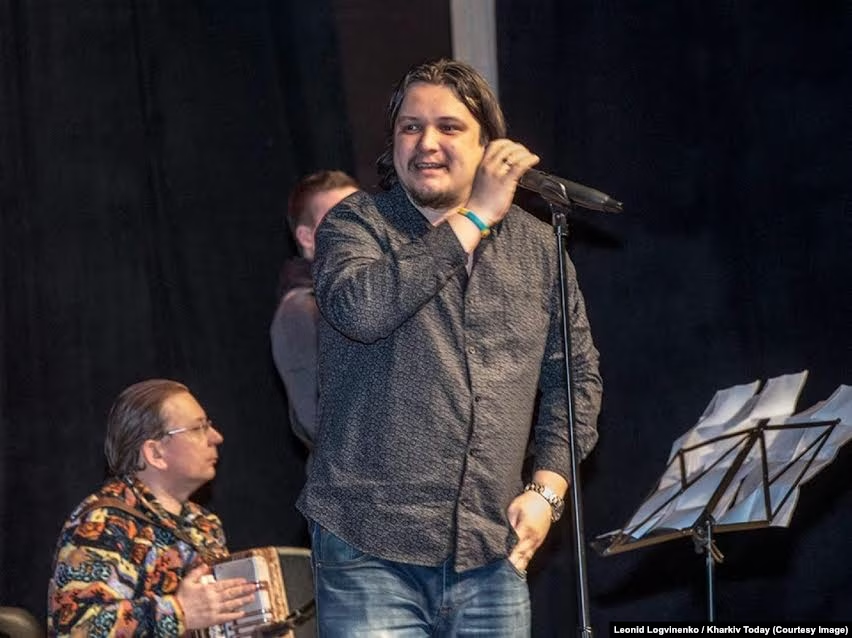
Boris Sevastyanov (Kharkov musician):
– Моя бабушка была убеждённой коммунисткой, и дедушка был коммунистом, но в семейном кругу за рюмкой водки мы пели такую песню, полушутя-полусерьёзно, но если бы бабушка была сейчас жива, то пела бы серьёзно:
Zhovto-Blakiti Our Prapori,
Ми непереможні, шаблі догори.
Bode Vilna Ukrainian, wake Nenka Samostyina,
Ми непереможні, шаблі догори.
Действительно моя бабушка пела эту песню. Она родилась в Макеевке. С возрастом в ней боролись украинство и коммунистическая идея. Я помню мы ехали в Питер поездом в начале 2000-х и какая-то россиянка начала говорить о том, что украинского языка нет, и бабушка впервые в моей жизни взорвалась, сказала дамочке, что её слова – великодержавный шовинизм и перешла на украинский. Дамочка ни фига не поняла.
Материя музыки
Передача о материальности, предметности, осязаемости музыки. В разговоре участвуют композитор, певица и мастер музыкальных инструментов