
Translated material
Divine comedy
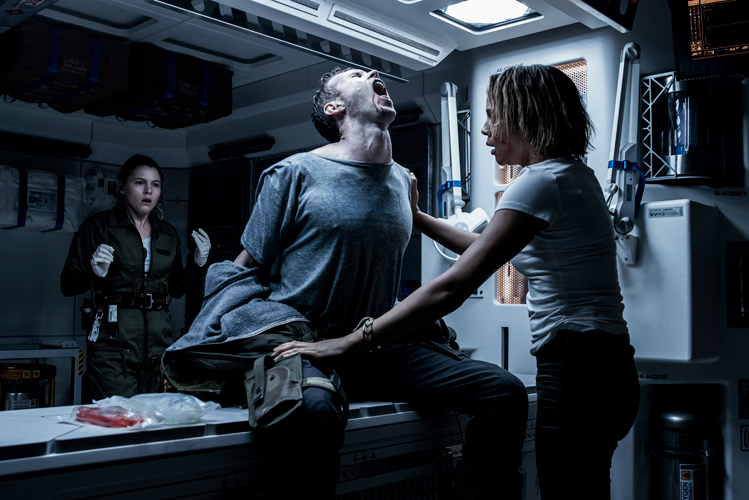
It has long been noticed that at the base of the franchise about strangers lies a deeply hidden fear of a woman before the birth of a new life in her. “I am the mother of the monster,” the heroine Sigurni Weaver, the heroine of Sigurni, declares calm despair. A curious variation on this fear was the recent comedy thriller “Prevenge” , invented, shot and played by actress Alice Low during pregnancy.
Fulfilling the promise - to talk about the genesis of someone else, in his new film, Ridley Scott replaces the tragic mother Ellen Ripley comic: android Fassbender. God created man, man created David, and David, a caricature for a caricature, creates a poisonous vile creature and admires it, as the mother admires the baby in the painting of Della Francesch. The robot quarches over his work, like a hen; He, in fact, blows a couple of eggs in the finale, with a characteristic clutches, pushing them out of the fact that, due to the anthropocentrism of perception, it seems to us from the esophagus. But even if the robot at the commemoration asks to pour it “like everyone”, he has no esophagus - there is only a pipe that he uses in his own, and not at ours, discretion. For example, like an egg. He doesn’t have a biological sex, no matter how you dispute your smiles, and the Robot gender is in the eyes of the watchman that Vasily Stepanov wittily noted in his review of Alex Garland’s film “Ex Machina” . Deprived of bodily and sex, David becomes an absolute parent who is insensitive to the Oedipus threat who does not know fear of the child.
 © Twentieta Century Fox Film Corporation
In a sense, the satire on reckless motherhood, the “Testament” is partly a satire on the creative act in general - the satire of a particularly cruel and self -critical performed by the eighty -year -old director, who shot all our favorite films. A question to himself: does anyone have the right to take the powers of God, creating even such a trifle as the first summer blockbuster in the season?
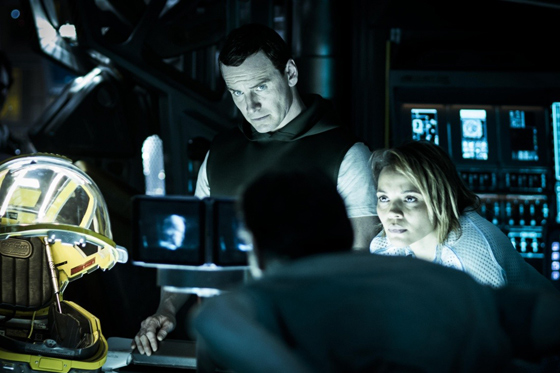
The robot David desperately wants to be a creator: he draws, dismisses the corpses, as Salieri in Pushkin dismembered music, and after Hamlet offers a flute to another, less ambitious, a robot with the same face - Walter (the mind is incomprehensible how the Fassbender manages to play fifty shades of plastic, but two equal heroes Without facial expressions, it is impossible to confuse it). David and archaeologist Elizabeth Show, a woman who wants to consider her beloved, is divided into a detailed terabytes of romantic poetry. David Cretaceous in the vain pursuit of beauty is the allegory of the graphomaniac, in which only terrible xenomorphs come out of the pen. Graphomaniac, due to understandable advantages of the opportunity to populate the Universe with his works. The only thing for the time he is lacking for the time being is an audience, and he lures it with a sentimental song launched into space orbit.
 © Twentieta Century Fox Film Corporation
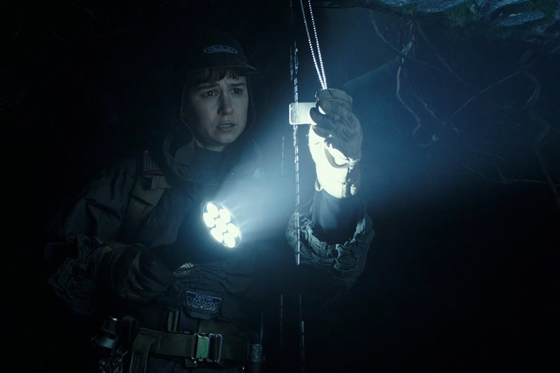
Immediately responding to the call sign, simple -minded men deviate from a given route, land on the planet unknown to them (but known to us) and in the first seconds see huge ears of wheat, which once allowed our type to make a populist breakthrough and about which the yuval harari in the book “Homo Sapiens” sarcastically He notices that it was not a person who colonized her, but she colonized a man, making the most impressive career among the grains. This time, it seems, wheat will not help people.
It is known that a large movie works with collective nightmares: radiation, epidemics, aliens, and uprising of cars. The Testament for the first time clearly formulates a new and completely justified fear: what if we created artificial intelligence in the evolutionary struggle, not to the side of a person, but to the side of someone else? Someone who does not boast of his affective disorders does not walk at the moon, does not compose poetry and does not spend twenty years on growing cubs? To the side of the cockroaches or rats - or to the side of a home -made chimera, as in the "Testament".
 © Twentieta Century Fox Film Corporation
Starting like a horror story about a person’s clash with an alien creature, in the late 1990s the first piece of the franchise ended with a call to understand the stranger (who did not burst out when the last and the saddest of the monsters sucked output space?) And frankly criticism of Homo sapiens . In the fourth film, only nonhumans were capable of compassion and love: Ripley’s clone with xenomorph DNA and the Last generation human Android. On a new piece of franchise, the circle closed: a stranger turned out to be our granddaughter, the creation of creation, and now we feed him with his flesh, as the eagle of Prometheus was fed. From the very idea of humanity in time, David dismisses, like from a fly. Still raving by the house by the lake in a distant galaxy, this species is doomed.
However, the peculiarity of the “Testament” and the reason for its ironic detachment is precisely in the fact that it was removed not from the point of view of a person, and not from the point of view of the Android, and not from the point of view of xenomorph, but as if from the position of evolution itself, which is not prone to sentiment and tries various options, combining living and non -living, organic and inorganic, ugly and beautiful in a single act of creation. And since the creature that created David and David dared to leave his planet, but could not adapt to life outside, someone else would take an empty place. And in space no one will hear our scream.