
Translated material
My dad is a drug trapter
Memories of son Pablo Escobar
Pablo Escobar is the most famous drug bore of the 20th century. He failed America with cocaine, but at the same time he was engaged in charity work in his homeland, in Colombia; After an unsuccessful attempt to enter the big policy, he declared war on the state and eventually ended up in a prison, which he built for himself. Semyon Kvasha talks about the memoirs of the son of Escobar, Juan, who were published several years ago.Juan Pablo Escobar. Pablo Escobar: Mi Padre. Bogotá, Colombia: Editorial Planeta Colombiana, SA, 2014
Three years ago, the memoirs of Juan Pablo, the son of Pablo Escobar, who, escaping from his blessed homeland and starting a new life, took the name Huang Sebastian Marrokin Santos. They were not translated with us, despite the series “drugs” dedicated to hunting for the most famous drug -agent of the 20th century, despite the enduring interest in the topic on the continuing fashion for cocaine and the war with drugs, which the West obviously lost.
Marrokin, of course, is in a very difficult position. When his father simply sold drugs to America and was engaged in charity in his homeland, the few Colombians had questions for him. When he took up politics, he was out of there with a shame and moved to the drug terror, began to blow up pharmacies, shopping centers, crowded intersections and even a plane, he turned in the eyes of compatriots into the feces of hell. And for his children, he remained a sweet daddy, the kindest and most powerful. Marrokin spent a fair amount of life on reconciliation and repentance, and in the book he tries to be objective with all his might, but, of course, does not really cope with this and tries to justify his dad.
First, the reader must break through the first two chapters. Immediately after his father was shot (Marrokin really hints that he shot himself so as not to give up), his widow and two children began a difficult and deadly dance. It was necessary to make sure that the Government of Colombia has no complaints about them and they would not be hidden in prison forever. It was necessary to exhale at least a small piece of inheritance at the brothers and cousins of his father, led by the energetic grandmother Ermilda, who for some reason firmly decided to leave her daughter-in-law without a penny. It was necessary to be able to agree with the rest of the cartels with whom Don Pablo fought: the leaders wanted blood, they were ready to even let women let go, but to kill Juan Pablo.
In the end, they managed to pay off. Finally, it was necessary to figure out how to leave their homeland, to get a passport and departure permission. The homeland in the person of various senators, prosecutors and politicians did not really understand what to do with the widow and children and behaved like a dog in the hay: it seems to be somehow embarrassed to plant them as accomplices of the most odious criminal of the country, but it is not very good to let them go with the world (and money, which is important).
It is hard to read this mainly because the family of Escobar can not be sympathized with. Marrokin writes with a terrible resentment about the “right” money that his relatives stole from him. We are talking about nightmares, hundreds of millions of dollars acquired by drug trafficking and for some reason not spent on drug-terrorism. Pablo with longing recalls how the enemies burned their native house and stole several originals from it from the collection of his mother. The leaders of hostile drug carters wanted his death because one of the last acts of the war from Pablo Escobar was a terrorist attack at the wedding of one of them. I would like to close the book and say “so that you are already blown up”, but here the chapters actually begin about Pablo, and this is a very instructive reading.
Even Marrokin did not know how much money his father had - Pablo himself did not know. “At some point, I turned into a money production machine and just stopped counting,” a respectful son quotes his father. At the same time, he giggles over other people's assessments of this wealth. Forbes believed that Escobar had three billion dollars, other sources - 25 billion, but not a single dad called and did not ask a simple question (although Pablo readily talked with reporters).
Marrokin, the principles managed to give up. He went to Argentina, learned to the architect, became interested in social architecture and urbanism (customers do not allow him to work publicly because everyone is remembered whose son he is), went a long way of apology and reconciliation and, apparently, was not a very bad person. At least he reads his father.
1/2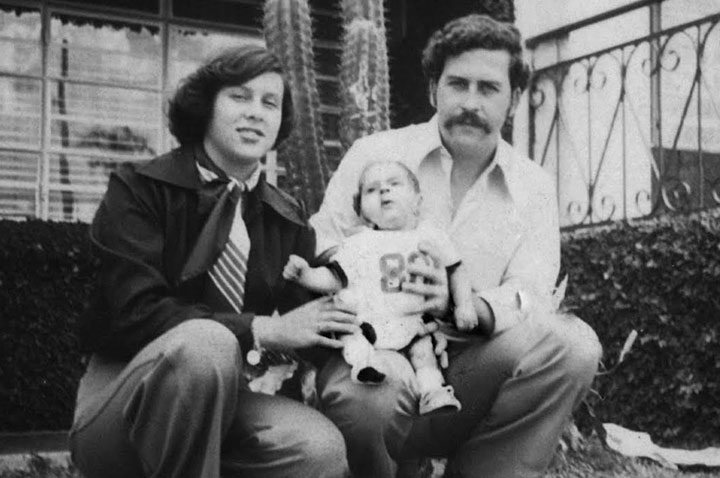 Pablo Escobar with wife Maria Victoria Eneo Vieho a few months after the birth of his son, 1977 photo: Property of the Marrquín Santos Family 2/2
 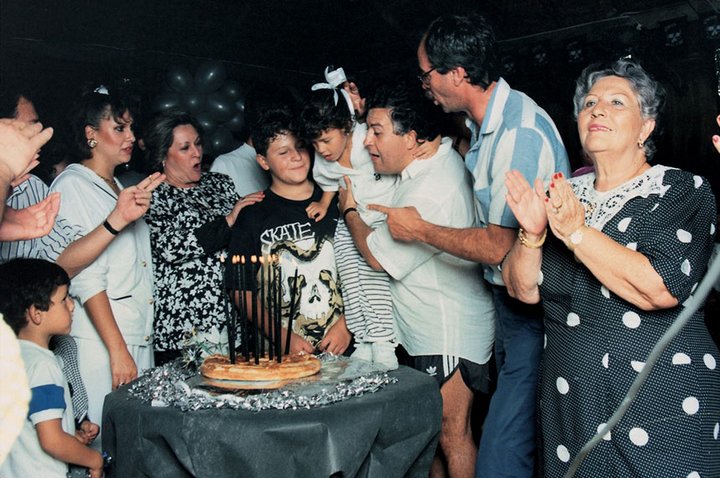 Huan Pablo's birthday, Asenda Polos estate, 1989
 Pablo had his own style. He always wore shirts unbuttoned to the middle of his chest, never sniffed, but smoked a lot of grass. He is used to seek everything he wanted. He liked the thirteen -year -old girl from a good family - and by fifteen she had already given birth to a son to him, and neither age difference, nor that he at that time was a smuggling and a bandit, and the girl’s parents did not really want to take her out of school and give him to him, Pablo did not stop him.
Pablo was generous, even when he was almost crazy in prison. When he sat with the accomplices in his own prison, one of them, Tato Andagno, married there on his bride, and they spent the honeymoon in a separate cell, and Don Pablo gave them a rotating bed in the shape of a heart.
Surprisingly, everything that they said and talked about him was true. Yes, he really built a manor with a huge zoo with giraffes, with a runway and several palaces. Yes, he and his accomplices packed half a hill with lifers with dollar cash, cubic pits with packs of Stobax bills, and then they forgot about half of them about half of them. Yes, at some point Pablo gave up and went to prison, which he built himself, where crazy parties with cocaine and whores took place, quiet evenings with his family and business meetings: with the help of an intercom and proxies, he restored his empire and managed it. True, the roof has already really gone in Pablo's Cathedral Prison-paranoia developed against the background of claustrophobia. He was friends with the rebels - communists and anarchists - and was a man of rather left -wing beliefs (and underground billionaire). This allowed his opponents to enlist the support of the CIA and right -winging militias who fought with FARC and killed the peasants, who, as a result, committed it.
But the most important thing is that this person possessed an amazing gift of self -justification. An important place in the book is occupied by the teachings of Don Pablo to his son, in which he says that he is actually good, he wants goodness to everyone, acts in accordance with his conscience, and they are enemies, vile bureaucrats, the military - the first began. The war with cartels, the police and ordinary residents of Medelin and all Columbia is going on because a man should not make his principles. The son asks his father to stop violence against the innocent (the dialogue looks like an antique biography in a tradition), and he answers:
“Do you think that your sister and you were not innocent children when you were put a bomb? How can I wage a war against the state, which is the same terrorist like me, or more? How will I fight against the police and the corrupt government, which in the Union with (hostile cartel) PEPES? You don’t see that they attack only one drug lord-me? At least I chose the bandit’s path, and that I am. Not that they are: in the uniform during the day, but at night they put on masks and hoods. ”