
Translated material
Two Siberians: "Where is Grammy give here?"
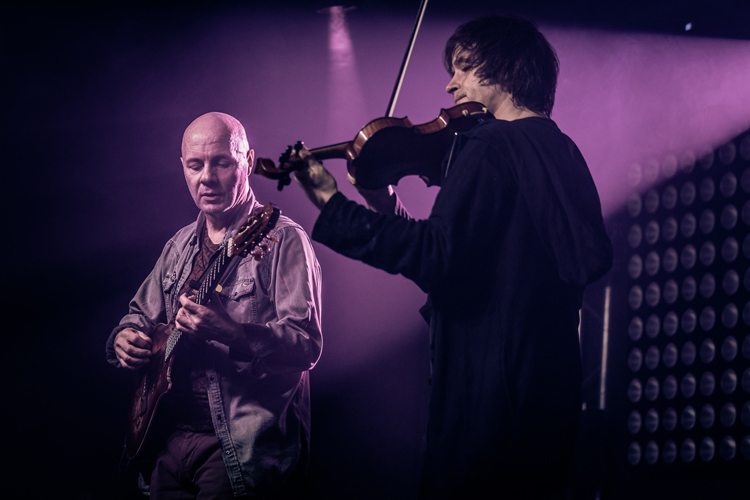
Two Siberians, the instrumental Fuzhn Duet (former White Ostrog)-the most famous musical project from Siberia, who performed at international festivals and recorded with the world stars of jazz-does not forget about its roots. On May 25, in the large star hall of the Moscow Planetarium, guitarist Yuri Matveev and violinist Artem Yakushenko will present their new work “Siberian Suite”, inspired by a trip to Trans -Siberian Railway and the old newsrescent. The musicians telling their stories about Siberia will accompany the Choy Vidji.
Before the premiere, Denis Boyarinov discussed with Artem Yakushenko and Yuri Matveev their life in New York and the ecology of Lake Baikal.
-Are there some unsplained places in the history of Two Siberians : nevertheless, your duet was formed in 1986 or in 1992?
Yuri Matveev: We first performed together when we were still students, at the All -Union Jazz Festival in Novosibirsk. It was in 1986. I was invited there to play the guitar. And I met Artem with a violin in the corridor of the Music School. We were both without a group. I invited him to play together.
After the festival, the school sent us to speak at the BAM. We traveled around it for three weeks. Then they worked at the Pilgrim Theater. After they left the theater, they began to play together again. It was in 1992.
- Hi, we are here. Where is Grammy give out here?
- And how did you meet your American director?
Artem Yakushenko: In Moscow. We returned from a monthly tour of France. We were invited to the photo exhibition David Burn from Talking Heads . It turned out that he was also fond of photography. There was some decent American blues group, well, we performed. Then a man approached us. He began to say what interesting music we have. According to Govor, an American. It turned out that he is Daryl Pete, manager Michael Breker (famous American tenor-saxophonist.- Ed. ). At first we did not really believe - they began to look for his name on the envelopes of the records. Found! They switched in his own way, then Google has not yet been (laughs) .
Our communication lasted two years - we corresponded, sent him our material. And then one fine day we flew to New York. They called him. They said: “Hello, we are here. Where is Grammy give out here? " So they began to work together.
Yuri: We arrived for a short while, and remained for five years.
Artem: Our first album was a trial - street. We sold 4000 records in four days. And then our big album “Out of Nowhere” was released with Michael Breker, Richard Bon, George Witti and the children's choir. It was very cool for us: to be next to the world -class jazzmen who like our music and play with them. Praise to the sky!
- What did life in America have taught you?
Artem: For us it was a big and interesting music school. The first year we almost did not perform - we sat with the manager and dismantled the recorded tracks. They carried out a thorough analysis of what to remove and what to leave. It was a novelty to us. But I would like to note American relations between the manager and the musician - very touching and subtle. With great delicacy and respect.
Yuri: Not like in the film "Obsession" (laugh) .
Artem: Besides, we went to all the concerts of the musicians that we listened to the records. They were celestials for us. However, we had no shock from arrival in America. By this moment, we have been abroad many times - almost all of Europe traveled.
Yuri: A shock happened when accounts raised in a mailbox. In America, everyone thinks very well, and the mail works very clearly (laughs) .
- How did you earn a living if you have not performed a year?
Yuri: There were hard times.
The shock happened when the bills fell into the mailbox.
Artem: We had separate concerts. There was no such thing that we did nothing at all. Then we started large tours - three months each. We traveled all the coast - two cars broke.
Yuri: We are still touring in America. Now they began to get to Asia to get into Asia: to India, South Korea and China.
- Now you are more often abroad than in your homeland - in Irkutsk and Angarsk. Did you write the Siberian suite according to the memories?
Artem: The idea of the “Siberian suite” arose when we, returning from the V-ROX festival, rode a train from Vladivostok to Ulan-Ude for two days. We had time to look out the window at the endless Siberian open spaces, think and talk. Our impresario Kirill suggested writing the Siberian suite. Suite form is well known to us. We have an esoteric suite in Castaneda and Zen Buddhists. There is a suite based on Colin Wilson’s book “Parasites of Consciousness”. There is a ballet suite that we play with academic quartets.
Then Cyril showed us the old newsreel about Siberia: how Fidel Castro comes to Bratsk, life in Siberian villages before the construction of the hydroelectric power station and their flooding. This chronicle inspired us to music.
We are often asked: how do you write music? I don't know how. Once-and some note sounded. Or they recorded some kind of magnifying glass, play it, play it, and suddenly-the music went.
Yuri: We had a very interesting recording process. In fact, we recorded the Siberian suite in London, but were in Moscow. We talked to Skype with the sound engineer of Heydn Bendell - he is one of the best in the world.
Artem: This is now not surprising. It was amazing when we wrote an album in America. When we arrived home to the bassist Matt Harrison, who played with John Mclaflin and Joe Navinul, with a compact digital studio. They only appeared then. He was so surprised that there is no need to go anywhere else, - he included the guitar in the studio and immediately wrote the party in the track.
- How often do you come to Siberia now?
Artem: We have a tradition - we go there every year, but in different months. In this June we will go. There will be a large event at the Baikal cellulose-paper plant. I heard that there is an idea to make a large art object from this plant, which will be inhabited by artists and musicians.
- And I heard that they want to build another large factory near him in order to pour fresh water for the Chinese.
Artem: I also heard something like that and even a petition on Change.org signed to prevent this.
Baikal will stand.
Yuri: And I managed to work at the cellulose-paper plant. Six months - a locksmith of the fourth category. When I studied at the institute. Surprisingly, until recently it was such an industrial monster, and now the plant is almost completely destroyed.
Artem: Now it is a zone of oblivion, as in Stalker. Of course, it would be good if he was turned into a zone for artists. But it will not be easy. After all, the Turin industry is now dominated by Baikal. We recently made music for the film about the ecology of Lake Baikal. There are terrible documentary shootings about what is going on. Especially in Severobaikalsk. Private hotels in which sewer drains are directly into the lake. But I think that Baikal will stand up and will filter all the dirt. He stood before this century.
- Are you satisfied with how Russian viewers perceive your music? Are you understanding here?
Artem: We love the audience - both in Russia and in the overseas countries. Our viewer is wonderful.
- wonderful, but there is little it.
Artem: Today is not enough, there is a lot of tomorrow. Today is rain, tomorrow the sun. The country is going through difficult time. The world is going through a difficult time! Humanity is experiencing a difficult time !! There are so many problems on Earth, maybe tomorrow everything will end.
The point is not even in the viewer, but in the information that comes to him. Or does not reach. There is so much information now - shaft. Everyone sits in phones. Even at concerts.
- At least it annoys you?
Artem: No, not annoying at all. I easily relate to this: someone smokes, someone drinks, but someone is sitting on the phone.
Yuri: It happens that the phones at concerts call, but we usually get everything successfully - they call in the correct tonality and at the right time (laugh) .